

Faster R-CNN: Towards Real-Time Object Detection with Region Proposal Networks
Open accessThe DOI matches its Crossref record; 56 of the 60 references it cites were found in a registry or an index; 15 of the 27 sources its claims cite were checked for support.
Abstract
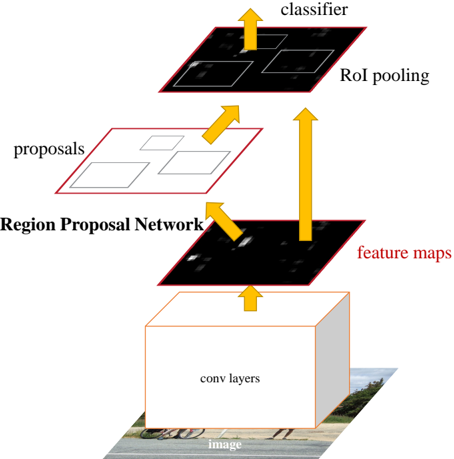
State-of-the-art object detection networks depend on region proposal algorithms to hypothesize object locations. Advances like SPPnet [1] and Fast R-CNN [2] have reduced the running time of these detection networks, exposing region proposal computation as a bottleneck. In this work, we introduce a Region Proposal Network (RPN) that shares full-image convolutional features with the detection network, thus enabling nearly cost-free region proposals. An RPN is a fully convolutional network that simultaneously predicts object bounds and objectness scores at each position. The RPN is trained end-to-end to generate high-quality region proposals, which are used by Fast R-CNN for detection. We further merge RPN and Fast R-CNN into a single network by sharing their convolutional features-using the recently popular terminology of neural networks with 'attention' mechanisms, the RPN component tells the unified network where to look. For the very deep VGG-16 model [3] , our detection system has a frame rate of 5 fps (including all steps) on a GPU, while achieving state-of-the-art object detection accuracy on PASCAL VOC 2007, 2012, and MS COCO datasets with only 300 proposals per image. In ILSVRC and COCO 2015 competitions, Faster R-CNN and RPN are the foundations of the 1st-place winning entries in several tracks. Code has been made publicly available.
Overview
CoChat Summary
TL;DR
Faster R-CNN introduces a Region Proposal Network (RPN) that shares convolutional features with Fast R-CNN, making region proposals nearly cost-free and enabling a unified object detection system. It achieves near real-time detection with state-of-the-art accuracy on PASCAL VOC and MS COCO.
Key findings
- With VGG-16 and shared features, Faster R-CNN reaches 69.9% mAP on PASCAL VOC 2007 test using 300 proposals, 73.2% with VOC07+12 training, 70.4% on VOC 2012 with 07++12, and 78.8% on VOC 2007 with COCO+07+12.
- Runtime: VGG-16 RPN + Fast R-CNN takes 198 ms total (5 fps), with RPN proposals costing 10 ms; ZF runs at 59 ms total (17 fps), versus SS + Fast R-CNN at 1830 ms (0.5 fps).
- Ablations: sharing features improves ZF mAP from 58.7% (unshared) to 59.9%; removing the reg layer drops mAP to 52.1%, and removing cls with 100 proposals drops it to 44.6%.
- On MS COCO test-dev, Faster R-CNN with VGG-16 and COCO train reaches 42.1% mAP@0.5 and 21.5% mAP@[.5,.95]; with COCO trainval it reaches 42.7% and 21.9%.
Methods
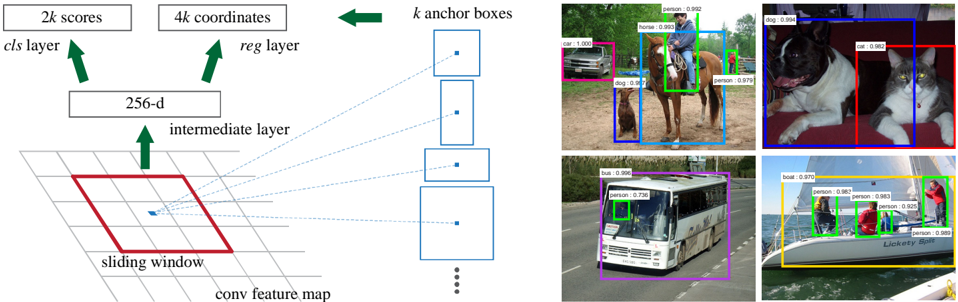
- The RPN is a fully convolutional network that slides a 3×3 window over shared conv features and predicts objectness scores and box regressions relative to anchors; default anchors use 3 scales (128², 256², 512²) and 3 aspect ratios (1:1, 1:2, 2:1), giving k = 9 anchors per position.
- Training uses a 4-step alternating scheme with ImageNet-pretrained ZF or VGG-16, SGD, single-scale images (shorter side s = 600), NMS at IoU 0.7, and 300 proposals at test time; evaluation is on PASCAL VOC 2007/2012 and MS COCO.
- Main metrics are detection mAP on PASCAL VOC and mAP@0.5 / mAP@[.5,.95] on MS COCO, with timing measured on a K40 GPU.
Limitations
- Stated in the paper: non-approximate joint training would require a differentiable RoI pooling/warping layer and is beyond the paper’s scope; the approximate joint training ignores gradients with respect to proposal box coordinates.
- Stated in the paper: cross-boundary anchors are ignored during training, and multi-scale feature extraction may improve accuracy but does not offer a good speed-accuracy trade-off.
- Evident from the text: the main experiments focus on PASCAL VOC and MS COCO with ZF/VGG-16 backbones, so generalization to other datasets, backbones, or detection regimes is not extensively characterized.
Model-written summary. Check it against the paper before relying on it.
Integrity signals
Registry
Cites
Statistics
Figures

Verification
Claims the paper makes
12 Valid · 5 Not valid · 8 Not checked · 83 Own results and interpretations
Every source the paper cites for this claim was checked and supports it.
In the paper
“Only by replacing VGG-16 with a 101layer residual net (ResNet-101) [18], the Faster R-CNN system increases the mAP from 41.5%/21.2% (VGG16) to 48.4%/27.2% (ResNet-101) on the COCO val set.”
What the sources say
- Supportedcites [18] [18] K. He, X. Zhang, S. Ren, and J. Sun, 'Deep residual learning for image recognition,' arXiv:1512.03385 , 2015. - source
Table 8 (p. 8) reports the exact COCO validation-set mAP values for baseline Faster R-CNN with VGG-16 and ResNet-101. Section 4.3 (p. 8) says the detection implementation was the same for both models and attributes the gain to replacing VGG-16 with ResNet-101. (LLM, conf=0.95)
plainstates a cause- Asserted: passes — The authors put it forward as true.
- Checkable: passes — It can be checked against evidence.
- Load-bearing: passes — The paper’s conclusions depend on it.
- Based: passes — The paper gives a reason why it holds.
- Supported
Every source the paper cites for this claim was checked and supports it.
In the paper
“This observation is still valid even when one increases the depth substantially to over 100 layers [18].”
What the sources say
- Supportedcites [18] [18] K. He, X. Zhang, S. Ren, and J. Sun, 'Deep residual learning for image recognition,' arXiv:1512.03385 , 2015. - source
In ImageNet Classification (p. 7), the paper reports that 101- and 152-layer ResNets outperform the 34-layer model, with no observed degradation. Its CIFAR-10 analysis (p. 7) also reports that a 110-layer ResNet converges well. These results support the stated extension to over 100 layers, although the isolated sentence does not specify what “this observation” refers to. (LLM, conf=0.87)
plain- Asserted: passes — The authors put it forward as true.
- Checkable: passes — It can be checked against evidence.
- Load-bearing: unclear — It is unclear whether the paper’s conclusions depend on it.
- Based: passes — The paper gives a reason why it holds.
- Supported
The cited sources support only part of this claim — read each source’s verdict below.
In the paper
“In ILSVRC and COCO 2015 competitions, Faster R-CNN and RPN are the basis of several 1st-place entries [18] in the tracks of ImageNet detection, ImageNet localization, COCO detection, and COCO segmentation.”
What the sources say
- Partly supportedcites [18] [18] K. He, X. Zhang, S. Ren, and J. Sun, 'Deep residual learning for image recognition,' arXiv:1512.03385 , 2015. - sourceExperimental — accuracy not yet measured
Section 4.3 (p. 8) lists first-place finishes in all four tracks, and the Object Detection Baselines (p. 10) describe a Faster R-CNN system using an RPN. The ImageNet Localization section (p. 12) also identifies its RPN-based method. But the copy attributes the entries collectively to deep residual nets; it does not establish that Faster R-CNN and RPN underpinned the COCO segmentation entry. (LLM, conf=0.86)
plainstates a cause- Asserted: passes — The authors put it forward as true.
- Checkable: passes — It can be checked against evidence.
- Load-bearing: unclear — It is unclear whether the paper’s conclusions depend on it.
- Based: passes — The paper gives a reason why it holds.
- Partly supported
The cited sources that could be checked couldn’t confirm or dispute this claim.
In the paper
“Yet when compared to efficient detection networks [2], Selective Search is an order of magnitude slower, at 2 seconds per image in a CPU implementation.”
What the sources say
- Could not verifycites [4] [4] J. R. Uijlings, K. E. van de Sande, T. Gevers, and A. W. Smeulders, 'Selective search for object recognition,' International Journal of Computer Vision (IJCV) , 2013. - sourceExperimental — accuracy not yet measured
The computational discussion in §5.3 (pp. 12–13) gives timings for complete object-recognition pipelines, not a two-second CPU runtime for Selective Search. The comparisons in §5.2.1 (p. 11) concern other object-location methods, not efficient detection networks. Searches for a two-second per-image runtime and a network comparison found neither claim in our copy. (LLM, conf=0.73)
- Not checked — no full text of the sourcecites [2] [2] R. Girshick, 'Fast R-CNN,' in IEEE International Conference on Computer Vision (ICCV) , 2015. - source
plainstates an association- Asserted: passes — The authors put it forward as true.
- Checkable: passes — It can be checked against evidence.
- Load-bearing: passes — The paper’s conclusions depend on it.
- Based: passes — The paper gives a reason why it holds.
- Could not verify
Every source the paper cites for this claim was checked and supports it.
In the paper
“We comprehensively evaluate our method on the PASCAL VOC detection benchmarks [11] where RPNs with Fast R-CNNs produce detection accuracy better than the strong baseline of Selective Search with Fast R-CNNs.”
What the sources say
- Supportedcites [11] [11] M. Everingham, L. Van Gool, C. K. I. Williams, J. Winn, and A. Zisserman, 'The PASCAL Visual Object Classes Challenge 2007 (VOC2007) Results,' 2007. - source
The citation is attached to “PASCAL VOC detection benchmarks,” not to the citing authors’ comparison of RPNs and Selective Search. Sections 5.2 and 6.2 describe the VOC detection task, its submitted methods, and its results, confirming the benchmark identification. (LLM, conf=0.92)
plainstates a cause- Asserted: passes — The authors put it forward as true.
- Checkable: passes — It can be checked against evidence.
- Load-bearing: passes — The paper’s conclusions depend on it.
- Based: passes — The paper gives a reason why it holds.
- Rests on an assumption not shown here.
- Supported
56 more claims
Create a free account to see all 108 claims and to verify the 2 references still open.
- Probably not a substantial claim. 11
- It may state two separate claims as one. 40
- The quote only partly states this claim. 1
Claims other papers make about this one
Each is checked against this paper’s own text: does it say what the citing paper says it does?
The source backs part of the claim, not all of it — or backs it for a different population, condition or comparison.
In the citing paper
“Unlike the original paper [19] that adopted stage-wise training regarding RPN, we use an improved implementation with end-to-end joint training similar to [37], which leads to higher baselines than [19].”
From Non-local Neural Networks (2018) · cites this paper as [37]
Experimental — accuracy not yet measuredThe source backs part of the claim, not all of it — or backs it for a different population, condition or comparison.
In the citing paper
“Faster RCNN is the first near-realtime deep learning detector (COCO mAP@.5=42.7%, VOC07 mAP=73.2%, 17fps with ZF-Net [48]).”
From Object Detection in 20 Years: A Survey (2023) · cites this paper as [19]
Experimental — accuracy not yet measuredThe source backs part of the claim, not all of it — or backs it for a different population, condition or comparison.
In the citing paper
“Faster RCNN is the first near-realtime deep learning detector (COCO mAP@.5=42.7%, VOC07 mAP=73.2%, 17fps with ZF-Net [48]).”
From Object Detection in 20 Years: A Survey (2023) · cites this paper as [47]
Experimental — accuracy not yet measuredThe source backs part of the claim, not all of it — or backs it for a different population, condition or comparison.
In the citing paper
“In the deep learning era, due to the increase of computing power, bootstrap was shortly discarded in object detection during 2014-2016 [16-20].”
From Object Detection in 20 Years: A Survey (2023) · cites this paper as [19]
Experimental — accuracy not yet measuredThe source backs part of the claim, not all of it — or backs it for a different population, condition or comparison.
In the citing paper
“The most commonly used idea to reduce the feature computational redundancy is to compute the feature map of the whole image only once [18, 19, 124], which have achieved tens or even hundreds of times of acceleration.”
From Object Detection in 20 Years: A Survey (2023) · cites this paper as [19]
Experimental — accuracy not yet measured
21 more claims about this paper
Create a free account to see every claim other papers make about this one.
Citations
Cites
Deep Residual Learning for Image Recognition
He, K., Zhang, X., Ren, S., & Sun, J. (2016) · 2016 IEEE Conference on Computer Vision and Pattern Recognition (CVPR) · doi:10.1109/cvpr.2016.90 · Cited by 235,474 · cited 7×
“to propose regions from data, and thus can easily benefit from deeper and more expressive features (such as the 101layer residual nets adopted in [18]).”
BackgroundInfluentialSelf-citationVery Deep Convolutional Networks for Large-Scale Image Recognition
Simonyan, K., & Zisserman, A. (2014) · arXiv · doi:10.48550/arxiv.1409.1556 · Cited by 114,148
ImageNet classification with deep convolutional neural networks
Krizhevsky, A., Sutskever, I., & Hinton, G. E. (2017) · Communications of the ACM · doi:10.1145/3065386 · Cited by 112,155 · cited 1×
“For the regression loss, we use L where R is the robust loss function (smooth L 1 ) defined in [5].”
MethodGoing deeper with convolutions
Szegedy, C., Liu, W., Jia, Y., Sermanet, P., Reed, S., Anguelov, D., Erhan, D., Vanhoucke, V., & Rabinovich, A. (2015) · 2015 IEEE Conference on Computer Vision and Pattern Recognition (CVPR) · doi:10.1109/cvpr.2015.7298594 · Cited by 48,562 · cited 1×
“1× 10(6) parameters (1536 × (4 + 1) × 800 for GoogleNet [34] in MultiBox [27]).”
Microsoft COCO: Common Objects in Context
Lin, T.-Y., Maire, M., Belongie, S., Hays, J., Perona, P., Ramanan, D., Dollár, P., & Zitnick, C. L. (2014) · Lecture Notes in Computer Science · doi:10.1007/978-3-319-10602-1_48 · Cited by 45,460 · cited 1×
“Region proposal methods typically rely on inexpensive features and economical inference schemes.”
MethodImageNet Large Scale Visual Recognition Challenge
Russakovsky, O., Deng, J., Su, H., Krause, J., Satheesh, S., Ma, S., Huang, Z., Karpathy, A., Khosla, A., Bernstein, M., et al. (2015) · International Journal of Computer Vision · doi:10.1007/s11263-015-0816-y · Cited by 39,380 · cited 1×
“, the shared convolutional layers) are initialized by pre-training a model for ImageNet classification [36], as is standard practice [5].”
MethodFully convolutional networks for semantic segmentation
Long, J., Shelhamer, E., & Darrell, T. (2015) · 2015 IEEE Conference on Computer Vision and Pattern Recognition (CVPR) · doi:10.1109/cvpr.2015.7298965 · Cited by 38,834 · cited 5×
“Our RPNs are thus a kind of fully-convolutional network (FCN) [14] and they can be trained end-to-end specifically for the task for generating detection proposals.”
BackgroundMethodInfluentialRich Feature Hierarchies for Accurate Object Detection and Semantic Segmentation
Girshick, R., Donahue, J., Darrell, T., & Malik, J. (2014) · 2014 IEEE Conference on Computer Vision and Pattern Recognition · doi:10.1109/cvpr.2014.81 · Cited by 32,684 · cited 7×
“, Selective Search [4] object detectors, RCNN [5], and Fast R-CNN [2]).”
BackgroundMethodInfluentialSelf-citationGirshick, R. (2015) · 2015 IEEE International Conference on Computer Vision (ICCV) · doi:10.1109/iccv.2015.169 · Cited by 28,105
Self-citationThe pascal visual object classes (VOC) challenge
Everingham, M., Van Gool, L., Williams, C. K. I., Winn, J., & Zisserman, A. (2010) · International Journal of Computer Vision · doi:10.1007/s11263-009-0275-4 · Cited by 19,599
Research works printed but not linked: 1
- [10] S. Ren, K. He, R. Girshick, and J. Sun, 'Faster R-CNN: Towards real-time object detection with region proposal networks,' in Neural Information Processing Systems (NIPS) , 2015. -
Cited by
Items 43,901–44,000 of 56,413
Bai, Y., Yang, D., Xu, J., Xu, L., & Wang, H. (2025) · Applied Sciences · doi:10.3390/app15042109 · Cited by 3
Research of Pedestrian Detection Methods with Anchor Frame Based on Deep Learning
Yan, T. (2025) · ITM Web of Conferences · doi:10.1051/itmconf/20257302021 · Cited by 1
Chen, Y., Xie, S., Wu, Y., & Hu, H. (2025) · Engineering Research Express · doi:10.1088/2631-8695/adb7ba · Cited by 1
Indoor Person Counting based on Multi-view Linkage
Guo, J., Ju, H., Ji, M., Wang, J., & Zhang, X. (2024) · International Conference on Data Science and Information Technology (DSIT) · doi:10.1109/dsit61374.2024.10881022 · Cited by 1
Brain Tumor Detection and Segmentation using SAM integrated YOLOv9 Scheme
Mayankeyshwar, M., Kumar, L., Wagh, M. P., Behuria, S., & Yadav, D. (2024) · IEEE International Conference on Advances in Signal Processing, Power, Communication, and Computing (ASPCC) · doi:10.1109/aspcc62191.2024.10881978 · Cited by 2
MoN-YOLO for Rotated Object Detection in SAR Ship Images
Kun, W., Su, Y., & Shijiao, H. (2024) · International Computer Conference on Wavelet Active Media Technology and Information Processing (ICCWAMTIP) · doi:10.1109/iccwamtip64812.2024.10873602 · Cited by 1
KTnet: Hazy weather object detection based on knowledge transfer
Deng, H., Lu, Z., Li, C., Wang, T., Changshi, L., & Xiong, Q. (2025) · IET Intelligent Transport Systems · doi:10.1049/itr2.12606 · Cited by 2
PP-DETR: Progressive Proposal Detection Transformer for 3D Visual Grounding
Li, J., Zhu, D., Liu, Z., et al. (2024) · International Conference on Electronic Information Technology and Computer Engineering (EITCE) · doi:10.1145/3711129.3711337 · Cited by 1
Enhanced YOLOv7 Model for Aerial Drone Detection in Complex Environments
Fu, C., Wu, Y., Jin, X., Wang, P., & Jiang, Q. (2024) · IEEE International Symposium on Parallel and Distributed Processing with Applications (ISPA) · doi:10.1109/ispa63168.2024.00186 · Cited by 1
YOLO-Vortex: Underwater Target Detection Model Based on Vortex Aggregation Network
常, 鲁. (2025) · Computer Science and Application · doi:10.12677/csa.2025.152033 · Cited by 1
Detection of small defects on packaging prints under sample-few conditions
Liu, H., Zheng, Y., Liao, K., Yang, F., Sun, B., & Zhong, C. (2025) · Signal Image and Video Processing · doi:10.1007/s11760-025-03882-6 · Cited by 2
Traffic volume measurement using nonlinear count-lines
Iwao, Y., Yamamoto, Y., Yaginuma, H., & Taniguchi, Y. (2025) · Machine Vision and Applications · doi:10.1007/s00138-025-01668-x · Cited by 3
Ortataş, F. N., & Çetin, E. (2025) · International Journal of Automotive Science And Technology · doi:10.30939/ijastech..1563319 · Cited by 1
RePCMA-YOLOv8n: A Lightweight Traffic Sign Detection Model
Huang, L., Cai, H., Peng, Y., et al. (2025) · Communications in computer and information science · doi:10.1007/978-981-96-1904-7_10 · Cited by 1
Zhu, S., Wei, L., Zheng, B., & Tao, X. (2025) · Journal of Electronic Imaging · doi:10.1117/1.jei.34.1.013047 · Cited by 3
Ret3D: rethinking object relations for efficient 3D object detection
Wu, Y., ZHANG, D., Liu, Y., ZHANG, L., & Cheng, M. (2025) · Scientia Sinica Informationis · doi:10.1360/ssi-2024-0295 · Cited by 1
Lightweight object detection algorithm based on improved YOLOv8n
Li, J., Gong, W., Hou, L., et al. (2024) · International Conference on Video, Signal and Image Processing (VSIP) · doi:10.1145/3708568.3708573 · Cited by 1
Design of a Lung Lesion Target Detection Algorithm Based on a Domain-Adaptive Neural Network Model
Liu, X., Liu, W., & Wu, A. (2025) · Applied Sciences · doi:10.3390/app15052625 · Cited by 1
Grid Fault Identification Based on CNN-BiLSTM-Attention
Wei, Z., Zhuang, G., Guo, C., Liu, S., Zhang, C., & Cheng, F. (2025) · Lecture notes in electrical engineering · doi:10.1007/978-981-96-1965-8_41 · Cited by 1
Feng, K., He, S., Wu, X., et al. (2025) · Journal of Real-Time Image Processing · doi:10.1007/s11554-025-01654-6 · Cited by 1
Zhang, H., Hu, F., & Xie, T. (2025) · Symmetry · doi:10.3390/sym17030384 · Cited by 3
YOLO-DynamicNet: A Dynamic Network for Maritime Tiny Object Detection
Fei, Z., Xie, Y., Ming, X., Deng, J. D., Sun, J., & Niu, F. (2024) · International Conference on Artificial Intelligence, Robotics, and Communication (ICAIRC) · doi:10.1109/icairc64177.2024.10900163 · Cited by 1
Self-citationGuna, A., Ganeriwala, P., & Bhattacharyya, S. (2024) · International Conference on Machine Learning and Applications · doi:10.1109/icmla61862.2024.00149 · Cited by 1
Tomato Fruit 3D Reconstruction Based on Improved YOLOv8 and MiDaS Depth Estimation
Ye, R., Shao, G., Gao, Y., et al. (2024) · International Conference on Advances in Electrical Engineering and Computer Applications (AEECA) · doi:10.1109/aeeca62331.2024.00093 · Cited by 1
Weakly supervised object detection for automatic tooth-marked tongue recognition
Zhang, Y., Xu, J., He, Y., Li, S., Luo, Z., & Lei, H. (2025) · Biomedical Signal Processing and Control · doi:10.1016/j.bspc.2025.107766 · Cited by 5
Synthetic aperture radar inshore ship detection based on multivariate feature fusion
Yan, J., Sang, D., Gao, Y., et al. (2025) · Journal of Electronic Imaging · doi:10.1117/1.jei.34.2.023007 · Cited by 1
Efficient helmet detection based on deep learning and pruning methods
Zhang, Y., Lin, C., & Chen, G. (2025) · Journal of Electronic Imaging · doi:10.1117/1.jei.34.2.023006 · Cited by 1
Selective Visual Relationship Detection with Adaptive Context Learning
Tu, J., & Liu, F. (2024) · International Congress on Image and Signal Processing, BioMedical Engineering and Informatics (CISP-BMEI) · doi:10.1109/cisp-bmei64163.2024.10906182 · Cited by 1
Liang, H., Dingqian, 邱. Q., Shiyu, 丁. D., & Kuan, 栾. L. (2025) · Chinese Journal of Lasers · doi:10.3788/cjl241265 · Cited by 2
Xu, C., Chen, Y., Liu, J., Wang, B., Zhang, Y., Chen, J., & Zhao, S. G. (2025) · Medical & Biological Engineering & Computing · doi:10.1007/s11517-025-03332-y · Cited by 1
Satellite target detection algorithm based on YOLO-GRU
Wang, S., Xu, M., Chen, S., et al. (2025) · doi:10.1117/12.3059821 · Cited by 1
SRS-YOLO: Improved YOLOv8-Based Smart Road Stud Detection
Mao, G., Wang, K., Du, H., Huang, B., Ren, X., Fu, T., & Zhang, Z. (2025) · IEEE Transactions on Intelligent Transportation Systems · doi:10.1109/tits.2025.3545942 · Cited by 4
“Typical two-stage detectors include region-based convolutional neural network (R-CNN) [20], Fast R-CNN [21], Faster R-CNN [25], and Mask R-CNN [26], etc., while one-stage detectors include single shot multibox detector (SSD) series [23] and you only look once (YOLO) series [22].”
Cross-Modality Fusion Deformable Transformer for Multispectral Object Detection
Wang, Y., Tang, C., & Shi, Q. (2025) · Lecture notes in electrical engineering · doi:10.1007/978-981-96-2216-0_36 · Cited by 3
POI Extraction From Digital City: An Engineering Exploration With Large‐Language Models
Sun, M., Li, Q., Pan, J., Wei, H., Liu, C., Xu, X., & Li, Y. (2025) · Expert Systems · doi:10.1111/exsy.70001 · Cited by 1
Deep Learning Algorithms in Aircraft Detection and Classification: An Analytical Survey
Alkharji, N., Almazrouei, H., Alzaabi, S., Nassif, A. B., Elsalhy, M., & Talib, M. W. A. (2024) · International Conference on Developments in eSystems Engineering (DeSE) · doi:10.1109/dese63988.2024.10912016 · Cited by 2
Study on end-to-end detection method for surface defects of automotive sheet metal parts
Dai, W., Lv, J., Xiang, R., & Jin, S. (2025) · Journal of Real-Time Image Processing · doi:10.1007/s11554-025-01656-4 · Cited by 1
Chen, Z., Liu, D., Dai, J., & Hu, S. (2025) · IEEE International Conference on Acoustics Speech and Signal Processing · doi:10.1109/icassp49660.2025.10888442 · Cited by 1
SAR Ship Detector Using Cross-stage Feature Fusion and Decoupled Head with Mutual Guidance
Qiao, Y., Yin, X., Zhou, X., et al. (2025) · IEEE International Conference on Acoustics Speech and Signal Processing · doi:10.1109/icassp49660.2025.10890187 · Cited by 1
ACRL-10K: A Dataset for Air Conditioner Refrigerant Leak Smoke Detection
Jiang, Y., Wang, Z., Hua, J., Liang, J., & Xu, Z. (2025) · IEEE International Conference on Acoustics Speech and Signal Processing · doi:10.1109/icassp49660.2025.10888781 · Cited by 1
Li, C., & Hua, Y. (2025) · IEEE Transactions on Instrumentation and Measurement · doi:10.1109/tim.2025.3550639 · Cited by 1
Automated Dress Code Compliance Monitoring using YOLO based Models
Sudharshan, R., Karthikeyan., P., Thirumalai Murugan, R., Kandavel, N., & Saran, S. L. (2025) · International Conference on Intelligent Data Communication Technologies and Internet of Things (IDCIoT) · doi:10.1109/idciot64235.2025.10915191 · Cited by 2
Multi-Level Feature Fusion Based UAV Object Detection Method Under Foggy Weather
Wang, H., Liu, Y., Li, G., et al. (2024) · doi:10.1109/icftic64248.2024.10913360 · Cited by 1
Decentralized learning for medical image classification with prototypical contrastive network
Cao, Z., Shi, Y., Zhang, S., Chen, H., Liu, W., Yue, G., & Lin, H. (2025) · Medical Physics · doi:10.1002/mp.17753 · Cited by 3
Pan, Y., Long, Y., Li, X. S., & Cai, Y. (2025) · Information · doi:10.3390/info16030229 · Cited by 2
Relation-based self-distillation method for 2D object detection
Wang, B., He, B., Li, C., Shen, X.-W., & Zhang, X.-Y. (2025) · Scientific Reports · doi:10.1038/s41598-025-93072-8 · Cited by 4
Automated Generation of Parking Data Sets for Underground Car Parks
Li, J., Liu, Y., & Zheng, R. (2025) · SAE technical papers on CD-ROM/SAE technical paper series · doi:10.4271/2025-01-7191 · Cited by 1
He, L., Yang, X., Zheng, J., Liu, Z., & Yang, X. (2025) · Applied Intelligence · doi:10.1007/s10489-024-05862-8 · Cited by 1
Height-Adaptive Deformable Multi-Modal Fusion for 3D Object Detection
Li, J., Chen, L., & Li, Z. (2025) · IEEE Access · doi:10.1109/access.2025.3553372 · Cited by 2
IDENTIFICATION OF DENTAL CARIES USING A STRUCTURED DEEP LEARNING APPROACH
LIU, C.-K., Lin, C., LIN, Y.-H., et al. (2025) · Journal of Mechanics in Medicine and Biology · doi:10.1142/s0219519425400469 · Cited by 1
Generalized Authoring Tool for Computer Vision Machine Learning Application Deployments
Stein, P., Antony, J., Bergweiler, S., et al. (2025) · Lecture notes in mechanical engineering · doi:10.1007/978-3-031-86489-6_10 · Cited by 1
Unsupervised Ship Detection in SAR Images Based on Fusion of Statistical and Structural Features
Shi, H., Zhou, S., Yang, T., et al. (2024) · IEEE Smart World Congress (SWC) · doi:10.1109/swc62898.2024.00283 · Cited by 1
Action Recognition Based on Two-Stage Distillation
陈, 凯. (2025) · Artificial Intelligence and Robotics Research · doi:10.12677/airr.2025.142036 · Cited by 1
Zhang, H., Luo, T., & Wang, J. (2025) · Theoretical and Applied Mechanics Letters · doi:10.1016/j.taml.2025.100585 · Cited by 1
Learning Observers’ Gaze Dynamics: An Efficient and Mobile Sport Scenery Recognition Pipeline
Lv, H., Gao, J., Li, Y., & Li, H. (2025) · IEEE Access · doi:10.1109/access.2025.3554704 · Cited by 1
Wound Detection and Size Estimation From DFU Images
Khalil, S., Arafat, S. Y., & Muzaffar, R. (2024) · International Conference on Emerging Technologies · doi:10.1109/icet63392.2024.10935182 · Cited by 1
Varpe, K., Sakhare, S. R., & Joshi, R. (2025) · International Conference on AIML-Applications for Engineering & Technology (ICAET) · doi:10.1109/icaet63349.2025.10932240 · Cited by 1
Hashgraph-Based Model Parameter Management for Reliable and Secure Deep Learning
Roh, E., Choi, J., Park, Y.-H., & Seo, S.-W. (2025) · International Conference on Consumer Electronics · doi:10.1109/icce63647.2025.10929979 · Cited by 1
Jia, Y., & Wang, Y. (2024) · International Conference on Electronic Information Engineering and Computer Communication (EIECC) · doi:10.1109/eiecc64539.2024.10929129 · Cited by 1
Xue, J., Rao, Y., Yao, Q., & Wu, J. (2024) · International Conference on Electronic Information Engineering and Computer Communication (EIECC) · doi:10.1109/eiecc64539.2024.10929242 · Cited by 1
Yang, L., Sun, Y., Zhai, Z., & Wei, L. (2025) · IEEE International Conference on Power, Electronics and Computer Applications (ICPECA) · doi:10.1109/icpeca63937.2025.10928769 · Cited by 1
An Efficient Dense Pedestrian Detection Model Based on RT-DETR
Wu, C., He, T., & Yang, K. (2025) · IEEE International Conference on Power, Electronics and Computer Applications (ICPECA) · doi:10.1109/icpeca63937.2025.10928774 · Cited by 1
Simenthy, J. R., & Singh, P. (2025) · International Conference on Intelligent Systems and Computational Networks (ICISCN) · doi:10.1109/iciscn64258.2025.10934699 · Cited by 1
Study on Few-Shot Object Detection Approach Based on Improved RPN and Feature Aggregation
Pan, Q., Fu, K., & Wang, G. (2025) · Applied Sciences · doi:10.3390/app15073734 · Cited by 1
Improved YOLOv5 Model Based Specific Bolt Detection for Automobile Manufacturing
Ma, Z., Li, J., & Kwon, K. (2024) · IEEE International Conference on Computer and Communications (ICCC) · doi:10.1109/iccc62609.2024.10941812 · Cited by 1
Deep ResNet-Based Classification of Long-Tailed Data with Renyi Entropy as Loss Function
Yousuf, S., Kumar, R., & Shah, S. M. (2025) · Lecture notes in electrical engineering · doi:10.1007/978-981-97-4711-5_4 · Cited by 1
Smart Shelf Monitoring Using YOLO
Kuldeep, Kumar, K. S., Patel, S., et al. (2025) · IEEE International Students' Conference on Electrical, Electronics and Computer Science (SCEECS) · doi:10.1109/sceecs64059.2025.10940703 · Cited by 1
Li, Y., & Zhang, X. (2025) · Computers & Electrical Engineering · doi:10.1016/j.compeleceng.2025.110298 · Cited by 2
End-to-end object detection method based on shape correction and feature selection cross-attention
He, L., Ge, L., Cheng, Z., Wang, X., Yao, G., & Hu, Z. (2025) · Journal of Electronic Imaging · doi:10.1117/1.jei.34.2.023033 · Cited by 1
Clothing image instance segmentation algorithm based on improved Mask R-CNN
Gu, M., Dong, X., & Hua, W. (2025) · Signal Image and Video Processing · doi:10.1007/s11760-025-03890-6 · Cited by 2
Liu, Z., Qin, L., Wang, J., Ao, W., & Ren, K. (2025) · International Journal of Intelligent Robotics and Applications · doi:10.1007/s41315-025-00439-1 · Cited by 1
Research on Camouflaged Object Segmentation Based on Feature Fusion and Attention Mechanism
Wang, Y., & Yan, J. (2025) · IET Image Processing · doi:10.1049/ipr2.70062 · Cited by 1
Creating Alert Messages Based on Wild Animal Activity Detection using Hybrid Deep Neural Network
Janani, D., Asma, C., Chandrika, B. N. S. M., Bunny, G., Bhuvaneswari, A., & Omkar, K. (2025) · International Journal of Advanced Research in Science Communication and Technology · doi:10.48175/ijarsct-24957 · Cited by 1
Li, S., Yan, F., Li, Z., Hu, Q., Xu, S., & Liu, S. (2025) · IEEE Access · doi:10.1109/access.2025.3558409 · Cited by 2
Foundation Models and Adaptive Feature Selection: A Synergistic Approach to Video Question Answering
Rongali, S. B., C, M. H. N., Jha, A., Bhargava, N., Prasad, S., & Banerjee, B. (2025) · IEEE Winter Conference on Applications of Computer Vision · doi:10.1109/wacv61041.2025.00898 · Cited by 1
ALPI: Auto-Labeller with Proxy Injection for 3D Object Detection using 2D Labels Only
Lahlali, S., Granger, N., Borgne, H. L., & Pham, Q.-C. (2025) · IEEE Winter Conference on Applications of Computer Vision · doi:10.1109/wacv61041.2025.00219 · Cited by 2
Jin, X., Fu, H., Kong, J., Ma, H., Bai, Y., & Su, T. (2025) · Chinese journal of information fusion. · doi:10.62762/cjif.2025.919344 · Cited by 1
Deepak Raj, R., Sowmiya, R., Swathi, K., Harikaran, G., Gayathri, K., Ezhil Litta, A., Vishvash, C., & Depuru, B. K. (2025) · doi:10.38124/ijisrt/25mar1796 · Cited by 2
Bian, E., Yin, M., Gao, Q., Wu, X., Zhang, L., & Bei, S. (2025) · Measurement Science and Technology · doi:10.1088/1361-6501/adcc45 · Cited by 2
Ding, Z., Wang, X., Liu, C., et al. (2025) · Acta Oceanologica Sinica · doi:10.1007/s13131-024-2399-3 · Cited by 1
Privacy-preserving people detection in the wild
Knapik, M., & Cyganek, B. (2025) · Pattern Analysis and Applications · doi:10.1007/s10044-025-01470-5 · Cited by 1
MtpNet: Multi-Task Panoptic Driving Perception Network
Li, Z., Yuan, X., Sun, B., Xia, Y., Jiang, T., Wang, C., Ma, W., Yang, S., Liu, S., & Gu, L. (2025) · IEEE Transactions on Intelligent Transportation Systems · doi:10.1109/tits.2025.3558467 · Cited by 3
Real-Time Safety Helmet Detection in Construction Site Using Deep Learning
Fariza, A., Karlita, T., & Iqbal, M. (2024) · International Seminar on Research of Information Technology and Intelligent Systems (ISRITI) · doi:10.1109/isriti64779.2024.10963659 · Cited by 1
Huang, Z., Chen, D., & Zhong, C. (2025) · Applied Sciences · doi:10.3390/app15084477 · Cited by 1
A Real-Time DAO-YOLO Model for Electric Power Operation Violation Recognition
Qian, X., Li, Y., Ding, X., et al. (2025) · Applied Sciences · doi:10.3390/app15084492 · Cited by 1
Lightweight Roadside Object Detection Algorithm Based on YOLOv5s
Du, M., Li, W., Su, S., Li, C., Zhu, X., & Zhang, H. (2025) · Lecture notes in electrical engineering · doi:10.1007/978-981-96-3957-1_42 · Cited by 1
Lie Group Intrinsic Mean Feature Detectors for Real-Time Industrial Surface Defect Detection
Xu, C., Shu, J., Wang, Z., & Wang, J. (2025) · Symmetry · doi:10.3390/sym17040612 · Cited by 1
Liu, X., Quan, W., Liu, X., Wang, X., Hong, P., & Xu, X. (2025) · International Journal of Rail Transportation · doi:10.1080/23248378.2025.2495200 · Cited by 1
Power System Equipment Detection in Thermal Images by Deep Learning Approach
Khandual, B., Balabantaraya, R., Sahoo, A. K., et al. (2025) · doi:10.1109/icidea64800.2025.10962932 · Cited by 1
An accurate and efficient surface defect detection network for hot-pressed light guide plates
Liu, C., Li, Z., & Li, J. (2025) · Digital Signal Processing · doi:10.1016/j.dsp.2025.105271 · Cited by 2
TPNet: A High-Performance and Lightweight Detector for Ship Detection in SAR Imagery
Zuo, W., & Fang, S. (2025) · Remote Sensing · doi:10.3390/rs17091487 · Cited by 4
Le, H. H., Nguyen, D. M. H., Bhatti, O. S., Kopácsi, L., Ngo, T. P., Nguyen, B. T., Barz, M., & Sonntag, D. (2025) · Scientific Reports · doi:10.1038/s41598-025-94593-y · Cited by 2
Improved YOLOv8-Based Obstacle Detection Algorithm for Waterborne Transportation
Zhang, H., Chang, Y., Wang, K., Wang, Y., Liu, Q., & Shi, J. (2025) · Journal of Physics Conference Series · doi:10.1088/1742-6596/2999/1/012008 · Cited by 1
VitaCap: A Vision Transformer-Based Framework for Image Captioning
Nia, A. H., Feizi, F., & Ahmadi, A. (2025) · International Computer Conference, Computer Society of Iran (CSICC) · doi:10.1109/csicc65765.2025.10967428 · Cited by 2
Enhancing Printed Lingala Script Recognition Using Deep Learning Techniques
Mbayandjambe, A. M., Kasereka, S. K., Kyamakya, K., & Ho, T. V. (2025) · Procedia Computer Science · doi:10.1016/j.procs.2025.03.017 · Cited by 4
Abbariki, M., & Shoman, M. (2025) · IEEE/CVF Winter Conference on Applications of Computer Vision Workshops (WACVW) · doi:10.1109/wacvw65960.2025.00076 · Cited by 1
Markerless Machine Learning Approach for Gait Classification in Knee Osteoarthritis
Pace, C. D., Nunzio, A. M. D., Stefano, C. D., Fontanella, F., & Molinara, M. (2025) · Lecture notes in computer science · doi:10.1007/978-3-031-87660-8_9 · Cited by 2
SPL-PlaneTR: Lightweight and Generalizable Indoor Plane Segmentation Based on Prompt Learning
Deng, Z., Ge, Y., Qi, X., Sun, K., Wan, R., Zhang, B., Zhang, S., Zhang, X., & Meng, Y. (2025) · Sensors · doi:10.3390/s25092797 · Cited by 1
SMILE: Segmentation-Based Centroid Matching for Image Rectification via Aligning Epipolar Lines
Choi, J., & Lee, D. (2025) · Applied Sciences · doi:10.3390/app15094962 · Cited by 1
Comparison of different deep learning algorithms in pavement crack detection
Naseri, A., Golroo, A., & Parsaei, A. (2025) · Road Materials and Pavement Design · doi:10.1080/14680629.2025.2498107 · Cited by 1
TMU-GAN: a compliance detection algorithm for protective equipment in power operations
Yang, X., Li, J., Zhang, Q., et al. (2025) · Multimedia Systems · doi:10.1007/s00530-025-01807-4 · Cited by 1
Metadata
- Authors
- Ren, S., He, K., Girshick, R., & Sun, J.
- Affiliations
- University of Science and Technology of China (CN)
- Visual Computing Group, Microsoft Research, Beijing, China
- Meta (United States) (US)
- ORCID
- Venue
- IEEE Transactions on Pattern Analysis and Machine Intelligence
- Published
- 2017-06-01
- Volume
- 39
- Issue
- 6
- Pages
- 1137-1149
- ISSN
- 0162-8828 (ISSN-L)
- 2160-9292
- 1939-3539
- OpenAlex
- W639708223
- Cited by
- 73,472
- References
- 60
- Citations by year
- 2026: 5632 · 2025: 9233 · 2024: 9699 · 2023: 9795 · 2022: 9251 · 2021: 9857 · 2020: 7617 · 2019: 6376 · 2018: 3729 · 2017: 1740
- FWCI
- 2215.09
- Type
- journal article
- Language
- en
- Open access
- green
- arxiv.org
- Licence
- Locations
- IEEE Transactions on Pattern Analysis and Machine Intelligence (publishedVersion)
- PubMed (publishedVersion)
- arXiv (Cornell University) (submittedVersion)
- arXiv (Cornell University)
- neural information processing systems
- Funders
- Microsoft Research
- Topics
- Physical Sciences › Computer Science › Computer Vision and Pattern Recognition › Advanced Neural Network Applications
- Physical Sciences › Computer Science › Computer Vision and Pattern Recognition › Visual Attention and Saliency Detection
- Physical Sciences › Computer Science › Computer Vision and Pattern Recognition › Advanced Image and Video Retrieval Techniques
- Keywords
- Faster R-CNN, region proposal network, real-time object detection, Fast R-CNN, bounding box regression, VGG16, attention mechanism, end-to-end learning, Pascal VOC, MS COCO
About these checks
Registry, retraction, Cites and statistics results are computed, not judged, with one exception: a printed reference that no index lists is read once by a model before it counts as a citation error. Claims are extracted by a model and kept only when their quote appears verbatim in the text; each cited source is then checked, with a model’s help, for whether it says what the claim relies on. Those verdicts can be wrong — read the claim’s quote and the cited source before relying on one.
The claim verdicts this report counts are experimental: their accuracy is not yet measured.
A language model drew the claims from the paper on 2026-10-10, under version 3 of the claim definition (model deepseek-v4.1-flash, prompt extract-v3).
A second model labelled each claim on 2026-10-10 (model jev-1.13-20260917, definition revision gold-guideline-v0.2).
Cited sources are checked with a language model’s help (gpt-6-sol).
Statistics and arithmetic are recomputed, not judged.
Confidence bands are shown only for fields calibrated on our annotated test set. None is calibrated yet, so no band is shown.
What counts as a claim ›How we measure confidence ›How we check this ›
Are you an author, or do you see a problem with this page? Request a review
Data sources
Bibliographic data: Semantic Scholar, OpenAlex, Crossref.
Contains information from the Semantic Scholar Academic Graph Datasets, made available under the ODC Attribution License (ODC-BY 1.0).
Semantic Scholar’s data is described in: Kinney, R., et al. (2023). The Semantic Scholar Open Data Platform. arXiv:2301.10140.
