

Optimal Power Flow With Physics-Informed Typed Graph Neural Networks
Open accessThe DOI matches its Crossref record; 33 of the 35 references it cites were found in a registry or an index; none of the 9 sources its claims cite is checked for support yet.
Abstract
This work describes a new way to solve the optimal power flow problem applying typed graph neural networks. Typed graph neural networks allow the representation of different elements of transmission systems with different types of nodes, thus adding accuracy and interpretability to the solutions obtained, in comparison to results obtained with conventional feed-forward neural network models. The proposed graph neural network architecture is trained without the need of training data, through a physics informed loss function which incorporates not only the optimization objective, but also operational constraints of the physical system. Results are comparable with those obtained with the interior point method, and it is shown that the calculation time is greatly reduced.
Overview
CoChat Summary
TL;DR
The authors propose a physics-informed typed graph neural network (PI-TGN) that solves the AC optimal power flow problem without any training data, using a multi-target loss combining branch power losses, bus power-balance residuals, and operational-limit violation degrees. Results on IEEE 14/30/57/118/200-bus benchmarks are close to Matpower's IPOPT solutions while being roughly 20× to >1000× faster.
Key findings
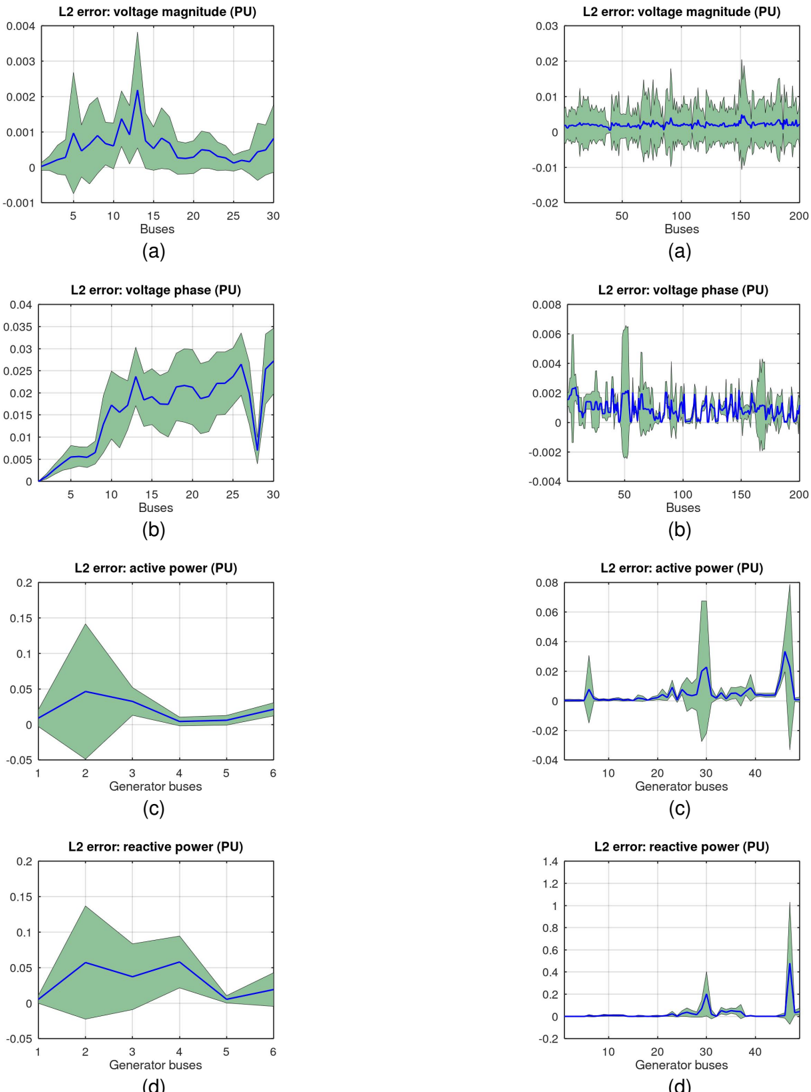
- Prediction errors versus Matpower AC OPF (IPOPT) on noisy benchmark cases ranged from 0.056–0.206% for voltage magnitude, 0.091–2.168% for phase angle, 0.476–13.31% for active power generation, and 0.817–14.58% for reactive power generation across the 14-, 30-, 57-, 118- and 200-bus cases (Table III).
- Runtime was greatly reduced: e.g. 14-bus 0.0328 s (Matpower) vs 1.77×10⁻³ s (PI-TGN); 200-bus 4.6744 s vs 3.646×10⁻³ s — "more than 1000 times faster" for the largest case, and nearly 20× for the smallest (Table VI).
- Operational-limit violations were small: none in the 30-bus case; ≤0.0023 p.u. (P) and ≤0.0014 p.u. (V) for 57 buses; ≤0.0038 p.u. (P) and ≤0.004 p.u. (V) for 118 buses; no P violation and ≤0.01 p.u. V violation for 200 buses (Table IV). Except for the 118-bus case, no more than five buses violated limits.
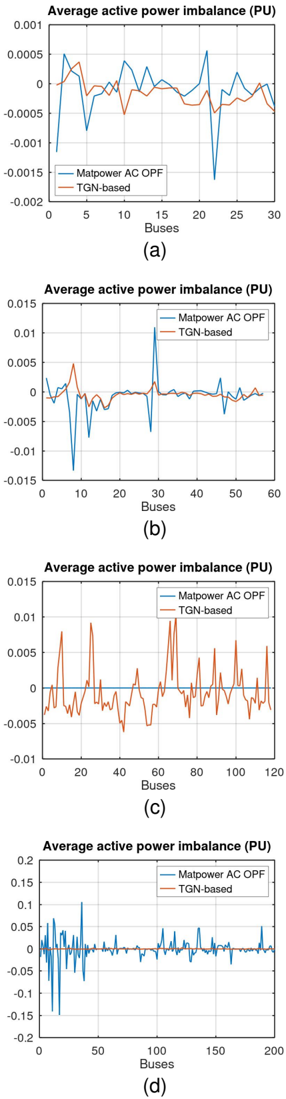
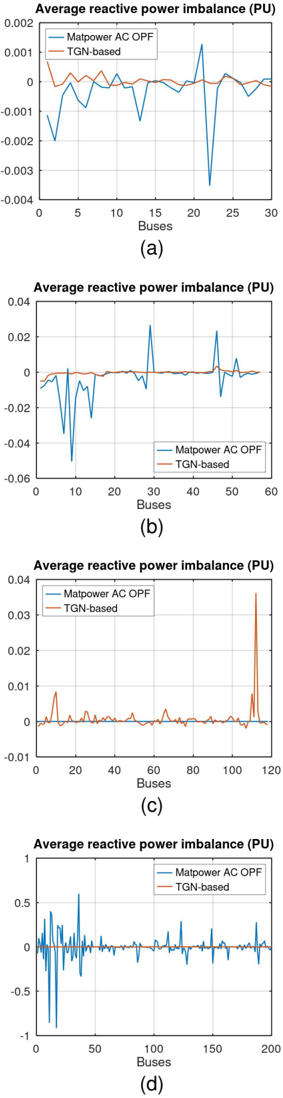
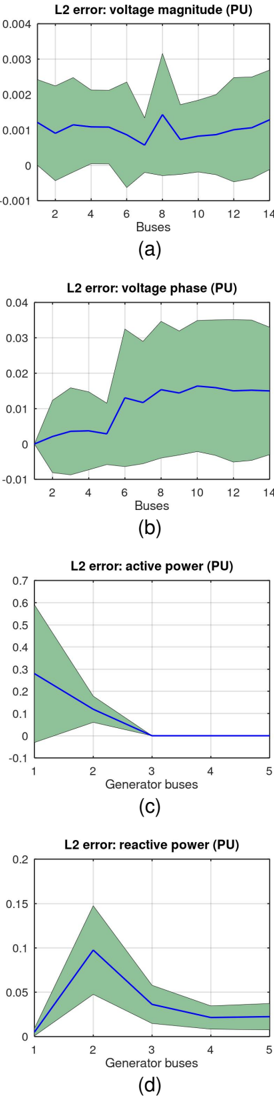
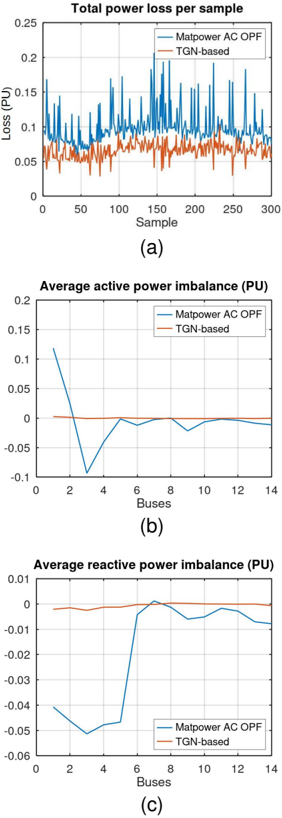
- In the time-series test (14-bus, Codalab "Learning to Run a Power Network 2019" load profiles, 300-sample batches), errors were V 0.104%, θ 1.03%, Pg 7.99%, Qg 3.65% (Table V); the solver generally achieved lower active/reactive power imbalance per bus than Matpower, except in the 118-bus case.
Methods
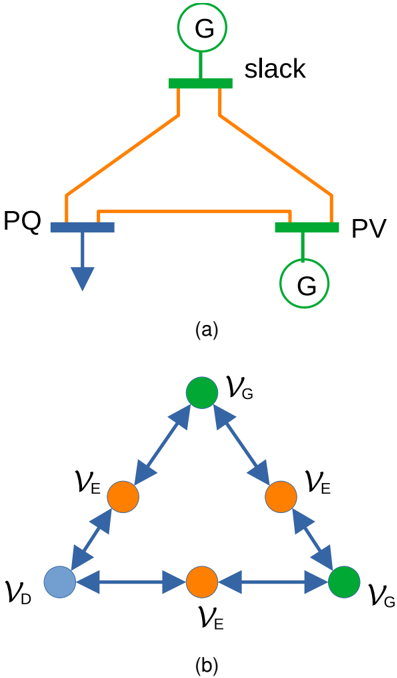
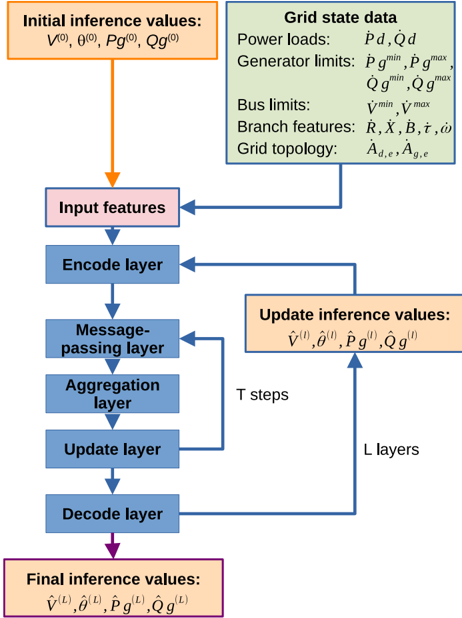
- Design: an unsupervised, physics-informed typed graph neural network where buses are split into generator (V_G) and load (V_D) node types and branches into a line type (V_E), connected by two adjacency matrices A_d,e and A_g,e; each layer encodes inputs, performs T message-passing/update steps, and decodes voltage magnitude/phase and active/reactive power increments.
- Loss: L = L_a + L_b + L_c, weighting branch active power losses (eq. 1–2), squared active/reactive power imbalance at each bus (eq. 3–5), and squared violation degrees for voltage magnitude and P/Q generation limits via ramp functions (eqs. 6–20), with weights λ_a, λ_b, λ_c.
- Data and analysis: benchmark cases from the IEEE PES PGLIB-OPF library (14, 30, 57, 118, 200 buses) with uniform noise added to loads (80–120%), shunt susceptance (0.9–1.1), branch parameters (90–110%), generation limits (90–110%), and one randomly deleted branch per sample; initial inference values randomized (P/Q at 25–75% of limits, V at 30–70% of limits, θ at slack angle). Hyperparameters: L = 4 layers, T = 2, embedding dimension d = 16, learning rate 1×10⁻³, Adam, batches of 20 test samples; results compared against Matpower AC OPF with IPOPT.
Limitations
- Stated by the authors: the method is fully unsupervised, so solutions are "not always the same" as conventional AC-OPF solvers, and adding a target-data term to the loss could bring results closer to a trusted numerical method; branch operational constraints were not considered (though they could be added as violation degrees); model instances were only tested on networks of the same size as training, and attempts to generalize across sizes were unsatisfactory; larger networks may exceed GPU memory.
- Evident from the text: the 118-bus case showed the largest generation errors (Pg 13.31%, Qg 14.58%) and roughly half its buses exhibited small limit breaches, which the authors hypothesize relates to a high ratio of compensators to active power generators; the reported solver runtime excludes the time to add noise to data and generate adjacency matrices.
Model-written summary. Check it against the paper before relying on it.
Integrity signals
Registry
Cites
Statistics
Figures


Verification
Claims the paper makes
0 Valid · 4 Not valid · 8 Not checked · 54 Own results and interpretations
A result the paper reports from its own data — it cites no other source for it, so there is none to check. The quote shows it is in the paper.
In the paper
“As shown in Table VI, even for the smallest grid of only 14 nodes, the proposed solver is nearly 20 times faster than the conventional AC OPF solver.”
§ Optimal Power Flow with Physics-informed Typed Graph Neural Networks > IV. CONCLUSION
plainSingle case- Asserted: passes — The authors put it forward as true.
- Checkable: passes — It can be checked against evidence.
- Load-bearing: passes — The paper’s conclusions depend on it.
- Based: passes — The paper gives a reason why it holds.
A result the paper reports from its own data — it cites no other source for it, so there is none to check. The quote shows it is in the paper.
In the paper
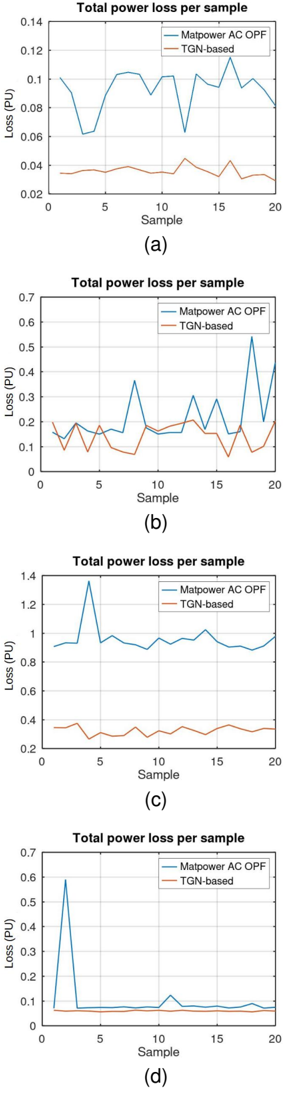
“It can be seen that the proposed solver underestimates power losses.”
§ Optimal Power Flow with Physics-informed Typed Graph Neural Networks > D. Prediction accuracy with time series case test
plainstates a causeSingle case- Asserted: passes — The authors put it forward as true.
- Checkable: passes — It can be checked against evidence.
- Load-bearing: unclear — It is unclear whether the paper’s conclusions depend on it.
- Based: passes — The paper gives a reason why it holds.
A result the paper reports from its own data — it cites no other source for it, so there is none to check. The quote shows it is in the paper.
In the paper
“However, in general very good results were obtained with this case even though it is larger than the others.”
§ Optimal Power Flow with Physics-informed Typed Graph Neural Networks > B. Prediction accuracy with noisy benchmark cases test
plainSingle case- Asserted: passes — The authors put it forward as true.
- Checkable: passes — It can be checked against evidence.
- Load-bearing: unclear — It is unclear whether the paper’s conclusions depend on it.
- Based: passes — The paper gives a reason why it holds.
A result the paper reports from its own data — it cites no other source for it, so there is none to check. The quote shows it is in the paper.
In the paper
“as can be seen, in general the total loss is lower with the proposed solution.”
§ Optimal Power Flow with Physics-informed Typed Graph Neural Networks > C. Loss function elements with noisy benchmark cases test
plainstates a cause- Asserted: passes — The authors put it forward as true.
- Checkable: passes — It can be checked against evidence.
- Load-bearing: passes — The paper’s conclusions depend on it.
- Based: passes — The paper gives a reason why it holds.
A result the paper states — it cites no source for it, so there is none to check. The quote shows it is in the paper.
In the paper
“In several trials, cases with many static synchronous or static var compensators in relation to active power generators seem to cause a negative effect on the predictive ability of the proposed model on the generator buses that have to compensate the load.”
§ Optimal Power Flow with Physics-informed Typed Graph Neural Networks > B. Prediction accuracy with noisy benchmark cases test
hedgedstates a possible cause- Asserted: passes — The authors put it forward as true.
- Checkable: passes — It can be checked against evidence.
- Load-bearing: unclear — It is unclear whether the paper’s conclusions depend on it.
- Based: passes — The paper gives a reason why it holds.
23 more claims
Create a free account to see all 66 claims and to verify the 9 references still open.
- The quote only partly states this claim. 2
- Probably not a substantial claim. 27
- It may state two separate claims as one. 19
Self-check
Percentages, sums and reported differences re-computed from the paper’s own numbers.
Each contradiction between two passages listed here was confirmed by an independent check.
Rated minor: it would not touch a result — a value no result rests on, a p-value that stays on the same side of the significance level, or a conflict that is clerical, resolved elsewhere in the paper, or outside its own findings.
In the paper
§ Optimal Power Flow with Physics-informed Typed Graph Neural Networks > C. Grid state data and initial inference values
“the headers used were the ones of cases 14, 30, 57 and 200 buses [28].”
§ Optimal Power Flow with Physics-informed Typed Graph Neural Networks > A. Simulation setup
“The headers used are: "PGLIB OPF case14 IEEE", "PGLIB OPF case30 IEEE", "PGLIB OPF case57 IEEE", "PGLIB OPF case118 IEEE" and "PGLIB OPF case200 activ" [29].”
Rated minor: it would not touch a result — a value no result rests on, a p-value that stays on the same side of the significance level, or a conflict that is clerical, resolved elsewhere in the paper, or outside its own findings.
In the paper
§ Optimal Power Flow with Physics-informed Typed Graph Neural Networks > B. Prediction accuracy with noisy benchmark cases test
“In all cases the best approximation is made of the voltage magnitude”
§ Optimal Power Flow with Physics-informed Typed Graph Neural Networks > B. Prediction accuracy with noisy benchmark cases test
“200 buses 0.206 0.091 0.476 7.25”
Citations
Cites
Contribution a l’etude du dispatching economique.
Carpentier, J. L. (1962) · Cited by 894
Momoh, J. A., Adapa, R., & El-Hawary, M. E. (1999) · IEEE Transactions on Power Systems · doi:10.1109/59.744492 · Cited by 836
A review of recent advances in economic dispatch
Chowdhury, B. H., & Rahman, S. (1990) · IEEE Transactions on Power Systems · doi:10.1109/59.99376 · Cited by 680
Grid Structural Characteristics as Validation Criteria for Synthetic Networks
Birchfield, A. B., Xu, T., Gegner, K. M., Shetye, K. S., & Overbye, T. J. (2017) · IEEE Transactions on Power Systems · doi:10.1109/tpwrs.2016.2616385 · Cited by 679
Momoh, J. A., El-Hawary, M. E., & Adapa, R. (1999) · IEEE Transactions on Power Systems · doi:10.1109/59.744495 · Cited by 645
A survey of the optimal power flow literature
Huneault, M., & Galiana, F. D. (1991) · IEEE Transactions on Power Systems · doi:10.1109/59.76723 · Cited by 603
Optimal dynamic economic dispatch of generation: A review
Xia, X., & Elaiw, A. M. (2010) · Electric Power Systems Research · doi:10.1016/j.epsr.2009.12.012 · Cited by 351
Critical review of recent advances and further developments needed in AC optimal power flow
Capitanescu, F. (2016) · Electric Power Systems Research · doi:10.1016/j.epsr.2016.02.008 · Cited by 286
Physics-Informed Neural Networks for AC Optimal Power Flow
Nellikkath, R., & Chatzivasileiadis, S. (2022) · Electric Power Systems Research · doi:10.1016/j.epsr.2022.108412 · Cited by 274
Review of Reactive Power Planning: Objectives, Constraints, and Algorithms
Zhang, W., Li, F. F., & Tolbert, L. M. (2007) · IEEE Transactions on Power Systems · doi:10.1109/tpwrs.2007.907452 · Cited by 265
Research works printed but not linked: 1
- J. Carpentier, "Contribution to the economic dispatch problem," Bull. De la Societe Francoise des Electriciens, vol. 3, pp. 431-447, 1962.
Cited by
Gulraiz, A., Zaidi, S. S. H., Gulraiz, H., Khan, B. M., Ali, M., & Khan, B. (2025) · Results in Engineering · doi:10.1016/j.rineng.2025.106169 · Cited by 24
Towards generalization of graph neural networks for AC optimal power flow
Arowolo, O., & Cremer, J. L. (2026) · Energy and AI · doi:10.1016/j.egyai.2026.100842 · Cited by 21
Improved Physics-Informed Neural Network based AC Power Flow for Distribution Networks
Eeckhout, V., Fani, H., Hashmi, M. U., & Deconinck, G. (2024) · IEEE PES Innovative Smart Grid Technologies Europe · doi:10.1109/isgteurope62998.2024.10863674 · Cited by 17
Physics-informed neural networks for power systems: A systematic review
Xu, X., Qiang, K., Wu, J., Xuan, L., Lu, Y., Ma, W., & Zhang, J. (2026) · Sustainable Energy Grids and Networks · doi:10.1016/j.segan.2026.102261 · Cited by 16
Beyond the Neural Fog: Interpretable Learning for AC Optimal Power Flow
Pineda, S., Pérez‐Ruiz, J., & Morales, J. M. (2025) · IEEE Transactions on Power Systems · doi:10.1109/tpwrs.2025.3559730 · Cited by 15
Wang, K., Cao, Y., & Gu, W. (2025) · IET Smart Grid · doi:10.1049/stg2.70042 · Cited by 10
Zhu, Z., Zhu, S., & Bu, S. (2025) · IEEE Transactions on Power Systems · doi:10.1109/tpwrs.2025.3603018 · Cited by 7
Anand, H., Khayambashi, K., Zandsalimi, Z., Taghizadeh, M., Hasnat, M. A., & Alemazkoor, N. (2025) · SSRN Electronic Journal · doi:10.2139/ssrn.5385353 · Cited by 6
An Explainable AI Framework for AC Optimal Power Flow
Kfouri, R., & Margossian, H. (2025) · IEEE Access · doi:10.1109/access.2025.3614071 · Cited by 5
Predicting Real-Time Carbon Emissions for Power Grids Using Graph Convolutional Networks
Zhao, Q. C., Chen, J., Jia, Q., Sun, C., Chen, X., & Chen, H. (2025) · Machines · doi:10.3390/machines13111061 · Cited by 5
Li, B., Weng, Y., Xu, C., Zheng, C., & Zhang, M. (2026) · Sustainable Energy Grids and Networks · doi:10.1016/j.segan.2026.102370 · Cited by 4
Duan, W., Huang, Y., Le, Q. D., & Wong, T. C. (2025) · Neurocomputing · doi:10.1016/j.neucom.2025.131489 · Cited by 3
Physics-aware machine learning for sustainable development of integrated energy systems
Jafari, P., Hayati, M. M., Zare, K., Abapour, M., & Aghaei, J. (2025) · Elsevier eBooks · doi:10.1016/b978-0-443-32984-5.00015-5 · Cited by 3
A Load Margin Calculation Method Using a Physics-Informed Neural Network
Bento, M. E. C. (2025) · Applied Sciences · doi:10.3390/app152312396 · Cited by 3
Physics-Informed Learning-based Attack Analytics for Electric Vehicle Charging Management Systems
Perry, D., Haider, M. Z., Kazmi, M. K., Rahman, M. A., & Shahriar, H. (2025) · IEEE Annual International Computer Software and Applications Conference (COMPSAC) · doi:10.1109/compsac65507.2025.00147 · Cited by 2
Topology-Aware Deep Reinforcement Learning for Renewable Dispatch: A Case Study on the Peshawar Grid
Khurshid, M. A., & Khan, G. M. (2025) · IEEE International Conference on Smart Communities: Improving Quality of Life using AI, Robotics and IoT (HONET) · doi:10.1109/honet67928.2025.11318493 · Cited by 2
Baù, M., Perbellini, L., & Grillo, S. (2025) · arXiv · doi:10.48550/arxiv.2508.19083 · Cited by 2
G-PIFNN: A Generalizable Physics-informed Fourier Neural Network Framework for Electrical CircuitsPreprint
Shahbaz, I., Abdel‐Rahman, M. J., & Hammad, E. M. (2025) · arXiv · doi:10.48550/arxiv.2512.02712 · Cited by 2
Hasan, A. A., & Koroleva, A. P. (2026) · Computation · doi:10.3390/computation14100242 · Cited by 1
Towards Systematic Generalization for Power Grid Optimization Problems
Memon, Z., Li, Y., Jin, H., Kim, K., & Zhao, L. (2026) · ACM SIGKDD Conference on Knowledge Discovery and Data Mining (KDD) · doi:10.1145/3770855.3819020 · Cited by 1
Scalable graph-based OPF learning
Jia, Y., Wang, Y., & Zhou, Y. (2026) · Sustainable Energy Grids and Networks · doi:10.1016/j.segan.2026.102169 · Cited by 1
Li, S., Yin, H., Xiao, Y., Chen, Z., Qi, Z., & Liang, Z. (2026) · International Journal of Electrical Power & Energy Systems · doi:10.1016/j.ijepes.2026.111798 · Cited by 1
Hierarchical Graph Neural Network for Probabilistic Power Flow With Grid Topology Contingencies
Wang, J., Liu, J., Zhang, S., Ma, X., Yan, L., Liu, H., & Maharjan, S. (2026) · IEEE Transactions on Industrial Informatics · doi:10.1109/tii.2026.3734758 · Cited by 1
Scalable Graph-based OPF LearningPreprint
Jia, Y., Zhou, Y., & Wang, Y. (2025) · SSRN Electronic Journal · doi:10.2139/ssrn.5648275 · Cited by 1
Jiang, B., Qu, J., & Wang, Q. (2025) · TechRxiv · doi:10.36227/techrxiv.176127198.84709317/v1 · Cited by 1
Graph Neural Network Analysis Techniques for Power Flow Analysis
Tanolli, N. A. K., Raza, A., & Gulraiz, A. (2025) · International Conference on Emerging Technologies in Electronics, Computing and Communication (ICETECC) · doi:10.1109/icetecc65365.2025.11070259
Zhang, P., Sun, Y., Cui, C., & Zhang, C. (2026) · IEEE Transactions on Smart Grid · doi:10.1109/tsg.2026.3717716
Meng, X., Liu, J., Wang, K., Yu, M., & Lin, Z. (2026) · arXiv · doi:10.48550/arxiv.2611.02711
Hu, X., Xue, S., Fan, Z., Ma, R., Wang, R., Su, N., & Zhang, B. (2026) · Applied Sciences · doi:10.3390/app16199601
Shuvarina, A., Morren, J., Slootweg, J. G., Ciupuliga, A. R., & Nguyen, P. H. (2026) · International Conference on Smart Energy Systems and Technologies (SEST) · doi:10.1109/sest67798.2026.11712498
Deep Learning-Based Optimal Power Flow Algorithm with Grid Topology-Variation Perception
Liang, Z., Liang, S., Xiong, L., Chen, B., Mo, D., & Li, P. (2026) · Energies · doi:10.3390/en19194582
Firdausi, M., & Syed, M. N. (2026) · IEEE Access · doi:10.1109/access.2026.3742257
A neural net fitting-based approach for optimal power flow
Radosavljevic, J., Grujić, A., & Milovanovi, M. (2026) · Journal of Electrical Engineering · doi:10.2478/jee-2026-0055
Gao, S., Yang, J., Sun, H., Wang, Q., Shi, M., Li, G., Zhang, Q. W. L., & Qian, Z. (2026) · Sustainable Energy Grids and Networks · doi:10.1016/j.segan.2026.102258
Modularity-Guided Physics-Informed Heterogeneous Graph Neural Network for Power Flow PredictionPreprint
Xianfeng, X. U., Qiang, K., Wu, J., Lu, Y., Huang, X., Xuan, Q. T. L., & Xuan, L. (2026) · SSRN Electronic Journal · doi:10.2139/ssrn.6964499
Modularity-guided physics-informed heterogeneous graph neural network for power flow prediction
Xu, X., Qiang, K., Wu, J., Lu, Y., Huang, X., Tan, Q., & Xuan, L. (2026) · Sustainable Energy Grids and Networks · doi:10.1016/j.segan.2026.102538
Yang, X., Wen, Y., Zhao, J., & Gao, T. (2026) · Electric Power Systems Research · doi:10.1016/j.epsr.2026.114401
Liu, D., Xu, S., Jin, Y., Honglei, Y. A. O., & Liu, Q. (2026) · PLoS ONE · doi:10.1371/journal.pone.0359953
Scalable Graph-based OPF LearningPreprint
Jia, Y., Zhou, Y., & Wang, Y. (2025) · SSRN Electronic Journal · doi:10.2139/ssrn.5735326
Wattanakitkarn, T., Piamvilai, N., & Sirisumrannukul, S. (2025) · IEEE PES GTD Grand International Conference and Exposition Asia (GTD Asia) · doi:10.1109/gtdasia60461.2025.11313253
A Hybrid Deep Learning and Optimization Framework for Transmission Network Expansion Planning
Chen, J., Zou, Q., Xie, H., & Su, D. (2025) · IEEE International Conference on Advances in Electrical Engineering and Computer Applications (AEECA) · doi:10.1109/aeeca65693.2025.00068
Tripathi, S., Mohsenzadeh-Yazdi, H., Raissi, M., & Mohsenian‐Rad, H. (2026) · International Conference on Harmonics and Quality of Power · doi:10.1109/ichqp67927.2026.11756073
Liu, Z., Li, Y., Lou, S., Wang, W. B., & Hao, X. (2026) · Engineering Research Express · doi:10.1088/2631-8695/ae76c4
Liu, C., Liao, C., Tian, X., Li, J., & Wang, W. (2026) · Electric Power Systems Research · doi:10.1016/j.epsr.2026.113420
LLM-Agent-Assisted PE-GNN for Accelerated MISOCP Power Flow in Hybrid AC/DC Distribution Networks
Ding, Y., Zhang, Y., Tian, X., Liu, C., Zuo, J., & Zhao, T. (2026) · IEEE International Conference on Electrical Power Systems and Intelligent Control (EPSIC) · doi:10.1109/epsic70071.2026.11590437
Inertia-Aware Optimal Power Flow Using PINN in IBR-Dominated Power SystemsPreprint
Tofighi‐Milani, M., Fattaheian–Dehkordi, S., Rohrhofer, F. M., & Lehtonen, M. (2026) · arXiv · doi:10.48550/arxiv.2607.09297
Zu, T., Ba, B., Liang, J., & Kang, R. (2026) · Reliability Engineering & System Safety · doi:10.1016/j.ress.2026.113147
Wang, Y., Liu, R. W., Liu, J., Yang, L., Piera, M. À., & Liu, Y. (2026) · Reliability Engineering & System Safety · doi:10.1016/j.ress.2026.113250
Application of Physics-Informed Neural Network to Fast Power Flow Calculation in Power Grids
Han, X. (2026) · International Symposium on Advances in Electrical, Electronics and Computer Engineering (ISAEECE) · doi:10.1109/isaeece70502.2026.11635175
A Physics-Data Dual-Driven Framework for Carbon Flow Tracking in Source-Grid-Load Power Systems
Chen, J., Wang, P., Zhang, X., Gong, J., Wei, B., & Zeng, J. (2026) · International Conference on Energy and Electrical Power Systems (ICEEPS) · doi:10.1109/iceeps70377.2026.11662764
Zhao, J. (2026) · SSRN Electronic Journal · doi:10.2139/ssrn.7438745
Zhang, B., Zhang, T., Liu, J., Ji, Y., Song, Y., & Gao, Q. (2026) · Sustainable Energy Grids and Networks · doi:10.1016/j.segan.2026.102531
GraphLLM-based low-carbon power system dispatch optimization under renewable energy uncertaintyPreprint
Jiang, S., & Luo, Z. (2026) · SSRN Electronic Journal · doi:10.2139/ssrn.7511959
AC OPF learning via modular decomposition and adaptation to topology changes
Zhang, Y., Karve, P., & Mahadevan, S. (2026) · Applied Energy · doi:10.1016/j.apenergy.2026.128996
PhyPro-FM: A Physics and Prompt-Guided Graph Foundation Model for Contingency AnalysisPreprint
Yang, X., Sheng, Z., Lin, C., Liu, H., Wang, Q., Yue, Y., & Wu, W. (2026) · arXiv · doi:10.48550/arxiv.2610.26351
Su, Y., Zhang, L., Chen, W., Wang, Y., Liu, F., Chang, J., & Bi, S. (2026) · Energies · doi:10.3390/en19215058
Zero-Shot Cross-Topology Generalization for DC Power Flow in Grids with High Renewable Penetration
Abdildayeva, A. A., Guldana, T., Shazhdekeyeva, N., Tuleuova, R., Adiyeva, A., Nigmetova, G., Urbissinova, B., & Sabirova, Z. (2026) · Mathematics · doi:10.3390/math14213972
SafeGraph-CP: Uncertainty-Gated Zero-Shot Topology Transfer for Graph-Based Power-Grid Control
Niño, C. H. V., González, C. A. F., & Marín, J. (2026) · Technologies · doi:10.3390/technologies14110768
Heterogeneous-Supervision Graph Pretraining for Power Flow Prediction and Convergence Diagnosis
雷盛武, Yanchun, Z., Li, D., Zhou, Y., Cai, H., & Yang, P. (2026) · International Conference on Power System and Power Engineering (PSPE) · doi:10.1109/pspe71359.2026.11780991
Metadata
- Authors
- Lopez-Garcia, T. B., & Domínguez-Navarro, J. A.
- Affiliations
- Electrical engineering, University of Zaragoza, Zaragoza, Spain
- Venue
- IEEE Transactions on Power Systems
- Published
- 2025-01
- Volume
- 40
- Issue
- 1
- Pages
- 381-393
- ISSN
- 0885-8950 (ISSN-L)
- 1558-0679
- OpenAlex
- W4395680440
- Cited by
- 59
- References
- 35
- Citations by year
- 2026: 38 · 2025: 20
- FWCI
- 5.09
- Type
- journal article
- Language
- en
- Open access
- hybrid
- doi.org
- Locations
- IEEE Transactions on Power Systems (publishedVersion, cc-by)
- Zaguan (University of Zaragoza Repository) (publishedVersion, cc-by)
- Funders
- National Science and Technology Council (710033)
- Spanish National Plan for Scientific and Technical Research and Innovation (PID2019-104711RB-I00)
- Topics
- Physical Sciences › Engineering › Electrical and Electronic Engineering › Optimal Power Flow Distribution
- Physical Sciences › Engineering › Electrical and Electronic Engineering › Power System Optimization and Stability
- Physical Sciences › Engineering › Electrical and Electronic Engineering › Electric Power System Optimization
- Keywords
- optimal power flow, physics-informed loss function, transmission systems, operational constraints, interpretability, computational efficiency, power system optimization
About these checks
Registry, retraction, Cites and statistics results are computed, not judged, with one exception: a printed reference that no index lists is read once by a model before it counts as a citation error. Claims are extracted by a model and kept only when their quote appears verbatim in the text; each cited source is then checked, with a model’s help, for whether it says what the claim relies on. Those verdicts can be wrong — read the claim’s quote and the cited source before relying on one.
A language model drew the claims from the paper on 2026-11-25, under version 3 of the claim definition (model deepseek-v4.1-flash, prompt extract-v3).
A second model labelled each claim on 2026-11-25 (model jev-1.13-20260917, definition revision gold-guideline-v0.2).
Statistics and arithmetic are recomputed, not judged.
Confidence bands are shown only for fields calibrated on our annotated test set. None is calibrated yet, so no band is shown.
What counts as a claim ›How we measure confidence ›How we check this ›
Are you an author, or do you see a problem with this page? Request a review
Data sources
Bibliographic data: Semantic Scholar, OpenAlex, Crossref.
Contains information from the Semantic Scholar Academic Graph Datasets, made available under the ODC Attribution License (ODC-BY 1.0).
Semantic Scholar’s data is described in: Kinney, R., et al. (2023). The Semantic Scholar Open Data Platform. arXiv:2301.10140.
