

MultiPL-E: A Scalable and Polyglot Approach to Benchmarking Neural Code Generation
Open accessThe DOI matches its Crossref record; 53 of the 54 references it cites were found in a registry or an index; 21 of the 42 sources its claims cite were checked for support.
Abstract
Large language models have demonstrated the ability to generate both natural language and programming language text. Although contemporary code generation models are trained on corpora with several programming languages, they are tested using benchmarks that are typically monolingual. The most widely used code generation benchmarks only target Python, so there is little quantitative evidence of how code generation models perform on other programming languages. We propose MultiPL-E, a system for translating unit test-driven code generation benchmarks to new languages. We create the first massively multilingual code generation benchmark by using MultiPL-E to translate two popular Python code generation benchmarks to 18 additional programming languages. We use MultiPL-E to extend the HumanEval benchmark [1] and MBPP benchmark [2] to 18 languages that encompass a range of programming paradigms and popularity. Using these new parallel benchmarks, we evaluate the multi-language performance of three state-of-the-art code generation models: Codex [1], CodeGen [3]and InCoder [4]. We find that Codex matches or even exceeds its performance on Python for several other languages. The range of programming languages represented in MultiPL-E allow us to explore the impact of language frequency and language features on model performance. Finally, the MultiPL-E approach of compiling code generation benchmarks to new programming languages is both scalable and extensible, making it straightforward to evaluate new models, benchmarks, and languages.
Overview
CoChat Summary
TL;DR
MultiPL-E translates unit-test-driven Python code generation benchmarks into 18 additional programming languages, producing parallel HumanEval and MBPP benchmarks across 19 languages. Evaluating Codex, CodeGen, and InCoder shows Codex often matches or exceeds Python on several languages, especially JavaScript, while perplexity and type annotations do not reliably predict correctness.
Key findings
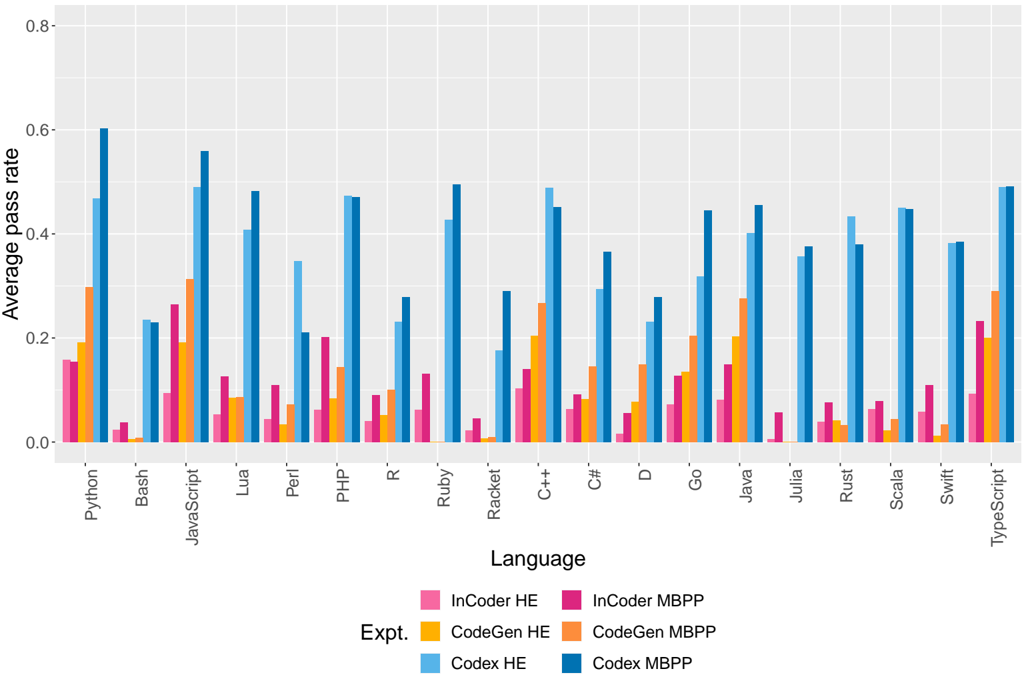
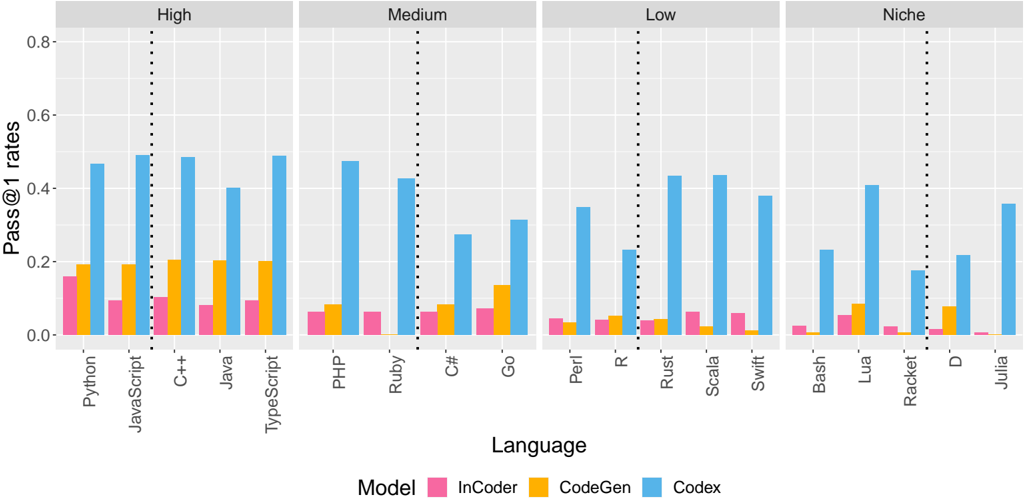
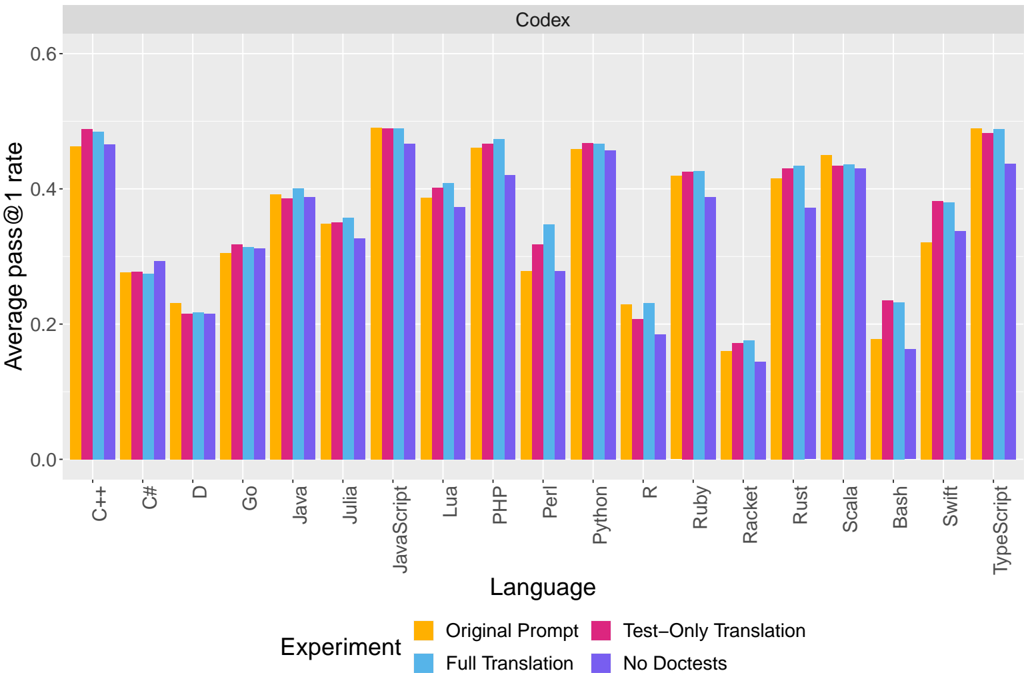
- Codex reaches 45.9% pass@1 on Python HumanEval, compared with 28.8% reported earlier; CodeGen reaches 19.2% versus 18.3% reported earlier, and InCoder exactly replicates its prior Python HumanEval result. Codex’s JavaScript pass@1 is +2.3% over Python (p = 0.43), and it exceeds 40% pass@1 on C++, Java, TypeScript, PHP, Ruby, Rust, Scala, and Lua.
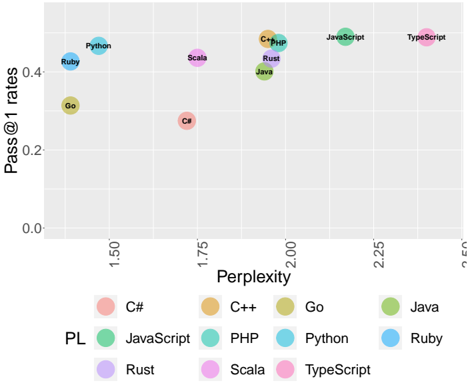
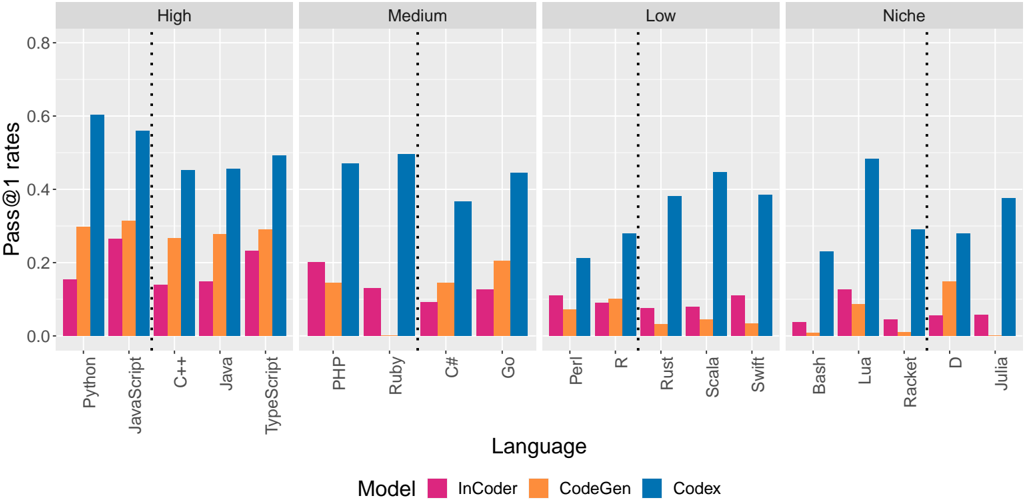
- All three models perform best on high-frequency languages, but Codex performs well on some LOW and NICHE languages: Lua is the 9th-best language in its evaluation despite only 0.2% GitHub activity and no TIOBE Top-20 rank. There is no strong correlation between Codex pass@1 and perplexity; JavaScript and TypeScript have the highest perplexity while Codex performs best on them.
- Type annotations show no overall effect on Codex pass@1 on MultiPL-HumanEval (p = 0.33) or MultiPL-MBPP (p = 0.23); removing Python annotations has no significant effect (p = 0.23), but replacing TypeScript types with `Any` hurts performance (-2.5%, p < 0.001).
- Prompt design matters: Full Translation vs. Test-Only Translation is significant (p = 0.03), No Doctests vs. Test-Only Translation is significant (p < 0.001), and omitting Perl argument naming lowers Codex pass@1 by 8% (p < 0.001). MBPP is less challenging than HumanEval for all but 6 of 57 model/language pairs.
Methods
- MultiPL-E uses 18 source-to-source compilers, each about 200 LOC, to translate function signatures, simple unit tests, doctests, Python-specific terminology, and type annotations from Python into target languages; a containerized sandbox compiles, runs, validates, and classifies generated programs.
- The authors translated HumanEval (164 problems) and MBPP into 19 languages. For MBPP, they removed assertions from prompts and mechanically added inferred function signatures; they manually validated 23 problems across every language.
- They evaluated Codex (175B `code-davinci-002`), CodeGen (16.1B), and InCoder (6.7B) using pass@k with 200 completions per prompt, temperature 0.2 for pass@1 and 0.8 for pass@10/pass@100, plus mixed-effects models for statistical comparisons.
Limitations
- The paper states that translated benchmarks may not represent real-world programming tasks, that prompt design and sampling choices can affect pass rates and may not be optimal for non-Python languages, and that all prompts use Python doctest `>>>` notation.
- The paper states that the approach excludes C and SQL, excludes 3 HumanEval problems with Python helper functions, modifies 2 to use unit tests instead of randomized testing, and fails to compile up to 5 problems for certain typed languages.
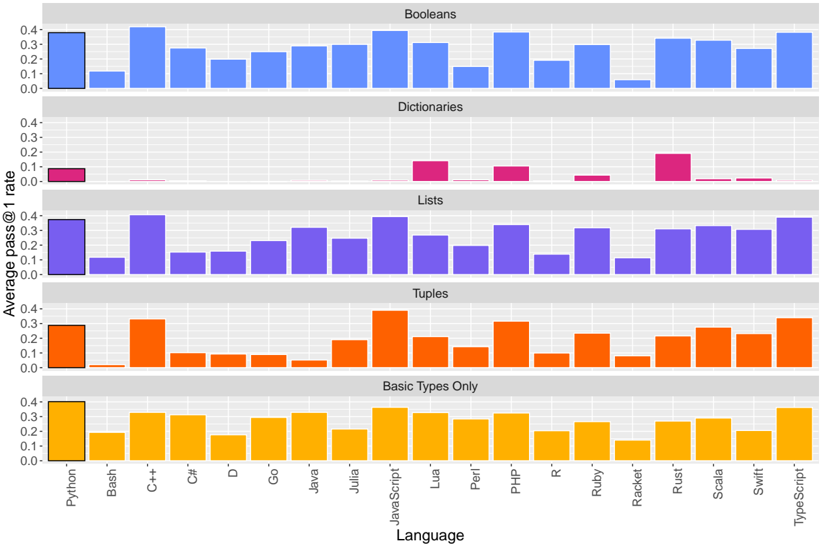
- The text makes evident that Codex’s training set is not public, so train/test overlap cannot be independently verified; dictionary-problem results are based on only 3 problems; and language selection depended on author expertise.
Model-written summary. Check it against the paper before relying on it.
Integrity signals
Registry
Cites
Statistics
Figures
Verification
Claims the paper makes
11 Valid · 7 Not valid · 19 Not checked · 97 Own results and interpretations
At least one cited source doesn’t support this claim or points to a different paper, and none confirmed it — see the verdicts below.
In the paper
“There is prior work on multi-language evaluation [7], but it uses perplexity as a proxy for performance, instead of benchmarks that check correctness.”
§ MultiPL-E: A Scalable and Polyglot Approach to Benchmarking Neural Code Generation > 1 INTRODUCTION
What the sources say
- Disputedcites [7] A. Ziegler, E. Kalliamvakou, X. A. Li, A. Rice, D. Rifkin, S. Simister, G. Sittampalam, and E. Aftandilian, "Pro- ductivity assessment of neural code completion," in Proceedings of the 6th ACM SIGPLAN International Sym- posium on Machine Programming, 2022, pp. 21-29. sourceExperimental — accuracy not yet measured
Section 5.1 (Language Use; page unavailable) compares GitHub Copilot across programming languages using completion acceptance rates. The Introduction and Section 8 (page unavailable) identify acceptance rate—not perplexity—as the paper’s proxy for performance and discuss its limitations. Section 2 discusses correctness-based evaluations as background, but the paper does not say it uses perplexity instead of them. (LLM, conf=0.87)
Checked by a reasoning model — may be wrong.
plain- Asserted: passes — The authors put it forward as true.
- Checkable: passes — It can be checked against evidence.
- Load-bearing: passes — The paper’s conclusions depend on it.
- Based: passes — The paper gives a reason why it holds.
- Disputed
Every source the paper cites for this claim was checked and supports it.
In the paper
“[1] describe a 12B parameter version of Codex finetuned on 159 GB of deduplicated, filtered Python code from Github.”
§ MultiPL-E: A Scalable and Polyglot Approach to Benchmarking Neural Code Generation > 4.1 Models
What the sources say
- Supportedcites [1] M. Chen, J. Tworek, H. Jun, Q. Yuan, H. P. d. O. Pinto, J. Kaplan, H. Edwards, Y. Burda, N. Joseph, G. Brockman et al., "Evaluating large language models trained on code," arXiv preprint arXiv:2107.03374, 2021. source
Section 3 (p. 4) says GPT models with up to 12B parameters were fine-tuned on code to produce Codex. Section 3.1 (p. 4) says the GitHub dataset contained unique Python files and totaled 159 GB after filtering; the paper also identifies a 12B-parameter Codex (p. 2). (LLM, conf=0.93)
plain- Asserted: passes — The authors put it forward as true.
- Checkable: passes — It can be checked against evidence.
- Load-bearing: unclear — It is unclear whether the paper’s conclusions depend on it.
- Based: passes — The paper gives a reason why it holds.
- Supported
The cited sources that could be checked couldn’t confirm or dispute this claim.
In the paper
“We do not observe a strong correlation between Codex pass@1 scores and their perplexity scores (Figure 8).”
§ MultiPL-E: A Scalable and Polyglot Approach to Benchmarking Neural Code Generation > 5.2.4 Perplexity and Code Correctness Do Not Correlate
What the sources say
- Could not verifycites [7] A. Ziegler, E. Kalliamvakou, X. A. Li, A. Rice, D. Rifkin, S. Simister, G. Sittampalam, and E. Aftandilian, "Pro- ductivity assessment of neural code completion," in Proceedings of the 6th ACM SIGPLAN International Sym- posium on Machine Programming, 2022, pp. 21-29. sourceExperimental — accuracy not yet measured
Section 5.1 discusses differences in GitHub Copilot acceptance rates across programming languages, while Section 4 correlates usage metrics with perceived productivity. Neither addresses a correlation between Codex pass@1 scores and perplexity scores. Searches for those terms and Figure 8 found no passage supporting the claim. (LLM, conf=0.76)
plain- Asserted: passes — The authors put it forward as true.
- Checkable: passes — It can be checked against evidence.
- Load-bearing: passes — The paper’s conclusions depend on it.
- Based: passes — The paper gives a reason why it holds.
- Could not verify
Every source the paper cites for this claim was checked and supports it.
In the paper
“Empirical results show these settings are optimal for Python [1], but it is possible that different settings would be better for other programming languages.”
§ MultiPL-E: A Scalable and Polyglot Approach to Benchmarking Neural Code Generation > 7 THREATS TO VALIDITY
What the sources say
- Supportedcites [1] M. Chen, J. Tworek, H. Jun, Q. Yuan, H. P. d. O. Pinto, J. Kaplan, H. Edwards, Y. Burda, N. Joseph, G. Brockman et al., "Evaluating large language models trained on code," arXiv preprint arXiv:2107.03374, 2021. source
Section 3.3 (pp. 4–5) reports empirically optimal sampling temperatures for Codex on the Python HumanEval tasks, with the best temperature depending on the number of samples. The finding is specific to that evaluation, not a claim of universal optimality for all Python code generation. (LLM, conf=0.88)
hedgedstates a cause- Asserted: passes — The authors put it forward as true.
- Checkable: passes — It can be checked against evidence.
- Load-bearing: unclear — It is unclear whether the paper’s conclusions depend on it.
- Based: passes — The paper gives a reason why it holds.
- Supported
Every source the paper cites for this claim was checked and supports it.
In the paper
“We evaluate a more recent Codex model (codedavinci-002) than the original paper and observe a large improvement on Python: a pass@1 rate of 45.9%, compared to 28.8% reported earlier [1].”
§ MultiPL-E: A Scalable and Polyglot Approach to Benchmarking Neural Code Generation > 5.2.1 Python Results and Replication
What the sources say
- Supportedcites [1] M. Chen, J. Tworek, H. Jun, Q. Yuan, H. P. d. O. Pinto, J. Kaplan, H. Edwards, Y. Burda, N. Joseph, G. Brockman et al., "Evaluating large language models trained on code," arXiv preprint arXiv:2107.03374, 2021. source
The citation supports the earlier 28.8% benchmark, not the citing authors’ own 45.9% result for code-davinci-002. Table 1 (p. 7) reports 28.81% pass@1 for Codex-12B on HumanEval, and the Figure 1 caption (p. 2) rounds this to 28.8% for the paper’s Python-function task. (LLM, conf=0.94)
plain- Asserted: passes — The authors put it forward as true.
- Checkable: passes — It can be checked against evidence.
- Load-bearing: unclear — It is unclear whether the paper’s conclusions depend on it.
- Based: passes — The paper gives a reason why it holds.
- Supported
64 more claims · 1 with their cited sources checked
Create a free account to see all 134 claims and to verify the 4 references still open.
- Probably not a substantial claim. 36
- It may state two separate claims as one. 38
- The quote only partly states this claim. 2
Claims other papers make about this one
Each is checked against this paper’s own text: does it say what the citing paper says it does?
The source backs part of the claim, not all of it — or backs it for a different population, condition or comparison.
In the citing paper
“However, their rules have limited support for type handling (e.g., they cannot handle a list with hybrid types)”
From CRUXEVAL-X: A Benchmark for Multilingual Code Reasoning, Understanding and Execution (2025) · cites this paper as Cassano et al., 2023
Experimental — accuracy not yet measuredThe cited source says what the claim attributes to it.
In the citing paper
“Some works focus on the multilingual scenarios (Wang et al., 2023; Athiwaratkun et al., 2023; Peng et al., 2024; Zheng et al., 2023b) by extending the Python-only HumanEval/MBPP benchmark (e.g. MultiPL-E (Cassano et al., 2023)), which is challenged by the number of the languages and data leaking problem (Jain et al., 2024).”
From McEval: Massively Multilingual Code Evaluation (2024) · cites this paper as Cassano et al., 2023
The cited source says what the claim attributes to it.
In the citing paper
“Prior work has extended HumanEval to new programming languages via automatic translation mechanisms (Athiwaratkun et al., 2022;Cassano et al., 2023;Orlanski et al., 2023).”
From OctoPack: Instruction Tuning Code Large Language Models (2023) · cites this paper as Cassano et al., 2023
The cited source says what the claim attributes to it.
In the citing paper
“This improves performance significantly for less common languages as measured by the MultiPL-E (Cassano et al., 2023) benchmark.”
From The Llama 3 Herd of Models (2024) · cites this paper as Cassano et al., 2023
In the citing paper
“Rule-based translation (Cassano et al., 2023;Ling et al., 2022) usually suffers from generalizability issues, making them limited in handling prescribed code structures.”
From CRUXEVAL-X: A Benchmark for Multilingual Code Reasoning, Understanding and Execution (2025) · cites this paper as Cassano et al., 2023
Self-check
Percentages, sums and reported differences re-computed from the paper’s own numbers.
Each contradiction between two passages listed here was confirmed by an independent check.
Rated major: it would touch a result — a value a result rests on, reported and recomputed p-values on opposite sides of the significance level, two passages that conflict with no sign which is right, or a cited work retracted before this paper was published.
In the paper
§ MultiPL-E: A Scalable and Polyglot Approach to Benchmarking Neural Code Generation > 5.2.2 Codex Performs Best on JavaScript
“However, that Codex matches or exceeds its Python performance on 18 new languages suggests a negligible impact of any train/test overlap.”
§ MultiPL-E: A Scalable and Polyglot Approach to Benchmarking Neural Code Generation > 5.2 MultiPL-HumanEval results
“We find reliable differences between Codex pass@1 rates on MultiPL-HumanEval for Python and all but 4 languages: C++, JavaScript, Scala, and TypeScript.For these languages, Codex performance is similar to Python.”
Rated minor: it would not touch a result — a value no result rests on, a p-value that stays on the same side of the significance level, or a conflict that is clerical, resolved elsewhere in the paper, or outside its own findings.
In the paper
§ MultiPL-E: A Scalable and Polyglot Approach to Benchmarking Neural Code Generation > 6.3 Type Annotations
“In Figure 7 and Figure 9, the dashed lines in each category separate languages with type annotations (left) from languages without (right).”
§ MultiPL-E: A Scalable and Polyglot Approach to Benchmarking Neural Code Generation > 9 CONCLUSION
“Languages to the left of dashed line are dynamically typed, and languages to the right are statically typed.”
Citations
Cites
Vaswani, A., Shazeer, N., Parmar, N., Uszkoreit, J., Jones, L., Gomez, A. N., Kaiser, L., & Polosukhin, I. (2017) · arXiv · doi:10.48550/arxiv.1706.03762 · Cited by 120,404 · cited 1×
“We evaluate three state-of-the-art code generation models, each of which use a Transformer architecture [29] and are trained with a language modeling objective on a mixture of natural language and code.”
MethodFitting Linear Mixed-Effects Models Using lme4
Bates, D., Mächler, M., Bolker, B., & Walker, S. (2015) · Journal of Statistical Software · doi:10.18637/jss.v067.i01 · Cited by 86,835
Exploiting Generative AI to Scale up Intelligent Tutoring Systems
Jakubův, J., Chvalovský, K., Goertzel, Z., Kaliszyk, C., Olšák, M., Piotrowski, B., Schulz, S., Suda, M., & Urban, J. (2023) · DROPS (Schloss Dagstuhl – Leibniz Center for Informatics) · doi:10.4230/lipics.itp.2023.19 · Cited by 76,658
Language Models are Few-Shot Learners
Brown, T. B., Mann, B., Ryder, N., Subbiah, M., Kaplan, J., Dhariwal, P., Neelakantan, A., Shyam, P., Sastry, G., Askell, A., et al. (2020) · arXiv · doi:10.48550/arxiv.2005.14165 · Cited by 23,372
BLEU: a method for automatic evaluation of machine translation
Papineni, K., Roukos, S., Ward, T., & Zhu, W.-J. (2001) · Proceedings of the 40th Annual Meeting on Association for Computational Linguistics - ACL '02 · doi:10.3115/1073083.1073135 · Cited by 21,344 · cited 1×
“For instance, Feng et al. [16] evaluate their CodeBERT model on six programming languages using BLEU [35].”
MethodCodeBERT: A Pre-Trained Model for Programming and Natural Languages
Feng, Z., Guo, D., Tang, D., Duan, N., Feng, X., Gong, M., Shou, L., Qin, B., Liu, T., Jiang, D., et al. (2020) · Findings of the Association for Computational Linguistics: EMNLP 2020 · doi:10.18653/v1/2020.findings-emnlp.139 · Cited by 2,824 · cited 6×
“Two influential early models were CodeBERT [16] and PyMT [17].”
BackgroundMethodInfluentialPaLM: Scaling Language Modeling with Pathways
Chowdhery, A., Narang, S., Devlin, J., Bosma, M., Mishra, G., Roberts, A., Barham, P., Chung, H. W., Sutton, C., Gehrmann, S., et al. (2022) · arXiv · doi:10.48550/arxiv.2204.02311 · Cited by 2,590 · cited 1×
“More recent models include PolyCoder [6], CodeParrot [39], AlphaCode [40], and PaLM-Coder [41].”
MethodGebru, T., Morgenstern, J., Vecchione, B., Vaughan, J. W., Wallach, H., III, H. D., & Crawford, K. (2021) · Communications of the ACM · doi:10.1145/3458723 · Cited by 2,469
Evaluating Large Language Models Trained on Code
Chen, M., Tworek, J., Jun, H., Yuan, Q., Pinto, H. P. D. O., Kaplan, J., Edwards, H., Burda, Y., Joseph, N., Brockman, G., et al. (2021) · arXiv · doi:10.48550/arxiv.2107.03374 · Cited by 1,436 · cited 9×
“Over the past few years, code generation models have demonstrated their utility on a wide variety of software engineering tasks, including test generation, documentation generation, and even synthesizing working programs from natural language descriptions [1], [3], [4], [5], [6].”
BackgroundMethodInfluentialThe Curious Case of Neural Text Degeneration
Holtzman, A., Buys, J., Du, L., Forbes, M., & Choi, Y. (2019) · arXiv · doi:10.48550/arxiv.1904.09751 · Cited by 1,304
Research works printed but not linked: 3
- S. Ren, D. Guo, S. Lu, L. Zhou, S. Liu, D. Tang, N. Sundaresan, M. Zhou, A. Blanco, and S. Ma, "Codebleu: a method for automatic evaluation of code synthesis," 2020. [Online]. Available: https: //arxiv.org/abs/2009.10297
- Guyon, U. V. Luxburg, S. Bengio, H. Wallach, R. Fergus, S. Vishwanathan, and R. Garnett, Eds., vol. 30. Curran Associates, Inc., 2017. [Online]. Avail- able: https://proceedings.neurips.cc/paper/2017/ file/3f5ee243547dee91fbd053c1c4a845aa-Paper.pdf
- L. Tunstall, L. von Werra, and T. Wolf, Natural Language Processing with Transformers. O'Reilly Media, 2022. [Online]. Available: https://books.google.com/books? id=nTxbEAAAQBAJ
Cited by
Large Language Models for Software Engineering: A Systematic Literature Review
Hou, X., Zhao, Y., Liu, Y., Yang, Z., Wang, K., Li, L., Luo, X., Lo, D., Grundy, J., & Wang, H. (2024) · ACM Transactions on Software Engineering and Methodology · doi:10.1145/3695988 · Cited by 1,029
Code Llama: Open Foundation Models for Code
Rozière, B., Gehring, J., Gloeckle, F., Sootla, S., Gat, I., Tan, X. E., Adi, Y., Liu, J., Sauvestre, R., Remez, T., et al. (2023) · arXiv · doi:10.48550/arxiv.2308.12950 · Cited by 531
“For that, we use the MultiPL-E benchmark (Cassano et al., 2023).”
BackgroundMethodInfluentialReflexion: Language Agents with Verbal Reinforcement Learning
Shinn, N., Cassano, F., Berman, E., Gopinath, A., Narasimhan, K., & Yao, S. (2023) · arXiv · doi:10.48550/arxiv.2303.11366 · Cited by 1,087
Self-citationStarCoder: may the source be with you!
Li, R., Allal, L. B., Zi, Y., Muennighoff, N., Kocetkov, D., Mou, C., Marone, M., Akiki, C., Li, J., Chim, J., et al. (2023) · arXiv · doi:10.48550/arxiv.2305.06161 · Cited by 261
Self-citationRefining ChatGPT-Generated Code: Characterizing and Mitigating Code Quality Issues
Liu, Y., Le-Cong, T., Widyasari, R., Tantithamthavorn, C., Li, L., Le, X.-B. D., & Lo, D. (2024) · ACM Transactions on Software Engineering and Methodology · doi:10.1145/3643674 · Cited by 149
“Specifically, popular benchmarks like HumanEval [9] encompassing 164 Python tasks, and MBPP [3] containing 974 programming tasks, have been widely used by prior research [7–9 , 32 ].”
MethodA survey on large language models for software engineering
Zhang, Q., Fang, C., Xie, Y., Zhang, Y., Yu, S., Sun, W., Yang, Y., & Chen, Z. (2026) · Science China Information Sciences · doi:10.1007/s11432-025-4670-0 · Cited by 124
Large Language Models for Software Engineering: A Systematic Literature Review
Hou, X., Zhao, Y., Liu, Y., Yang, Z., Wang, K., Li, L., Luo, X., Lo, D., Grundy, J., & Wang, H. (2023) · arXiv · doi:10.48550/arxiv.2308.10620 · Cited by 114
Yang, A., Li, A., Yang, B., Zhang, B., Hui, B., Zheng, B., Yu, B., Gao, C., Huang, C., Lv, C., et al. (2025) · arXiv · doi:10.48550/arxiv.2505.09388 · Cited by 17,283
CodeBERTScore: Evaluating Code Generation with Pretrained Models of Code
Zhou, S., Alon, U., Agarwal, S., & Neubig, G. (2023) · arXiv · doi:10.48550/arxiv.2302.05527 · Cited by 100
Using Large Language Models to Generate JUnit Tests: An Empirical Study
Siddiq, M. L., Santos, J. C. S., Tanvir, R. H., Ulfat, N., Rifat, F. A., & Lopes, V. C. (2024) · International Conference on Evaluation and Assessment in Software Engineering (EASE) · doi:10.1145/3661167.3661216 · Cited by 252
StarCoder 2 and The Stack v2: The Next Generation
Lozhkov, A., Li, R., Allal, L. B., Cassano, F., Lamy-Poirier, J., Tazi, N., Tang, A., Pykhtar, D., Liu, J., Wei, Y., et al. (2024) · arXiv · doi:10.48550/arxiv.2402.19173 · Cited by 74
Self-citationHow Beginning Programmers and Code LLMs (Mis)read Each Other
Nguyen, S., Babe, H. M., Zi, Y., Guha, A., Anderson, C. J., & Feldman, M. Q. (2024) · Proceedings of the CHI Conference on Human Factors in Computing Systems · doi:10.1145/3613904.3642706 · Cited by 66
“5-turbo and code-davinci-002 score 48% and 46% respectively on the Hu-manEval Python programming benchmark [11, 74], the most commonly used Python benchmark for Code LLMs.”
MethodSelf-citationA Survey on LLM-Based Code Generation for Low-Resource and Domain-Specific Programming Languages
Joel, S., Wu, J. J., & Fard, F. H. (2026) · ACM Transactions on Software Engineering and Methodology · doi:10.1145/3770084 · Cited by 209
When large language model meets optimization
Huang, S., Yang, K., Qi, S., & Wang, R. (2024) · Swarm and Evolutionary Computation · doi:10.1016/j.swevo.2024.101663 · Cited by 118
Exploring Parameter-Efficient Fine-Tuning Techniques for Code Generation with Large Language Models
Weyssow, M., Zhou, X., Kim, K., Lo, D., & Sahraoui, H. (2023) · ACM Transactions on Software Engineering and Methodology · doi:10.1145/3714461 · Cited by 121
“However, we anticipate that PEFT techniques is also applicable to other programming languages, considering the impressive generation capabilities of LLMs on a diverse range of programming languages [3, 8].”
Automatic Programming: Large Language Models and Beyond
Lyu, M. R.-T., Ray, B., Roychoudhury, A., Tan, S. H., & Thongtanunam, P. (2025) · ACM Transactions on Software Engineering and Methodology · doi:10.1145/3708519 · Cited by 134
Kohen-Vacs, D., Usher, M., & Jansen, M. (2025) · International Journal of Artificial Intelligence in Education · doi:10.1007/s40593-025-00496-4 · Cited by 39
“In programming education, LLM-powered tools, such as ChatGPT and GitHub Copilot, have been integrated into development environments to provide contextual code suggestions, natural language explanations, and real-time debugging support (Cassano et al., 2023; Fenu et al., 2024; Lau & Guo, 2023).”
CrossCodeEval: A Diverse and Multilingual Benchmark for Cross-File Code Completion
Ding, Y., Wang, Z., Ahmad, W. U., Ding, H., Tan, M., Jain, N., Ramanathan, M. K., Nallapati, R., Bhatia, P., Roth, D., et al. (2023) · arXiv · doi:10.48550/arxiv.2310.11248 · Cited by 37
Knowledge Transfer from High-Resource to Low-Resource Programming Languages for Code LLMs
Cassano, F., Gouwar, J., Lucchetti, F., Schlesinger, C., Freeman, A., Anderson, C. J., Feldman, M. Q., Greenberg, M., Jangda, A., & Guha, A. (2024) · Proceedings of the ACM on Programming Languages · doi:10.1145/3689735 · Cited by 150
“Finally, to compile tests to the low-resource language ( 4 (cid:13) ), we build on an existing toolchain ([Cassano et al. 2023]), adding support for OCaml, new prompting formats, and support for an LLM-translation task that is three orders of magnitude larger than what it originally supported.”
InfluentialSelf-citationCRUXEVAL-X: A Benchmark for Multilingual Code Reasoning, Understanding and Execution
Xu, R., Cao, J., Lu, Y., Wen, M., Lin, H., Han, X., He, B., Cheung, S.-C., & Sun, L. (2025) · Proceedings of the 63rd Annual Meeting of the Association for Computational Linguistics (Volume 1: Long Papers) · doi:10.18653/v1/2025.acl-long.1158 · Cited by 35
Can Large Language Models Write Parallel Code?
Nichols, D., Davis, J. H., Xie, Z., Rajaram, A., & Bhatele, A. (2024) · IEEE International Symposium on High-Performance Parallel Distributed Computing · doi:10.1145/3625549.3658689 · Cited by 86
“Only more recent benchmarks such as DS-1000 [28], test the usage of APIs, which are critical to using parallel programming models.”
BackgroundSWE-agent: Agent-Computer Interfaces Enable Automated Software Engineering
Yang, J., Jimenez, C. E., Wettig, A., Lieret, K., Yao, S., Narasimhan, K., & Press, O. (2024) · arXiv · doi:10.48550/arxiv.2405.15793 · Cited by 3,708
BioCoder: a benchmark for bioinformatics code generation with large language models
Tang, X., Qian, B., Gao, R., Chen, J., Chen, X., & Gerstein, M. B. (2024) · Bioinformatics · doi:10.1093/bioinformatics/btae230 · Cited by 30
“We used the Pass@K metric to measure the functional accuracy (Chen et al. 2021, 2022, Cassano et al. 2023) of code generation models.”
Bias Testing and Mitigation in LLM-based Code Generation
Huang, D., Zhang, J. M., Bu, Q., Xie, X., Chen, J., & Cui, H. (2025) · ACM Transactions on Software Engineering and Methodology · doi:10.1145/3724117 · Cited by 174
“Protected attributes are highlighted in bold.”
Fight Fire with Fire: How Much Can We Trust ChatGPT on Source Code-Related Tasks?
Yu, X., Liu, L., Hu, X., Keung, J. W., Liu, J., & Xia, X. (2024) · arXiv · doi:10.48550/arxiv.2405.12641 · Cited by 29
Learning-based Widget Matching for Migrating GUI Test Cases
Zhang, Y., Zhang, W., Ran, D., Zhu, Q., Dou, C., Hao, D., Xie, T., & Zhang, L. (2024) · ACM/IEEE International Conference on Software Engineering: Companion Proceedings (ICSE-Companion) · doi:10.1145/3597503.3623322 · Cited by 63
“The synthesized target events and the target assertions are used to form the target test case.”
BackgroundMethodPrompting Techniques for Secure Code Generation: A Systematic Investigation
Tony, C., Ferreyra, N. E. D., Mutas, M., Dhiff, S., & Scandariato, R. (2025) · ACM Transactions on Software Engineering and Methodology · doi:10.1145/3722108 · Cited by 109
“Besides the aforementioned studies, there exist papers introducing code synthesis benchmarks like EvalPlus [60] and Multipl-E [13], which assess the code generated by various LLMs.”
Benchmarks and Metrics for Evaluations of Code Generation: A Critical Review
Paul, D. G., Zhu, H., & Bayley, I. (2024) · IEEE International Conference on Artificial Intelligence Testing (AITest) · doi:10.1109/aitest62860.2024.00019 · Cited by 73
Fight Fire With Fire: How Much Can We Trust ChatGPT on Source Code-Related Tasks?
Yu, X., Liu, L., Hu, X., Keung, J., Liu, J., & Xia, X. (2024) · IEEE Transactions on Software Engineering · doi:10.1109/tse.2024.3492204 · Cited by 61
“Any code that fails to pass a test case is considered incorrect [12].”
Feedback on Feedback: Student’s Perceptions for Feedback from Teachers and Few-Shot LLMs
Rüdian, S., Podelo, J., Kužílek, J., & Pinkwart, N. (2025) · International Conference on Learning Analytics and Knowledge (LAK) · doi:10.1145/3706468.3706479 · Cited by 46
Zhuang, W., Pan, X., Wen, S., Yu, W., Li, X., & Bao, J. (2025) · International Journal of Production Research · doi:10.1080/00207543.2025.2509155 · Cited by 23
“Firstly, current LLMs are predominantly employed in general domains with abundant training data, such as code generation (Cassano et al. 2023; Liu et al. 2024), customer service support (Baghdasaryan et al. 2024), and literary creation (Dergaa et al. 2023).”
Measuring The Impact Of Programming Language Distribution
Orlanski, G., Xiao, K., Garcia, X., Hui, J., Howland, J., Malmaud, J., Austin, J., Singh, R., & Catasta, M. (2023) · arXiv · doi:10.48550/arxiv.2302.01973 · Cited by 21
Agentless: Demystifying LLM-based Software Engineering Agents
Xia, C. S., Deng, Y., Dunn, S., & Zhang, L. (2024) · arXiv · doi:10.48550/arxiv.2407.01489 · Cited by 24
“However, instead of embedding all files in the repository, A GENTLESS first filters out irrelevant folders.”
BackgroundZhou, C., Zhang, X., Song, D., Chen, X., Gu, W., Ma, H., Tian, Y., Zhang, M., & Hu, L. (2025) · arXiv · doi:10.48550/arxiv.2502.09183 · Cited by 18
Generating Programs Trivially: Student Use of Large Language Models
Prasad, S., Greenman, B., Nelson, T., & Krishnamurthi, S. (2023) · ACM Global Computing Education Conference (CompEd) · doi:10.1145/3576882.3617921 · Cited by 37
“Although prior work shows that llms can succeed on harder problems and in languages other than Python [7, 15], success is by no means guaranteed.”
BackgroundIsolating Compiler Bugs by Generating Effective Witness Programs With Large Language Models
Tu, H., Zhou, Z., Jiang, H., Yusuf, I. N. B., Li, Y., & Jiang, L. (2024) · IEEE Transactions on Software Engineering · doi:10.1109/tse.2024.3397822 · Cited by 35
“Two main categories of LLMs are available to the community for code generation tasks: infilling and general [20], [29], [31].”
BackgroundL2CEval: Evaluating Language-to-Code Generation Capabilities of Large Language Models
Ni, A., Yin, P.-C., Zhao, Y., Riddell, M., Feng, T., Shen, R., Yin, S., Liu, Y., Yavuz, S., Xiong, C.-M., et al. (2023) · Transactions of the Association for Computational Linguistics · doi:10.1162/tacl_a_00705 · Cited by 50
OctoPack: Instruction Tuning Code Large Language Models
Muennighoff, N., Liu, Q., Zebaze, A., Zheng, Q., Hui, B., Zhuo, T. Y., Singh, S., Tang, X., von Werra, L., & Longpre, S. (2023) · arXiv · doi:10.48550/arxiv.2308.07124 · Cited by 245
“Prior work has extended HumanEval to new programming languages via automatic translation mechanisms (Athiwaratkun et al., 2022; Cassano et al., 2023; Orlanski et al., 2023).”
BackgroundLLMEffiChecker: Understanding and Testing Efficiency Degradation of Large Language Models
Feng, X.-N., Han, X.-H., Chen, S.-M., & Yang, W. (2022) · ACM Transactions on Software Engineering and Methodology · doi:10.1145/3664812 · Cited by 42
“However, in most cases with normal inputs, such a threshold will not yield any real impact, as the EOS token often appears much earlier (e.g., in code generation applications, setting the max_length of LLMs to 512 is a widely adopted practice [8, 48, 94]).”
LLM-based methods for the creation of unit tests in game development
Păduraru, C., Staicu, A.-N., & Ştefănescu, A. (2024) · Procedia Computer Science · doi:10.1016/j.procs.2024.09.473 · Cited by 19
VLATest: Testing and Evaluating Vision-Language-Action Models for Robotic Manipulation
Wang, Z., Zhou, Z., Song, J., Huang, Y., Shu, Z., & Ma, L. (2025) · Proceedings of the ACM on Software Engineering · doi:10.1145/3729343 · Cited by 14
Benchmarking Causal Study to Interpret Large Language Models for Source Code
Rodriguez-Cardenas, D., Palacio, D. N., Khati, D., Burke, H., & Poshyvanyk, D. (2023) · 2023 IEEE International Conference on Software Maintenance and Evolution (ICSME) · doi:10.1109/icsme58846.2023.00040 · Cited by 14
Large Language Models for Constructing and Optimizing Machine Learning Workflows: A Survey
Gu, Y., You, H., Cao, J., Yu, M., Fan, H., & Qian, S. (2026) · ACM Transactions on Software Engineering and Methodology · doi:10.1145/3773084 · Cited by 65
“This paradigm has long been a core topic in Software Engineering (SE) , encompassing research areas such as program synthesis, code transformation, and automated software construction [17, 61, 70].”
CoderUJB: An Executable and Unified Java Benchmark for Practical Programming Scenarios
Zeng, Z., Wang, Y., Xie, R., Ye, W., & Zhang, S. (2024) · ACM SIGSOFT International Symposium on Software Testing and Analysis (ISSTA) · doi:10.1145/3650212.3652115 · Cited by 34
Type-Constrained Code Generation with Language Models
Mündler, N., He, J., Wang, H., Sen, K., Song, D. X., & Vechev, M. (2025) · Proceedings of the ACM on Programming Languages · doi:10.1145/3729274 · Cited by 83
Kimi k1.5: Scaling Reinforcement Learning with LLMs
Kimi Team, Du, A., Gao, B., Xing, B., Jiang, C., Chen, C., Li, C., Xiao, C., Du, C., Liao, C., et al. (2025) · arXiv · doi:10.48550/arxiv.2501.12599 · Cited by 12
Hu, X., Niu, F., Chen, J., Zhou, X., Zhang, J., He, J., Xia, X., & Lo, D. (2025) · ACM Transactions on Software Engineering and Methodology · doi:10.1145/3786771 · Cited by 15
Evaluating quantized Large Language Models for code generation on low-resource language benchmarks
Nyamsuren, E. (2025) · Journal of Computer Languages · doi:10.1016/j.cola.2025.101351 · Cited by 21
LLM4TDG: test-driven generation of large language models based on enhanced constraint reasoning
Liu, J., Liang, R., Zhu, X., Zhang, Y., Liu, Y., & Liu, Q. (2025) · Cybersecurity · doi:10.1186/s42400-024-00335-4 · Cited by 20
“…there are other benchmarks for other languages, such as Spider (Yu et al. 2018) (SQL), HUMANEVAL-X (Zheng et al. 2023) (C ++ , Javascript, and Go), CodeContests (Li et al. 2022) (C ++ and Java), and MultiPL-E (Cassano et al. 2023), which extend HUMANEVAL and MBPP to 18 programming languages.”
SUPER: Evaluating Agents on Setting Up and Executing Tasks from Research Repositories
Bogin, B., Yang, K., Gupta, S., Richardson, K., Bransom, E., Clark, P., Sabharwal, A., & Khot, T. (2024) · Proceedings of the 2024 Conference on Empirical Methods in Natural Language Processing · doi:10.18653/v1/2024.emnlp-main.702 · Cited by 9
Nemotron-4 15B Technical Report
Parmar, J., Prabhumoye, S., Jennings, J., Patwary, M., Subramanian, S., Su, D., Zhu, C., Narayanan, D., Jhunjhunwala, A., Dattagupta, A., et al. (2024) · arXiv · doi:10.48550/arxiv.2402.16819 · Cited by 9
“…(Cobbe et al., 2021) • Code: Pass@1 scores on HumanEval (0-shot) (Chen et al., 2021), MBPP (3-shot) (Austin et al., 2021), and MultiPL-E (0-shot) (Cassano et al., 2023a) • Multilingual: classification via XCOPA (0 and 4-shot) (Ponti et al., 2020), machine translation with FLORES-101 (8-shot)…”
MethodGutierrez, S., Hou, I., Lee, J., Angelikas, K., Man, O., Mettille, S., Prather, J. E., Denny, P. C., & MacNeil, S. (2025) · Australasian Computing Education Conference · doi:10.1145/3716640.3716654 · Cited by 15
Promoting open science in test-driven software experiments
Kessel, M., & Atkinson, C. (2024) · Journal of Systems and Software · doi:10.1016/j.jss.2024.111971 · Cited by 13
Unit Test Generation using Large Language Models for Unity Game Development
Păduraru, C., Ştefănescu, A., & Jianu, A. (2024) · doi:10.1145/3663532.3664466 · Cited by 17
Challenges and Paths Towards AI for Software EngineeringPreprint
Gu, A., Jain, N., Li, W., Shetty, M., Shao, Y., Li, Z., Yang, D., Ellis, K., Sen, K., & Solar-Lezama, A. (2025) · Qeios · doi:10.32388/vv1661 · Cited by 50
Delgado, D., Burgueño, L., & Clarisó, R. (2026) · Journal of Systems and Software · doi:10.1016/j.jss.2026.112871 · Cited by 10
“In code generation, this problem is also discussed as the high, low, and very low resource programming languages problem [8, 9, 10, 11, 3, 12].”
Large Language Models for Software Engineering: A Systematic Mapping Study
Görmez, M. K., Yılmaz, M., & Clarke, P. M. (2024) · Communications in computer and information science · doi:10.1007/978-3-031-71139-8_5 · Cited by 18
Fuzzy-Assisted Contrastive Decoding Improving Code Generation of Large Language Models
Wang, S., Ding, L., Zhan, Y., Luo, Y., Liu, S., & Ding, W. (2025) · IEEE Transactions on Fuzzy Systems · doi:10.1109/tfuzz.2025.3575060 · Cited by 5
“3) Extensive experiments on HumanEval [7], MBPP [25], and MultiPL-E [26] benchmarks demonstrate that the proposed FCD mechanism outperforms direct contrastive decoding, reducing time required for inference and contrast decoding.”
Enhancing Code Generation for Low-Resource Languages: No Silver Bullet
Giagnorio, A., Martin-Lopez, A., & Bavota, G. (2025) · IEEE International Conference on Program Comprehension (ICPC) · doi:10.1109/icpc66645.2025.00058 · Cited by 31
“For example, the term “dictionary” in a Python docstring was replaced by “hash table” in Racket [19].”
InfluentialAgent-as-a-Judge: Evaluate Agents with Agents
Zhuge, M., Zhao, C., Ashley, D., Wang, W., Khizbullin, D., Xiong, Y., Liu, Z., Chang, E., Krishnamoorthi, R., Tian, Y., et al. (2024) · arXiv · doi:10.48550/arxiv.2410.10934 · Cited by 5
“Early benchmarks, such as MBPP (Austin et al., 2021), HumanEval (Chen et al., 2021), and MultiPL-E (Cassano et al., 2023), focus primarily on generating simple functions.”
BackgroundEvaluating the Test Adequacy of Benchmarks for LLMs on Code Generation
Liu, X., Sun, X., Bo, L., Hu, Y., Liu, X., & Ye, Z. (2025) · Journal of Software Evolution and Process · doi:10.1002/smr.70034 · Cited by 9
“However, there may also be situations where the majority of the training set is also related to that programming language, resulting in a lack of clarity in evaluating the model's capabilities in other programming languages [36].”
A Pilot Study on AI-Assisted Code Generation with Large Language Models for Software Engineering
Liu, H.-C., Tsai, C.-T., & Day, M.-Y. (2024) · Communications in computer and information science · doi:10.1007/978-981-97-1711-8_12 · Cited by 6
Exploring the Landscape of Programming Language Identification With Machine Learning Approaches
Verma, A., Saha, R., Kumar, G., Brighente, A., Conti, M., & Kim, T.-H. (2025) · IEEE Access · doi:10.1109/access.2025.3538108 · Cited by 10
“MultiPL-E Benchmark [82]: MultiPL-E is a scalable and extensible approach to benchmarking neural code generation across multiple programming languages.”
ScenEval: A Benchmark for Scenario-Based Evaluation of Code Generation
Paul, D. G., Zhu, H., & Bayley, I. (2024) · IEEE International Conference on Artificial Intelligence Testing (AITest) · doi:10.1109/aitest62860.2024.00015 · Cited by 13
N-Version Assessment and Enhancement of Generative AI: Differential GAI
Kessel, M., & Atkinson, C. (2024) · IEEE Software · doi:10.1109/ms.2024.3469388 · Cited by 8
“In the GAI community this is usually referred to as a code completion “problem”, 10 but essentially provides a service called “code recommendation” in the traditional software reuse community.”
GlueTest: Testing Code Translation via Language Interoperability
Abid, M. S., Pawagi, M., Adhikari, S., Cheng, X., Badr, R., Wahiduzzaman, M., Rathi, V., Qi, R., Li, C., Liu, L., et al. (2024) · IEEE International Conference on Software Maintenance (ICSM) · doi:10.1109/icsme58944.2024.00061 · Cited by 8
“The other approach is to translate the test code itself [5], [7], [14].”
The Fault in our Stars: Quality Assessment of Code Generation Benchmarks
Siddiq, M. L., Dristi, S., Saha, J., & Santos, J. C. S. (2024) · IEEE International Working Conference on Source Code Analysis and Manipulation (SCAM) · doi:10.1109/scam63643.2024.00028 · Cited by 44
Morescient GAI for Software Engineering
Kessel, M., & Atkinson, C. (2025) · ACM Transactions on Software Engineering and Methodology · doi:10.1145/3709354 · Cited by 11
“For example, while the Codex LLM powering GitHub Copilot can help prevent some types of “simple, stupid” bugs, it also generates code containing instances these bugs at twice the rate of correct code [14].”
Is Quantization a Deal-Breaker? Empirical Insights From Large Code Models
Afrin, S., Xu, B., & Mastropaolo, A. (2025) · IEEE International Conference on Software Maintenance (ICSM) · doi:10.1109/icsme64153.2025.00049 · Cited by 18
“E is a comprehensive code generation benchmark introduced by Cassano et al. [58], incorporating two widely used datasets: HumanEval [56] and MBPP [59], along with their translations into 18 programming languages.”
Esmaeili, A., Saberi, I., & Fard, F. H. (2025) · Empirical Software Engineering · doi:10.1007/s10664-025-10740-z · Cited by 6
Effectiveness of symmetric metamorphic relations on validating the stability of code generation LLM
Chan, P. Y. P., Keung, J., & Yang, Z. (2024) · Journal of Systems and Software · doi:10.1016/j.jss.2024.112330 · Cited by 8
Automatically Testing Functional Properties of Code Translation Models
Enişer, H. F., Wüstholz, V., & Christakis, M. (2024) · Proceedings of the AAAI Conference on Artificial Intelligence · doi:10.1609/aaai.v38i19.30097 · Cited by 17
Generating and Reviewing Programming Codes with Large Language Models: A Systematic Mapping Study
de Albuquerque, B. V. L., da Cunha, A. F. S., Souza, L., Siqueira, S. W. M., & dos Santos, R. P. (2024) · Anais do Simpósio Brasileiro de Sistemas de Informação (SBSI) · doi:10.1145/3658271.3658342 · Cited by 7
“• Avaliação de modelos: E11 [5] investigou o desafio da falta de evidências quantitativas para avaliar o desempenho de modelos de geração de código em linguagens de programação que não sejam Python; E10 [11] identificou a falta de estudos de larga escala sobre o desempenho de LLM na geração de…”
BackgroundInfluentialUtomo, M. S., Utami, E., Kusrini, K., & Setyanto, A. (2024) · International Conference on Information Technology and Computing (ICITCOM) · doi:10.1109/icitcom62788.2024.10762291 · Cited by 5
“…[24], [25], [26], [27], [28], [29], [30] Transformer Transformer Models [10], [14], [15], [16], [17], [19], [20], [31], [32], [33], [34], [35], [36], [37], [38], [39] CNN Image-related CNNs [40] Other Neural Network Generative Models [20], [35] Other Various Neural Network Models [41], [42],…”
Do Current Language Models Support Code Intelligence for R Programming Language?
Zhao, Z., & Fard, F. H. (2024) · ACM Transactions on Software Engineering and Methodology · doi:10.1145/3735635 · Cited by 11
“We prompted the LLMs in a zero-shot and few-shot setting and compare their results with the full fine-tuned models.”
InfluentialVERINA: Benchmarking Verifiable Code Generation
Ye, Z., Yan, Z., He, J., Kasriel, T., Yang, K., & Song, D. (2025) · arXiv · doi:10.48550/arxiv.2505.23135 · Cited by 3
“• Full code coverage with positive tests : Beyond the original test cases, we expanded the set of positive tests to ensure that they achieve full line coverage on the ground truth code.”
Seed-Coder: Let the Code Model Curate Data for Itself
Seed, B., Zhang, Y., Su, J., Sun, Y., Xi, C., Xiao, X., Zheng, S., Zhang, A., Liu, K., Zan, D., et al. (2025) · arXiv · doi:10.48550/arxiv.2506.03524 · Cited by 3
“Single-line MultiPL-HumanEval FIM [Allal et al., 2023] refines MultiPL-E [Cassano et al., 2023] into a set of single-line infilling challenges across Python, Java, and JavaScript, which serves as a classic benchmark for FIM evaluation.”
CatCoder : Repository-Level Code Generation with Relevant Code and Type Context
Pan, Z., Hu, X., Xia, X., & Yang, X. (2026) · ACM Transactions on Software Engineering and Methodology · doi:10.1145/3779217 · Cited by 26
“To our knowledge, the only code generation benchmark for the Rust programming language is MultiPL-E [16], which translates the original HumanEval [17] and MBPP [14] benchmarks.”
Deng, H., Chen, H., & Dong, Y. (2026) · Journal of Educational Computing Research · doi:10.1177/07356331261424211 · Cited by 7
“The rise of powerful LLMs has led to their increasing integration into programming education, where they can provide students with contextual code suggestions, natural language explanations, and real-time debugging support (Cassano et al., 2023; Garcia, 2025).”
Are LLMs reliable code reviewers? systematic overcorrection in requirement conformance judgement
Jin, H., & Chen, H. (2026) · Automated Software Engineering · doi:10.1007/s10515-026-00638-5 · Cited by 18
RepoMod-Bench: A Benchmark for Code Repository Modernization via Implementation-Agnostic Testing
Li, X., Ben-Israel, N. I., Raz, Y., Ahmed, B., Serebro, D., & Raux, A. (2026) · ACM SIGKDD Conference on Knowledge Discovery and Data Mining (KDD) · doi:10.1145/3770855.3817463 · Cited by 5
Evaluation of the Code Generated By Large Language Models: The State of the Art
Ying, Z., Towey, D., & Zhang, Y. (2025) · IEEE Annual International Computer Software and Applications Conference (COMPSAC) · doi:10.1109/compsac65507.2025.00064 · Cited by 3
“Beyond Python, there are other benchmarks targeting additional languages such as Spider (e.g., SQL) [42], HUMANEVAL-X (e.g., C++, JavaScript, and Go) [43], CodeContests (e.g., C++ and Java) [44], and MultiPL-E (e.g., extending HUMANEVAL and MBPP to 18 programming languages) [45].”
FullStack Bench: Evaluating LLMs as Full Stack Coders
Bytedance-Seed-Foundation-Code-Team, :, Cheng, Y., Chen, J., Chen, J., Chen, L., Chen, L., Chen, W., Chen, Z., Geng, S., et al. (2024) · arXiv · doi:10.48550/arxiv.2412.00535 · Cited by 2
Improving FIM Code Completions via Context & Curriculum Based Learning
Sagtani, H., Mehrotra, R., & Liu, B. (2025) · ACM International Conference on Web Search and Data Mining (WSDM) · doi:10.1145/3701551.3703563 · Cited by 12
On the Applicability of Code Language Models to Scientific Computing Programs
Zhao, Q., Liu, F., Long, X., Wu, C., & Zhang, L. (2025) · IEEE Transactions on Software Engineering · doi:10.1109/tse.2025.3564599 · Cited by 4
“MultiPL-E [8] is a system for translating unit test-driven code generation benchmarks to new languages, which extends the HumanEval benchmark [11] and MBPP benchmark [4] to 18 languages that compass a range of programming paradigms and popularity.”
InfluentialMix-of-Language-Experts Architecture for Multilingual Programming
Zong, Y., Deng, Y., & Nie, P. (2025) · International Workshop on Large Language Models for Code (LLM4Code) · doi:10.1109/llm4code66737.2025.00030 · Cited by 4
“Most LLMs for code in recent years [1], [5], [9], [25], [35], [42] To evaluate code LLMs’ performance across multiple programming languages, a number of multilingual benchmarks have been created, such as HumanEvalPack [28] (which we used in our study), MultiPL-E [8], and HumanEval-X [42].”
Toward Enhancing Reasoning Capabilities of LLMs: An Approach via Synthetic Logic Corpus
Morishita, T., Morio, G., Yamaguchi, A., & Sogawa, Y. (2025) · Journal of Natural Language Processing · doi:10.5715/jnlp.32.520 · Cited by 1
Smaller but Better: Self-Paced Knowledge Distillation for Lightweight yet Effective LCMs
Chen, Y., Ye, Y.-C., Li, Z., Ma, Y., & Gao, C. (2025) · Proceedings of the ACM on software engineering. · doi:10.1145/3729405 · Cited by 12
“Notable examples of these benchmarks include HumanEval [11], MBPP [4], and MultiPL-E [6].”
RAG and Agentic Assistant: A Combined Approach
HajHmida, M. B., & Lee, E. A. (2025) · Lecture notes in computer science · doi:10.1007/978-3-032-07132-3_4 · Cited by 3
Feischl, C., & Kern, R. (2026) · ACM Transactions on Software Engineering and Methodology · doi:10.1145/3777383 · Cited by 5
Exploring Multi-Lingual Bias of Large Code Models in Code Generation
Wang, C., Li, Z., Gao, C., Wang, W., Peng, T., Huang, H., Deng, Y., Wang, S., & Lyu, M. R. (2026) · ACM Transactions on Software Engineering and Methodology · doi:10.1145/3786793 · Cited by 46
“This indicates that these reasoning-enhancement techniques improve the models’ general code generation capabilities rather than addressing the fundamental NL bias issue.”
SWE-Sharp-Bench: A Reproducible Benchmark for C# Software Engineering Tasks
Mhatre, S., Bajpai, Y., Gulwani, S., Murphy-Hill, E. R., & Soares, G. (2025) · ACM International Conference on AI-Powered Software (AIware) · doi:10.1109/aiware69974.2025.00039 · Cited by 8
“This approach was subsequently scaled and generalized in HumanEval-XL, MBXP, and MultiPL-E [9] (which includes C#).”
ODEL: An Experience-Augmented Self-Evolving Framework for Efficient Python-to-C++ Code Translation
Feng, K., Peng, F., & Wu, J. (2026) · Applied Sciences · doi:10.3390/app16031506 · Cited by 2
A Large-Scale Empirical Evaluation of LLMs for Automated Self-Admitted Technical Debt Repayment
Sheikhaei, M. S., Tian, Y., Wang, S., & Xu, B. (2026) · ACM Transactions on Software Engineering and Methodology · doi:10.1145/3796704 · Cited by 5
Retrieval-Augmented Code Generation of Low-Resource Programming Languages
Lin, J., Zhang, Y., Li, C., Zou, W., Ge, J., & Luo, B. (2025) · Asia-Pacific Software Engineering Conference (APSEC) · doi:10.1109/apsec66846.2025.00106 · Cited by 2
“Following prior work [8], [10], we measure functional correctness using Pass@1.”
InfluentialThink Before You Code: Dual Reasoning for the NLSafety–Utility Trade-Off in LLM Code Generation
Tan, H., Wang, H., & Tan, S. H. (2026) · IEEE/ACM International Conference on Automated Software Engineering (ASE) · doi:10.1145/3832783.3834385
Siebenmann, M., Sánchez–Vaquerizo, J. A., Arisona, S. M., Samp, K., Gisler, L., & Helbing, D. (2026) · IEEE Conference on Artificial Intelligence (CAI) · doi:10.1109/cai68641.2026.11536530 · Cited by 4
“The programming language Python was chosen for this task as it consistently ranks high in LLM-oriented code generation benchmarks comparing programming languages [19].”
How much does an LLM know about my programming language?
Delgado, D., Burgueño, L., & Clarisó, R. (2026) · ACM SIGPLAN International Conference on Software Language Engineering (SLE) · doi:10.1145/3806383.3815518 · Cited by 1
Retrofitting language models to operate over bytes
Minixhofer, B., Murray, T., Limisiewicz, T., Korhonen, A., Zettlemoyer, L., Smith, N. A., Ponti, E. M., Soldaini, L., & Hofmann, V. (2026) · Nature · doi:10.1038/s41586-026-11111-4 · Cited by 22
Benchmarking Large Language Models for Code Generation
-, S. A. P., -, D. R. R., -, V. H. P., & -, R. K. (2024) · International Journal For Multidisciplinary Research · doi:10.36948/ijfmr.2024.v06i02.17132 · Cited by 3
Metadata
- Authors
- Cassano, F., Gouwar, J., Nguyen, D., Nguyen, S., Phipps-Costin, L., Pinckney, D., Yee, M.-H., Zi, Y., Anderson, C. J., Feldman, M. Q., Guha, A., Greenberg, M., & Jangda, A.
- Affiliations
- Northeastern University (US)
- Hanover High School, Hanover, NH, USA
- Wellesley College (US)
- Oberlin College (US)
- Stevens Institute of Technology (US)
- Microsoft (United States) (US)
- ORCID
- Venue
- IEEE Transactions on Software Engineering
- Published
- 2023-07
- Volume
- 49
- Issue
- 7
- Pages
- 3675-3691
- ISSN
- 0098-5589 (ISSN-L)
- 1939-3520
- 2326-3881
- OpenAlex
- W4366204357
- Semantic Scholar
- f9acfdf58ccc27ac7d4b815ef8a2b9e03c5b215a
- Cited by
- 394
- References
- 54
- Citations by year
- 2026: 149 · 2025: 142 · 2024: 88 · 2023: 15
- FWCI
- 72.25
- Type
- journal article
- Language
- en
- Open access
- hybrid
- doi.org
- Licence
- Locations
- IEEE Transactions on Software Engineering (publishedVersion, cc-by)
- arXiv (Cornell University) (submittedVersion, other-oa)
- arXiv (Cornell University)
- Funders
- National Science Foundation (CCF-2052696)
- Topics
- Physical Sciences › Computer Science › Information Systems › Software Engineering Research
- Physical Sciences › Computer Science › Artificial Intelligence › Topic Modeling
- Physical Sciences › Computer Science › Software › Software Testing and Debugging Techniques
- Keywords
- code generation benchmarks, multilingual programming languages, HumanEval, MBPP, codices, CodeGen, linguistic features, large language models
About these checks
Registry, retraction, Cites and statistics results are computed, not judged, with one exception: a printed reference that no index lists is read once by a model before it counts as a citation error. Claims are extracted by a model and kept only when their quote appears verbatim in the text; each cited source is then checked, with a model’s help, for whether it says what the claim relies on. Those verdicts can be wrong — read the claim’s quote and the cited source before relying on one.
The claim verdicts this report counts are experimental: their accuracy is not yet measured.
A language model drew the claims from the paper on 2026-10-05, under version 3 of the claim definition (model deepseek-v4.1-flash, prompt extract-v3).
A second model labelled each claim on 2026-10-05 (model jev-1.13-20260917, definition revision gold-guideline-v0.2).
Cited sources are checked with a language model’s help (gpt-6-sol).
Statistics and arithmetic are recomputed, not judged.
Confidence bands are shown only for fields calibrated on our annotated test set. None is calibrated yet, so no band is shown.
What counts as a claim ›How we measure confidence ›How we check this ›
Are you an author, or do you see a problem with this page? Request a review
Data sources
Bibliographic data: Semantic Scholar, OpenAlex, Crossref.
Contains information from the Semantic Scholar Academic Graph Datasets, made available under the ODC Attribution License (ODC-BY 1.0).
Semantic Scholar’s data is described in: Kinney, R., et al. (2023). The Semantic Scholar Open Data Platform. arXiv:2301.10140.
