

The DOI matches its Crossref record; 150 of the 168 references it cites were found in a registry or an index; 4 of the 73 sources its claims cite were checked for support.
Understanding Plagiarism Linguistic Patterns, Textual Features, and Detection Methods
Abstract
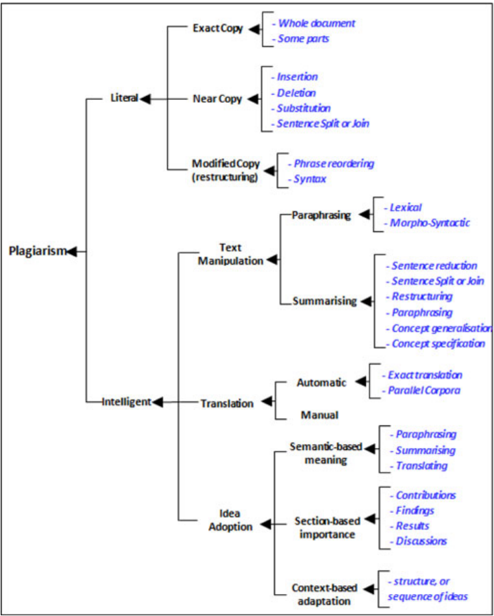
Plagiarism can be of many different natures, ranging from copying texts to adopting ideas, without giving credit to its originator. This paper presents a new taxonomy of plagiarism that highlights differences between literal plagiarism and intelligent plagiarism, from the plagiarist's behavioral point of view. The taxonomy supports deep understanding of different linguistic patterns in committing plagiarism, for example, changing texts into semantically equivalent but with different words and organization, shortening texts with concept generalization and specification, and adopting ideas and important contributions of others. Different textual features that characterize different plagiarism types are discussed. Systematic frameworks and methods of monolingual, extrinsic, intrinsic, and cross-lingual plagiarism detection are surveyed and correlated with plagiarism types, which are listed in the taxonomy. We conduct extensive study of state-of-the-art techniques for plagiarism detection, including character n-gram-based (CNG), vector-based (VEC), syntax-based (SYN), semantic-based (SEM), fuzzy-based (FUZZY), structural-based (STRUC), stylometric-based (STYLE), and cross-lingual techniques (CROSS). Our study corroborates that existing systems for plagiarism detection focus on copying text but fail to detect intelligent plagiarism when ideas are presented in different words.
Overview
CoChat Summary
TL;DR
This survey proposes a taxonomy distinguishing literal from intelligent plagiarism and correlates linguistic patterns, textual features, and detection methods. It finds that existing plagiarism detection systems mainly detect copied text and fail on intelligent plagiarism when ideas are reworded or adopted.
Key findings
- The taxonomy divides plagiarism into literal plagiarism and intelligent plagiarism; intelligent plagiarism includes text manipulation (paraphrasing, summarization), translation, and idea adoption. Idea plagiarism is further categorized into semantic-based meaning, section-based importance, and context-based adaptation.
- Existing systems focus on copying text but fail to detect intelligent plagiarism when ideas are presented in different words; the paper states current antiplagiarism tools “can pinpoint only word-for-word plagiarism and only some instances of it” and do not cater adopting ideas of others.
- Detection methods are categorized as CNG, VEC, SYN, SEM, FUZZY, STRUC, STYLE, and CROSS. CNG, VEC, and SYN are fast but lose semantic information and are unable to detect types other than literal plagiarism; SEM and FUZZY can detect rewording but have received less attention due to semantic representation challenges and time complexity; STYLE methods lack source-document evidence.
- A qualitative study at the University of Technology Malaysia interviewed faculty members with 10–20-year teaching expertise to inform the taxonomy. A cited Arabic fuzzy IR study used a corpus of 4477 source statements and 303 query/suspicious statements, with permission threshold p = 0.825 and variation threshold v = 0.15.
Methods
- Survey/review of state-of-the-art plagiarism detection techniques and frameworks for monolingual, extrinsic, intrinsic, and cross-lingual detection, mapping methods to plagiarism types in the proposed taxonomy.
- Qualitative study at the University of Technology Malaysia: interviews with several faculty members with 10–20-year teaching expertise about student plagiarism practices; the main output was a new taxonomy of plagiarism.
- Conceptual synthesis of textual features—lexical, syntactic, semantic, structural, and stylometric—and detection methods, with examples and reported thresholds from prior work rather than a unified new benchmark.
Limitations
- The paper states that current antiplagiarism tools can pinpoint only word-for-word plagiarism and only some instances of it, and do not cater adopting ideas of others; idea plagiarism is described as a key academic problem needing future research.
- The paper states SEM and FUZZY approaches have received less attention due to the challenge of representing semantics and the time complexity of representative algorithms, making them inefficient and impractical for real-world tools; STYLE methods lack the source-document evidence crucial to a human investigator.
- Evident from the text: the taxonomy is based on a qualitative study at one university plus literature review, and the survey does not report a unified empirical benchmark comparing all surveyed methods.
Model-written summary. Check it against the paper before relying on it.
Integrity signals
Registry
Cites
Statistics
Figures




Verification
Claims the paper makes
3 Valid · 20 Not valid · 51 Not checked · 34 Own results and interpretations
None of the sources cited for this claim have been checked yet.
In the paper
“Approximate string matching and similarity metrics have been widely used in plagiarism detection.”
boosted- Asserted: passes — The authors put it forward as true.
- Checkable: passes — It can be checked against evidence.
- Load-bearing: unclear — It is unclear whether the paper’s conclusions depend on it.
- Based: passes — The paper gives a reason why it holds.
A result the paper reports from its own data — it cites no other source for it, so there is none to check. The quote shows it is in the paper.
In the paper
“The main output of the qualitative study is a new taxonomy of plagiarism that comprehensively relates different types, as shown in Fig. 2.”
plain- Asserted: passes — The authors put it forward as true.
- Checkable: passes — It can be checked against evidence.
- Load-bearing: passes — The paper’s conclusions depend on it.
- Based: passes — The paper gives a reason why it holds.
None of the sources cited for this claim have been checked yet.
In the paper
“Different plagiarism techniques, which feature the text as character n -gram or word n -gram, use exact string matching.”
plain- Asserted: passes — The authors put it forward as true.
- Checkable: passes — It can be checked against evidence.
- Load-bearing: unclear — It is unclear whether the paper’s conclusions depend on it.
- Based: passes — The paper gives a reason why it holds.
A result the paper states — it cites no source for it, so there is none to check. The quote shows it is in the paper.
In the paper
“In all of them, writing style is quantified and/or feature complexity is analyzed.”
plain- Asserted: passes — The authors put it forward as true.
- Checkable: passes — It can be checked against evidence.
- Load-bearing: unclear — It is unclear whether the paper’s conclusions depend on it.
- Based: passes — The paper gives a reason why it holds.
A claim is checked only against the cited paper’s full text, never its abstract, and none is available for its sources.
In the paper
“SYN methods [6], [12] are based on decomposing documents into statements and extracting POS features.”
What the sources say
- Not checked — no full text of the sourcecites [6] [6] M. Elhadi and A. Al-Tobi, 'Duplicate detection in documents and webpages using improved longest common subsequence and documents syntactical structures,' in Proc. 4th Int. Conf. Comput. Sci. Converg. Inf. Technol. , Seoul, Korea, Nov. 2009, pp. 679-684. - source
- Not checked — no full text of the sourcecites [12] [12] M. Elhadi and A. Al-Tobi, 'Use of text syntactical structures in detection of document duplicates,' in Proc. 3rd Int. Conf. Digital Inf. Manage. , London, U.K., 2008, pp. 520-525. - source
plain- Asserted: passes — The authors put it forward as true.
- Checkable: passes — It can be checked against evidence.
- Load-bearing: unclear — It is unclear whether the paper’s conclusions depend on it.
- Based: passes — The paper gives a reason why it holds.
14 more claims
Create a free account to see all 108 claims and to verify the 4 references still open.
- Probably not a substantial claim. 80
- It may state two separate claims as one. 37
Self-check
Percentages, sums and reported differences re-computed from the paper’s own numbers.
Each contradiction between two passages listed here was confirmed by an independent check.
Rated minor: it would not touch a result — a value no result rests on, a p-value that stays on the same side of the significance level, or a conflict that is clerical, resolved elsewhere in the paper, or outside its own findings.
In the paper
§ A. Retrieval Models of Candidate Documents
“x="aaabbbccc" y="aaabbbccd" d(x,y)=8”
§ B. Exhaustive Analysis Methods of Plagiarism Detection
“longest common subsequence (LCS) distance, which allows only insertions and deletions at cost 1.”
Citations
Cites
WordNet: a lexical database for English
Miller, G. A. (1995) · Communications of the ACM · doi:10.1145/219717.219748 · Cited by 14,015
Introduction to information retrieval
(2009) · Choice Reviews Online · doi:10.5860/choice.46-2715 · Cited by 12,278
Introduction to Modern Information Retrieval
Salton, G., & McGill, M. J. (1983) · Virtual Defense Library (Ministerio de Defensa) · Cited by 11,392
Introduction to Information Retrieval
Manning, C. D., Raghavan, P., & Schütze, H. (2008) · doi:10.1017/cbo9780511809071 · Cited by 11,288
Self-Organization and Associative Memory
Kohonen, T. (1989) · Springer Series in Information Sciences · doi:10.1007/978-3-642-88163-3 · Cited by 8,740
Self-Organization and Associative Memory
Kohonen, T. (1988) · Springer Series in Information Sciences · doi:10.1007/978-3-662-00784-6 · Cited by 3,812
A guided tour to approximate string matching
Navarro, G. (2001) · ACM Computing Surveys · doi:10.1145/375360.375365 · Cited by 2,561
A comparison of string distance metrics for name-matching tasks
Cohen, W. W., Ravikumar, P., & Fienberg, S. E. (2003) · International Joint Conference on Artificial Intelligence · Cited by 1,369
A survey of modern authorship attribution methods
Stamatatos, E. (2009) · Journal of the American Society for Information Science and Technology · doi:10.1002/asi.21001 · Cited by 1,176
Schleimer, S., S, W. D., & Aiken, A. (2003) · Proceedings of the 2003 ACM SIGMOD International Conference on Management of Data · doi:10.1145/872757.872770 · Cited by 1,099 · cited 1×
“Fingerprint [115], [116] and hash-based [117], [118] are com-”
Research works printed but not linked: 12
- alzahrani, 2008, Plagiarism detection in Arabic scripts using fuzzy information retrieval, presented at the Student Conf Res Develop
- ceska, 0, The future of copy detection techniques, Proc YRCAS, 5
- palkovskii, 0, Counter plagiarism detection software” and “Counter counter plagiarism detection” methods, Proc SEPLN, 67
- 10.1016/j.esp.2009.01.004 · doi:10.1016/j.esp.2009.01.004
- rao, 2008, Plagiarism, a scourge, Current Sci, 94, 581
- rijsbergen, 1979, Information Retrieval
- balaguer, 0, Putting ourselves in SME's shoes: Automatic detection of plagiarism by the WCopyFind tool, Proc SEPLN, 34
- manning, 2009, Introduction to Information Retrieval, 109
- alzahrani, 2009, Statement-based fuzzy-set IR versus fingerprints matching for plagiarism detection in arabic documents, Proceedings of the Postgraduate Annual Research Seminar, 267
- heintze, 1996, Scalable document fingerprinting, Proc 2nd Usenix Workshop Electron Commerce, 191
- 10.1017/CBO9780511809071 · DOI · Paper page
- manning, 2009, Introduction to Information Retrieval, 403
Cited by
Academic Plagiarism Detection: A Systematic Literature Review
Foltýnek, T., Meuschke, N., & Gipp, B. (2020) · ACM Computing Surveys · doi:10.1145/3345317 · Cited by 238
Surveying Stylometry Techniques and Applications
Neal, T., Sundararajan, K., Fatima, A., Yan, Y., Xiang, Y., & Woodard, D. (2018) · ACM Computing Surveys · doi:10.1145/3132039 · Cited by 222
An improved plagiarism detection scheme based on semantic role labeling
Osman, A. H., Salim, N. B., Binwahlan, M. S., Alteeb, R., & Abuobieda, A. (2012) · Applied Soft Computing · doi:10.1016/j.asoc.2011.12.021 · Cited by 115
Self-citationKauffman, Y., & Young, M. F. (2015) · Comput. Educ. · doi:10.1016/j.compedu.2014.12.016 · Cited by 78
Pudasaini, S., Miralles-Pechuán, L., Lillis, D., & Llorens Salvador, M. (2025) · Journal of Academic Ethics · doi:10.1007/s10805-024-09576-x · Cited by 70
Metadata
- Authors
- Alzahrani, S. M., Salim, N., & Abraham, A.
- Affiliations
- Taif University (SA)
- University of Technology Malaysia (MY)
- VSB - Technical University of Ostrava (CZ)
- Venue
- IEEE Transactions on Systems, Man, and Cybernetics, Part C (Applications and Reviews)
- Published
- 2012-03
- Volume
- 42
- Issue
- 2
- Pages
- 133-149
- ISSN
- 1094-6977 (ISSN-L)
- 1558-2442
- OpenAlex
- W2147742901
- Cited by
- 299
- References
- 168
- Citations by year
- 2026: 17 · 2025: 8 · 2024: 18 · 2023: 7 · 2022: 12 · 2021: 23 · 2020: 27 · 2019: 30 · 2018: 24 · 2017: 27 · 2016: 26 · 2015: 28 · 2014: 25 · 2013: 15 · 2012: 8
- FWCI
- 43.02
- Type
- journal article
- Language
- en
- Open access
- closed
- Locations
- IEEE Transactions on Systems Man and Cybernetics Part C (Applications and Reviews) (publishedVersion)
- Oxford University Research Archive (ORA) (University of Oxford) (submittedVersion)
- Topics
- Social Sciences › Education › Academic integrity and plagiarism
- Physical Sciences › Computer Science › Artificial Intelligence › Authorship Attribution and Profiling
- Physical Sciences › Computer Science › Information Systems › Software Engineering Research
- Keywords
- plagiarism detection, text features, stylometry, character n-grams
About these checks
Registry, retraction, Cites and statistics results are computed, not judged, with one exception: a printed reference that no index lists is read once by a model before it counts as a citation error. Claims are extracted by a model and kept only when their quote appears verbatim in the text; each cited source is then checked, with a model’s help, for whether it says what the claim relies on. Those verdicts can be wrong — read the claim’s quote and the cited source before relying on one.
The claim verdicts this report counts are experimental: their accuracy is not yet measured.
A language model drew the claims from the paper on 2026-10-10, under version 3 of the claim definition (model deepseek-v4.1-flash, prompt extract-v3).
A second model labelled each claim on 2026-10-10 (model jev-1.13-20260917, definition revision gold-guideline-v0.2).
Statistics and arithmetic are recomputed, not judged.
Confidence bands are shown only for fields calibrated on our annotated test set. None is calibrated yet, so no band is shown.
What counts as a claim ›How we measure confidence ›How we check this ›
Are you an author, or do you see a problem with this page? Request a review
How to cite
Cite CoChat for the checks on this page, and the paper for its own findings.
- This page
- CoChat. (2026). Citation check: Understanding Plagiarism Linguistic Patterns, Textual Features, and Detection Methods. https://app.cochat.ai/papers/10.1109/tsmcc.2011.2134847
- The paper
- Alzahrani, S. M., Salim, N., & Abraham, A. (2012). Understanding Plagiarism Linguistic Patterns, Textual Features, and Detection Methods. IEEE Transactions on Systems, Man, and Cybernetics, Part C (Applications and Reviews). https://doi.org/10.1109/tsmcc.2011.2134847
Data sources
Bibliographic data: Semantic Scholar, OpenAlex, Crossref.
Contains information from the Semantic Scholar Academic Graph Datasets, made available under the ODC Attribution License (ODC-BY 1.0).
Semantic Scholar’s data is described in: Kinney, R., et al. (2023). The Semantic Scholar Open Data Platform. arXiv:2301.10140.
