

A Deixis-Centered Approach for Documenting Remote Synchronous Communication Around Data Visualizations
Open accessThe DOI matches its Crossref record; 57 of the 57 references it cites were found in a registry or an index.
Abstract
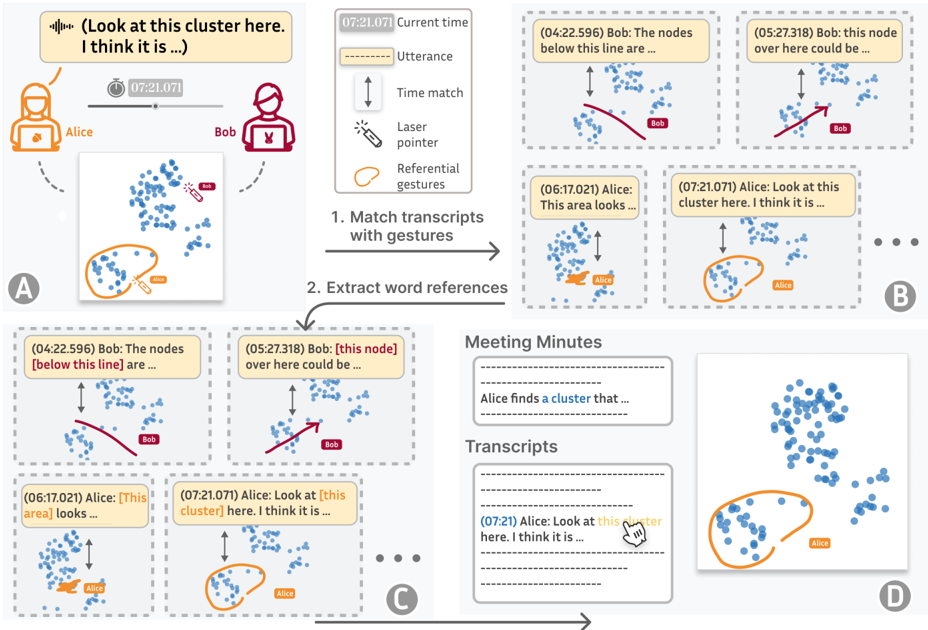
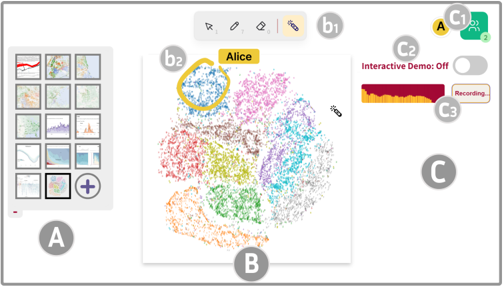
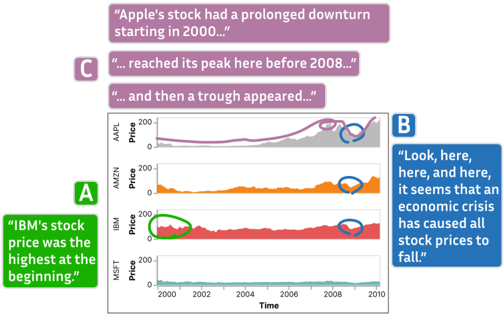
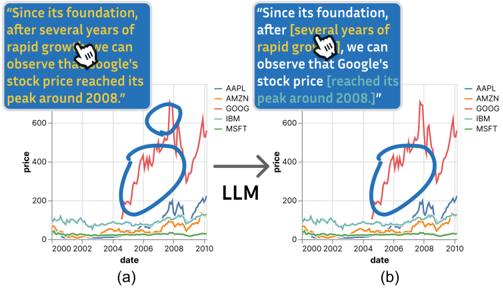
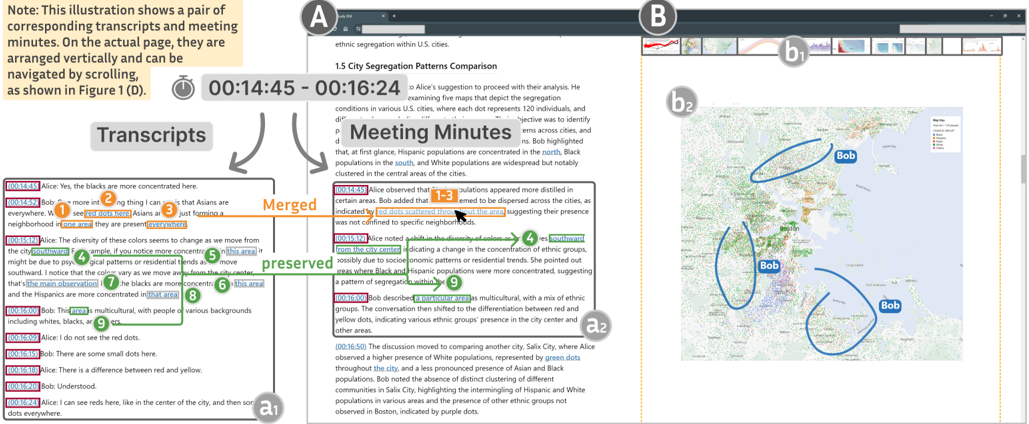
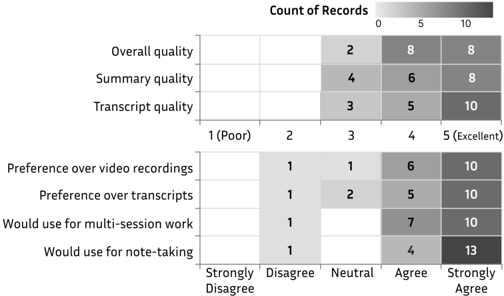
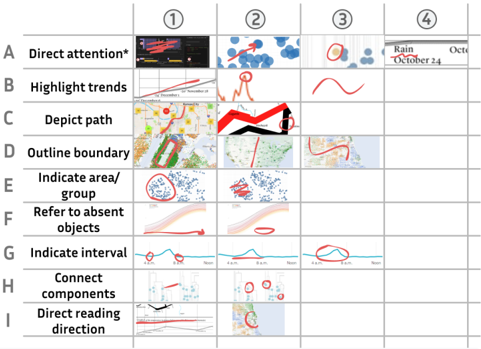
Referential gestures, or as termed in linguistics, deixis, are an essential part of communication around data visualizations. Despite their importance, such gestures are often overlooked when documenting data analysis meetings. Transcripts, for instance, fail to capture gestures, and video recordings may not adequately capture or emphasize them. We introduce a novel method for documenting collaborative data meetings that treats deixis as a first-class citizen. Our proposed framework captures cursor-based gestural data along with audio and converts them into interactive documents. The framework leverages a large language model to identify word correspondences with gestures. These identified references are used to create context-based annotations in the resulting interactive document. We assess the effectiveness of our proposed method through a user study, finding that participants preferred our automated interactive documentation over recordings, transcripts, and manual note-taking. Furthermore, we derive a preliminary taxonomy of cursor-based deictic gestures from participant actions during the study. This taxonomy offers further opportunities for better utilizing cursor-based deixis in collaborative data analysis scenarios.
Overview
The claims and statistics of this paper haven’t been checked yet.
Free: it reads the open-access text and checks the first 5 claims that cite a source we can check. Create a free account to check every claim.
Integrity signals
Registry
Cites
Statistics
Figures
Verification
Claims the paper makes
The claims and statistics of this paper haven’t been checked yet.
Free: it reads the open-access text and checks the first 5 claims that cite a source we can check. Create a free account to check every claim.
Claims other papers make about this one
Each is checked against this paper’s own text: does it say what the citing paper says it does?
The source backs part of the claim, not all of it — or backs it for a different population, condition or comparison.
In the citing paper
“The work demonstrates a new collaborative data story creation mode, where humans freely express their insights and AI documents and organizes humans' ideas into a more structured data story .”
From Reflection on Data Storytelling Tools in the Generative AI Era from the Human-AI Collaboration Perspective (2025) · cites this paper as [11]
Experimental — accuracy not yet measuredThe cited source says what the claim attributes to it.
In the citing paper
“Furthermore, from the human-AI collaboration perspective, this AI-assistant has a notable difference with others . It serves as a third-party collaborator to document multiple humans' communication, while not collaborating with individual humans and contributing to their creation or presentation.”
From Reflection on Data Storytelling Tools in the Generative AI Era from the Human-AI Collaboration Perspective (2025) · cites this paper as [11]
The cited source says what the claim attributes to it.
In the citing paper
“Building on LLMs' ability to understand and generate texts, Han and Isaacs [11] proposed an innovative usage case of AI-assistant to record the communication process between human-creators around charts and create an interactive data document based on the recording.”
From Reflection on Data Storytelling Tools in the Generative AI Era from the Human-AI Collaboration Perspective (2025) · cites this paper as [11]
Self-check
Percentages, sums and reported differences re-computed from the paper’s own numbers.
The self-check needs the paper’s full text.
Citations
Cites
Language Models are Few-Shot Learners
Brown, T. B., Mann, B., Ryder, N., Subbiah, M., Kaplan, J., Dhariwal, P., Neelakantan, A., Shyam, P., Sastry, G., Askell, A., et al. (2020) · arXiv · doi:10.48550/arxiv.2005.14165 · Cited by 23,372 · cited 1×
“To enhance the precision and reliability of the extraction process, we adopt the “chain-of-thought” [61] prompting strategy coupled with a few-shot learning approach [8].”
Chain-Of-Thought Prompting Elicits Reasoning in Large Language Models
Wei, J., Wang, X., Schuurmans, D., Bosma, M., Ichter, B., Xia, F., Chi, E., Le, Q. V., & Zhou, D. (2022) · Advances in Neural Information Processing Systems 35 · doi:10.52202/068431-1800 · Cited by 4,505
Robust Speech Recognition via Large-Scale Weak Supervision
Radford, A., Kim, J. W., Xu, T., Brockman, G., McLeavey, C., & Sutskever, I. (2022) · arXiv · doi:10.48550/arxiv.2212.04356 · Cited by 1,953 · cited 1×
“In our implementation, the recorded audio is transcribed using Whisper [52], an open-source automatic speech recognition (ASR) system.”
Rethinking the Role of Demonstrations: What Makes In-Context Learning Work?
Min, S., Lyu, X., Holtzman, A., Artetxe, M., Lewis, M., Hajishirzi, H., & Zettlemoyer, L. (2022) · Proceedings of the 2022 Conference on Empirical Methods in Natural Language Processing · doi:10.18653/v1/2022.emnlp-main.759 · Cited by 755
Rethinking the Role of Demonstrations: What Makes In-Context Learning Work?
Min, S., Lyu, X., Holtzman, A., Artetxe, M., Lewis, M., Hajishirzi, H., & Zettlemoyer, L. (2022) · arXiv · doi:10.48550/arxiv.2202.12837 · Cited by 752 · cited 2×
“We associate recorded gestures from annotation tools and visualization interactions with audio transcripts based on both temporal overlap and utterance semantics, utilizing the in-context learning capability of a large language model (LLM) [18,44] to perform the latter.”
ManyEyes: a Site for Visualization at Internet Scale
Viegas, F. B., Wattenberg, M., van Ham, F., Kriss, J., & McKeon, M. (2007) · IEEE Transactions on Visualization and Computer Graphics · doi:10.1109/tvcg.2007.70577 · Cited by 720 · cited 1×
“Existing methods of documenting insights during visual analysis are either not designed for synchronous communication [26,59] or demand significant manual annotation and input [11,64], posing considerable challenges for their use in highly interactive settings like collaborative visualization…”
Becker, R. A., & Cleveland, W. S. (1987) · Technometrics · doi:10.1080/00401706.1987.10488204 · Cited by 696 · cited 1×
“Video conferencing software [43,65] further allows people to annotate what is shown on screen with tools like the virtual laser pointer or pencil tool while interactive visualizations have deictic interactions such as brushing and highlighting [5,41].”
Pointing: Where Language, Culture, and Cognition Meet
(2003) · Psychology Press eBooks · doi:10.4324/9781410607744 · Cited by 695 · cited 1×
“When people meet to present and discuss data and data visualizations, significant communication occurs through referential gestures such as pointing and indications of movement and flow [35].”
Cognitive effort during note taking
Piolat, A., Olive, T., & Kellogg, R. T. (2005) · Applied Cognitive Psychology · doi:10.1002/acp.1086 · Cited by 517 · cited 1×
“Additionally, manual note-taking can be distracting and must often be selective in what context it captures to keep up with the pace of the meeting [51].”
Common ground at the understanding of demonstrative reference
Clark, H. H., Schreuder, R., & Buttrick, S. (1983) · Journal of Verbal Learning and Verbal Behavior · doi:10.1016/s0022-5371(83)90189-5 · Cited by 445 · cited 2×
“However, previous work in non-pointer-based settings has found that the familiarity between two people can affect the referential gestures they use [14].”
Research works printed but not linked: 7
- S. E. Brennan et al. How conversation is shaped by visual and spoken evidence. Approaches to studying world-situated language use: Bridging the language-as-product and language-as-action traditions, MIT Press, pp. 95-129, 2005. 2, 3
- Excalidraw community. Excalidraw. https://excalidraw.com, 2023. 3, 4
- S. Hall. Encoding and Decoding in the Television Discourse. Media series: 1972. Centre for Contemporary Cultural Studies, University of Birmingham, 1973. 2
- R. Johansen. Groupware: Computer support for business teams. The Free Press, 1988. doi: 10.5555/542298 2 · doi:10.5555/542298
- Microsoft Corporation. Microsoft teams: Meet, chat, call, and col- laborate in just one place. https://www.microsoft.com/en-us/ microsoft-teams, 2024. 2, 3
- Mural. Mural. https://www.mural.co, 2024. 3
- Zoom Video Communications, Inc. Zoom: Video conferencing, web conferencing, webinars, screen sharing. https://zoom.us, 2024. 2, 3
Cited by
A Survey on Annotations in Information Visualization: Empirical Studies, Applications and Challenges
Rahman, M. D., Doppalapudi, B., Quadri, G. J., & Rosen, P. (2025) · IEEE Transactions on Visualization and Computer Graphics · doi:10.1109/tvcg.2025.3600957 · Cited by 17
“Inconsistentannotationpractices,particularlyacross long-term or collaborative projects, make it difficult to reconstruct reasoning or share findings [4], [162].”
Wang, L., Wang, Z., Xiao, S., Liu, L., Tsung, F., & Zeng, W. (2025) · Computer Graphics Forum · doi:10.1111/cgf.70110 · Cited by 10
“Second, interchanges concerning visualizations often rely on referential expressions (known as deixis ) such as “this point” [HI25].”
From Speech-to-Spatial: Grounding Utterances on A Live Shared View with Augmented Reality
Kim, Y., Pradhan, D., Jadeja, D., & Kaufman, A. E. (2026) · IEEE Conference on Virtual Reality and 3D User Interfaces (VR) · doi:10.1109/vr67842.2026.00045 · Cited by 3
“Han and Issac leverage deictic references (e.g., this, that, here, there) to enrich interaction for visual analytics [24].”
Memento: Towards Proactive Visualization of Everyday Memories with Personal Wearable AR Assistant
Kim, Y., Yang, Y., & Kaufman, A. E. (2026) · IEEE Conference on Virtual Reality and 3D User Interfaces Abstracts and Workshops (VRW) · doi:10.1109/vrw70859.2026.00180 · Cited by 4
“They are increasingly integrated into data analysis and visualization workflows [12, 13, 24, 71], as well as immersive applications, where LLMs function as intelligent companions [14,76].”
Li, H., Wang, Y., & Qu, H. (2025) · arXiv · doi:10.48550/arxiv.2503.02631 · Cited by 10
“They only reflect shifts in research interest.”
Metadata
- Authors
- Han, C., & Isaacs, K. E.
- Affiliations
- University of Utah (US)
- ORCID
- Isaacs, Katherine E.
- Venue
- IEEE Transactions on Visualization and Computer Graphics
- Published
- 2025-01
- Volume
- 31
- Issue
- 1
- Pages
- 930-940
- ISSN
- 1077-2626 (ISSN-L)
- 1941-0506
- 2160-9306
- OpenAlex
- W4402401737
- Cited by
- 8
- References
- 55
- Citations by year
- 2026: 4 · 2025: 4
- FWCI
- 1.12
- Type
- journal article
- Language
- en
- Open access
- green
- arxiv.org
- Licence
- Locations
- IEEE Transactions on Visualization and Computer Graphics (publishedVersion)
- PubMed (publishedVersion)
- arXiv (Cornell University) (submittedVersion, cc-by)
- OSF Preprints (OSF Preprints) (submittedVersion)
- arXiv (Cornell University) (cc-by)
- Funders
- Defense Advanced Research Projects Agency (HR00112290092)
- Topics
- Physical Sciences › Computer Science › Computer Graphics and Computer-Aided Design › Data Visualization and Analytics
- Physical Sciences › Computer Science › Human-Computer Interaction › Usability and User Interface Design
- Physical Sciences › Computer Science › Human-Computer Interaction › Interactive and Immersive Displays
- Keywords
- deixis, referential gestures, collaborative data analysis, interactive documentation, gesture annotation, large language models, gesture taxonomy
- MeSH terms
- Data Visualization, Algorithms, Communication, Computer Graphics, Documentation, Gestures, Humans, User-Computer Interface, Video Recording
About these checks
Registry, retraction, Cites and statistics results are computed, not judged, with one exception: a printed reference that no index lists is read once by a model before it counts as a citation error. Claims are extracted by a model and kept only when their quote appears verbatim in the text; each cited source is then checked, with a model’s help, for whether it says what the claim relies on. Those verdicts can be wrong — read the claim’s quote and the cited source before relying on one.
Statistics and arithmetic are recomputed, not judged.
Confidence bands are shown only for fields calibrated on our annotated test set. None is calibrated yet, so no band is shown.
What counts as a claim ›How we measure confidence ›How we check this ›
Are you an author, or do you see a problem with this page? Request a review
How to cite
Cite CoChat for the checks on this page, and the paper for its own findings.
- This page
- CoChat. (2026). Citation check: A Deixis-Centered Approach for Documenting Remote Synchronous Communication Around Data Visualizations. https://app.cochat.ai/papers/10.1109/tvcg.2024.3456351
- The paper
- Han, C., & Isaacs, K. E. (2025). A Deixis-Centered Approach for Documenting Remote Synchronous Communication Around Data Visualizations. IEEE Transactions on Visualization and Computer Graphics. https://doi.org/10.1109/tvcg.2024.3456351
Data sources
Bibliographic data: Semantic Scholar, OpenAlex, Crossref.
Contains information from the Semantic Scholar Academic Graph Datasets, made available under the ODC Attribution License (ODC-BY 1.0).
Semantic Scholar’s data is described in: Kinney, R., et al. (2023). The Semantic Scholar Open Data Platform. arXiv:2301.10140.
