

The DOI matches its Crossref record; 4 of the 4 references it cites were found in a registry or an index.
The revisited genome of Pseudomonas putida KT2440 enlightens its value as a robust metabolic chassis
Abstract
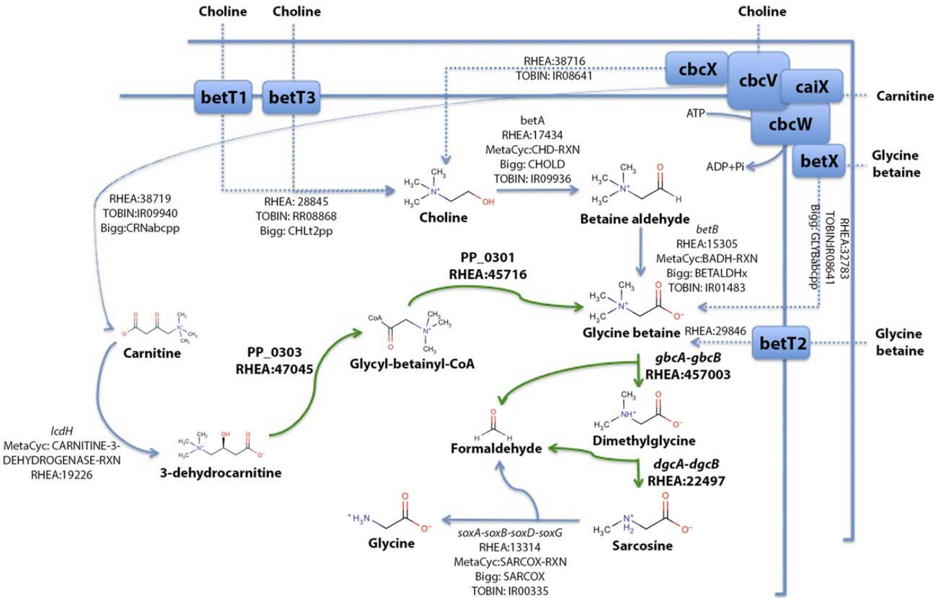
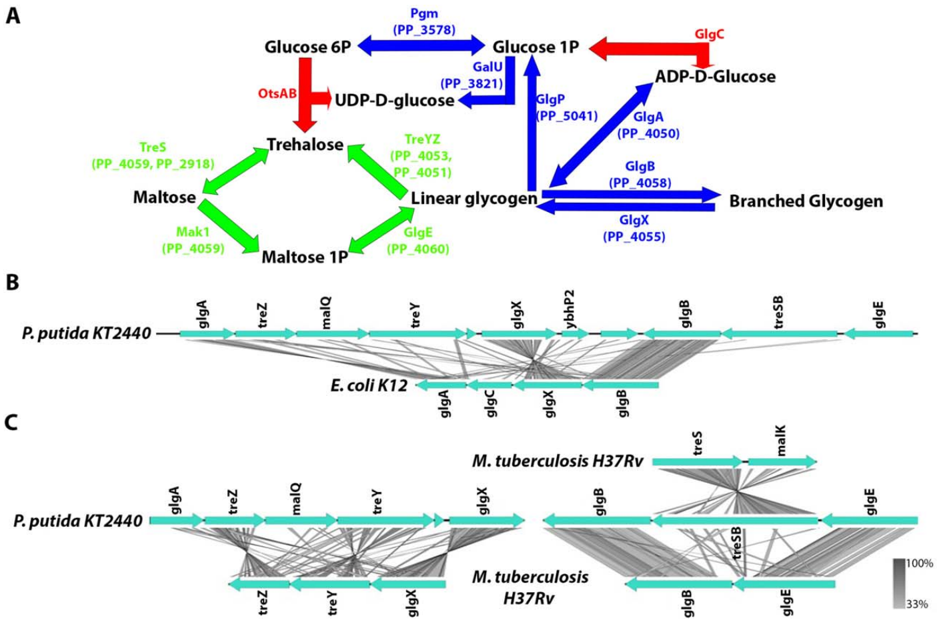
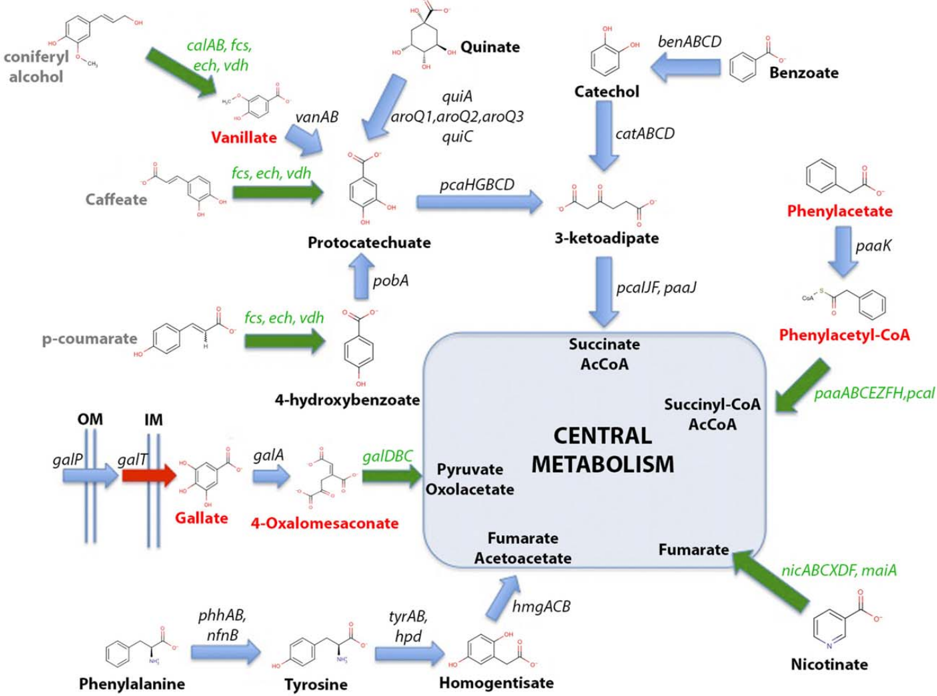
Summary: By the time the complete genome sequence of the soil bacterium Pseudomonas putida KT2440 was published in 2002 (Nelson et al ., ) this bacterium was considered a potential agent for environmental bioremediation of industrial waste and a good colonizer of the rhizosphere. However, neither the annotation tools available at that time nor the scarcely available omics data—let alone metabolic modeling and other nowadays common systems biology approaches—allowed them to anticipate the astonishing capacities that are encoded in the genetic complement of this unique microorganism. In this work we have adopted a suite of state‐of‐the‐art genomic analysis tools to revisit the functional and metabolic information encoded in the chromosomal sequence of strain KT2440. We identified 242 new protein‐coding genes and re‐annotated the functions of 1548 genes, which are linked to almost 4900 PubMed references. Catabolic pathways for 92 compounds (carbon, nitrogen and phosphorus sources) that could not be accommodated by the previously constructed metabolic models were also predicted. The resulting examination not only accounts for some of the known stress tolerance traits known in P. putida but also recognizes the capacity of this bacterium to perform difficult redox reactions, thereby multiplying its value as a platform microorganism for industrial biotechnology.
Overview
The claims and statistics of this paper haven’t been checked yet.
Run the check — free, no account needed. It reads the open-access text and checks the sources it cites.
Integrity signals
Registry
Cites
Statistics
Figures
Verification
Claims the paper makes
The claims and statistics of this paper haven’t been checked yet.
Run the check — free, no account needed. It reads the open-access text and checks the sources it cites.
Claims other papers make about this one
Each is checked against this paper’s own text: does it say what the citing paper says it does?
In the citing paper
“DusB is identified as a tRNA dihydrouridine synthase (Belda et al., 2016).”
From Role of the CrcB transporter of Pseudomonas putida in the multi‐level stress response elicited by mineral fluoride (2022) · cites this paper as Belda et al., 2016
Self-check
Percentages, sums and reported differences re-computed from the paper’s own numbers.
The self-check needs the paper’s full text.
Citations
Cites
SignalP 4.0: discriminating signal peptides from transmembrane regions
Petersen, T. N., Brunak, S., von Heijne, G., & Nielsen, H. (2011) · Nature Methods · doi:10.1038/nmeth.1701 · Cited by 8,847
Caspi, R., Billington, R., Ferrer, L., Foerster, H., Fulcher, C. A., Keseler, I. M., Kothari, A., Krummenacker, M., Latendresse, M., Mueller, L. A., et al. (2016) · Nucleic Acids Research · doi:10.1093/nar/gkv1164 · Cited by 3,395
Quantitative prediction of cellular metabolism with constraint-based models: the COBRA Toolbox v2.0
Schellenberger, J., Que, R., Fleming, R. M. T., Thiele, I., Orth, J. D., Feist, A. M., Zielinski, D. C., Bordbar, A., Lewis, N. E., Rahmanian, S., et al. (2011) · Nature Protocols · doi:10.1038/nprot.2011.308 · Cited by 1,835
Quantitative proteomic analysis reveals a simple strategy of global resource allocation in bacteria
Hui, S., Silverman, J. M., Chen, S. S., Erickson, D. W., Basan, M., Wang, J., Hwa, T., & Williamson, J. R. (2015) · Molecular Systems Biology · doi:10.15252/msb.20145697 · Cited by 369
Research works printed but not linked: 129
- 10.1016/j.tig.2012.11.001 · DOI
- 10.1093/oxfordjournals.molbev.a026410 · DOI
- 10.1073/pnas.062526999 · DOI
- 10.1186/gb-2010-11-10-r106 · DOI · Paper page
- 10.1111/j.1462-2920.2007.01464.x · DOI
- 10.1007/s12038-007-0055-7 · DOI
- 10.1093/nar/gks1193 · DOI · Paper page
- 10.1038/nature08480 · DOI · Paper page
- 10.1038/nchembio.1387 · DOI
- 10.1128/JB.00666-12 · DOI
- 10.1093/bib/bbs058 · DOI
- 10.1371/journal.pone.0098367 · DOI
- 10.1016/B978-0-12-800143-1.00002-6 · DOI
- 10.1038/339157a0 · DOI
- 10.1101/gr.186501 · DOI
- 10.1093/nar/gkg590 · DOI
- 10.1152/ajpcell.00360.2004 · DOI
- 10.1093/nar/gks1005 · DOI
- 10.1093/emboj/16.19.5922 · DOI
- 10.1093/nar/gkt1103 · DOI · Paper page
- 10.1099/mic.0.044263-0 · DOI
- 10.1093/nar/gku1068 · DOI
- 10.1128/JB.01585-07 · DOI
- 10.1111/j.1365-2958.2009.06962.x · DOI
- 10.1016/S0167-4781(97)00097-3 · DOI
- 10.1093/nar/gkg847 · DOI
- 10.1111/1462-2920.12270 · DOI
- 10.1111/1758-2229.12223 · DOI
- 10.1099/00221287-146-1-199 · DOI
- 10.1093/genetics/54.1.61 · DOI
- 10.1111/j.1462-2920.2004.00734.x · DOI
- 10.1128/JB.183.2.644-653.2001 · DOI
- 10.1074/jbc.M109.033944 · DOI
- 10.1186/1471-2164-13-69 · DOI
- 10.1016/S1369-5274(99)80030-7 · DOI
- 10.1038/nrmicro1021 · DOI
- 10.1111/j.1462-2920.2011.02430.x · DOI
- 10.1093/nar/gku1223 · DOI
- 10.1093/bioinformatics/btt036 · DOI
- 10.1074/jbc.274.53.37901 · DOI
- 10.1139/cjm-46-1-59 · DOI
- 10.1038/sj.emboj.7601041 · DOI
- 10.1093/nar/gks1146 · DOI
- 10.1093/database/bat059 · DOI
- 10.1128/JB.01178-10 · DOI
- 10.1186/1471-2105-11-119 · DOI
- 10.1046/j.1462-2920.2002.00370.x · DOI
- 10.1073/pnas.0802273105 · DOI
- 10.1128/jb.174.3.889-898.1992 · DOI
- 10.1128/JB.00968-07 · DOI
- 10.4056/sigs.1794338 · DOI
- 10.1074/jbc.M300815200 · DOI
- 10.3389/fphar.2014.00231 · DOI
- 10.1093/nar/gks1027 · DOI
- 10.1002/pmic.200500329 · DOI
- 10.1111/1758-2229.12090 · DOI
- 10.1271/bbb.60.1720 · DOI
- 10.1006/jmbi.2000.4315 · DOI · Paper page
- 10.1371/journal.pcbi.1000308 · DOI
- 10.1111/1462-2920.12812 · DOI
- 10.1093/nar/gkm160 · DOI
- 10.1371/journal.pcbi.1003118 · DOI
- 10.1007/s00253-004-1862-5 · DOI
- 10.1007/978-1-61779-412-4_15 · DOI
- 10.1073/pnas.0405375101 · DOI
- 10.1093/bioinformatics/btp352 · DOI · Paper page
- 10.1093/nar/25.5.955 · DOI
- 10.1111/1574-6976.12076 · DOI
- 10.1016/S0005-2736(99)00085-1 · DOI
- 10.1128/JB.184.10.2837-2840.2002 · DOI
- 10.1093/nar/gkp698 · DOI
- 10.1016/j.pep.2003.07.006 · DOI
- 10.1111/j.1462-2920.2010.02331.x · DOI
- 10.1093/nar/gku1243 · DOI
- 10.1111/j.1462-2920.2010.02166.x · DOI
- 10.1093/nar/gku961 · DOI
- 10.1046/j.1462-2920.2002.00366.x · DOI
- 10.1038/nrmicro3253 · DOI
- 10.1074/jbc.M115.687749 · DOI
- 10.1101/gr.194201 · DOI · Paper page
- 10.1074/jbc.M502585200 · DOI
- 10.1186/1752-0509-2-79 · DOI
- 10.1111/j.1365-2958.2010.07448.x · DOI
- 10.1371/journal.pcbi.1001116 · DOI
- 10.1073/pnas.0601119103 · DOI
- Overhage J., 1999, Biochemical and genetic analyses of ferulic acid catabolism in Pseudomonas sp. strain HR199, Appl Environ Microbiol, 65, 4837, 10.1128/AEM.65.11.4837-4847.1999 · DOI
- 10.1016/j.bbamem.2005.09.010 · DOI
- Palleroni N.J., 1984, Bergey's Manual of Systematic Bacteriology, 141
- 10.1016/S0167-4838(00)00214-4 · DOI
- 10.1093/nar/gku1002 · DOI
- 10.1016/S0021-9258(18)53913-2 · DOI
- 10.1371/journal.pcbi.1000210 · DOI
- Rahav‐Manor O., 1992, NhaR, a protein homologous to a family of bacterial regulatory proteins (LysR), regulates nhaA, the sodium proton antiporter gene in Escherichia coli, J Biol Chem, 267, 10433, 10.1016/S0021-9258(19)50037-0 · DOI
- 10.1038/nchembio768 · DOI
- 10.1074/jbc.M801195200 · DOI
- 10.1128/JB.180.13.3421-3431.1998 · DOI
- 10.1046/j.1462-2920.2002.00368.x · DOI
- 10.1128/jb.178.10.2804-2812.1996 · DOI
- 10.1128/jb.178.6.1663-1670.1996 · DOI
- 10.1111/1751-7915.12029 · DOI
- 10.1529/biophysj.106.084343 · DOI
- 10.1016/j.bbapap.2008.01.005 · DOI
- 10.1128/jb.178.11.3362-3364.1996 · DOI
- 10.1111/j.1574-6976.2011.00269.x · DOI
- 10.1016/0022-2836(81)90087-5 · DOI
- 10.1128/jb.170.7.3142-3149.1988 · DOI
- 10.1371/journal.pcbi.1002540 · DOI
- 10.1002/biot.201000124 · DOI
- 10.1128/JB.184.15.4246-4258.2002 · DOI
- 10.1128/JB.185.14.4233-4242.2003 · DOI
- 10.1093/nar/gku989 · DOI · Paper page
- 10.1093/nar/gkt900 · DOI
- 10.1128/jb.172.8.4339-4347.1990 · DOI
- 10.1371/journal.pgen.1000344 · DOI
- 10.1111/1462-2920.13015 · DOI
- 10.1093/nar/gks1194 · DOI
- 10.1186/1472-6750-13-93 · DOI
- 10.1007/s00203-005-0054-8 · DOI
- 10.1046/j.1365-2958.2003.03547.x · DOI
- 10.1128/AEM.03565-12 · DOI
- 10.1099/mic.0.028787-0 · DOI
- 10.1128/JB.01393-07 · DOI
- 10.1023/A:1012275512136 · DOI
- 10.1093/nar/gkq869 · DOI
- 10.1111/j.1574-6976.2010.00249.x · DOI
- 10.1073/pnas.1501384112 · DOI
- 10.1371/journal.pone.0110038 · DOI
- 10.1093/nar/gkq1093 · DOI
- 10.1111/j.1365-2958.2010.07332.x · DOI
Cited by
Sorted by citations
Calero, P., Gurdo, N., & Nikel, P. I. (2022) · Environmental Microbiology · doi:10.1111/1462-2920.16110 · Cited by 56
Self-citation
Metadata
- Authors
- Belda, E., van Heck, R. G. A., José Lopez‐Sanchez, M., Cruveiller, S., Barbe, V., Fraser, C., Klenk, H., Petersen, J., Morgat, A., Nikel, P. I., Vallenet, D., Rouy, Z., Sekowska, A., Martins dos Santos, V. A. P., de Lorenzo, V., Danchin, A., & Médigue, C.
- Affiliations
- Alternative Energies and Atomic Energy Commission (CEA), Genomic Institute & CNRS‐UMR8030 & Evry University, Laboratory of Bioinformatics Analysis in Genomics and Metabolism 2 rue Gaston Crémieux 91057 Evry France
- Laboratory of Systems and Synthetic Biology, Wageningen University Dreijenplein 10, Building number 316 6703 HB Wageningen The Netherlands
- Alternative Energies and Atomic Energy Commission (CEA), Genomic Institute, National Sequencing Center 2 rue Gaston Crémieux 91057 Evry France
- Institute for Genome Sciences, Department of Microbiology and Immunology, University of Maryland School of Medicine Baltimore MD USA
- Leibniz Institute DSMZ – German Collection of Microorganisms and Cell Cultures Braunschweig Germany
- Swiss‐Prot Group, SIB Swiss Institute of Bioinformatics Geneva CH‐1206 Switzerland
- Systems and Synthetic Biology Program, Centro Nacional de Biotecnología (CNB‐CSIC) C/Darwin 3 28049 Madrid Spain
- AMAbiotics SAS, Institut du Cerveau et de la Moëlle Épinière, Hôpital de la Pitié‐Salpêtrière Paris France
- Venue
- Environmental Microbiology
- Publisher
- Wiley
- Published
- 2016-04-28
- Volume
- 18
- Issue
- 10
- Pages
- 3403-3424
- ISSN
- 1462-2912
- 1462-2920
- Cited by
- 338
- References
- 4
- Language
- en
About these checks
Registry, retraction, Cites and statistics results are computed, not judged, with one exception: a printed reference that no index lists is read once by a model before it counts as a citation error. Claims are extracted by a model and kept only when their quote appears verbatim in the text; each cited source is then checked, with a model’s help, for whether it says what the claim relies on. Those verdicts can be wrong — read the claim’s quote and the cited source before relying on one.
Statistics and arithmetic are recomputed, not judged.
Confidence bands are shown only for fields calibrated on our annotated test set. None is calibrated yet, so no band is shown.
What counts as a claim ›How we measure confidence ›How we check this ›
Are you an author, or do you see a problem with this page? Request a review
