

The DOI matches its Crossref record; 16 of the 16 references it cites were found in a registry or an index.
The management and outcomes of placenta accreta, increta, and percreta in the UK: a population‐based descriptive study
Open accessAbstract
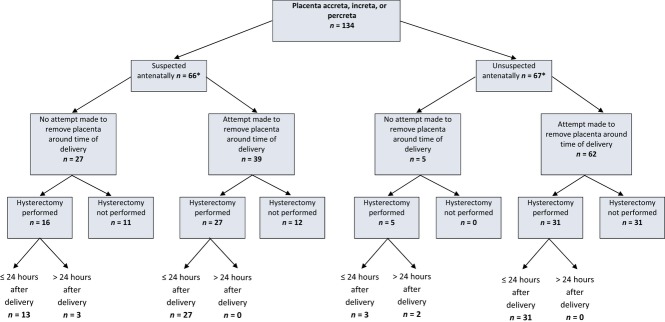
Objective: To describe the management and outcomes of placenta accreta, increta, and percreta in the UK. Design: A population‐based descriptive study using the UK O bstetric S urveillance S ystem (UKOSS). Setting: All 221 UK hospitals with obstetrician‐led maternity units. Population: All women diagnosed with placenta accreta, increta, and percreta in the UK between May 2010 and April 2011. Methods: Prospective case identification through the monthly mailing of UKOSS. Main outcome measures: Median estimated blood loss, transfusion requirements. Results: A cohort of 134 women were identified with placenta accreta, increta, or percreta: 50% (66/133) were suspected to have this condition antenatally. In women with a final diagnosis of placenta increta or percreta, antenatal diagnosis was associated with reduced levels of haemorrhage (median estimated blood loss 2750 versus 6100 ml, P = 0.008) and a reduced need for blood transfusion (59 versus 94%, P = 0.014), possibly because antenatally diagnosed women were more likely to have preventative therapies for haemorrhage (74 versus 52%, P = 0.007), and were less likely to have an attempt made to remove their placenta (59 versus 93%, P < 0.001). Making no attempt to remove any of the placenta, in an attempt to conserve the uterus or prior to hysterectomy, was associated with reduced levels of haemorrhage (median estimated blood loss 1750 versus 3700 ml, P = 0.001) and a reduced need for blood transfusion (57 versus 86%, P < 0.001). Conclusions: Women with placenta accreta, increta, or percreta who have no attempt to remove any of their placenta, with the aim of conserving their uterus, or prior to hysterectomy, have reduced levels of haemorrhage and a reduced need for blood transfusion, supporting the recommendation of this practice.
Overview
The claims and statistics of this paper haven’t been checked yet.
Run the check — free, no account needed. It reads the open-access text and checks the sources it cites.
Integrity signals
Registry
Cites
Statistics
Figures
Verification
Claims the paper makes
The claims and statistics of this paper haven’t been checked yet.
Run the check — free, no account needed. It reads the open-access text and checks the sources it cites.
Claims other papers make about this one
Each is checked against this paper’s own text: does it say what the citing paper says it does?
In the citing paper
“PAS becomes a clinical problem after birth, when the placenta does not physiologically detach from the uterus and the forcible removal of the placenta is followed by massive obstetric haemorrhage (MOH), leading to further morbidity and risk of maternal death.”
From Placenta accreta spectrum – variations in clinical practice and maternal morbidity between the UK and France: a population‐based comparative study (2022) · cites this paper as [3]
Self-check
Percentages, sums and reported differences re-computed from the paper’s own numbers.
The self-check needs the paper’s full text.
Citations
Cites
Placenta Previa, Placenta Accreta, and Vasa Previa
Oyelese, Y., & Smulian, J. C. (2006) · Obstetrics and Gynecology · doi:10.1097/01.aog.0000207559.15715.98 · Cited by 967
Optimal management strategies for placenta accreta
Eller, A., Porter, T., Soisson, P., & Silver, R. (2009) · BJOG: An International Journal of Obstetrics & Gynaecology · doi:10.1111/j.1471-0528.2008.02037.x · Cited by 578
Maternal Outcome After Conservative Treatment of Placenta Accreta
Sentilhes, L., Ambroselli, C., Kayem, G., Provansal, M., Fernandez, H., Perrotin, F., Winer, N., Pierre, F., Benachi, A., Dreyfus, M., et al. (2010) · Obstetrics & Gynecology · doi:10.1097/aog.0b013e3181d066d4 · Cited by 515
ACOG Practice Bulletin No. 76: Postpartum Hemorrhage
(2006) · Obstetrics and Gynecology · doi:10.1097/00006250-200610000-00046 · Cited by 496
Urgency of caesarean section: A new classification
Lucas, D. N., Yentis, S. M., Kinsella, S. M., Holdcroft, A., May, A. E., Wee, M., & Robinson, P. N. (2000) · Journal of the Royal Society of Medicine · doi:10.1177/014107680009300703 · Cited by 465
Fitzpatrick, K. E., Sellers, S., Spark, P., Kurinczuk, J. J., Brocklehurst, P., & Knight, M. (2012) · PLoS ONE · doi:10.1371/journal.pone.0052893 · Cited by 463
Self-citationA prospective national study of acute fatty liver of pregnancy in the UK
Knight, M., Nelson‐Piercy, C., Kurinczuk, J. J., Spark, P., & Brocklehurst, P. (2008) · Gut · doi:10.1136/gut.2008.148676 · Cited by 373
Self-citationAntenatal diagnosis of placenta accreta: a review
Comstock, C. H. (2005) · Ultrasound in Obstetrics and Gynecology · doi:10.1002/uog.1926 · Cited by 327
Cesarean Delivery and Peripartum Hysterectomy
Knight, M., Kurinczuk, J. J., Spark, P., & Brocklehurst, P. (2008) · Obstetrics and Gynecology · doi:10.1097/01.aog.0000296658.83240.6d · Cited by 293
Self-citationConservative Versus Extirpative Management in Cases of Placenta Accreta
Kayem, G., Davy, C., Goffinet, F., Thomas, C., Clément, D., & Cabrol, D. (2004) · Obstetrics & Gynecology · doi:10.1097/01.aog.0000136086.78099.0f · Cited by 283
Research works printed but not linked: 5
- Office for National Statistics, 2011, Birth Summary Tables, England and Wales 2010
- General Register Office for Scotland, 2011, Vital Events Reference Tables 2010
- Northern Ireland Statistics and Research Agency, 2011, Registrar General Annual Report 2010
- Centre for Maternal and Child Enquiries, 2010, Perinatal Mortality 2008
- Royal College of Obstetricians and Gynaecologists, 2011, Green‐top Guideline No. 27: Placenta Praevia, Placenta Praevia Accreta and Vasa Praevia: Diagnosis and Management
Cited by
Sorted by citations
Items 301–357 of 357
Assessment of different management options used in morbidly adherent placenta and pregnancy outcomes
Tawfik, W. M. (2020) · Women Health Care and Issues · doi:10.31579/2642-9756/026
THE INVESTIGATION ON KINETICS OF HOT PRESSING OF TUNGSTEN AND TUNGSTEN-BASE PSEUDOALLOYS.
Pilipovskii, Y. L., Karpinos, D. M., Kondrat’ev, Y. V., Koval'chenko, & Shamatov, Y. M. (1969) · OSTI OAI (U.S. Department of Energy Office of Scientific and Technical Information)
Dobos, N. M., Crozier, T. M. E., & McLintock, C. (2020) · Springer eBooks · doi:10.1007/978-3-030-43477-9_6
Total Placenta Previa with High-risk MAP and Transverse Lie Fetal Position
Soepraptomo, R. T., Hapsari, F., & Wijaya, T. (2021) · Journal of Anesthesiology and Clinical Research · doi:10.37275/jacr.v1i2.139
Analysis of Etiology and Risk Factors of Hysterectomy for Refractory Postpartum Hemorrhage
赵, 雅. (2022) · Advances in Clinical Medicine · doi:10.12677/acm.2022.123328
Jauniaux, E. R. M., Bhidé, A., & Wright, J. D. (2017) · Elsevier eBooks · doi:10.1016/b978-0-323-32108-2.00021-4
(2015) · International Journal of Science and Research (IJSR) · doi:10.21275/v4i12.nov151797
Management of Morbidly Adherent Placenta
Townsend, R., & Chandraharan, E. (2016) · Cambridge University Press eBooks · doi:10.1017/9781316144961.018
Monteiro, R., Salman, M., Malhotra, S., & Yentis, S. M. (2019) · Cambridge University Press eBooks · doi:10.1017/9781108684729.072
Fox, K. A. (2021) · Springer eBooks · doi:10.1007/978-3-030-56338-7_12
Vierkoetter, K. R., & Folkins, A. K. (2018) · Cambridge University Press eBooks · doi:10.1017/9781316848616.031
De gecompliceerde zwangerschap en complicaties die door de zwangerschap worden veroorzaakt
Prins, M., van Roosmalen, J., Smit, Y., Scherjon, S. A., & van Dillen, J. (2019) · Bohn Stafleu van Loghum eBooks · doi:10.1007/978-90-368-2279-4_9
Prospects for the use of biochemical markers in placental in-growth
Yashchuk, A. G., Musin, I. I., Berg, E. A., Дмитриевна, Г. Д., Ринатовна, Я. А., Gromenko, I. D., & Berdigulova, E. F. (2022) · V F Snegirev Archives of Obstetrics and Gynecology · doi:10.17816/2313-8726-2022-9-3-133-142
Epidemiology of Placenta Accreta Spectrum: A Comprehensive Review of Current Evidence
Chintamani, A., & Lim, B. (2022) · Springer eBooks · doi:10.1007/978-3-031-10347-6_2
Evidence-Based Management of Placenta Accreta Spectrum
Shazly, S. A., Radwan, A. A., AlMahdy, A. M., Ateya, M. I., Abouzeid, M. H., Sayed, E. G., & Elassall, G. M. (2022) · Springer eBooks · doi:10.1007/978-3-031-10347-6_11
Salmanian, B., Shainker, S. A., Shamshirsaz, A. A., & Nassr, A. A. (2022) · Springer eBooks · doi:10.1007/978-3-031-10347-6_6
Placenta Increta With Uterus Didelphys Gravidity: Single Hospital Case Report
Urushadze, O., Kintraia, N., EZIESHVILI, L., Metskhvarishvili, N., & Rizvadze, M. (2022) · International Journal of Progressive Sciences and Technologies · doi:10.52155/ijpsat.v34.1.4541
Александрович, К. И., Николаевна, Б. Т., Николаевна, П. Е., Iskakov, D. D., & Milyutina, E. R. (2022) · Russian Bulletin of Obstetrician-Gynecologist · doi:10.17116/rosakush20222206154
Collins, S., Weeks, E., majd, H. S., Addley, S., & Cavallaro, A. (2023) · doi:10.22541/au.168267791.10651660/v1
Complicated Cesarean Hysterectomy
Önder, P. Ö., Kılıççı, Ç., & Hatırnaz, Ş. (2023) · Springer eBooks · doi:10.1007/978-3-031-10067-3_35
Unexpected Placental Invasion: Scenario, Management, and Simulation
Calì, G., Labate, F., Maria, F. D., Calò, F., & Messina, L. (2023) · Springer eBooks · doi:10.1007/978-3-031-10067-3_22
Placenta Accreta: A Case Series and Literature Review
YATABE, N., Kitano, R., Tsubata, F., KANEKO, S., TAKEUCHI, S., Teramoto, Y., MATSUOKA, T., ICHIKAWA, M., Seiichi, E. N. D. O., SAKAMOTO, M., et al. (2023) · JOURNAL OF THE JAPANESE ASSOCIATION OF RURAL MEDICINE · doi:10.2185/jjrm.72.1
[Prenatal diagnosis of placenta acretta by ultrasound and its histopathological association].
Zapien-Terrones, B. C., Naves-Sánchez, J., Sosa-Bustamante, G. P., González, A. P., Paque-Bautista, C., Luna-Anguiano, J. L. F., & Peralta-Cortázar, C. (2023) · PubMed Central
Takahashi, J., Orisaka, M., Inoue, D., Kawamura, H., Takahashi, N., Tsuyoshi, H., Shinagawa, A., Kurokawa, T., & Yoshida, Y. (2024) · BMC Surgery · doi:10.1186/s12893-024-02311-8
Enquête nationale sur la stratégie de prise en charge du placenta accreta en France
Lauroy, A., Buffeteau, A., Vidal, F., Parant, O., & Guerby, P. (2024) · Gynécologie Obstétrique Fertilité & Sénologie · doi:10.1016/j.gofs.2024.03.008
Erdoğan, G., Kaya, S., Peker, N., İBİLOĞLU, İ., & Devecí, E. (2024) · Harran Üniversitesi Tıp Fakültesi Dergisi · doi:10.35440/hutfd.1487194
RETROSPECTIVE ANALYSIS OF ANESTHETIC APPROACHES IN CESAREAN DELIVERIES INVOLVING PLACENTAL ANOMALIES
MULAGUND, S., Dhage, A., & ASWIN, M. S. (2025) · International Journal of Current Pharmaceutical Research · doi:10.22159/ijcpr.2025v17i2.6035
Tsoy, L. V., Kutusheva, M., Barinova, I. V., Paramonova, N. B., Lerner, Y. V., Varshavsky, V. A., & Демура, Т. А. (2025) · Russian Journal of Archive of Pathology · doi:10.17116/patol20258702164
Enormous placenta percreta bleeding in a twin pregnancy: a case report
Farahani, M., Ataei, M., Mashak, B., Nirouei, M., & Hashemnejad, M. (2025) · Journal of Medical Case Reports · doi:10.1186/s13256-025-05256-5
De gecompliceerde zwangerschap en complicaties die door de zwangerschap worden veroorzaakt
de Jonge, A., Verhoeven, C. J. M., Jong, E. F., van Dillen, J., & Bakker, P. (2025) · doi:10.1007/978-90-368-3142-0_9
Management of Placenta Accreta Spectrum
Naimi, A. A., & Collins, S. (2025) · Cambridge University Press eBooks · doi:10.1017/9781009497459.018
Propecio, I. A., & Holsbach, D. C. B. S. (2025) · Research Society and Development · doi:10.33448/rsd-v14i11.49576
Root, E. R., Curbelo, J., Ramsey, P. S., & Munoz, J. L. (2025) · Medicina · doi:10.3390/medicina61122139
Arum, S. P., Nugraha, G. B. A., & Yuliantara, E. E. (2025) · Journal of South Asian Federation of Obstetrics and Gynaecology · doi:10.5005/jp-journals-10006-2745
Takahashi, J., Orisaka, M., Inoue, D., Hiroshi, K., Takahashi, N., Tsuyoshi, H., Shinagawa, A., Kurokawa, T., & Yoshida, Y. (2024) · Figshare · doi:10.6084/m9.figshare.26667616
Takahashi, J., Orisaka, M., Inoue, D., Hiroshi, K., Takahashi, N., Tsuyoshi, H., Shinagawa, A., Kurokawa, T., & Yoshida, Y. (2024) · Figshare · doi:10.6084/m9.figshare.26667619
Maged, A. M., El-Mazny, A. N., Kamal, N., Mahmoud, S. I., Fouad, M. A., El‐Nassery, N., Kotb, A., Ragab, W. S., Ogila, A. I., Metwally, A. A., et al. (2024) · Figshare · doi:10.6084/m9.figshare.26589606
Maged, A. M., El-Mazny, A. N., Kamal, N., Mahmoud, S. I., Fouad, M. A., El‐Nassery, N., Kotb, A., Ragab, W. S., Ogila, A. I., Metwally, A. A., et al. (2024) · Figshare · doi:10.6084/m9.figshare.26589609
Takahashi, J., Orisaka, M., Inoue, D., Hiroshi, K., Takahashi, N., Tsuyoshi, H., Shinagawa, A., Kurokawa, T., & Yoshida, Y. (2024) · Figshare · doi:10.6084/m9.figshare.26667613
Maternal outcomes in morbidly adherent placenta: a prospective cohort study
Sirsam, S. S., Karad, P. B., Raut, N. N., & Nangia, A. (2025) · International Journal of Reproduction Contraception Obstetrics and Gynecology · doi:10.18203/2320-1770.ijrcog20254275
Tunn, R., & Knight, M. (2026) · NIHR Open Research · doi:10.3310/nihropenres.14196.1
Self-citationPrenatal ultrasound markers for predicting blood transfusion in placenta accreta spectrum
Kından, A., Ulusoy, C. O., Kurt, A., Dereli, M. L., Sucu, S., Yıldız, A. G., Yücel, K. Y., Çelen, Ş., Çağlar, A. T., & Üstün, Y. E. (2026) · BMC Pregnancy and Childbirth · doi:10.1186/s12884-026-08696-z
Hematologic markers and machine learning in predicting placenta accreta: A case–control study
Jochum, M. D., Albrecht, K. D., Mendez, Y. H., Zhang, V., Sarada, S., Burnett, B., Reed, C. C., Fox, K. A., Shamshirsaz, A. A., Belfort, M. A., et al. (2026) · International Journal of Gynecology & Obstetrics · doi:10.1002/ijgo.70782
Zullino, S., Romani, E., Ottanelli, S., Vangelisti, M., Gallucci, E., Fanelli, F., Micaglio, M., Petraglia, F., & Mecacci, F. (2026) · European Journal of Obstetrics & Gynecology and Reproductive Biology · doi:10.1016/j.ejogrb.2026.115002
Genco, M., Genco, M., Aksoy, H., Göçer, H., Göçer, E., Kaya, K., & Aslım, B. (2026) · Research Square · doi:10.21203/rs.3.rs-9011421/v1
Development of a simplified MRI model for diagnosing placenta accreta spectrum disorders
Lu, T., Hu, S., Zhao, Y., Xiao, R., Fu, G., Ren, S., & Li, A. (2026) · Placenta · doi:10.1016/j.placenta.2026.05.005
Lee, S., Lee, H., Lee, H. J., Yu, E. H., Joo, J. K., & Kim, S. C. (2026) · Diagnostics · doi:10.3390/diagnostics16131960
Vetvitayavatana, N., Chanprapaph, P., & Pooliam, J. (2026) · International Journal of Gynecology & Obstetrics · doi:10.1002/ijgo.71127
A Novel Uterus‐Sparing Technique for Placenta Accreta Spectrum (PAS), at a Tertiary Center
Ghourab, S., Alsahan, N., Alomar, O., & Labani, R. (2026) · Obstetrics and Gynecology International · doi:10.1155/ogi/1224673
Coldman, S., Zhou, G., Wu, D., Guo, L., WHITBY, E. H., & Li, X. (2026) · British Journal of Radiology · doi:10.1093/bjr/tqag194
Diagnostic Performance of Ultrasound and MRI in Placenta Accreta Spectrum
Singh, A., Sooch, N. K., Sood, R., Awal, G., Sood, M. K., & Kaur, P. (2026) · Indian journal of radiology and imaging - new series/Indian journal of radiology and imaging/Indian Journal of Radiology & Imaging · doi:10.1055/s-0046-1827463
Bonsen, L. R., Harskamp, V., van den Akker, T., van der Bom, J. G., & Henriquez, D. D. C. A. (2026) · International Journal of Gynecology & Obstetrics · doi:10.1002/ijgo.71324
Flindris, S., Margioula‐Siarkou, C., Christopoulos, K., Margioula‐Siarkou, G., Chatzikalogiannis, I., Kalinderis, M., Traianos, A., Empliouk, E., Pantazis, K., Sotiriadis, A., et al. (2026) · Journal of Clinical Medicine · doi:10.3390/jcm15197738
Pinton, A., Deneux‐Tharaux, C., Seco, A., Sentilhes, L., & Kayem, G. (2026) · International Journal of Gynecology & Obstetrics · doi:10.1002/ijgo.71445
Metadata
- Authors
- Fitzpatrick, K., Sellers, S., Spark, P., Kurinczuk, J., Brocklehurst, P., & Knight, M.
- Affiliations
- University of Oxford (GB)
- University Hospitals Bristol NHS Foundation Trust (GB)
- National Perinatal Epidemiology Unit University of Oxford Oxford UK
- University College London (GB)
- Corresponding author
- Fitzpatrick, KE
- Venue
- BJOG: An International Journal of Obstetrics & Gynaecology
- Publisher
- Wiley
- Published
- 2013-08-07
- Volume
- 121
- Issue
- 1
- Pages
- 62-71
- ISSN
- 0306-5456 (ISSN-L)
- 1470-0328
- 1471-0528
- PMC
- PMC3906842
- OpenAlex
- W2024611038
- Cited by
- 357
- References
- 16
- Citations by year
- 2026: 19 · 2025: 17 · 2024: 23 · 2023: 28 · 2022: 30 · 2021: 48 · 2020: 39 · 2019: 28 · 2018: 36 · 2017: 32 · 2016: 19 · 2015: 18 · 2014: 14 · 2013: 4
- FWCI
- 17.08
- Type
- journal article
- Language
- en
- Open access
- hybrid
- doi.org
- Licence
- Locations
- BJOG An International Journal of Obstetrics & Gynaecology (publishedVersion, cc-by-nc)
- Europe PMC (PubMed Central) (publishedVersion, cc-by)
- PubMed Central (publishedVersion, cc-by)
- PubMed (publishedVersion)
- UCL Discovery (University College London) (submittedVersion)
- University of Birmingham Research Portal (University of Birmingham) (submittedVersion, cc-by-nc)
- Funders
- National Institute for Health and Care Research (RP-PG-0608-10038)
- Topics
- Health Sciences › Medicine › Pediatrics, Perinatology and Child Health › Maternal and fetal healthcare
- Health Sciences › Medicine › Hematology › Blood transfusion and management
- Health Sciences › Medicine › Obstetrics and Gynecology › Uterine Myomas and Treatments
- Keywords
- placenta accreta, placenta increta, placenta percreta, prenatal diagnosis, uterine preservation, hysterectomy, obstetric hemorrhage, blood transfusion, estimated blood loss, placenta removal, UK Obstetric Surveillance System
- MeSH terms
- Blood Transfusion, Cesarean Section, Ergonovine, Female, United Kingdom, Postpartum Hemorrhage, Humans, Hysterectomy, Oxytocics, Oxytocin, Placenta Accreta, Pregnancy, Prospective Studies, Dinoprost, Cohort Studies, Misoprostol, Treatment Outcome, Uterine Artery Embolization
About these checks
Registry, retraction, Cites and statistics results are computed, not judged, with one exception: a printed reference that no index lists is read once by a model before it counts as a citation error. Claims are extracted by a model and kept only when their quote appears verbatim in the text; each cited source is then checked, with a model’s help, for whether it says what the claim relies on. Those verdicts can be wrong — read the claim’s quote and the cited source before relying on one.
Statistics and arithmetic are recomputed, not judged.
Confidence bands are shown only for fields calibrated on our annotated test set. None is calibrated yet, so no band is shown.
What counts as a claim ›How we measure confidence ›How we check this ›
Are you an author, or do you see a problem with this page? Request a review
