Cited by 1,182Gut microbiota and healthMicrobial Community Ecology and PhysiologyInfant Nutrition and Health

The DOI matches its Crossref record; 375 of the 375 references it cites were found in a registry or an index.

The first 1000 cultured species of the human gastrointestinal microbiota

Open access
Rajilić-Stojanović, Mirjana, de Vos, Willem M.·2014·FEMS Microbiology Reviews

Abstract

The microorganisms that inhabit the human gastrointestinal tract comprise a complex ecosystem with functions that significantly contribute to our systemic metabolism and have an impact on health and disease. In line with its importance, the human gastrointestinal microbiota has been extensively studied. Despite the fact that a significant part of the intestinal microorganisms has not yet been cultured, presently over 1000 different microbial species that can reside in the human gastrointestinal tract have been identified. This review provides a systematic overview and detailed references of the total of 1057 intestinal species of Eukarya (92), Archaea (8) and Bacteria (957), based on the phylogenetic framework of their small subunit ribosomal RNA gene sequences. Moreover, it unifies knowledge about the prevalence, abundance, stability, physiology, genetics and the association with human health of these gastrointestinal microorganisms, which is currently scattered over a vast amount of literature published in the last 150 years. This detailed physiological and genetic information is expected to be instrumental in advancing our knowledge of the gastrointestinal microbiota. Moreover, it opens avenues for future comparative and functional metagenomic and other high-throughput approaches that need a systematic and physiological basis to have an impact.

Overview

The claims and statistics of this paper haven’t been checked yet.

Run the check — free, no account needed. It reads the open-access text and checks the sources it cites.

A few free checks a day · papers already verified open instantly · results are public

Integrity signals

Registry

Crossref · 10.1111/1574-6976.12075

Cites

375 of 375 references verified0 citation errors · 0 not checkable

Statistics

Figures
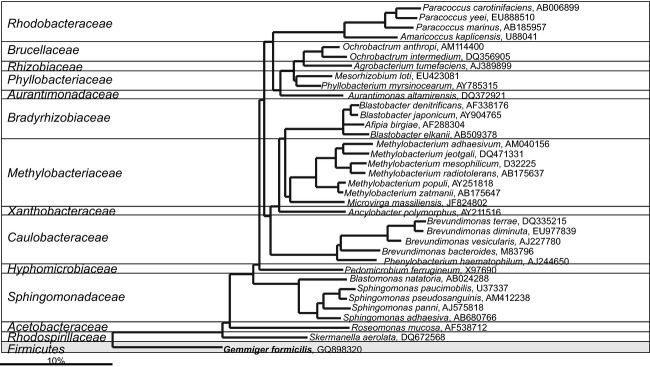
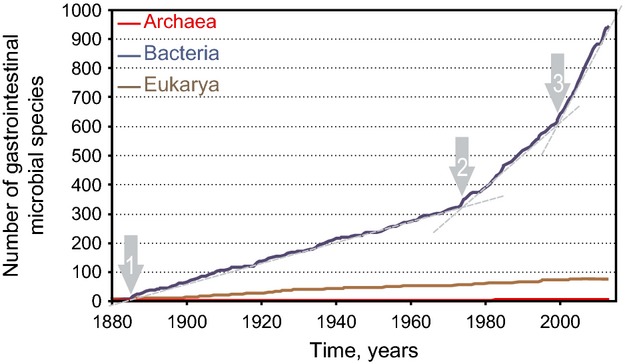
Fig 1 Graphical representation of the cumulative number of cultured species from Bacteria, Archaea and Eukarya from the human gastrointestinal tract as a function of time. The arrows indicate the turning points of the gastrointestinal microbiota research: (1) Isolation of the first gastrointestinal bacterial species, (2) Introduction of strictly anaerobic techniques, and (3) Introduction of molecular techniques in the field of the gastrointestinal microbiota research.
Fig 1 Graphical representation of the cumulative number of cultured species from Bacteria, Archaea and Eukarya from the human gastrointestinal tract as a function of time. The arrows indicate the turning points of the gastrointestinal microbiota research: (1) Isolation of the first gastrointestinal bacterial species, (2) Introduction of strictly anaerobic techniques, and (3) Introduction of molecular techniques in the field of the gastrointestinal microbiota research.CC BY-NC · PubMed Central
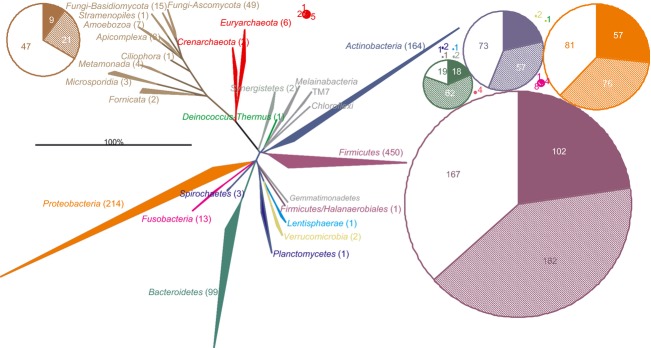
Fig 2 Phylogenetic tree of the human gastrointestinal microbiota. The numbers in parentheses indicate the number of cultured species given per phylum. The pie charts illustrate distribution between the number of species with full genome sequence genome (full sectors), the number of species with partial genome sequence (semi-full sectors) and number of species without any genome sequence (empty sectors) given for Archaea, Eukarya and per phylum for Bacteria. The color code of pies corresponds to the color code of the phylogenetic tree.
Fig 2 Phylogenetic tree of the human gastrointestinal microbiota. The numbers in parentheses indicate the number of cultured species given per phylum. The pie charts illustrate distribution between the number of species with full genome sequence genome (full sectors), the number of species with partial genome sequence (semi-full sectors) and number of species without any genome sequence (empty sectors) given for Archaea, Eukarya and per phylum for Bacteria. The color code of pies corresponds to the color code of the phylogenetic tree.CC BY-NC · PubMed Central
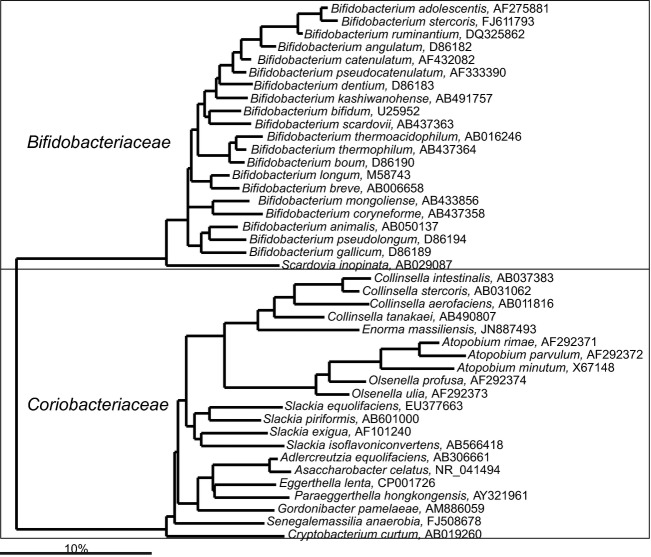
Fig 3 Phylogenetic tree of the human gastrointestinal species that belong to the orders of the Bifidobacteriales and Coriobacteriales. GenBank Accession Numbers of the SSU rRNA gene sequence are provided for each species and the family names are indicated.
Fig 3 Phylogenetic tree of the human gastrointestinal species that belong to the orders of the Bifidobacteriales and Coriobacteriales. GenBank Accession Numbers of the SSU rRNA gene sequence are provided for each species and the family names are indicated.CC BY-NC · PubMed Central
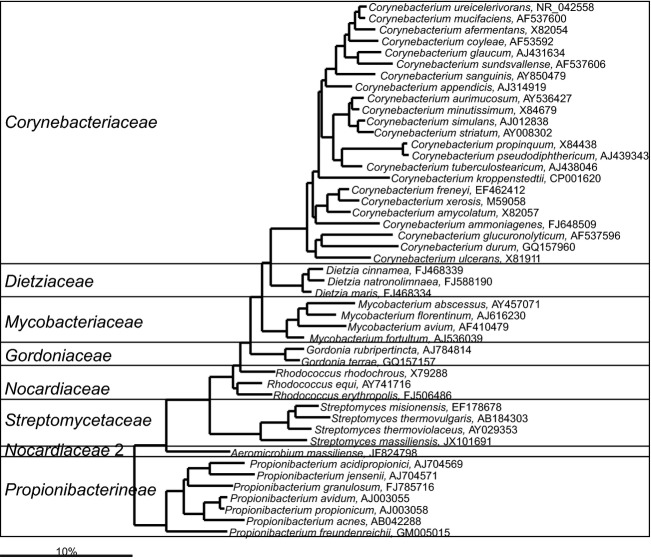
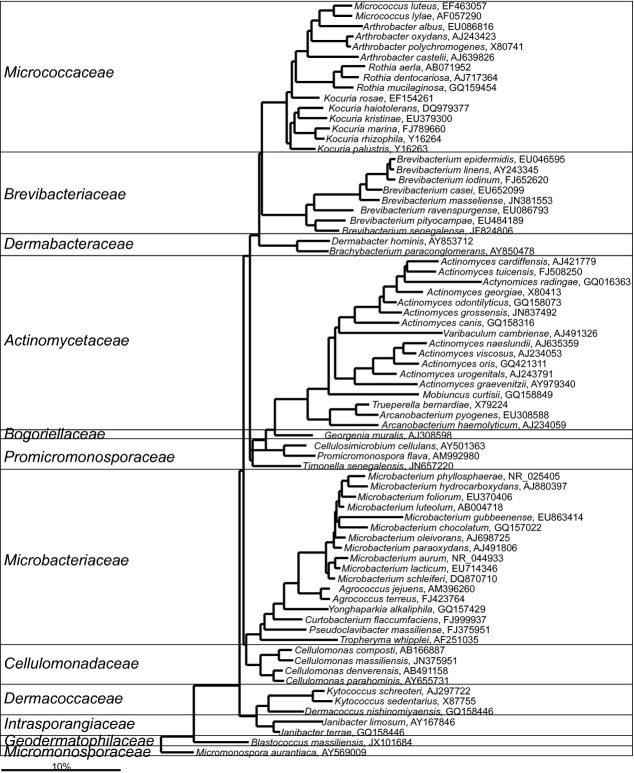
Fig 4 Phylogenetic tree of a fraction of the human gastrointestinal species that belong to the order of the Actinomycetales. GenBank Accession Numbers of the SSU rRNA gene sequence are provided for each species and the family names are indicated. For the other human gastrointestinal species that cluster within the Actinomycetales see Fig. 5.
Fig 4 Phylogenetic tree of a fraction of the human gastrointestinal species that belong to the order of the Actinomycetales. GenBank Accession Numbers of the SSU rRNA gene sequence are provided for each species and the family names are indicated. For the other human gastrointestinal species that cluster within the Actinomycetales see Fig. 5.CC BY-NC · PubMed Central
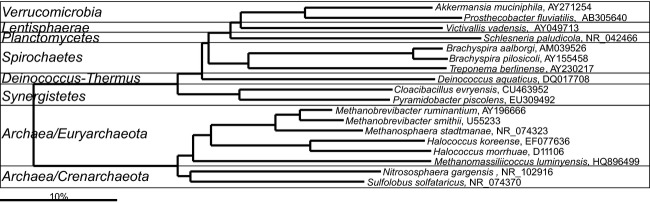
Fig 5 Phylogenetic tree of a fraction of the human gastrointestinal species that belong to the order of the Actinomycetales. GenBank Accession Numbers of the SSU rRNA gene sequence are provided for each species and the family names are indicated. For the other human gastrointestinal species that cluster within the Actinomycetales see Fig. 4.
Fig 5 Phylogenetic tree of a fraction of the human gastrointestinal species that belong to the order of the Actinomycetales. GenBank Accession Numbers of the SSU rRNA gene sequence are provided for each species and the family names are indicated. For the other human gastrointestinal species that cluster within the Actinomycetales see Fig. 4.CC BY-NC · PubMed Central
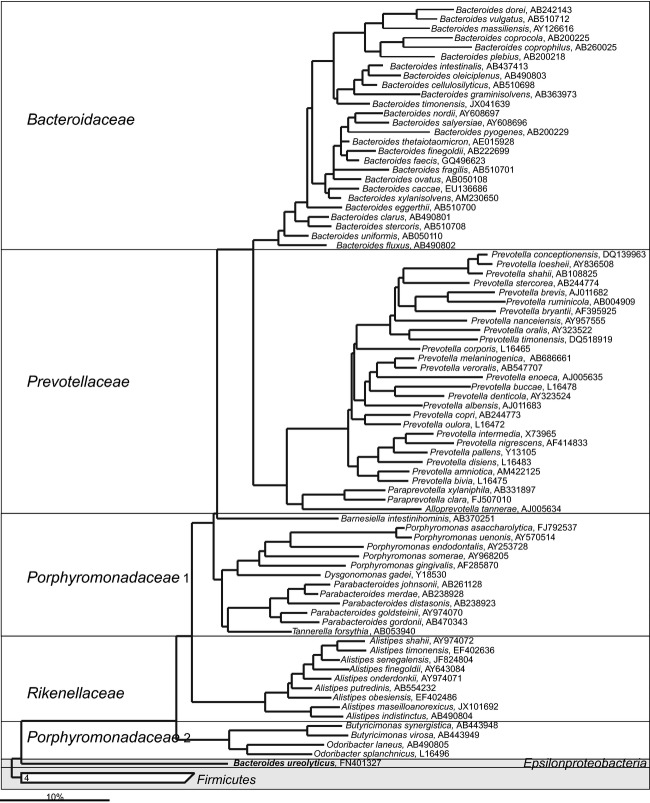
Fig 6 Phylogenetic tree of the human gastrointestinal species that belong to the class of the Bacteroidia. GenBank Accession Numbers of the SSU rRNA gene sequence are provided for each species and the family names are indicated. Deeply rooted Bacteroides spp., which based on the SSU rRNA gene sequence cluster within distant phylogenetic groups are depicted in the gray area.
Fig 6 Phylogenetic tree of the human gastrointestinal species that belong to the class of the Bacteroidia. GenBank Accession Numbers of the SSU rRNA gene sequence are provided for each species and the family names are indicated. Deeply rooted Bacteroides spp., which based on the SSU rRNA gene sequence cluster within distant phylogenetic groups are depicted in the gray area.CC BY-NC · PubMed Central
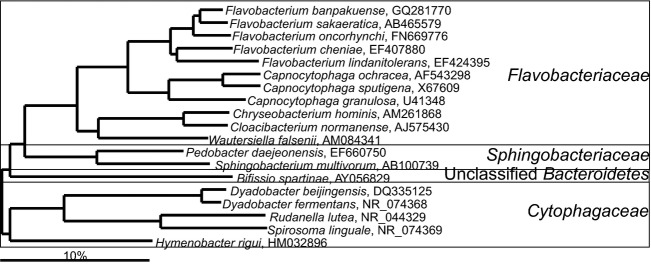
Fig 7 Phylogenetic tree of the human gastrointestinal species that belong to the classes of the Cytophagia and Sphingobacteria. GenBank Accession Numbers of the SSU rRNA gene sequence are provided for each species and the family names are indicated.
Fig 7 Phylogenetic tree of the human gastrointestinal species that belong to the classes of the Cytophagia and Sphingobacteria. GenBank Accession Numbers of the SSU rRNA gene sequence are provided for each species and the family names are indicated.CC BY-NC · PubMed Central
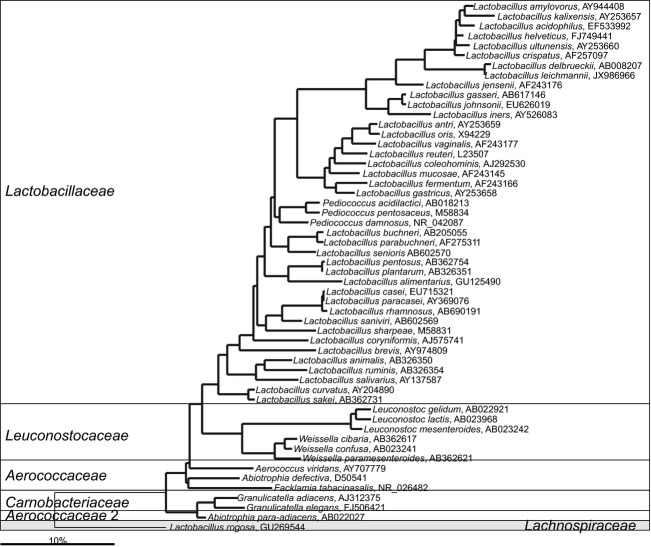
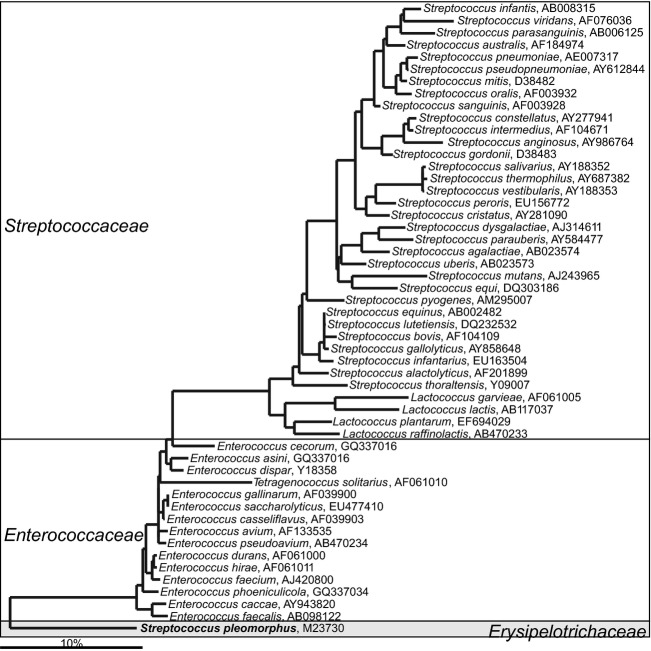
Fig 8 Phylogenetic tree of a fraction of the human gastrointestinal species that belong to the order of the Lactobacillales. GenBank Accession Numbers of the SSU rRNA gene sequence are provided for each species and the family names are indicated. For the other gastrointestinal species that belong to the order of the Lactobacillales see Fig. 9.
Fig 8 Phylogenetic tree of a fraction of the human gastrointestinal species that belong to the order of the Lactobacillales. GenBank Accession Numbers of the SSU rRNA gene sequence are provided for each species and the family names are indicated. For the other gastrointestinal species that belong to the order of the Lactobacillales see Fig. 9.CC BY-NC · PubMed Central
Fig 9 Phylogenetic tree of the human gastrointestinal species that belong to the families of Streptococcaceae and Enterococcaceae. GenBank Accession Numbers of the SSU rRNA gene sequence are provided for each species and the family names are indicated. For the other gastrointestinal species that belong to the order of the Lactobacillales see Fig. 8.
Fig 9 Phylogenetic tree of the human gastrointestinal species that belong to the families of Streptococcaceae and Enterococcaceae. GenBank Accession Numbers of the SSU rRNA gene sequence are provided for each species and the family names are indicated. For the other gastrointestinal species that belong to the order of the Lactobacillales see Fig. 8.CC BY-NC · PubMed Central
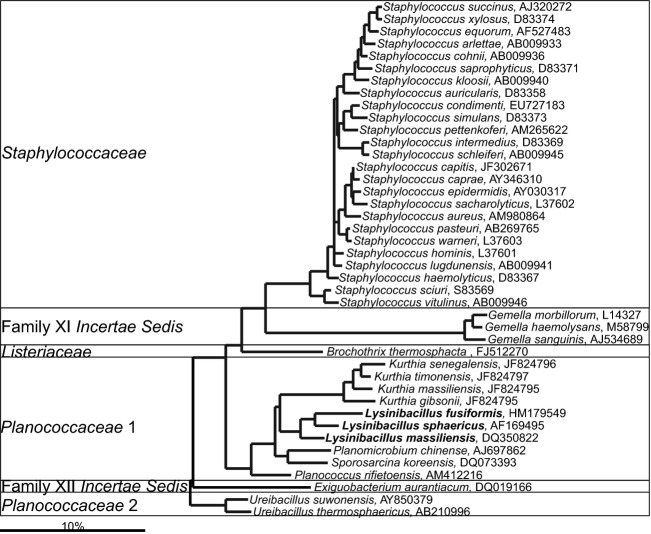
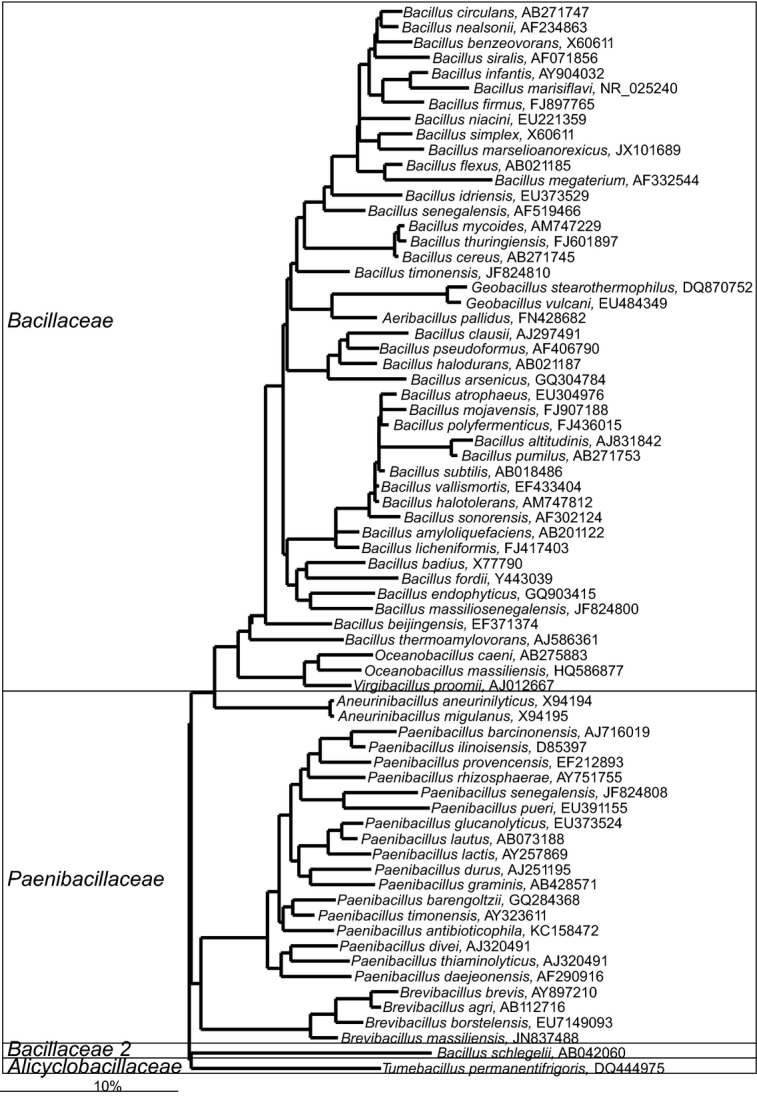
Fig 10 Phylogenetic tree of a fraction of the human gastrointestinal species that belong to the order of the Bacillales. GenBank Accession Numbers of the SSU rRNA gene sequence are provided for each species and the family names are indicated. The species indicated in bold are based on the SSU rRNA gene sequence clustering within the families that are designated on the figure in contrast to their official classification. For the other gastrointestinal species that belong to the order of the Bacillales see Fig. 11.
Fig 10 Phylogenetic tree of a fraction of the human gastrointestinal species that belong to the order of the Bacillales. GenBank Accession Numbers of the SSU rRNA gene sequence are provided for each species and the family names are indicated. The species indicated in bold are based on the SSU rRNA gene sequence clustering within the families that are designated on the figure in contrast to their official classification. For the other gastrointestinal species that belong to the order of the Bacillales see Fig. 11.CC BY-NC · PubMed Central
Fig 11 Phylogenetic tree of a fraction of the human gastrointestinal species that belong to the order of the Bacillales. GenBank Accession Numbers of the SSU rRNA gene sequence are provided for each species and the family names are indicated. For the other gastrointestinal species that belong to the order of the Bacillales order see Fig. 10.
Fig 11 Phylogenetic tree of a fraction of the human gastrointestinal species that belong to the order of the Bacillales. GenBank Accession Numbers of the SSU rRNA gene sequence are provided for each species and the family names are indicated. For the other gastrointestinal species that belong to the order of the Bacillales order see Fig. 10.CC BY-NC · PubMed Central
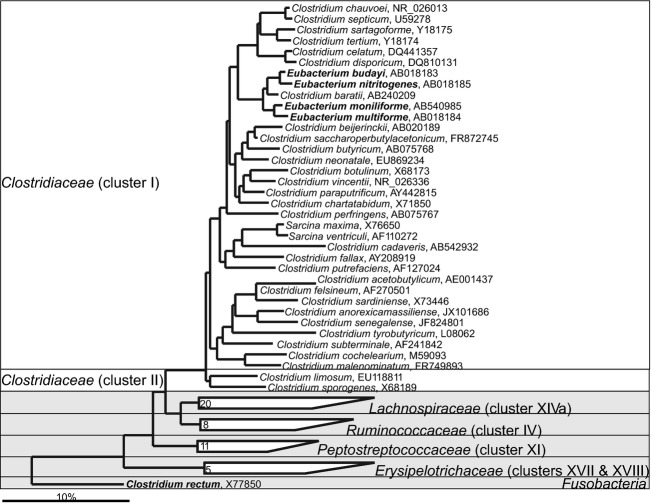
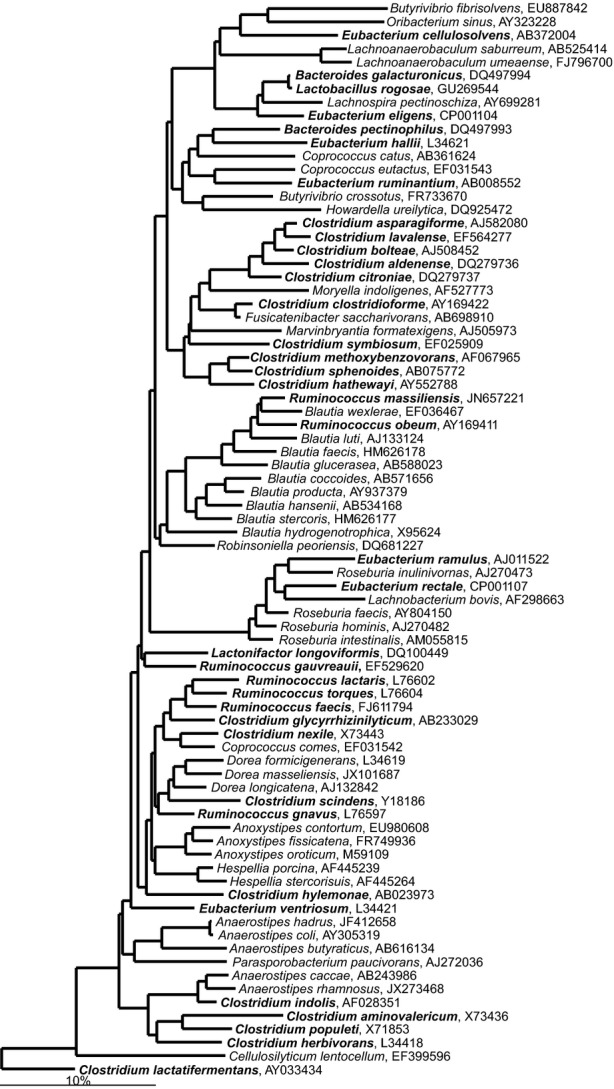
Fig 12 Phylogenetic tree the human gastrointestinal species that belong to the family of Clostridiaceae. GenBank Accession Numbers of the SSU rRNA gene sequence are provided for each species and the family names are indicated. The species indicated in bold are based on the SSU rRNA gene sequence clustering within the families that are designated on the figure in contrast to their official classification. Deeply rooted Clostridium spp., which based on the SSU rRNA gene sequence cluster within distant phylogenetic groups, are depicted in the gray area.
Fig 12 Phylogenetic tree the human gastrointestinal species that belong to the family of Clostridiaceae. GenBank Accession Numbers of the SSU rRNA gene sequence are provided for each species and the family names are indicated. The species indicated in bold are based on the SSU rRNA gene sequence clustering within the families that are designated on the figure in contrast to their official classification. Deeply rooted Clostridium spp., which based on the SSU rRNA gene sequence cluster within distant phylogenetic groups, are depicted in the gray area.CC BY-NC · PubMed Central
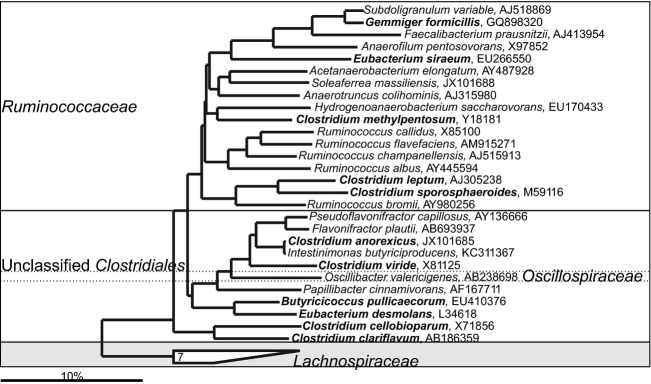
Fig 13 Phylogenetic tree the human gastrointestinal species that belong to the family of the Lachnospiraceae. GenBank Accession Numbers of the SSU rRNA gene sequence are provided for each species and the family names are indicated. The species indicated in bold are based on the SSU rRNA gene sequence clustering within the families that are designated on the figure in contrast to their official classification.
Fig 13 Phylogenetic tree the human gastrointestinal species that belong to the family of the Lachnospiraceae. GenBank Accession Numbers of the SSU rRNA gene sequence are provided for each species and the family names are indicated. The species indicated in bold are based on the SSU rRNA gene sequence clustering within the families that are designated on the figure in contrast to their official classification.CC BY-NC · PubMed Central
Fig 14 Phylogenetic tree the human gastrointestinal species that belong to the Clostridium cluster IV, most of which belong to the family of the Ruminococcaceae. GenBank Accession Numbers of the SSU rRNA gene sequence are provided for each species and the family names are indicated. The species indicated in bold are based on the SSU rRNA gene sequence clustering within the families that are designated on the figure in contrast to their official classification. Deeply rooted Ruminococcus spp., which based on the SSU rRNA gene sequence cluster within distant phylogenetic groups, are depicted in the gray area.
Fig 14 Phylogenetic tree the human gastrointestinal species that belong to the Clostridium cluster IV, most of which belong to the family of the Ruminococcaceae. GenBank Accession Numbers of the SSU rRNA gene sequence are provided for each species and the family names are indicated. The species indicated in bold are based on the SSU rRNA gene sequence clustering within the families that are designated on the figure in contrast to their official classification. Deeply rooted Ruminococcus spp., which based on the SSU rRNA gene sequence cluster within distant phylogenetic groups, are depicted in the gray area.CC BY-NC · PubMed Central
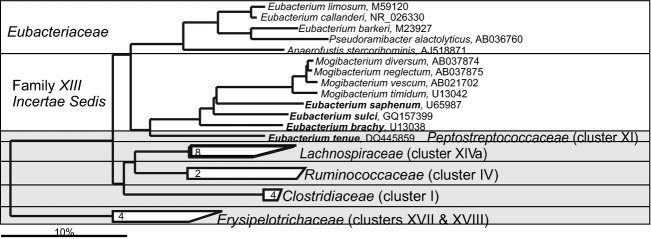
Fig 15 Phylogenetic tree the human gastrointestinal species that belong to the family of the Eubacteriaceae and Clostridiales Family XIII Incertae Sedis. GenBank Accession Numbers of the SSU rRNA gene sequence are provided for each species and the family names are indicated. The species indicated in bold are based on the SSU rRNA gene sequence clustering within the families that are designated on the figure in contrast to their official classification. Deeply rooted Eubacterium spp., which based on the SSU rRNA gene sequence cluster within distant phylogenetic groups are depicted in the gray area.
Fig 15 Phylogenetic tree the human gastrointestinal species that belong to the family of the Eubacteriaceae and Clostridiales Family XIII Incertae Sedis. GenBank Accession Numbers of the SSU rRNA gene sequence are provided for each species and the family names are indicated. The species indicated in bold are based on the SSU rRNA gene sequence clustering within the families that are designated on the figure in contrast to their official classification. Deeply rooted Eubacterium spp., which based on the SSU rRNA gene sequence cluster within distant phylogenetic groups are depicted in the gray area.CC BY-NC · PubMed Central
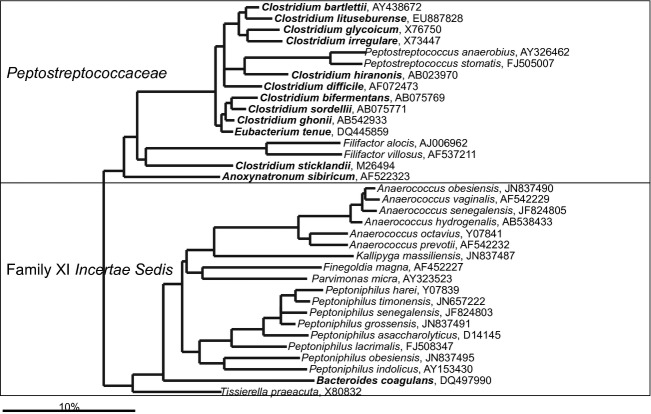
Fig 16 Phylogenetic tree the human gastrointestinal species that belong to families of the Peptostreptococcaceae and Clostridiales Family XI Incertae Sedis. GenBank Accession Numbers of the SSU rRNA gene sequence are provided for each species and the family names are indicated. The species indicated in bold are based on the SSU rRNA gene sequence clustering within the families that are designated on the figure in contrast to their official classification.
Fig 16 Phylogenetic tree the human gastrointestinal species that belong to families of the Peptostreptococcaceae and Clostridiales Family XI Incertae Sedis. GenBank Accession Numbers of the SSU rRNA gene sequence are provided for each species and the family names are indicated. The species indicated in bold are based on the SSU rRNA gene sequence clustering within the families that are designated on the figure in contrast to their official classification.CC BY-NC · PubMed Central
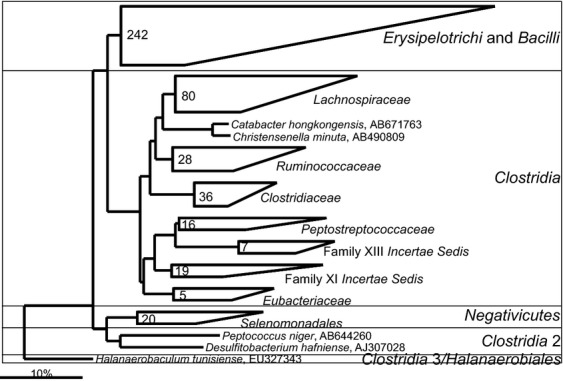
Fig 17 Partially opened phylogenetic tree the human gastrointestinal species that belong to the Firmicutes phylum on which five species that cluster within the three families with low diversity are indicated.
Fig 17 Partially opened phylogenetic tree the human gastrointestinal species that belong to the Firmicutes phylum on which five species that cluster within the three families with low diversity are indicated.CC BY-NC · PubMed Central
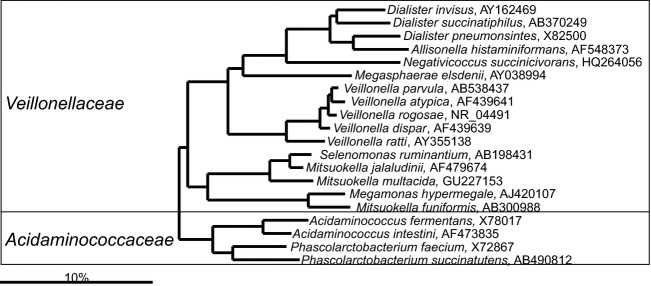
Fig 18 Phylogenetic tree the human gastrointestinal species that belong to the order of the Negativicutes. GenBank Accession Numbers of the SSU rRNA gene sequence are provided for each species and the family names are indicated.
Fig 18 Phylogenetic tree the human gastrointestinal species that belong to the order of the Negativicutes. GenBank Accession Numbers of the SSU rRNA gene sequence are provided for each species and the family names are indicated.CC BY-NC · PubMed Central
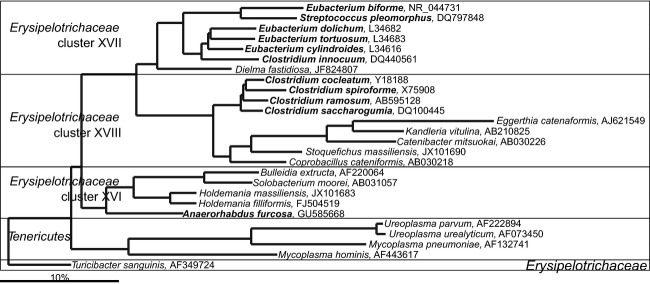
Fig 19 Phylogenetic tree the human gastrointestinal species that belong to the order of the Erysipelotrichi. GenBank Accession Numbers of the SSU rRNA gene sequence are provided for each species, while the family is divided over Clostridium clusters (Collins et al., 1994). The species indicated in bold are based on the SSU rRNA gene sequence clustering within the Erysipelotrichi in contrast to their official classification.
Fig 19 Phylogenetic tree the human gastrointestinal species that belong to the order of the Erysipelotrichi. GenBank Accession Numbers of the SSU rRNA gene sequence are provided for each species, while the family is divided over Clostridium clusters (Collins et al., 1994). The species indicated in bold are based on the SSU rRNA gene sequence clustering within the Erysipelotrichi in contrast to their official classification.CC BY-NC · PubMed Central
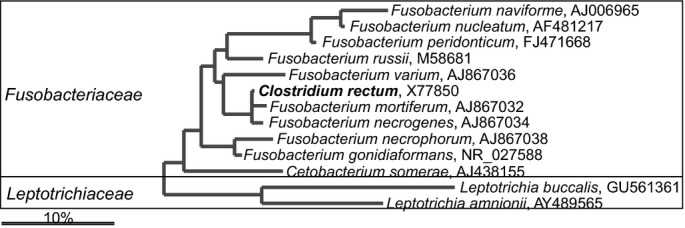
Fig 20 Phylogenetic tree the human gastrointestinal species that belong to the phylum of the Fusobacteria. GenBank Accession Numbers of the SSU rRNA gene sequence are provided for each species and the family names are indicated. The species indicated in bold are based on the SSU rRNA gene sequence clustering within the families that are designated on the figure in contrast to their official classification.
Fig 20 Phylogenetic tree the human gastrointestinal species that belong to the phylum of the Fusobacteria. GenBank Accession Numbers of the SSU rRNA gene sequence are provided for each species and the family names are indicated. The species indicated in bold are based on the SSU rRNA gene sequence clustering within the families that are designated on the figure in contrast to their official classification.CC BY-NC · PubMed Central
Fig 21 Phylogenetic tree the human gastrointestinal species that belong to the class of the Alphaproteobacteria class. GenBank Accession Numbers of the SSU rRNA gene sequence are provided for each species and the family names are indicated.
Fig 21 Phylogenetic tree the human gastrointestinal species that belong to the class of the Alphaproteobacteria class. GenBank Accession Numbers of the SSU rRNA gene sequence are provided for each species and the family names are indicated.CC BY-NC · PubMed Central
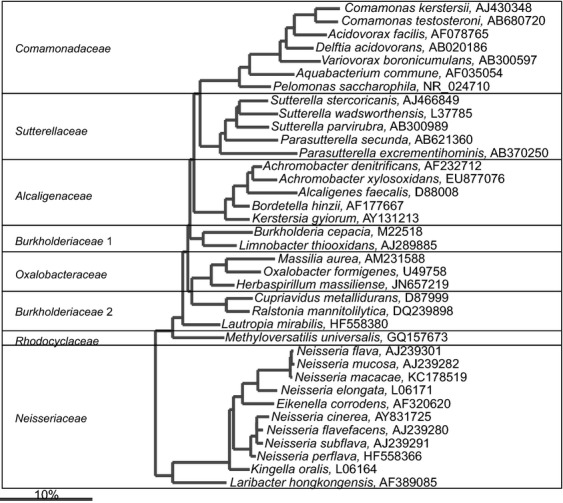
Fig 22 Phylogenetic tree the human gastrointestinal species that belong to the class of the Betaproteobacteria. GenBank Accession Numbers of the SSU rRNA gene sequence are provided for each species and the family names are indicated.
Fig 22 Phylogenetic tree the human gastrointestinal species that belong to the class of the Betaproteobacteria. GenBank Accession Numbers of the SSU rRNA gene sequence are provided for each species and the family names are indicated.CC BY-NC · PubMed Central
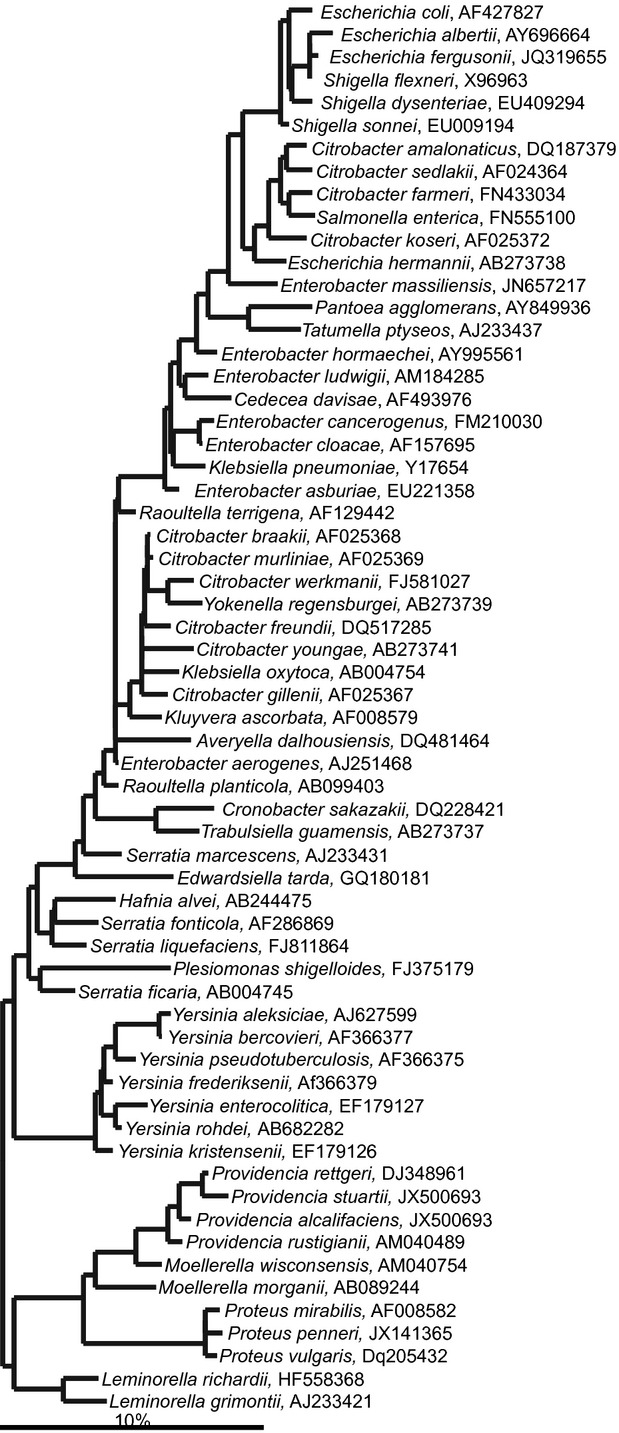
Fig 23 Phylogenetic tree the human gastrointestinal species that belong to the family of the Enterobacteriaceae. GenBank Accession Numbers of the SSU rRNA gene sequence are provided for each species and the family names are indicated.
Fig 23 Phylogenetic tree the human gastrointestinal species that belong to the family of the Enterobacteriaceae. GenBank Accession Numbers of the SSU rRNA gene sequence are provided for each species and the family names are indicated.CC BY-NC · PubMed Central
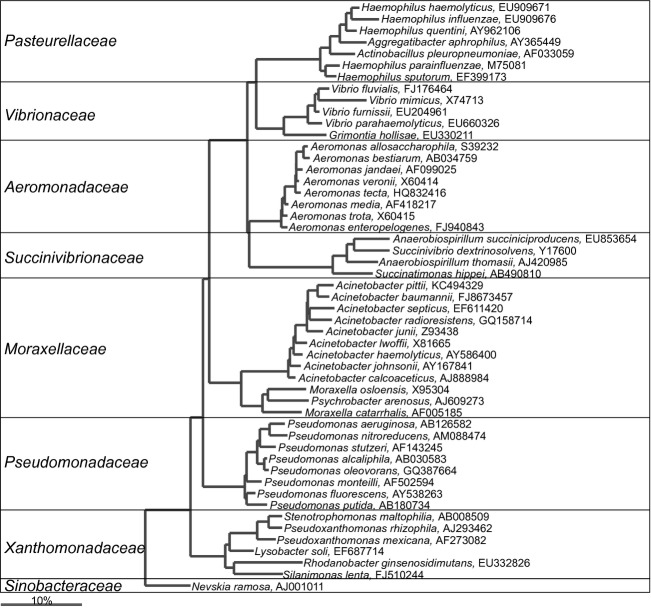
Fig 24 Phylogenetic tree the human gastrointestinal species that belong to the class of the Gammaproteobacteria without Enterobacteriaceae family. GenBank Accession Numbers of the SSU rRNA gene sequence are provided for each species and the family names are indicated.
Fig 24 Phylogenetic tree the human gastrointestinal species that belong to the class of the Gammaproteobacteria without Enterobacteriaceae family. GenBank Accession Numbers of the SSU rRNA gene sequence are provided for each species and the family names are indicated.CC BY-NC · PubMed Central
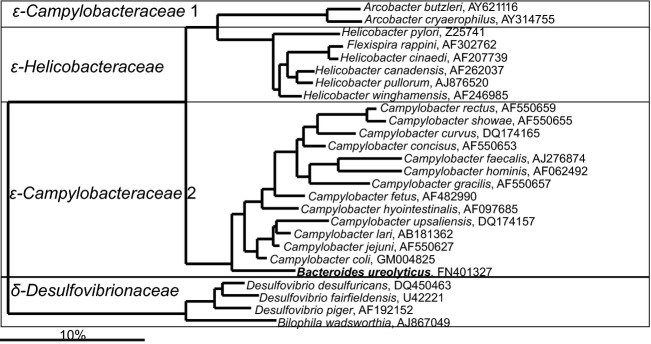
Fig 25 Phylogenetic tree the human gastrointestinal species that belong to the classes of the Deltaproteobacteria and Epsilonproteobacteria. GenBank Accession Numbers of the SSU rRNA gene sequence are provided for each species and the family names are indicated. The species indicated in bold is based on the SSU rRNA gene sequence clustering within the indicated family in contrast to its official classification.
Fig 25 Phylogenetic tree the human gastrointestinal species that belong to the classes of the Deltaproteobacteria and Epsilonproteobacteria. GenBank Accession Numbers of the SSU rRNA gene sequence are provided for each species and the family names are indicated. The species indicated in bold is based on the SSU rRNA gene sequence clustering within the indicated family in contrast to its official classification.CC BY-NC · PubMed Central
Fig 26 Phylogenetic tree the human gastrointestinal species that belong to the different bacterial phyla with limited diversity, and two archaeal phyla. GenBank Accession Numbers of the SSU rRNA gene sequence are provided for each species and the phylum names are indicated.
Fig 26 Phylogenetic tree the human gastrointestinal species that belong to the different bacterial phyla with limited diversity, and two archaeal phyla. GenBank Accession Numbers of the SSU rRNA gene sequence are provided for each species and the phylum names are indicated.CC BY-NC · PubMed Central
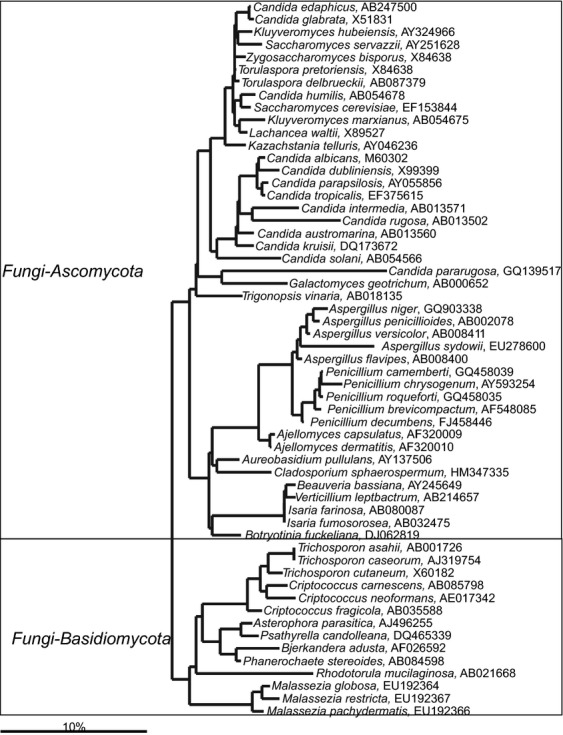
Fig 27 Phylogenetic tree the human gastrointestinal Fungi. GenBank Accession Numbers of the SSU rRNA gene sequence are provided for each species and the phylum names are indicated.
Fig 27 Phylogenetic tree the human gastrointestinal Fungi. GenBank Accession Numbers of the SSU rRNA gene sequence are provided for each species and the phylum names are indicated.CC BY-NC · PubMed Central
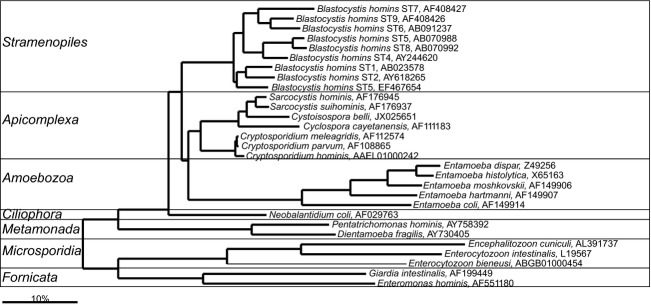
Fig 28 Phylogenetic tree the human gastrointestinal microeukarya. GenBank Accession Numbers of the SSU rRNA gene sequence are provided for each species and the phylum names are indicated.
Fig 28 Phylogenetic tree the human gastrointestinal microeukarya. GenBank Accession Numbers of the SSU rRNA gene sequence are provided for each species and the phylum names are indicated.CC BY-NC · PubMed Central

Verification

Claims the paper makes

The claims and statistics of this paper haven’t been checked yet.

Run the check — free, no account needed. It reads the open-access text and checks the sources it cites.

A few free checks a day · papers already verified open instantly · results are public

Claims other papers make about this one

Each is checked against this paper’s own text: does it say what the citing paper says it does?

Self-check

Percentages, sums and reported differences re-computed from the paper’s own numbers.

The self-check needs the paper’s full text.

Citations

Cites

3 retracted

Show all 375 references

Research works printed but not linked: 13

  1. Alexieff, 1911, Sur la nature des formations dites ‘Kystes de Trichomonas intestinalis’, CR Soc Biol, 71, 296
  2. Aslam, 1992, Hydrogen sulphide induced damage to the colonic mucosal barrier in the rat, Gut, 33, S69
  3. Distaso, 1911, Sur les microbes protéolytiques de la flore intestinale de l'homme et des animaux, Zbl Bakt Parasit, 59, 97
  4. Hungate RE (1969) Methods in Microbiology. Academic Press, London.
  5. Knorr, 1922, Über die fusispirillare Symbiose, die Gattung Fusobacterium (K. B. Lehman) und Spirillum sputigenum. Die Gattung Fusobacterium, Zbl Bakt Parasit, 87, 536
  6. Kohlbrugge JHI (1901). Die Atiologie der Aphthae tropicae. Archiv für Schiffs- und Tropen-Hygiene, Vol. 5 ( Cassel CM , ed.), pp. 394–397. Johann Amrosius Barth, Leipzig.
  7. Levy, 1946, A gastroenteritis outbreak probably due to a bovine strain of Vibrio, Yale J Biol Med, 18, 243
  8. Metchnikoff, 1908, Etude sur la flore intestinale, Ann Inst Pasteur, 22, 929
  9. Moro, 1900, Ueber den Bacillus acidophilus, Jahrb Kinderh, 52, 38
  10. Petruschky, 1896, Bacillus faecalis alcaligenes (n.sp.), Zentbl Bakteriol Parasitenk Infektionskr Hyg Abt I, 19, 187
  11. Tissier, 1908, Recherches sur la flore intestinale normale des enfants ages dún an a cin. ans, Ann Inst Pasteur, 22, 189
  12. Veillon, 1898, Recherches sur quelques microbes strictement anaerobies et leur role en pathologie, Arch Med Exp Anat Pathol, 10, 517
  13. Welch, 1892, A gas producing bacillus (Bacillus aerogenes capsulatus, nov. spec.) capable of rapid development in the blood vessels after death, Bull Johns Hopkins Hosp, 3, 81

Cited by

Sorted by citations

See all 1,182

Metadata

Authors
Rajilić-Stojanović, M., & de Vos, W. M.
Affiliations
University of Belgrade (RS)
Venue
FEMS Microbiology Reviews
Published
2014-09
Volume
38
Issue
5
Pages
996-1047
ISSN
  • 0168-6445 (ISSN-L)
  • 1574-6976
OpenAlex
W2126295648
Cited by
1,182
References
375
Citations by year
2026: 44 · 2025: 86 · 2024: 107 · 2023: 109 · 2022: 135 · 2021: 132 · 2020: 136 · 2019: 128 · 2018: 110 · 2017: 92 · 2016: 66 · 2015: 32 · 2014: 4
FWCI
6.10
Type
journal article
Language
en
Open access
Locations
  • FEMS Microbiology Reviews (publishedVersion)
  • PubMed Central (publishedVersion, cc-by-nc)
  • PubMed (publishedVersion)
  • TechnoRep (University of Belgrade – Faculty of Technology and Metallurgy) (publishedVersion, other-oa)
  • Socio-Environmental Systems Modeling (acceptedVersion)
  • Työväentutkimus Vuosikirja (submittedVersion)
  • Data Archiving and Networked Services (DANS) (submittedVersion)
Funders
FP7 Ideas: European Research Council (250172)
Topics
  • Life Sciences › Biochemistry, Genetics and Molecular Biology › Molecular Biology › Gut microbiota and health
  • Physical Sciences › Environmental Science › Ecology › Microbial Community Ecology and Physiology
  • Health Sciences › Nursing › Nutrition and Dietetics › Infant Nutrition and Health
Keywords
intestinal microorganisms, small subunit rRNA phylogeny, archaea, microbial physiology, microbial genetics, host-microbe interactions, health and disease
MeSH terms
Archaea, Bacteria, Humans, Bacterial Physiological Phenomena, Gastrointestinal Tract, Biodiversity, Eukaryota

About these checks

Registry, retraction, Cites and statistics results are computed, not judged, with one exception: a printed reference that no index lists is read once by a model before it counts as a citation error. Claims are extracted by a model and kept only when their quote appears verbatim in the text; each cited source is then checked, with a model’s help, for whether it says what the claim relies on. Those verdicts can be wrong — read the claim’s quote and the cited source before relying on one.

Statistics and arithmetic are recomputed, not judged.

Confidence bands are shown only for fields calibrated on our annotated test set. None is calibrated yet, so no band is shown.

What counts as a claim ›How we measure confidence ›How we check this ›

Are you an author, or do you see a problem with this page? Request a review