

The DOI matches its Crossref record; 1 of the 1 references it cites were found in a registry or an index.
Non‐invasive, ratiometric determination of intracellular pH in Pseudomonas species using a novel genetically encoded indicator
Abstract
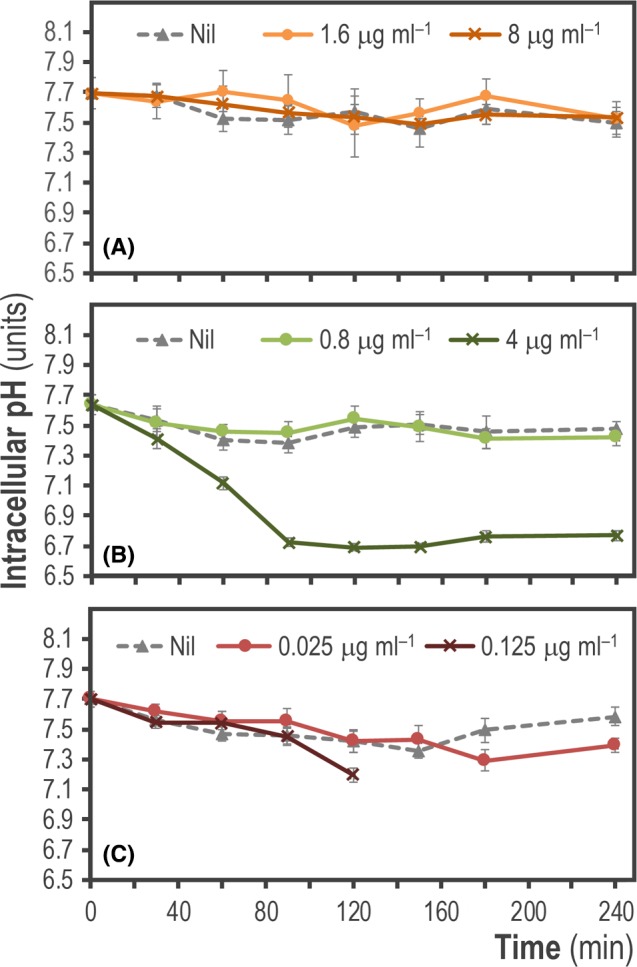
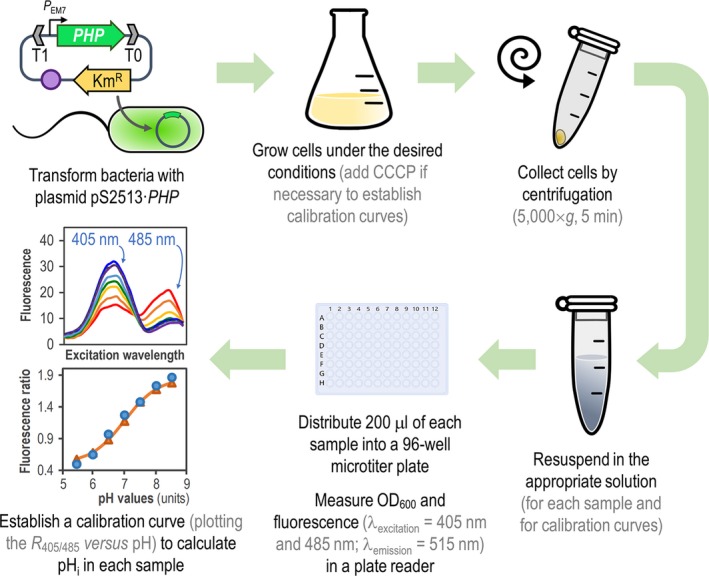
Summary: The ability of Pseudomonas species to thrive in all major natural environments (i.e. terrestrial, freshwater and marine) is based on its exceptional capability to adapt to physicochemical changes. Thus, environmental bacteria have to tightly control the maintenance of numerous physiological traits across different conditions. The intracellular pH ( pH i ) homoeostasis is a particularly important feature, since the pH i influences a large portion of the biochemical processes in the cell. Despite its importance, relatively few reliable, easy‐to‐implement tools have been designed for quantifying in vivo pH i changes in Gram‐negative bacteria with minimal manipulations. Here we describe a convenient, non‐invasive protocol for the quantification of the pH i in bacteria, which is based on the ratiometric fluorescent indicator protein PHP ( pH indicator for P seudomonas ). The DNA sequence encoding PHP was thoroughly adapted to guarantee optimal transcription and translation of the indicator in Pseudomonas species. Our PHP ‐based quantification method demonstrated that pH i is tightly regulated over a narrow range of pH values not only in Pseudomonas , but also in other Gram‐negative bacterial species such as Escherichia coli . The maintenance of the cytoplasmic pH homoeostasis in vivo could also be observed upon internal (e.g. redirection of glucose consumption pathways in P . putida ) and external (e.g. antibiotic exposure in P . aeruginosa ) perturbations, and the PHP indicator was also used to follow dynamic changes in the pH i upon external pH shifts. In summary, our work describes a reliable method for measuring pH i in Pseudomonas , allowing for the detailed investigation of bacterial pH i homoeostasis and its regulation.
Overview
The claims and statistics of this paper haven’t been checked yet.
Run the check — free, no account needed. It reads the open-access text and checks the sources it cites.
Integrity signals
Registry
Cites
Statistics
Figures
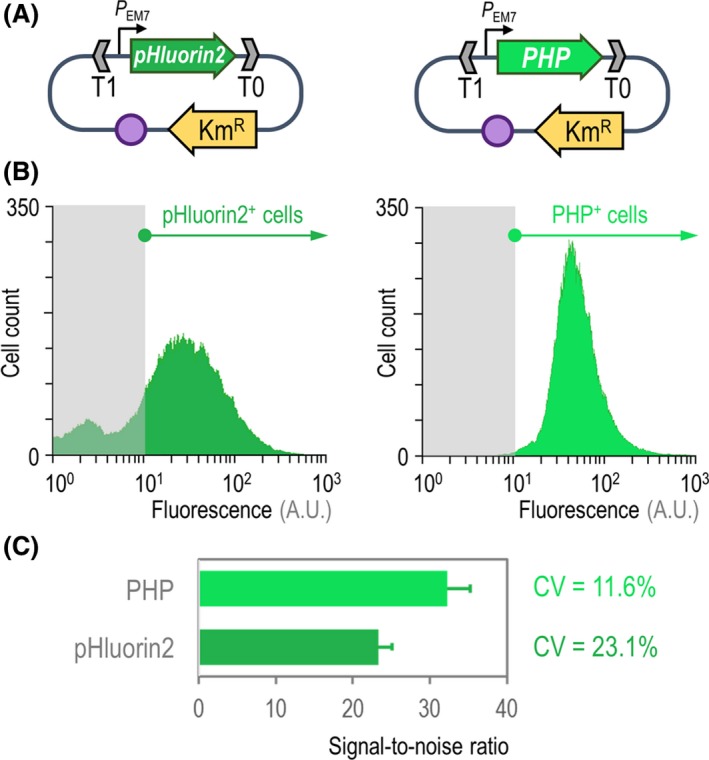
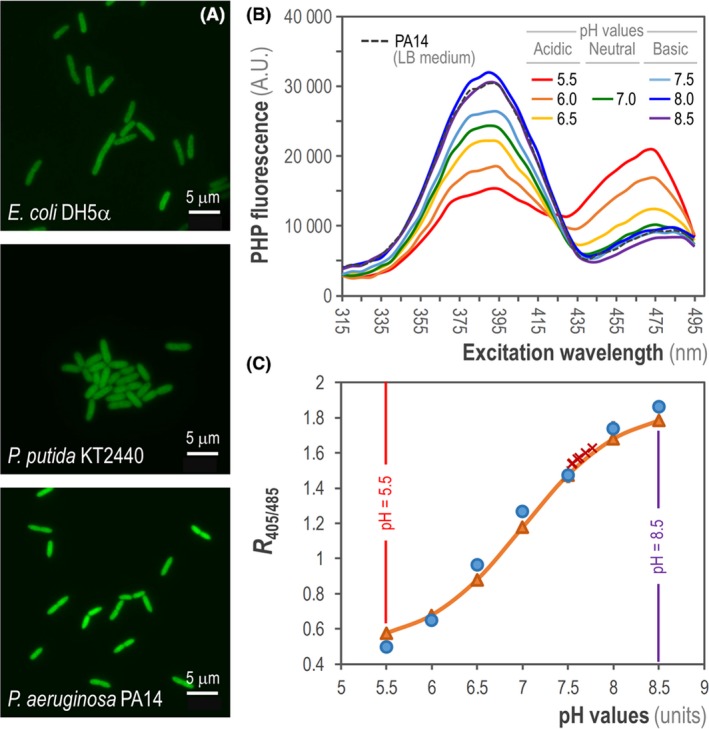
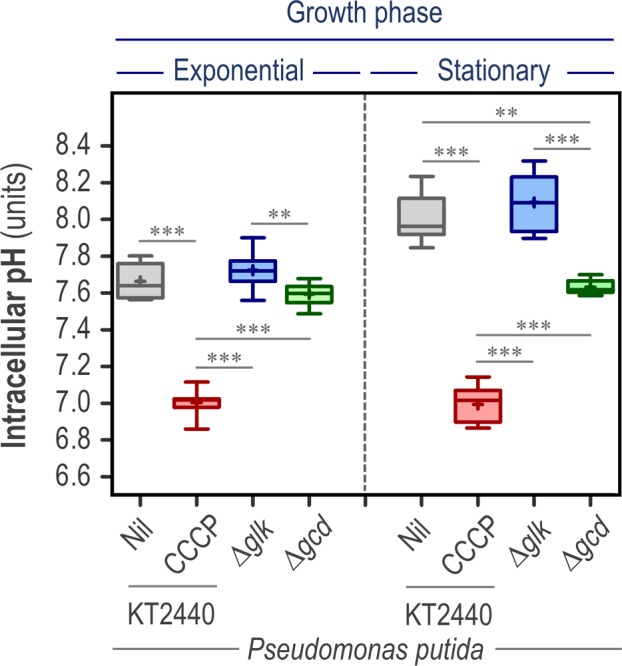
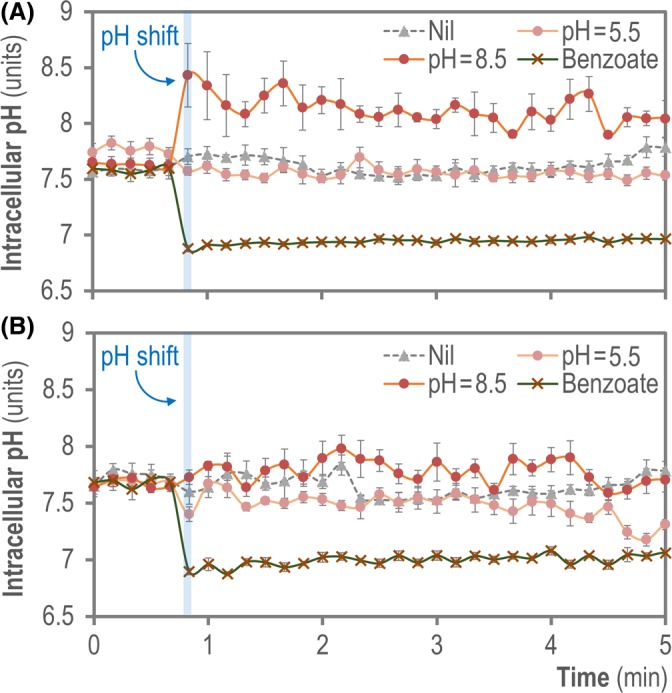
Verification
Claims the paper makes
The claims and statistics of this paper haven’t been checked yet.
Run the check — free, no account needed. It reads the open-access text and checks the sources it cites.
Claims other papers make about this one
Each is checked against this paper’s own text: does it say what the citing paper says it does?
In the citing paper
“Changes in the intracellular change of pH in the presence of NaF were studied by using a non‐invasive, pH‐sensitive fluorescence biosensor (an engineered variant of GFP) borne by plasmid pS2513·PHP (Arce‐Rodríguez et al., 2019).”
From Role of the CrcB transporter of Pseudomonas putida in the multi‐level stress response elicited by mineral fluoride (2022) · cites this paper as Arce‐Rodríguez et al., 2019
In the citing paper
“we used a genetically encoded, non‐invasive pH biosensor that we have previously tailored for Pseudomonas species and other Gram‐negative bacteria (Arce‐Rodríguez et al., 2019).”
From Role of the CrcB transporter of Pseudomonas putida in the multi‐level stress response elicited by mineral fluoride (2022) · cites this paper as Arce‐Rodríguez et al., 2019
Self-check
Percentages, sums and reported differences re-computed from the paper’s own numbers.
The self-check needs the paper’s full text.
Citations
Cites
Weak Organic Acids: A Panoply of Effects on Bacteria
Hirshfield, I. N., Terzulli, S., & O'Byrne, C. (2003) · Science Progress · doi:10.3184/003685003783238626 · Cited by 245
Research works printed but not linked: 89
- 10.1128/jb.171.12.6782-6790.1989 · DOI
- 10.1128/mBio.01512-18 · DOI · Paper page
- 10.1006/bbrc.2001.6004 · DOI
- 10.1016/0378-1119(81)90080-9 · DOI
- 10.1128/mSphere.00176-16 · DOI
- 10.7573/dic.212527 · DOI
- 10.1111/1462-2920.13230 · DOI · Paper page
- 10.3390/s131216736 · DOI
- 10.1016/j.ymben.2015.11.004 · DOI
- 10.1007/s00253-016-7832-x · DOI
- 10.1093/emboj/17.20.6061 · DOI
- 10.1128/mr.49.4.359-378.1985 · DOI
- 10.1128/aem.62.1.178-183.1996 · DOI
- 10.1111/1751-7915.13292 · DOI
- 10.1038/nrm2820 · DOI · Paper page
- 10.1128/JB.00203-07 · DOI
- 10.1007/978-3-319-32189-9_6 · DOI
- 10.1111/j.1365-2958.2004.04155.x · DOI
- 10.1371/journal.pone.0144650 · DOI
- 10.1128/MMBR.51.3.341-350.1987 · DOI
- 10.1128/AAC.37.11.2506 · DOI
- 10.1007/BF01871715 · DOI
- 10.1128/AAC.28.2.200 · DOI
- 10.1016/j.biotechadv.2017.08.001 · DOI
- 10.3390/antibiotics8020037 · DOI
- 10.1021/bi8009482 · DOI
- 10.1002/biot.201800439 · DOI
- 10.1046/j.1365-2958.2003.03877.x · DOI
- 10.1128/JB.187.5.1581-1590.2005 · DOI
- 10.1021/acs.est.6b00288 · DOI
- Ghoul M., 1989, Effect of carbonyl cyanide m‐chlorophenylhydrazone on Escherichia coli halotolerance, Appl Environ Microbiol, 55, 1040, 10.1128/aem.55.4.1040-1043.1989 · DOI
- 10.1002/cyto.a.23250 · DOI
- Green M.R., 2012, Molecular Cloning: A Laboratory Manual
- 10.1016/B978-0-12-420138-5.00023-9 · DOI
- 10.1021/cr900249z · DOI
- 10.1038/373663b0 · DOI
- 10.1093/nar/gky895 · DOI
- 10.1128/AEM.71.5.2501-2510.2005 · DOI
- 10.1038/nrmicro2549 · DOI · Paper page
- 10.1111/j.1462-2920.2005.00913.x · DOI
- Lambert P.A., 2002, Mechanisms of antibiotic resistance in Pseudomonas aeruginosa, J Roy Soc Med, 95, 22
- 10.1128/jb.179.23.7595-7599.1997 · DOI
- 10.3389/fcimb.2017.00059 · DOI
- 10.1128/JB.182.17.4764-4772.2000 · DOI
- 10.1073/pnas.95.12.6803 · DOI
- 10.4236/abb.2011.23021 · DOI
- 10.1073/pnas.82.23.8129 · DOI
- 10.1128/AEM.00354-12 · DOI
- 10.1021/bi047581f · DOI
- 10.1038/28190 · DOI
- 10.1016/0304-4165(91)90014-8 · DOI
- 10.3389/fmicb.2013.00422 · DOI
- Nikel P.I., 2016, Hydrocarbon and Lipid Microbiology Protocols–Synthetic and Systems Biology–Tools, 39
- 10.1016/j.ymben.2012.09.006 · DOI
- 10.1016/j.nbt.2014.02.006 · DOI
- 10.1016/j.ymben.2018.05.005 · DOI · Paper page
- 10.1159/000111992 · DOI
- 10.1074/jbc.M115.687749 · DOI
- 10.1111/1462-2920.13434 · DOI
- 10.1021/es990646v · DOI
- 10.1128/AAC.44.4.827-834.2000 · DOI
- 10.1128/mBio.00500-17 · DOI
- 10.1128/AEM.68.8.4145-4147.2002 · DOI
- 10.1016/j.bbamem.2005.09.010 · DOI
- 10.1038/s41598-018-30367-z · DOI
- 10.1128/JB.00101-06 · DOI · Paper page
- 10.1023/A:1018492217623 · DOI
- 10.1111/j.1745-6584.2006.00199.x · DOI
- 10.1021/bi00522a006 · DOI
- 10.1016/j.jbiotec.2017.05.006 · DOI
- 10.1021/acssynbio.6b00230 · DOI
- 10.1016/j.ymben.2019.04.005 · DOI
- 10.1038/nmeth.2019 · DOI · Paper page
- 10.1016/j.micres.2005.06.002 · DOI
- 10.1128/JB.01368-07 · DOI
- Sharrow S.O., 2001, Analysis of flow cytometry data, Curr Protoc Immunol, 5, 5.2.1‐5.2.10
- 10.1128/AAC.00784-19 · DOI
- 10.1002/(SICI)1097-0290(19961005)52:1<176::AID-BIT18>3.0.CO;2-M · DOI
- 10.1093/nar/gks1119 · DOI
- Slonczewski J.L., 2009, Cytoplasmic pH measurement and homeostasis in bacteria and archaea, Adv Microb Physiol, 55, 799
- 10.1007/978-3-319-43676-0_57-1 · DOI
- 10.1128/mSphere.00276-17 · DOI
- 10.1111/1751-7915.13383 · DOI
- 10.1016/bs.ampbs.2018.06.002 · DOI
- 10.1038/nprot.2007.521 · DOI · Paper page
- 10.1111/1751-7915.13396 · DOI
- 10.1128/jb.152.2.636-642.1982 · DOI
- 10.1038/nprot.2011.432 · DOI
- 10.1371/journal.pone.0135198 · DOI
Cited by
Sorted by citations
Calero, P., Gurdo, N., & Nikel, P. I. (2022) · Environmental Microbiology · doi:10.1111/1462-2920.16110 · Cited by 56
Self-citation
Metadata
- Authors
- Arce‐Rodríguez, A., Volke, D. C., Bense, S., Häussler, S., & Nikel, P. I.
- Affiliations
- Department of Molecular Bacteriology Helmholtz Centre for Infection Research 38124 Braunschweig Germany
- The Novo Nordisk Foundation Center for Biosustainability Technical University of Denmark 2800 Kongens Lyngby Denmark
- Venue
- Microbial Biotechnology
- Publisher
- Wiley
- Published
- 2019-06-04
- Volume
- 12
- Issue
- 4
- Pages
- 799-813
- ISSN
- 1751-7915
- PMC
- PMC6559197
- Cited by
- 40
- References
- 1
- Language
- en
- Funders
- Novo Nordisk Fonden (NNF10CC1016517)
- Horizon 2020 Framework Programme (814418)
- Communities Foundation of Texas (SRC 017)
- H2020 European Research Council (COMBAT 724290)
About these checks
Registry, retraction, Cites and statistics results are computed, not judged, with one exception: a printed reference that no index lists is read once by a model before it counts as a citation error. Claims are extracted by a model and kept only when their quote appears verbatim in the text; each cited source is then checked, with a model’s help, for whether it says what the claim relies on. Those verdicts can be wrong — read the claim’s quote and the cited source before relying on one.
Statistics and arithmetic are recomputed, not judged.
Confidence bands are shown only for fields calibrated on our annotated test set. None is calibrated yet, so no band is shown.
What counts as a claim ›How we measure confidence ›How we check this ›
Are you an author, or do you see a problem with this page? Request a review
