

The DOI matches its Crossref record; 3 of the 3 references it cites were found in a registry or an index.
Tau‐induced nuclear envelope invagination causes a toxic accumulation of mRNA in Drosophila
Abstract
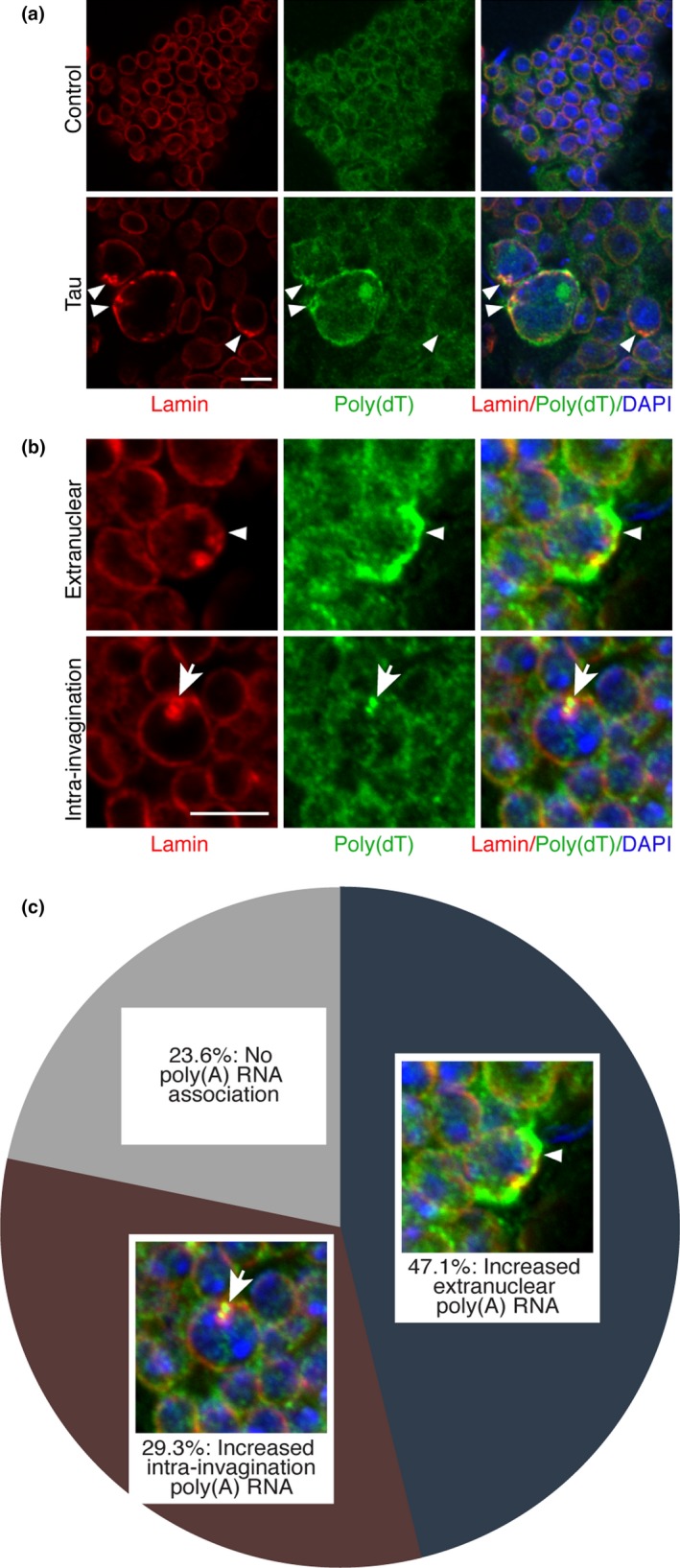
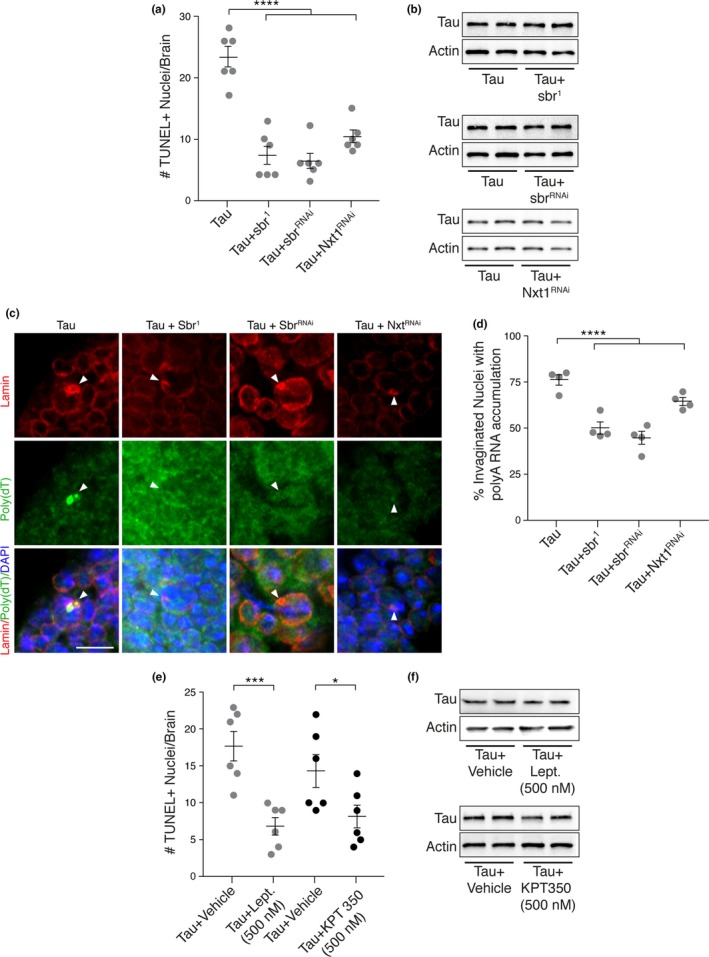
The nucleus is a spherical dual‐membrane bound organelle that encapsulates genomic DNA. In eukaryotes, messenger RNAs (mRNA) are transcribed in the nucleus and transported through nuclear pores into the cytoplasm for translation into protein. In certain cell types and pathological conditions, nuclei harbor tubular invaginations of the nuclear envelope known as the “nucleoplasmic reticulum.” Nucleoplasmic reticulum expansion has recently been established as a mediator of neurodegeneration in tauopathies, including Alzheimer's disease. While the presence of pore‐lined, cytoplasm‐filled, nuclear envelope invaginations has been proposed to facilitate the rapid export of RNAs from the nucleus to the cytoplasm, the functional significance of nuclear envelope invaginations in regard to RNA export in any disorder is currently unknown. Here, we report that polyadenylated RNAs accumulate within and adjacent to tau‐induced nuclear envelope invaginations in a Drosophila model of tauopathy. Genetic or pharmacologic inhibition of RNA export machinery reduces accumulation of polyadenylated RNA within and adjacent to nuclear envelope invaginations and reduces tau‐induced neuronal death. These data are the first to point toward a possible role for RNA export through nuclear envelope invaginations in the pathogenesis of a neurodegenerative disorder and suggest that nucleocytoplasmic transport machinery may serve as a possible novel class of therapeutic targets for the treatment of tauopathies.
Overview
The claims and statistics of this paper haven’t been checked yet.
Run the check — free, no account needed. It reads the open-access text and checks the sources it cites.
Integrity signals
Registry
Cites
Statistics
Figures
Verification
Claims the paper makes
The claims and statistics of this paper haven’t been checked yet.
Run the check — free, no account needed. It reads the open-access text and checks the sources it cites.
Claims other papers make about this one
Each is checked against this paper’s own text: does it say what the citing paper says it does?
In the citing paper
“also, more subtle forms of Tau accumulations, for example around the nucleus, can occur (Eftekharzadeh et al, 2018; Cornelison et al, 2019).”
From Molecular crowding and RNA synergize to promote phase separation, microtubule interaction, and seeding of Tau condensates (2022) · cites this paper as Cornelison et al, 2019
In the citing paper
“Tau accumulating at the nuclear envelope was shown to inhibit neuronal nucleocytoplasmic transport of proteins (Eftekharzadeh et al, 2018) and RNA (Cornelison et al, 2019)”
From Molecular crowding and RNA synergize to promote phase separation, microtubule interaction, and seeding of Tau condensates (2022) · cites this paper as Cornelison et al, 2019
In the citing paper
“It was suggested that Tau at the NE interacts with nuclear pore complexes, thereby impairing the nucleocytoplasmic transport (NCT) of proteins (Eftekharzadeh et al, 2018) and RNA (Cornelison et al, 2019).”
From Molecular crowding and RNA synergize to promote phase separation, microtubule interaction, and seeding of Tau condensates (2022) · cites this paper as Cornelison et al, 2019
In the citing paper
“Since nuclear envelope Tau can impair protein and RNA transport in and out of the nucleus (Eftekharzadeh et al, 2018; Cornelison et al, 2019), our findings provide a novel and intriguing link between Tau condensation and neurotoxicity in the brain.”
From Molecular crowding and RNA synergize to promote phase separation, microtubule interaction, and seeding of Tau condensates (2022) · cites this paper as Cornelison et al, 2019
Self-check
Percentages, sums and reported differences re-computed from the paper’s own numbers.
The self-check needs the paper’s full text.
Citations
Cites
GGGGCC repeat expansion in C9orf72 compromises nucleocytoplasmic transport
Freibaum, B. D., Lu, Y., Lopez-Gonzalez, R., Kim, N. C., Almeida, S., Lee, K.-H., Badders, N., Valentine, M., Miller, B. L., Wong, P. C., et al. (2015) · Nature · doi:10.1038/nature14974 · Cited by 841
Arendt, T., Stieler, J. T., & Holzer, M. (2016) · Brain Research Bulletin · doi:10.1016/j.brainresbull.2016.08.018 · Cited by 609
Tau promotes neurodegeneration through global chromatin relaxation
Frost, B., Hemberg, M., Lewis, J., & Feany, M. B. (2014) · Nature Neuroscience · doi:10.1038/nn.3639 · Cited by 495
Self-citation
Research works printed but not linked: 11
- 10.1038/s41593-017-0047-3 · DOI
- 10.1080/19491034.2016.1183859 · DOI · Paper page
- 10.1016/j.cub.2015.11.039 · DOI · Paper page
- 10.1016/j.neuron.2017.03.027 · DOI
- 10.1038/nn.3953 · DOI
- 10.1093/nar/gkw010 · DOI · Paper page
- 10.1016/j.tcb.2011.03.008 · DOI
- 10.1038/ncb2056 · DOI
- 10.1242/jcs.198697 · DOI
- 10.1016/j.jmb.2015.09.023 · DOI
- 10.1126/science.1062382 · DOI · Paper page
Cited by
Interaction of tau with HNRNPA2B1 and N6-methyladenosine RNA mediates the progression of tauopathy
Jiang, L., Lin, W., Zhang, C., Ash, P. E. A., Verma, M., Kwan, J., van Vliet, E., Yang, Z., Cruz, A. L., Boudeau, S., et al. (2021) · Molecular Cell · doi:10.1016/j.molcel.2021.07.038 · Cited by 177
Hochmair, J., Exner, C., Franck, M., Dominguez‐Baquero, A., Diez, L., Brognaro, H., Kraushar, M. L., Mielke, T., Radbruch, H., Kaniyappan, S., et al. (2022) · The EMBO Journal · doi:10.15252/embj.2021108882 · Cited by 106
Nuclear pore complexes — a doorway to neural injury in neurodegeneration
Coyne, A. N., & Rothstein, J. D. (2022) · Nature Reviews Neurology · doi:10.1038/s41582-022-00653-6 · Cited by 96
McMillan, P. J., Strovas, T. J., Baum, M., Mitchell, B. K., Eck, R. J., Hendricks, N., Wheeler, J. M., Latimer, C. S., Keene, C. D., & Kraemer, B. C. (2021) · Acta Neuropathologica Communications · doi:10.1186/s40478-021-01219-1 · Cited by 64
m6A-dependent circular RNA formation mediates tau-induced neurotoxicity
Atrian, F., Ramirez, P., De Mange, J., Marquez, M., Gonzalez, E. M., Minaya, M., Karch, C. M., & Frost, B. (2024) · doi:10.1101/2024.01.25.577211 · Cited by 7
Self-citation
Metadata
- Authors
- Cornelison, G. L., Levy, S. A., Jenson, T., & Frost, B.
- Venue
- Aging Cell
- Publisher
- Wiley
- Published
- 2018-11-09
- Volume
- 18
- Issue
- 1
- ISSN
- 1474-9718
- 1474-9726
- PMC
- PMC6351838
- Cited by
- 67
- References
- 3
- Language
- en
- Funders
- National Institute on Aging (T32 AG 21890‐14)
- National Institute of Neurological Disorders and Stroke (R00 NS 088429)
- American Federation for Aging Research (2017 New Investigator in Alzheimer's Disease)
About these checks
Registry, retraction, Cites and statistics results are computed, not judged, with one exception: a printed reference that no index lists is read once by a model before it counts as a citation error. Claims are extracted by a model and kept only when their quote appears verbatim in the text; each cited source is then checked, with a model’s help, for whether it says what the claim relies on. Those verdicts can be wrong — read the claim’s quote and the cited source before relying on one.
Statistics and arithmetic are recomputed, not judged.
Confidence bands are shown only for fields calibrated on our annotated test set. None is calibrated yet, so no band is shown.
What counts as a claim ›How we measure confidence ›How we check this ›
Are you an author, or do you see a problem with this page? Request a review
How to cite
Cite CoChat for the checks on this page, and the paper for its own findings.
- This page
- CoChat. (2026). Citation check: Tau‐induced nuclear envelope invagination causes a toxic accumulation of mRNA in Drosophila. https://app.cochat.ai/papers/10.1111/acel.12847
- The paper
- Cornelison, G. L., Levy, S. A., Jenson, T., & Frost, B. (2019). Tau‐induced nuclear envelope invagination causes a toxic accumulation of mRNA in Drosophila. Aging Cell. https://doi.org/10.1111/acel.12847
Data sources
Bibliographic data: Semantic Scholar, OpenAlex, Crossref.
Contains information from the Semantic Scholar Academic Graph Datasets, made available under the ODC Attribution License (ODC-BY 1.0).
Semantic Scholar’s data is described in: Kinney, R., et al. (2023). The Semantic Scholar Open Data Platform. arXiv:2301.10140.
