

The DOI matches its Crossref record; 18 of the 18 references it cites were found in a registry or an index.
The effects of psychotherapies for depression on response, remission, reliable change, and deterioration: A meta‐analysis
Abstract
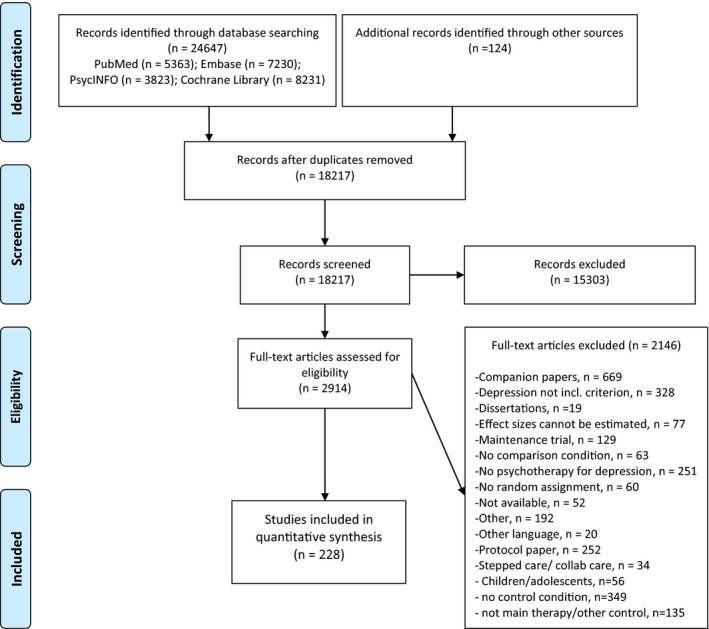
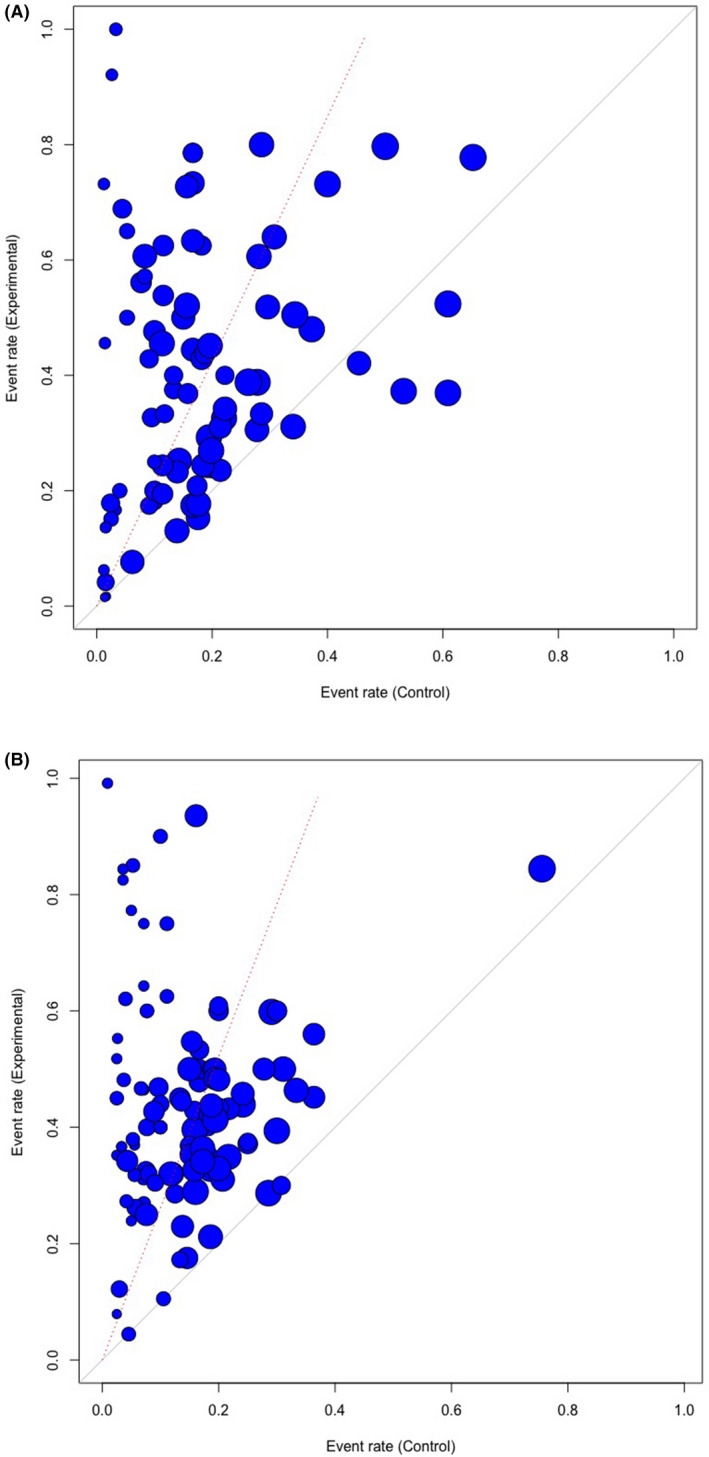
Objective: Meta‐analyses of psychotherapies usually report effects sizes, while clinicians and patients need to know the proportion of patients who benefit from therapy. We conducted a meta‐analysis of therapies for depression reporting the rates of response (50% symptom reduction), remission (HAM‐D <7), clinical significant deterioration for psychotherapy, and control conditions (CAU, waitlist, and pill placebo), as well as the relative risk of these outcomes and the numbers‐needed‐to‐be‐treated (NNTs). Methods: We searched bibliographic databases and included 228 randomized trials comparing psychotherapy for depression against control conditions (75 with low risk of bias). Only therapies with at least 10 trials were included. We extracted outcomes from the studies, and for those studies not reporting the outcomes, we used a validated method to estimate the rates. Results: The overall response rate in psychotherapies at 2 (±1) months after baseline was 41% (95% CI: 38~43), 17% (15~20) for usual care (CAU), and 16% (95% CI: 14~18) for waitlist. No significant differences between types of therapy were found. The NNT for therapy versus CAU was 5.3 and versus waitlist 3.9. About one third of patients remitted after therapy compared with 7%–13% in control conditions. The rates of deterioration were 5% versus 12%–13%, respectively. Most sensitivity analyses supported the general findings. Conclusion: Psychotherapies for depression may be effective compared with control conditions, but more than half of patients receiving therapy do not respond and only one third remitted. More effective treatments and treatment strategies such as sequencing and combining treatments are clearly needed.
Overview
The claims and statistics of this paper haven’t been checked yet.
Run the check — free, no account needed. It reads the open-access text and checks the sources it cites.
Integrity signals
Registry
Cites
Statistics
Figures
Verification
Claims the paper makes
The claims and statistics of this paper haven’t been checked yet.
Run the check — free, no account needed. It reads the open-access text and checks the sources it cites.
Claims other papers make about this one
Each is checked against this paper’s own text: does it say what the citing paper says it does?
In the citing paper
“Nevertheless, several methodological reviews highlight common issues in psychotherapy RCTs, such as poor controls, high dropout rates, inconsistent intervention fidelity, incomplete adverse effect reporting, and selection bias (Bertolín-Guillén, 2024;Crotty et al., 2024;Cuijpers et al., 2021;Melo-Carrillo et al., 2023).”
From Effectiveness Of Narrative Therapy In Addressing Psychological Challenges: A Systematic Review Of Randomised Controlled Trials (2026) · cites this paper as Cuijpers et al., 2021
In the citing paper
“Premature dropout hampers accurate assessment of therapy effectiveness (Melo-Carrillo et al., 2023), and variations in NT implementation reduce the comparability of study results (Cuijpers et al., 2021).”
From Effectiveness Of Narrative Therapy In Addressing Psychological Challenges: A Systematic Review Of Randomised Controlled Trials (2026) · cites this paper as Cuijpers et al., 2021
In the citing paper
“The absence of adverse event reporting hampers risk-benefit analysis (Cuijpers et al., 2021), while weak randomization can introduce selection bias (Bertolín-Guillén, 2024).”
From Effectiveness Of Narrative Therapy In Addressing Psychological Challenges: A Systematic Review Of Randomised Controlled Trials (2026) · cites this paper as Cuijpers et al., 2021
Self-check
Percentages, sums and reported differences re-computed from the paper’s own numbers.
The self-check needs the paper’s full text.
Citations
Cites
The Cochrane Collaboration's tool for assessing risk of bias in randomised trials
Higgins, J. P. T., Altman, D. G., Gotzsche, P. C., Juni, P., Moher, D., Oxman, A. D., Savovic, J., Schulz, K. F., Weeks, L., Sterne, J. A. C., et al. (2011) · BMJ · doi:10.1136/bmj.d5928 · Cited by 33,817
Duval, S., & Tweedie, R. (2000) · Biometrics · doi:10.1111/j.0006-341x.2000.00455.x · Cited by 14,099
The assessment of anxiety states by rating
HAMILTON, M. (1959) · British Journal of Medical Psychology · doi:10.1111/j.2044-8341.1959.tb00467.x · Cited by 11,455
Jacobson, N. S., & Truax, P. (1991) · Journal of Consulting and Clinical Psychology · doi:10.1037/0022-006x.59.1.12 · Cited by 7,770
Frank, E. (1991) · Archives of General Psychiatry · doi:10.1001/archpsyc.1991.01810330075011 · Cited by 1,959
Charlson, F., van Ommeren, M., Flaxman, A., Cornett, J., Whiteford, H., & Saxena, S. (2019) · The Lancet · doi:10.1016/s0140-6736(19)30934-1 · Cited by 1,702
An Assessment of Clinically Useful Measures of the Consequences of Treatment
Laupacis, A., Sackett, D. L., & Roberts, R. S. (1988) · New England Journal of Medicine · doi:10.1056/nejm198806303182605 · Cited by 1,681
Meta-Analysis in Clinical Research
L'ABBÉ, K. A., DETSKY, A. S., & O'ROURKE, K. (1987) · Annals of Internal Medicine · doi:10.7326/0003-4819-107-2-224 · Cited by 1,267
Psychotherapy for depression in adults: A meta-analysis of comparative outcome studies.
Cuijpers, P., van Straten, A., Andersson, G., & van Oppen, P. (2008) · Journal of Consulting and Clinical Psychology · doi:10.1037/a0013075 · Cited by 1,050
Self-citationCuijpers, P., Karyotaki, E., Weitz, E., Andersson, G., Hollon, S. D., & van Straten, A. (2014) · Journal of Affective Disorders · doi:10.1016/j.jad.2014.02.026 · Cited by 586
Self-citation
Research works printed but not linked: 13
- 10.1002/da.22491 · DOI
- 10.1017/S2045796018000057 · DOI
- 10.1001/archpediatrics.2011.97 · DOI
- 10.1177/0269881120922950 · DOI
- 10.1001/jama.2016.17324 · DOI · Paper page
- Cuijpers P, 2021, The effects of psychological treatments of depression on response, remission, reliable change, and deterioration: a meta‐analysis, Open Science Framework
- CuijpersP KaryotakiE.A meta‐analytic database of randomised trials on psychotherapies for depression.2020.https://doi.org/10.17605/OSF.IO/825C6 · DOI
- 10.1002/sim.1186 · DOI · Paper page
- Higgins JPT, 2011, Cochrane Handbook for Systematic Reviews of Interventions Version 5.1.0
- 10.1093/ije/31.1.72 · DOI · Paper page
- 10.4088/JCP.09m05949blu · DOI
- 10.1192/bjp.bp.115.179275 · DOI
- 10.1002/wps.20900 · DOI · Paper page
Cited by
Sorted by citations
Cuijpers, P., Miguel, C., Harrer, M., Plessen, C. Y., Ciharova, M., Ebert, D., & Karyotaki, E. (2023) · World Psychiatry · doi:10.1002/wps.21069 · Cited by 354
Self-citationMore treatment but no less depression: The treatment-prevalence paradox
Ormel, J., Hollon, S. D., Kessler, R. C., Cuijpers, P., & Monroe, S. M. (2022) · Clinical Psychology Review · doi:10.1016/j.cpr.2021.102111 · Cited by 213
Self-citationCuijpers, P., Karyotaki, E., Ciharova, M., Miguel, C., Noma, H., Stikkelbroek, Y., Weisz, J. R., & Furukawa, T. A. (2023) · European Child & Adolescent Psychiatry · doi:10.1007/s00787-021-01884-6 · Cited by 118
Self-citationAndersson, G., Käll, A., Juhlin, S., Wahlström, C., de Fine Licht, E., Färdeman, S., Franck, A., Tholcke, A., Nachtweij, K., Fransson, E., et al. (2023) · Behaviour Research and Therapy · doi:10.1016/j.brat.2023.104265 · Cited by 51
Systematic review and meta-analysis of adverse events in clinical trials of mental health apps
Linardon, J., Fuller-Tyszkiewicz, M., Firth, J., Goldberg, S. B., Anderson, C., McClure, Z., & Torous, J. (2024) · npj Digital Medicine · doi:10.1038/s41746-024-01388-y · Cited by 44
Schramm, E., Elsaesser, M., Jenkner, C., Hautzinger, M., & Herpertz, S. C. (2024) · World Psychiatry · doi:10.1002/wps.21204 · Cited by 34
Negative effects in internet-based interventions for depression: a qualitative content analysis
Fenski, F., Rozental, A., Heinrich, M., Knaevelsrud, C., Zagorscak, P., & Boettcher, J. (2021) · Internet Interventions · doi:10.1016/j.invent.2021.100469 · Cited by 28
Cuijpers, P., Miguel, C., Harrer, M., Ciharova, M., & Karyotaki, E. (2024) · Journal of Affective Disorders · doi:10.1016/j.jad.2024.05.019 · Cited by 30
Self-citationElsaesser, M., Herpertz, S., Piosczyk, H., Jenkner, C., Hautzinger, M., & Schramm, E. (2022) · BMJ Open · doi:10.1136/bmjopen-2021-057672 · Cited by 19
Gloster, A. T., Haller, E., Villanueva, J., Block, V., Benoy, C., Meyer, A. H., Brogli, S., Kuhweide, V., Karekla, M., Bader, K., et al. (2023) · Psychotherapy and Psychosomatics · doi:10.1159/000529411 · Cited by 16
Franken, K., Schuffelen, P., ten Klooster, P., van Doesum, K., Westerhof, G., & Bohlmeijer, E. (2023) · Frontiers in Psychology · doi:10.3389/fpsyg.2023.985408 · Cited by 16
Rickwood, D., McEachran, J., Saw, A., Telford, N., Trethowan, J., & McGorry, P. (2022) · doi:10.1101/2022.08.24.22279102 · Cited by 73
“For adults, almost 60% do 419 not respond to treatment, 41% respond within two months, and 17% respond in 420 control conditions [25].”
BackgroundDelli Colli, C., Viglione, A., Poggini, S., Cirulli, F., Chiarotti, F., Giuliani, A., & Branchi, I. (2025) · Translational Psychiatry · doi:10.1038/s41398-025-03246-1 · Cited by 7
Apolinário-Hagen, J., Drüge, M., Guthardt, L., & Haller, E. (2024) · Advances in Experimental Medicine and Biology · doi:10.1007/978-981-97-4402-2_12 · Cited by 6
Johns, E. K., Kokokyi, S., Neufeld, D., Krysanski, V., & Meek, B. P. (2024) · Journal of Contextual Behavioral Science · doi:10.1016/j.jcbs.2024.100812 · Cited by 2
Permatasari, D. P., Windarwati, H. D., & Lestari, R. (2026) · Indigenous: Jurnal Ilmiah Psikologi · doi:10.23917/indigenous.v11i1.13778
Metadata
- Authors
- Cuijpers, P., Karyotaki, E., Ciharova, M., Miguel, C., Noma, H., & Furukawa, T. A.
- Affiliations
- Department of Clinical, Neuro and Developmental Psychology Amsterdam Public Health Research Institute Vrije Universiteit Amsterdam Amsterdam the Netherlands
- Department of Data Science Institute of Statistical Mathematics Tokyo Japan
- Department of Health Promotion and Human Behavior Kyoto University Graduate School of Medicine/School of Public Health Kyoto Japan
- Venue
- Acta Psychiatrica Scandinavica
- Publisher
- Wiley
- Published
- 2021-07-04
- Volume
- 144
- Issue
- 3
- Pages
- 288-299
- ISSN
- 0001-690X
- 1600-0447
- PMC
- PMC8457213
- Cited by
- 336
- References
- 18
- Language
- en
About these checks
Registry, retraction, Cites and statistics results are computed, not judged, with one exception: a printed reference that no index lists is read once by a model before it counts as a citation error. Claims are extracted by a model and kept only when their quote appears verbatim in the text; each cited source is then checked, with a model’s help, for whether it says what the claim relies on. Those verdicts can be wrong — read the claim’s quote and the cited source before relying on one.
Statistics and arithmetic are recomputed, not judged.
Confidence bands are shown only for fields calibrated on our annotated test set. None is calibrated yet, so no band is shown.
What counts as a claim ›How we measure confidence ›How we check this ›
Are you an author, or do you see a problem with this page? Request a review
