

Pubertal testicular volume references for ruler, orchidometer, and ultrasonography measurements based on a longitudinal follow‐up
Open accessThe DOI matches its Crossref record; 40 of the 41 references it cites were found in a registry or an index, and 1 are not checked yet; none of the 31 sources its claims cite is checked for support yet.
Abstract
Background: Testicular volume is a marker of male pubertal development. Various clinical conditions and their treatments may influence testicular growth. Objectives: To create ruler‐based age‐dependent pubertal testicular volume references that enable calculation of standard deviation (SD) scores. Materials and Methods: Study cohort comprised 65 boys who attended clinical examination twice a year from the age of 8.5 years until the attainment of final testicular size. Forty‐nine (75.4%) boys completed the follow‐up and 16 (24.6%) boys dropped out before the attainment of final post‐pubertal testicular size. At each follow‐up visit testicular size was measured with a ruler, orchidometer, and ultrasonography. LMS or LMSP method served as the technique for creating reference growth curves for testicular volumes. Using the novel references for ruler measurements, development of SD scores was assessed in a cohort of boys with unilateral cryptorchidism. Results: Reference growth curves were constructed separately for ruler, orchidometer, and ultrasonography measurements. Median orchidometer volume of 4 mL, marker of male pubertal onset, occurred at the age of 11.7 years, whereas +2SD curve surpassed 4 mL at 10.2 years and −2SD curve at 13.7 years. Modeled ages at the attainment of 4 mL testicular volume based on ruler measurements were 9.7 years for +2SD curve, 11.5 years for median curve, and 13.6 years for −2SD curve. Ultrasonography‐based volume of 1.3 mL corresponded with the median modeled orchidometer‐based volume of 4 mL. In boys with unilateral cryptorchidism, ruler‐based SD scores decreased during puberty in undescended testes, but not in descended testes. Discussion and Conclusion: The present study provides reference values for pubertal testicular volume measured with a ruler enabling an age‐dependent assessment of testicular size. Comparison with measurements by an orchidometer and ultrasonography is also presented.
Checked 2026-11-27 · 1 reference not checked yet
Overview
CoChat Summary
TL;DR
This longitudinal study of 65 healthy boys constructed age-specific pubertal testicular volume reference curves for ruler, Prader orchidometer, and ultrasonography measurements, including ruler-based SD scores. It reports the first ruler-based references and validates them in boys with unilateral cryptorchidism and Klinefelter syndrome.
Key findings
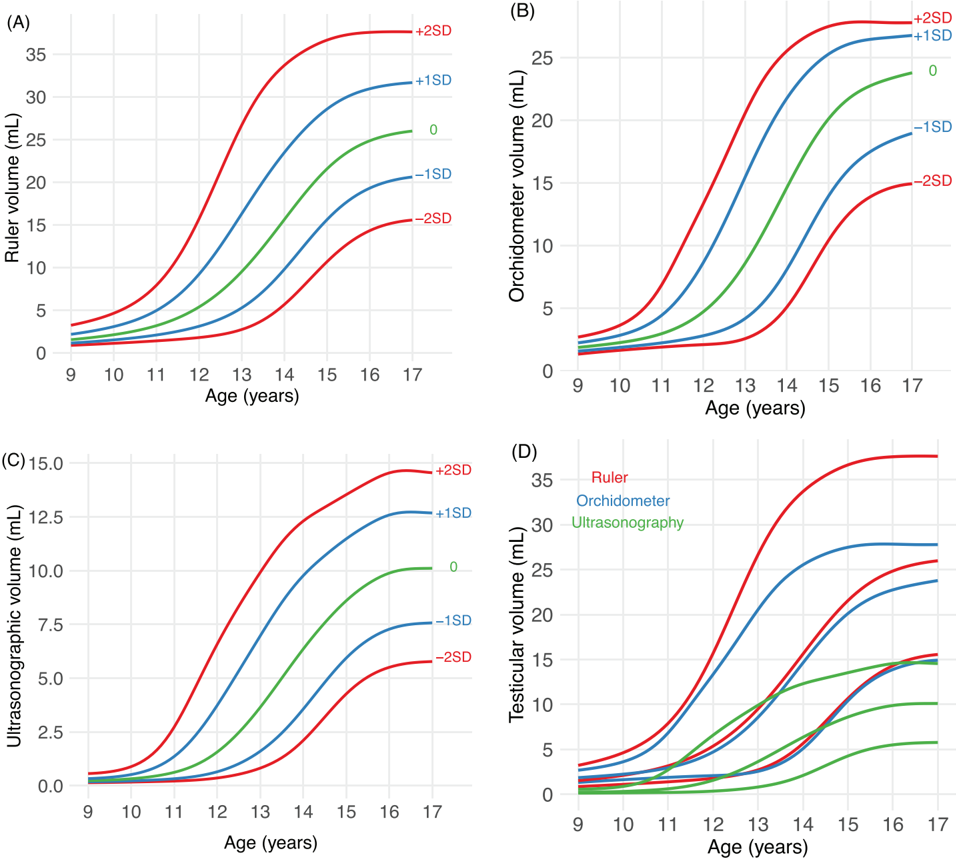
- Reference growth curves were constructed separately for ruler, orchidometer, and ultrasonography measurements. Median orchidometer volume of 4 mL occurred at 11.7 years; the +2SD curve surpassed 4 mL at 10.2 years and the -2SD curve at 13.7 years.
- Modeled ages at attainment of 4 mL by ruler were 9.7 years for +2SD, 11.5 years for median, and 13.6 years for -2SD. Ultrasonography-based volume of 1.3 mL corresponded with the median modeled orchidometer-based volume of 4 mL.
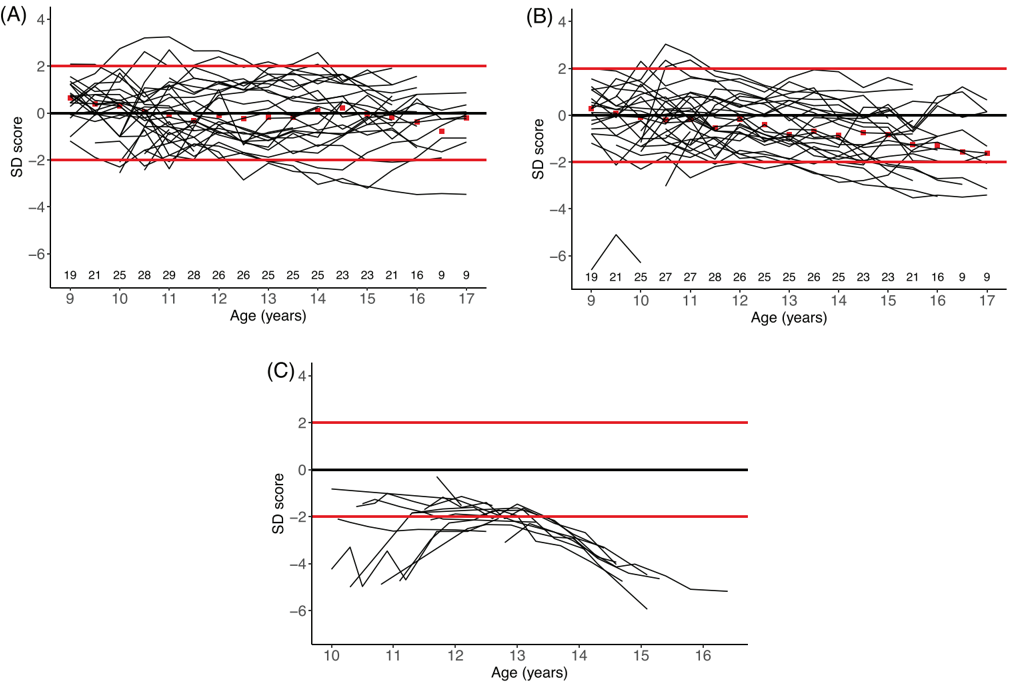
- In boys with unilateral cryptorchidism, ruler-based SD scores decreased during puberty in undescended testes but not in descended testes. In Klinefelter syndrome, all SD scores were below the median growth curve and declined further approximately after age 13 years.
Methods
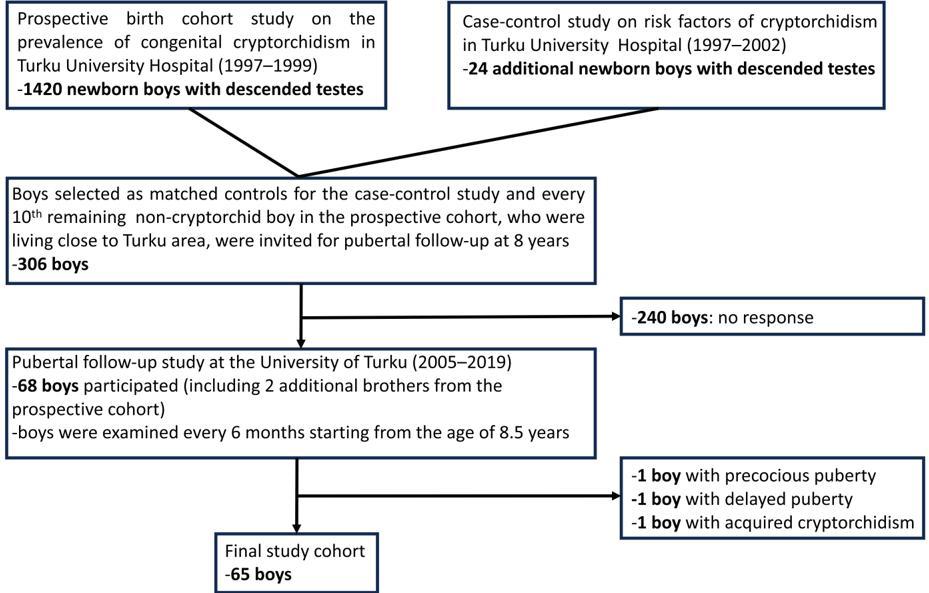
- Longitudinal follow-up of 65 healthy boys with biannual visits from age 8.5 years until attainment of final post-pubertal testicular size; 49 (75.4%) completed follow-up and 16 (24.6%) dropped out. There were 947 testicular volume measurements between ages 8.5 and 17.5 years, plus 99 imputed measurements.
- At each visit, testicular size was measured with a ruler, Prader orchidometer, and ultrasonography; the mean of right and left testicle was used. Ruler- and ultrasonography-based volumes were calculated with the ellipsoid formula (π/6 × length × width²).
- Growth curves were constructed with GAMLSS using the LMS method for ruler measurements and the LMSP method (BCPE distribution) for orchidometer and ultrasonography measurements. Validation used boys with unilateral cryptorchidism (n = 30) and Klinefelter syndrome (n = 14; data extracted from published plots using WebPlotDigitizer).
Limitations
- Stated by the paper: interobserver variation may be noteworthy, particularly for orchidometer; the sample size of 65 longitudinally followed boys limited observations beyond -2SD and +2SD, so SD scores outside these limits should be interpreted with caution; orchidometer volume is discrete but treated as continuous; ultrasonography used only length and width, not the three dimensions recommended by the European Academy of Andrology; median growth curves may not approximate individual growth shape; and curves extend only to age 17 years, so adult testicular volumes cannot be estimated.
- Evident from the text: 24.6% of boys dropped out before attaining final post-pubertal testicular size, imputation was used for boys reaching final size before age 17.5 years, and validation cohorts were small (n = 30 cryptorchidism, n = 14 Klinefelter) with Klinefelter data digitized from published plots.
Model-written summary. Check it against the paper before relying on it.
Integrity signals
Registry
Cites
Statistics
Figures


Verification
Claims the paper makes
0 Valid · 0 Not valid · 16 Not checked · 45 Own results and interpretations
A result the paper reports from its own data — it cites no other source for it, so there is none to check. The quote shows it is in the paper.
In the paper
“Furthermore, to some extent the ruler-based reference curves followed the corresponding orchidometer-based curves.”
§ Pubertal testicular volume references for ruler, orchidometer, and ultrasonography measurements based on a longitudinal follow-up > 4 DISCUSSION
hedgedstates an association- Asserted: passes — The authors put it forward as true.
- Checkable: passes — It can be checked against evidence.
- Load-bearing: passes — The paper’s conclusions depend on it.
- Based: passes — The paper gives a reason why it holds.
A result the paper reports from its own data — it cites no other source for it, so there is none to check. The quote shows it is in the paper.
In the paper
“At the age (11.7 years) when median orchidometer-based testicular volume was 4 mL, modeled median ultrasonography-based volume was 1.3 mL.”
§ Pubertal testicular volume references for ruler, orchidometer, and ultrasonography measurements based on a longitudinal follow-up > 3.1 Study cohort
plain- Asserted: passes — The authors put it forward as true.
- Checkable: passes — It can be checked against evidence.
- Load-bearing: passes — The paper’s conclusions depend on it.
- Based: passes — The paper gives a reason why it holds.
A result the paper reports from its own data — it cites no other source for it, so there is none to check. The quote shows it is in the paper.
In the paper
“In conclusion, the present longitudinal study provides reference growth charts for testicular volume measured with a ruler.”
§ Pubertal testicular volume references for ruler, orchidometer, and ultrasonography measurements based on a longitudinal follow-up > 4 DISCUSSION
plain- Asserted: passes — The authors put it forward as true.
- Checkable: passes — It can be checked against evidence.
- Load-bearing: passes — The paper’s conclusions depend on it.
- Based: passes — The paper gives a reason why it holds.
- Rests on 2 assumptions not shown here.
A result the paper reports from its own data — it cites no other source for it, so there is none to check. The quote shows it is in the paper.
In the paper
“The estimated growth curve for ultrasonography-based testicular volume differed distinctly from the orchidometer-and ruler-based curves (Figure 3D).”
§ Pubertal testicular volume references for ruler, orchidometer, and ultrasonography measurements based on a longitudinal follow-up > 3.1 Study cohort
plain- Asserted: passes — The authors put it forward as true.
- Checkable: passes — It can be checked against evidence.
- Load-bearing: passes — The paper’s conclusions depend on it.
- Based: passes — The paper gives a reason why it holds.
A result the paper reports from its own data — it cites no other source for it, so there is none to check. The quote shows it is in the paper.
In the paper
“The difference in the modeled -2SD rulerand orchidometer-based curves was less than 0.6 mL throughout the pubertal growth”
§ Pubertal testicular volume references for ruler, orchidometer, and ultrasonography measurements based on a longitudinal follow-up > 3.1 Study cohort
plain- Asserted: passes — The authors put it forward as true.
- Checkable: passes — It can be checked against evidence.
- Load-bearing: passes — The paper’s conclusions depend on it.
- Based: passes — The paper gives a reason why it holds.
15 more claims
Create a free account to see all 61 claims and every source verdict.
- Probably not a substantial claim. 24
- It may state two separate claims as one. 30
Self-check
Percentages, sums and reported differences re-computed from the paper’s own numbers.
Each contradiction between two passages listed here was confirmed by an independent check.
Rated minor: it would not touch a result — a value no result rests on, a p-value that stays on the same side of the significance level, or a conflict that is clerical, resolved elsewhere in the paper, or outside its own findings.
In the paper
§ Pubertal testicular volume references for ruler, orchidometer, and ultrasonography measurements based on a longitudinal follow-up > 3.1 Study cohort
“The difference in the modeled -2SD rulerand orchidometer-based curves was less than 0.6 mL throughout the pubertal growth (Figure 3D).”
§ Pubertal testicular volume references for ruler, orchidometer, and ultrasonography measurements based on a longitudinal follow-up > 4 DISCUSSION
“17 15.6 26.0 37.6 14.9 23.8 27.8 5.8 10.1 14.6”
Citations
Cites
Variations in the pattern of pubertal changes in boys
Marshall, W. A., & Tanner, J. M. (1970) · Archives of Disease in Childhood · doi:10.1136/adc.45.239.13 · Cited by 5,147
WHO Child Growth Standards based on length/height, weight and age
WHO MULTICENTRE GROWTH REFERENCE STUDY GROUP, & de Onis, M. (2006) · Acta Paediatrica · doi:10.1111/j.1651-2227.2006.tb02378.x · Cited by 3,977
Generalized additive models for location, scale and shape.
Rigby, R. A., & Stasinopoulos, D. M. (2005) · Journal of the Royal Statistical Society Series C: Applied Statistics · doi:10.1111/j.1467-9876.2005.00510.x · Cited by 3,228
Smoothing reference centile curves: The lms method and penalized likelihood
Cole, T. J., & Green, P. J. (1992) · Statistics in Medicine · doi:10.1002/sim.4780111005 · Cited by 2,781
Sharpe, R. M., McKinnell, C., Kivlin, C., & Fisher, J. S. (2003) · Reproduction · doi:10.1530/rep.0.1250769 · Cited by 1,272
10.1016/b978-1-4160-2911-3.50026-1
(2000) · CrossRef Listing of Deleted DOIs · doi:10.1016/b978-1-4160-2911-3.50026-1 · Cited by 554
Difference in prevalence of congenital cryptorchidism in infants between two Nordic countries
Boisen, K., Kaleva, M., Main, K., Virtanen, H., Haavisto, A.-M., Schmidt, I., Chellakooty, M., Damgaard, I., Mau, C., Reunanen, M., et al. (2004) · The Lancet · doi:10.1016/s0140-6736(04)15998-9 · Cited by 511
Self-citationSaari, A., Sankilampi, U., Hannila, M.-L., Kiviniemi, V., Kesseli, K., & Dunkel, L. (2011) · Annals of Medicine · doi:10.3109/07853890.2010.515603 · Cited by 488
Borghi, E., de Onis, M., Garza, C., Van den Broeck, J., Frongillo, E. A., Grummer-Strawn, L., Van Buuren, S., Pan, H., Molinari, L., Martorell, R., et al. (2006) · Statistics in Medicine · doi:10.1002/sim.2227 · Cited by 450
Flexible Regression and Smoothing: Using GAMLSS in R
Stasinopoulos, M. D., Rigby, R. A., Heller, G. Z., Voudouris, V., & Bastiani, F. D. (2017) · Chapman & Hall/CRC eBooks · doi:10.1201/b21973 · Cited by 405
Research works printed but not linked: 2
- European Commission (grants BMH4-CT96-0314, QLK4-CT-1999- 01422, QLK4-CT-2001-00269, QLK4-2002-00603, and FP7/2008- 2012: DEER 212844); the Academy of Finland (grants 77320, 211480, 121880, 136850, 253341, 308065, 128576); and the Foundation for Pediatric Research. 20472927, 0, Downloaded from https://onlinelibrary.wiley.com/doi/10.1111/andr.13629 by Readcube (Labtiva Inc.), Wiley Online Library on [14/03/2024]. See the Terms and Conditions (https://onlinelibrary.wiley.com/terms-and-conditions) on Wiley Online Library for rules of use; OA articles are governed by the applicable Creative Commons License
- Grumbach MM, Styne DM. Puberty: ontogeny, neuroendocrinol- ogy, physiology, and disorders. In: Melmed S, Polonsky K, Larsen P, Kronenberg H, eds. Williams Textbook of Endocrinology. Elsevier; 2012:1054-1201.
Cited by
Korhonen, M., Jahnukainen, K., & Koskela, M. (2024) · Cancer · doi:10.1002/cncr.35623 · Cited by 13
Self-citationPinhas‐Hamiel, O., Simchoni, M., Derazne, E., Bendor, C. D., Tsur, A. M., Vinograd, A., Lutski, M., Zucker, I., Singhal, V., Gerstein, H. C., et al. (2026) · The Lancet Child & Adolescent Health · doi:10.1016/s2352-4642(25)00333-5 · Cited by 2
Devi, K. B., Gorsi, U., Lal, A., Saini, S., Jerath, A., Thingujam, D., Baruah, M. M., & Walia, R. (2024) · Endocrine · doi:10.1007/s12020-024-04032-7 · Cited by 2
Cui, Y., Lohi, J., Lindskog, C., Jahnukainen, K., & Stukenborg, J. (2026) · Leukemia · doi:10.1038/s41375-026-02938-x · Cited by 2
Self-citationSoliman, A., Alaaraj, N., Alyafei, F., Ahmed, S., AlHumaidi, N., Hamed, N., Elsayed, S., & Elawwa, A. (2025) · GSC Advanced Research and Reviews · doi:10.30574/gscarr.2025.25.1.0310 · Cited by 1
Kawashima, R., Haruyama, E., Moriyama, A., Mizuyoshi, K., & Asano, A. (2026) · Animals · doi:10.3390/ani16162592 · Cited by 1
Haque, F., Harmon, S. A., Kumnick, A. R., Soliman, M., Berman, K. F., Yanovski, J. A., Turkbey, E. B., Nieman, L. K., Gomez‐Lobo, V., Wei, S.-M., et al. (2026) · Diagnostics · doi:10.3390/diagnostics16091357
Pubertal Timing Associates With Cardiometabolic Markers During Puberty and in Young Adulthood
Nummela, S. R., Pahkala, K., Karppinen, S., Toppari, J., Raitakari, O. T., Viikari, J. S. A., Rönnemaa, T., & Niinikoski, H. (2026) · Acta Paediatrica · doi:10.1111/apa.70624
Self-citationObservation or treatment of paediatric varicoceles: revisiting the evidence
Buchinsky, D. S., Naelitz, B. D., Siva, J., Vallabhaneni, S., Momtazi-Mar, L., Klock, J. A., Hannick, J. H., Lundy, S. D., Weaver, J. K., & Woo, L. L. (2026) · Nature Reviews Urology · doi:10.1038/s41585-026-01187-y
The role of testicular ultrasonography as a screening tool for testicular dysfunction in hypospadias
Kroon, M., Spinoit, A., Hoebeke, P. B., Springer, A., Tonnhofer, U., Riedl, S., Hiess, M., Mahmoud, A. B., LAECKE, E. V., Cools, M., et al. (2025) · British Journal of Urology · doi:10.1111/bju.70036
Preoperative Testicular Volume: A Useful Clinical Signal, With Important Measurement Caveats
Esteves, S. C. (2026) · Andrology · doi:10.1111/andr.70223
Muranishi, Y., Osawa, T., Hirata, Y., Higuchi, M., Chiba, H., Horie, T., Sakamoto, K., Ito, Y. M., Kon, M., & Abe, T. (2026) · International Journal of Urology · doi:10.1111/iju.70482
Pubertal Testicular Function in Childhood Cancer Survivors and Future Fertility
Koskela, M., Duffin, K., Korhonen, M., Anttonen, M., Frederiksen, H. W., Juul, A., Mitchell, R. T., & Jahnukainen, K. (2026) · JAMA Network Open · doi:10.1001/jamanetworkopen.2026.38294
Self-citationLong-term speech outcomes following functional palatal repair
Szwedyc, A., Alaluusua, S. A., Kinnula, V. P., Pitkänen, V. V., & Saarikko, A. M. (2026) · Annals of Medicine and Surgery · doi:10.1097/ms9.0000000000005580
Bašković, M. (2026) · Korean journal of urology · doi:10.4111/icu.20260102
Metadata
- Authors
- Koskela, M., Virtanen, H. E., Rodprasert, W., Jahnukainen, K., Toppari, J., & Koskenniemi, J. J.
- Affiliations
- University of Helsinki (FI)
- University of Turku (FI)
- Karolinska University Hospital (SE)
- Corresponding author
- Toppari, Jorma
- ORCID
- Venue
- Andrology
- Publisher
- Wiley
- Published
- 2024-03-14
- Volume
- 12
- Issue
- 8
- Pages
- 1771-1779
- ISSN
- 2047-2919 (ISSN-L)
- 2047-2927
- OpenAlex
- W4392807797
- Cited by
- 15
- References
- 38
- Citations by year
- 2026: 11 · 2025: 2 · 2024: 2
- FWCI
- 3.23
- Type
- journal article
- Language
- en
- Open access
- hybrid
- doi.org
- Licence
- Locations
- Andrology (publishedVersion, cc-by)
- PubMed (publishedVersion)
- Helda - University of Helsinki Institutional Repository (publishedVersion)
- UTUPub (University of Turku) (submittedVersion)
- UTUPub (University of Turku) (submittedVersion, cc-by)
- Funders
- Lastentautien Tutkimussäätiö
- Turun Yliopistollinen Keskussairaala
- Novo Nordisk Fonden (NNF16OC0021302)
- European Commission (BMH4‐CT96‐0314, QLK4‐CT‐1999‐01422, QLK4‐CT‐2001‐00269, QLK4‐2002‐00603, FP7/2008‐2012: DEER 212844)
- Sigrid Juséliuksen Säätiö
- Topics
- Health Sciences › Medicine › Reproductive Medicine › Hypothalamic control of reproductive hormones
- Health Sciences › Medicine › Surgery › Testicular diseases and treatments
- Health Sciences › Medicine › Reproductive Medicine › Sperm and Testicular Function
- Keywords
- testicular volume, pubertal development, reference growth curves, ruler measurement, testicular ultrasound, standard deviation scores, unilateral cryptorchidism, puberty onset, longitudinal follow-up, boys
- MeSH terms
- Adolescent, Child, Cryptorchidism, Follow-Up Studies, Humans, Longitudinal Studies, Male, Organ Size, Puberty, Reference Values, Testis, Ultrasonography
About these checks
Registry, retraction, Cites and statistics results are computed, not judged, with one exception: a printed reference that no index lists is read once by a model before it counts as a citation error. Claims are extracted by a model and kept only when their quote appears verbatim in the text; each cited source is then checked, with a model’s help, for whether it says what the claim relies on. Those verdicts can be wrong — read the claim’s quote and the cited source before relying on one.
A language model drew the claims from the paper on 2026-11-27, under version 3 of the claim definition (model deepseek-v4.1-flash, prompt extract-v3).
A second model labelled each claim on 2026-11-27 (model jev-1.13-20260917, definition revision gold-guideline-v0.2).
Statistics and arithmetic are recomputed, not judged.
Confidence bands are shown only for fields calibrated on our annotated test set. None is calibrated yet, so no band is shown.
What counts as a claim ›How we measure confidence ›How we check this ›
Are you an author, or do you see a problem with this page? Request a review
Data sources
Bibliographic data: Semantic Scholar, OpenAlex, Crossref.
Contains information from the Semantic Scholar Academic Graph Datasets, made available under the ODC Attribution License (ODC-BY 1.0).
Semantic Scholar’s data is described in: Kinney, R., et al. (2023). The Semantic Scholar Open Data Platform. arXiv:2301.10140.
