

The DOI matches its Crossref record; 5 of the 5 references it cites were found in a registry or an index.
The well‐being and mental health of doctoral candidates
Abstract
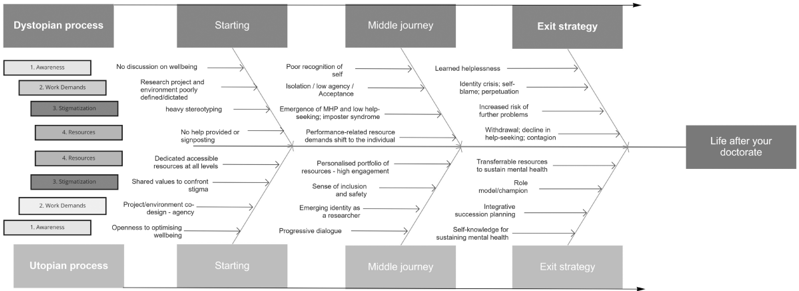
After a long period of relative neglect, the mental well‐being and the mental health of researchers and employees in academia are increasingly entering the limelight. The growing body of evidence suggests that a high number of doctoral researchers work under elevated levels of stress and frustration, and that this has a significant impact not only on their personal health and research output, but also on their future career development. In this paper, therefore, we first discuss what a dystopian and a utopian learning journey of early career researchers may look like from a well‐being perspective. Subsequently, and based on extensive dialogues with more than 250 researchers and professionals active in the researcher mental health domain, we highlight a number of key focal points that both early career researchers, their supervisors, and institutions alike should consider when it comes to planning and delivering mental health oriented educational activities for doctoral researchers.
Overview
The claims and statistics of this paper haven’t been checked yet.
Run the check — free, no account needed. It reads the open-access text and checks the sources it cites.
Integrity signals
Registry
Cites
Statistics
Figures
Verification
Claims the paper makes
The claims and statistics of this paper haven’t been checked yet.
Run the check — free, no account needed. It reads the open-access text and checks the sources it cites.
Claims other papers make about this one
Each is checked against this paper’s own text: does it say what the citing paper says it does?
In the citing paper
“Because a culture of critique is embedded in the academic community and doctoral programs, PhD students are at especially high risk of developing IS (Pervez et al., 2020) and other mental health problems (Deem, 2020;Kismihók et al., 2022;Levecque et al., 2017;Mackie & Bates, 2019;Schmidt & Hansson, 2018).”
From Too stupid for PhD? Doctoral impostor syndrome among Finnish PhD students (2023) · cites this paper as Kismihók et al., 2022
Self-check
Percentages, sums and reported differences re-computed from the paper’s own numbers.
The self-check needs the paper’s full text.
Citations
Cites
Resources for mental health: scarcity, inequity, and inefficiency
Saxena, S., Thornicroft, G., Knapp, M., & Whiteford, H. (2007) · The Lancet · doi:10.1016/s0140-6736(07)61239-2 · Cited by 1,789
Work organization and mental health problems in PhD students
Levecque, K., Anseel, F., De Beuckelaer, A., Van der Heyden, J., & Gisle, L. (2017) · Research Policy · doi:10.1016/j.respol.2017.02.008 · Cited by 1,182
The relationship between burnout, depression, and anxiety: a systematic review and meta-analysis.
Koutsimani, P., Montgomery, A., & Georganta, K. (2019) · Frontiers in Psychology · doi:10.3389/fpsyg.2019.00284 · Cited by 1,091
Byrd, D. R., & McKinney, K. J. (2012) · Journal of American College Health · doi:10.1080/07448481.2011.584334 · Cited by 315
Stigma and student mental health in higher education
Martin, J. M. (2010) · Higher Education Research & Development · doi:10.1080/07294360903470969 · Cited by 284
Research works printed but not linked: 61
- 10.1016/j.cpr.2011.05.003 · DOI
- 10.1007/s11024‐019‐09391‐4 · DOI
- Ayres Z. J., 2022, 100 voices
- 10.1057/978-1-137-55562-5_9 · DOI · Paper page
- 10.1080/1359432X.2019.1602041 · DOI
- Beadle B., 2020, Being a doctoral researcher in the Leibniz Association: 2019 Leibniz PhD Network Survey report
- CBS, 2020, Gepromoveerdenonderzoek 2019
- 10.1007/s10551‐021‐04905‐1 · DOI
- 10.28945/3754 · DOI · Paper page
- 10.3109/09638237.2015.1021902 · DOI
- 10.7554/eLife.59806 · DOI
- 10.1080/14703297.2016.1174143 · DOI
- Directorate‐General for Education and Youth, 2021, Marie Skłodowska‐curie actions guidelines on supervision
- Erasmus+ UK, 2018, Impact+ exercise: workshop guide, version 1.1
- European Commission, 2020, A new ERA for research and innovation
- 10.1177/2397002220903247 · DOI
- 10.1016/j.socscimed.2017.11.029 · DOI
- 10.1038/nj7668‐489a · DOI
- 10.12688/f1000research.12538.2 · DOI
- 10.7249/RR2022 · DOI
- Harbin A, 2022, Post‐PhD 2.0
- Harrison S., 2021, Outcome of the 3 impact workshops held by the ReMO COST action between 21st and 28th January 2021
- 10.1080/07294360220124648 · DOI
- 10.1016/j.scaman.2018.10.001 · DOI
- Heuritsch J., 2020, ‘People take you more seriously’: The perceived value of a PhD degree and the skills mismatch in the labour market
- Initiative for Science in Europe, 2020, Position on precarity of academic careers
- Kismihók G., 2021, Outcome of the 3 SWOT analyses held by the ReMO COST action between 24th November and 2nd December 2020
- Kismihók G., 2021, Outcome of the 3 manifesto development workshops held by the ReMO COST action between 20th and 26th April 2021
- Kismihók G., 2021, Researcher mental health and well‐being manifesto
- Kismihók G., 2019, Declaration on sustainable researcher careers
- Kismihók G., 2022, OSCAR conceptual and technical framework for researcher well‐being and career development training and mentoring
- 10.5220/0009389703880395 · DOI
- Klemenčič M., 2015, Student engagement in Europe: Society, higher education and student governance, 11
- Leigh D., 2009, Handbook of improving performance in the workplace, 115, 10.1002/9780470592663.ch24 · DOI
- 10.4324/9781315223490-6 · DOI
- Marie Curie Alumni Association, 2022, Referent—A mentoring initiative for MSCA early career researchers
- 10.1080/07294360.2016.1139547 · DOI
- McKenzie L., 2021, Reading academic quit lit—How and why precarious scholars leave academia, LSE Impact Blog
- 10.1080/13538322.2014.979547 · DOI
- Mortier A., 2020, PhD candidates and their satisfaction with non‐academic career opportunities
- OECD, 2021, Reducing the precarity of academic research careers
- OEduverse, 2022, A project supported by the European Commission Erasmus Plus programme
- Olsthoorn L. H. M., 2020, Max Planck PhDnet survey 2019 report
- OSCAR, 2022, A project supported by the European Commission Erasmus Plus programme
- 10.1007/s10734‐018‐0288‐4 · DOI
- Peukert C., 2020, Helmholtz juniors survey report
- Reithmeier R., 2020, Promoting a healthy lab culture at the University of Toronto
- ReMO, 2022, Researcher mental health observatory
- Ross J., 2020, Academic ‘quit lit’: Power inequity ‘still present at exit door’, Times Higher Education
- 10.1038/nbt.2706 · DOI · Paper page
- Tavakoli M., 2022, Mentoring function implementation in the personalised learning environment of the OSCAR project
- 10.1109/FIE44824.2020.9274175 · DOI
- 10.5220/0009420300960104 · DOI
- 10.4337/9781782547037.00006 · DOI
- Van der Weijden I. C. M., 2017, The mental well‐being of Leiden University PhD candidates
- 10.1037/0022‐006X.51.5.730 · DOI
- Vitae, 2020, Wellbeing and mental health lens on the Vitae Researcher Development Framework (RDF)
- Weber C. T., 2018, Identifying transferable skills and competences to enhance early‐career researchers employability and competitiveness
- 10.1023/A:1017513615819 · DOI
- 10.1108/IJRD‐03‐2016‐0006 · DOI
- 10.1038/d41586‐018‐02696‐6 · DOI
Cited by
Sorted by citations
Too stupid for PhD? Doctoral impostor syndrome among Finnish PhD students
Nori, H., & Vanttaja, M. (2023) · Higher Education · doi:10.1007/s10734-022-00921-w · Cited by 73
Metadata
- Authors
- Kismihók, G., McCashin, D., Mol, S. T., & Cahill, B.
- Venue
- European Journal of Education
- Publisher
- Wiley
- Published
- 2022-06-24
- Volume
- 57
- Issue
- 3
- Pages
- 410-423
- ISSN
- 0141-8211
- 1465-3435
- Cited by
- 13
- References
- 5
- Language
- en
About these checks
Registry, retraction, Cites and statistics results are computed, not judged, with one exception: a printed reference that no index lists is read once by a model before it counts as a citation error. Claims are extracted by a model and kept only when their quote appears verbatim in the text; each cited source is then checked, with a model’s help, for whether it says what the claim relies on. Those verdicts can be wrong — read the claim’s quote and the cited source before relying on one.
Statistics and arithmetic are recomputed, not judged.
Confidence bands are shown only for fields calibrated on our annotated test set. None is calibrated yet, so no band is shown.
What counts as a claim ›How we measure confidence ›How we check this ›
Are you an author, or do you see a problem with this page? Request a review
How to cite
Cite CoChat for the checks on this page, and the paper for its own findings.
- This page
- CoChat. (2026). Citation check: The well‐being and mental health of doctoral candidates. https://app.cochat.ai/papers/10.1111/ejed.12519
- The paper
- Kismihók, G., McCashin, D., Mol, S. T., & Cahill, B. (2022). The well‐being and mental health of doctoral candidates. European Journal of Education. https://doi.org/10.1111/ejed.12519
