

The DOI matches its Crossref record; 50 of the 50 references it cites were found in a registry or an index; none of the 16 sources its claims cite is checked for support yet.
Incidence and risk factors of posttraumatic epilepsy following pediatric traumatic brain injury: A systematic review and meta‐analysis
Open accessAbstract
Posttraumatic epilepsy (PTE) is a well‐known chronic complication following traumatic brain injury (TBI). Despite some evidence that age at the time of injury may influence the likelihood of PTE, the incidence of PTE in pediatric populations remains unclear. We therefore conducted a systematic review to determine the overall reported incidence of PTE, and explore potential risk factors associated with PTE after pediatric TBI. A comprehensive literature search of the PubMed, Embase, and Web of Science databases was conducted, including randomized controlled trials and cohort studies assessing the incidence of PTE in TBI pediatric patients. We excluded studies with a sample size of <10 patients and those in which a pediatric cohort was not clearly discernable. The review was conducted in accordance with the PRISMA (Preferred Reporting Items for Systematic Reviews and Meta‐Analyses) guidelines. We found that the overall incidence of PTE following pediatric TBI was 10% (95% confidence interval [CI] = 5.9%–15%). Subgroup analysis of a small number of studies demonstrated that the occurrence of early seizures (cumulative incidence ratio [CIR] = 7.28, 95% CI = 1.09–48.4, p = .040), severe TBI (CIR = 1.81, 95% CI = 1.23–2.67, p < .001), and intracranial hemorrhage (CIR = 1.60, 95% CI = 1.06–2.40, p = .024) increased the risk of PTE in this population. Other factors, including male sex and neurosurgical intervention, were nonsignificantly associated with a higher incidence of PTE. In conclusion, PTE is a significant chronic complication following childhood TBI, similar to in the adult population. Further standardized investigation into clinical risk factors and management guidelines is warranted. PROSPERO ID# CRD42021245802.
Overview
CoChat Summary
TL;DR
This systematic review and meta-analysis estimated the pooled incidence of posttraumatic epilepsy (PTE) after pediatric traumatic brain injury (TBI) at 10% (95% CI = 5.9%–15%) across 19 studies and 4374 patients. Early seizures, severe TBI, and intracranial hemorrhage were significantly associated with increased PTE risk, whereas male sex and neurosurgical intervention were not statistically significant.
Key findings
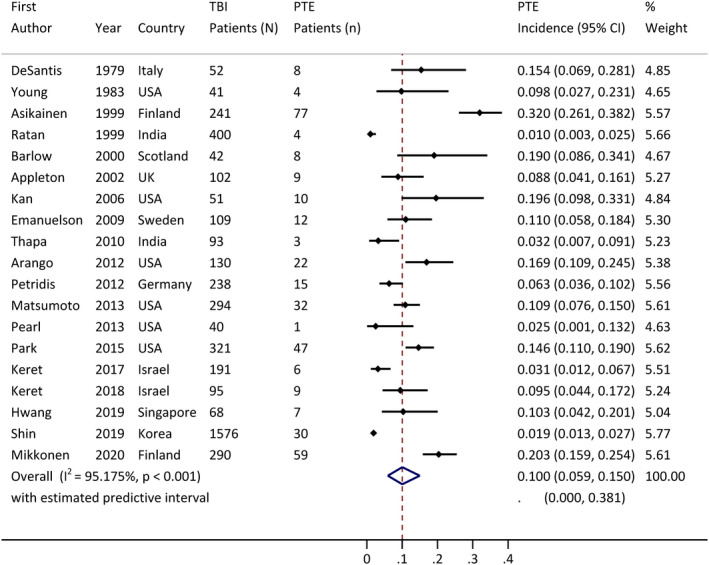
- The pooled incidence of PTE following pediatric TBI was 10% (95% CI = 5.9%–15%), with high heterogeneity across the 19 included studies (I² = 95%).
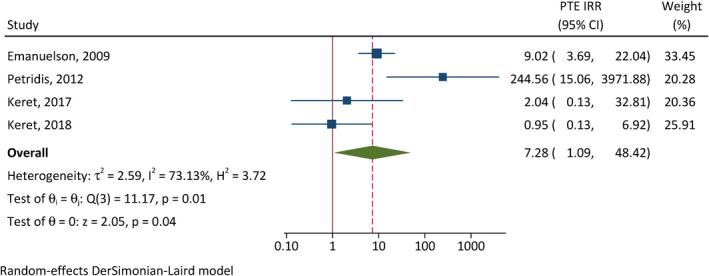
- Early seizures were associated with a higher incidence of PTE (CIR = 7.28, 95% CI = 1.09–48.4, p = .040).
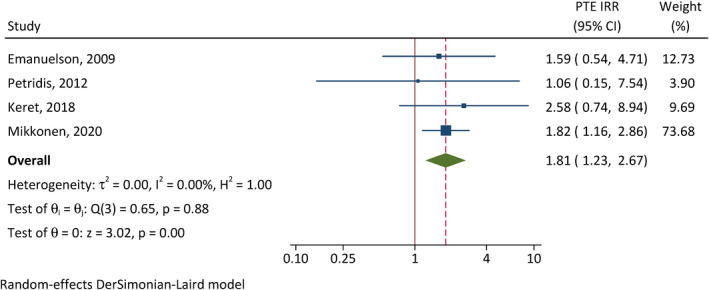
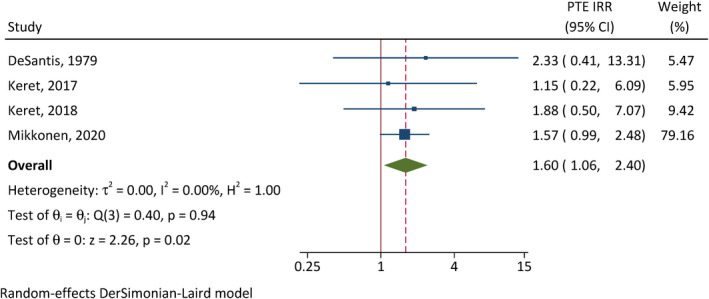
- Severe TBI (CIR = 1.81, 95% CI = 1.23–2.67, p < .001) and intracranial hemorrhage (CIR = 1.60, 95% CI = 1.06–2.40, p = .024) were also significantly associated with increased PTE incidence.
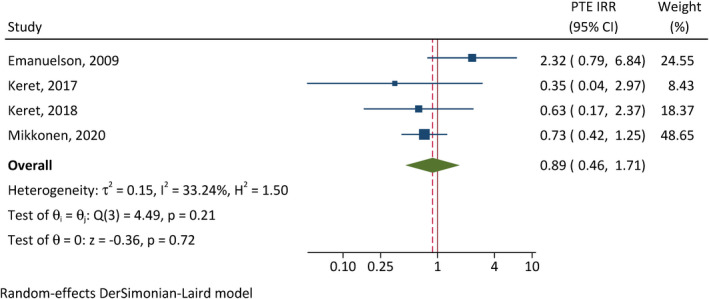
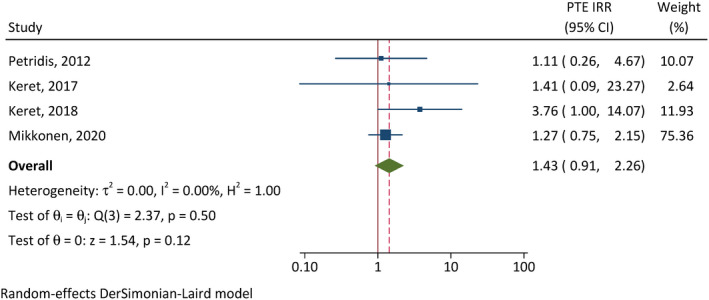
- Female versus male sex (CIR = .89, 95% CI = .46–1.71, p = .72) and neurosurgical intervention (CIR = 1.43, 95% CI = .91–2.26, p = .12) were not significantly associated with PTE.
Methods
- Systematic review and meta-analysis conducted according to PRISMA and a registered protocol (PROSPERO ID# CRD42021245802), searching PubMed, Ovid Embase, and Web of Science in May 2021 for randomized controlled trials and cohort studies of TBI patients younger than 18 years with sample size ≥10.
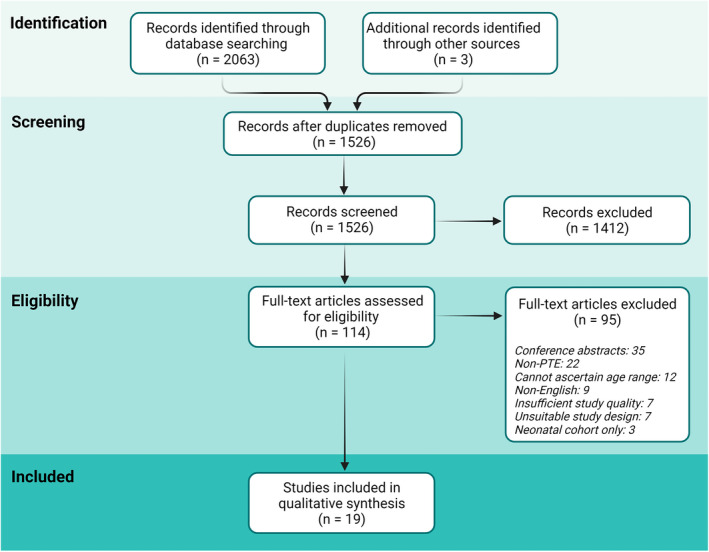
- The final analysis included 19 articles with a pooled sample of 4374 pediatric TBI patients; median sample size was 109 (range = 41–1576), comprising 10 retrospective cohort studies, 7 prospective cohort studies, and 2 randomized controlled trials.
- A random-effects meta-analysis using the DerSimonian and Laird method calculated pooled cumulative incidence; heterogeneity was assessed with I², meta-regression explored publication year and country, and subgroup meta-analyses with cumulative incidence ratios (CIRs) were performed where four or more studies were available.
Limitations
- Stated: significant heterogeneity in reported clinical variables and very limited reporting meant few studies could be included in subgroup analyses, preventing thorough investigation of predisposing factors and clinical variables.
- Stated: the search excluded non-English publications, and most included studies were retrospective, introducing bias and limiting the strength of conclusions.
- Evident from the text: the pooled estimate had high heterogeneity (I² = 95%); subgroup analyses were univariate because confounding variables could not be accounted for; and age effects could not be analyzed due to lack of individual patient data and between-study variation in age reporting.
Model-written summary. Check it against the paper before relying on it.
Integrity signals
Registry
Cites
Statistics
Figures
Verification
Claims the paper makes
0 Valid · 0 Not valid · 9 Not checked · 30 Own results and interpretations
A result the paper reports from its own data — it cites no other source for it, so there is none to check. The quote shows it is in the paper.
In the paper
“Subgroup analysis of a small number of studies demonstrated that the occurrence of early seizures (cumulative incidence ratio [CIR] = 7.28, 95% CI = 1.09–48.4, p = .040), severe TBI (CIR = 1.81, 95% CI = 1.23–2.67, p < .001), and intracranial hemorrhage (CIR = 1.60, 95% CI = 1.06–2.40, p = .024) increased the risk of PTE in this population.”
- Also stated in: § Subgroup analyses to explore risk factors · plain
“Patients with early seizures have 7.28 times the incidence of developing PTE of those without early seizures (95% CI = 1.09–48.4, p = .040).”
- Also stated in: § CONCLUSIONS · plain
“Seizures within 1 week of initial presentation, intracranial hemorrhage, and severe injury were significantly associated with an increased risk of PTE”
§ Incidence and risk factors of posttraumatic epilepsy following pediatric traumatic brain injury: A systematic review and meta‐analysis > Abstract
plainstates a cause- Asserted: passes — The authors put it forward as true.
- Checkable: passes — It can be checked against evidence.
- Load-bearing: passes — The paper’s conclusions depend on it.
- Based: passes — The paper gives a reason why it holds.
- Also stated in: § Subgroup analyses to explore risk factors · plain
A result the paper reports from its own data — it cites no other source for it, so there is none to check. The quote shows it is in the paper.
In the paper
“between patients requiring neurosurgical intervention and those not (CIR = 1.43, 95% CI = .91–2.26, p = .12, I 2 = 0; Figure 7)”
- Also stated in: § Abstract · plain
“Other factors, including male sex and neurosurgical intervention, were nonsignificantly associated with a higher incidence of PTE.”
§ Incidence and risk factors of posttraumatic epilepsy following pediatric traumatic brain injury: A systematic review and meta‐analysis > RESULTS > Subgroup analyses to explore risk factors
plain- Asserted: passes — The authors put it forward as true.
- Checkable: passes — It can be checked against evidence.
- Load-bearing: passes — The paper’s conclusions depend on it.
- Based: passes — The paper gives a reason why it holds.
- Also stated in: § Abstract · plain
A result the paper reports from its own data — it cites no other source for it, so there is none to check. The quote shows it is in the paper.
In the paper
“We found that the overall incidence of PTE following pediatric TBI was 10% (95% confidence interval [CI] = 5.9%–15%).”
- Also stated in: § Incidence of PTE · plain
“The pooled incidence of PTE, based on a random‐effects model, was 10% (95% confidence interval [CI] = 5.9%–15%; Figure 2).”
- Also stated in: § CONCLUSIONS · plain
“In the reported literature, the overall incidence of PTE following pediatric TBI is 10.0%.”
§ Incidence and risk factors of posttraumatic epilepsy following pediatric traumatic brain injury: A systematic review and meta‐analysis > Abstract
plain- Asserted: passes — The authors put it forward as true.
- Checkable: passes — It can be checked against evidence.
- Load-bearing: passes — The paper’s conclusions depend on it.
- Based: passes — The paper gives a reason why it holds.
- Also stated in: § Incidence of PTE · plain
A result the paper reports from its own data — it cites no other source for it, so there is none to check. The quote shows it is in the paper.
In the paper
“Results of the meta‐regression analysis demonstrated that country of origin could explain a substantial amount of heterogeneity (R 2 = 83%) but not year of publication (R 2 = 0%).”
§ Incidence and risk factors of posttraumatic epilepsy following pediatric traumatic brain injury: A systematic review and meta‐analysis > RESULTS > Incidence of PTE
hedgedstates an association- Asserted: passes — The authors put it forward as true.
- Checkable: passes — It can be checked against evidence.
- Load-bearing: unclear — It is unclear whether the paper’s conclusions depend on it.
- Based: passes — The paper gives a reason why it holds.
A result the paper reports from its own data — it cites no other source for it, so there is none to check. The quote shows it is in the paper.
In the paper
“Subgroup analysis of a small number of studies demonstrated that the occurrence of early seizures (cumulative incidence ratio [CIR] = 7.28, 95% CI = 1.09–48.4, p = .040), severe TBI (CIR = 1.81, 95% CI = 1.23–2.67, p < .001), and intracranial hemorrhage (CIR = 1.60, 95% CI = 1.06–2.40, p = .024) increased the risk of PTE in this population.”
- Also stated in: § Subgroup analyses to explore risk factors · plain
“In addition, severe TBI (CIR = 1.81, 95% CI = 1.23–2.67, p < .001, I 2 = 0%; Figure 4) and intracranial hemorrhage (CIR = 1.60, 95% CI = 1.06–2.40, p = .024, I 2 = 0%; Figure 5) were also associated with elevated cumulative incidence of PTE, and the results of studies were relatively homogenous.”
- Also stated in: § CONCLUSIONS · plain
“Seizures within 1 week of initial presentation, intracranial hemorrhage, and severe injury were significantly associated with an increased risk of PTE”
§ Incidence and risk factors of posttraumatic epilepsy following pediatric traumatic brain injury: A systematic review and meta‐analysis > Abstract
boostedstates a cause- Asserted: passes — The authors put it forward as true.
- Checkable: passes — It can be checked against evidence.
- Load-bearing: passes — The paper’s conclusions depend on it.
- Based: passes — The paper gives a reason why it holds.
- Also stated in: § Subgroup analyses to explore risk factors · plain
15 more claims
Create a free account to see all 39 claims and to verify the 15 references still open.
- It may state two separate claims as one. 17
- Probably not a substantial claim. 9
Self-check
Percentages, sums and reported differences re-computed from the paper’s own numbers.
Each contradiction between two passages listed here was confirmed by an independent check.
Rated minor: it would not touch a result — a value no result rests on, a p-value that stays on the same side of the significance level, or a conflict that is clerical, resolved elsewhere in the paper, or outside its own findings.
In the paper
§ Incidence and risk factors of posttraumatic epilepsy following pediatric traumatic brain injury: A systematic review and meta‐analysis > RESULTS > Study quality
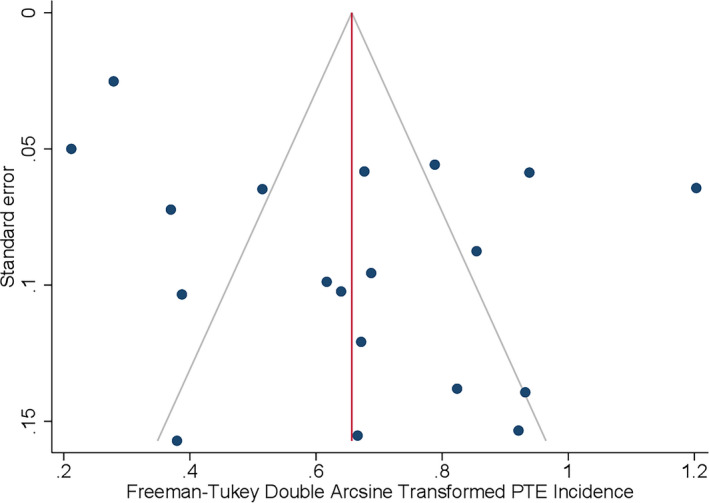
“The funnel plot examination did not demonstrate any apparent asymmetry (Figure 8)”
§ Incidence and risk factors of posttraumatic epilepsy following pediatric traumatic brain injury: A systematic review and meta‐analysis > RESULTS > Study quality
“Figure: FIGURE 8 Funnel plot analysis. The apparent asymmetry suggests a lack of publication bias.”
Rated minor: it would not touch a result — a value no result rests on, a p-value that stays on the same side of the significance level, or a conflict that is clerical, resolved elsewhere in the paper, or outside its own findings.
In the paper
§ Incidence and risk factors of posttraumatic epilepsy following pediatric traumatic brain injury: A systematic review and meta‐analysis > RESULTS > Descriptive summary
“with a median sample size of 109 (range = 41–1576)”
§ Incidence and risk factors of posttraumatic epilepsy following pediatric traumatic brain injury: A systematic review and meta‐analysis > RESULTS > Descriptive summary
“| Pearl 2013 | 40 | 1 | NR | NR | NR | NR | NR | NR | NR |”
Citations
Cites
PRISMA-P Group, Moher, D., Shamseer, L., Clarke, M., Ghersi, D., Liberati, A., Petticrew, M., Shekelle, P., & Stewart, L. A. (2015) · Systematic Reviews · doi:10.1186/2046-4053-4-1 · Cited by 26,223 · cited 1×
“18 Considering the nature of the study (derived from previously published work), ethics approval and patient consent were not required.”
Fisher, R. S., Boas, W. V. E., Blume, W., Elger, C., Genton, P., Lee, P., & Engel, J. (2005) · Epilepsia · doi:10.1111/j.0013-9580.2005.66104.x · Cited by 3,671
Estimating the global incidence of traumatic brain injury
Dewan, M. C., Rattani, A., Gupta, S., Baticulon, R. E., Hung, Y.-C., Punchak, M., Agrawal, A., Adeleye, A. O., Shrime, M. G., Rubiano, A. M., et al. (2019) · Journal of Neurosurgery · doi:10.3171/2017.10.jns17352 · Cited by 3,291
Beghi, E., Berg, A., Carpio, A., Forsgren, L., Hesdorffer, D. C., Hauser, W. A., Malmgren, K., Shinnar, S., Temkin, N., Thurman, D., et al. (2005) · Epilepsia · doi:10.1111/j.1528-1167.2005.00273_1.x · Cited by 2,296
Metaprop: a Stata command to perform meta-analysis of binomial data
Nyaga, V. N., Arbyn, M., & Aerts, M. (2014) · Archives of Public Health · doi:10.1186/2049-3258-72-39 · Cited by 2,139
Bramlett, H. M., & Dietrich, W. D. (2015) · Journal of Neurotrauma · doi:10.1089/neu.2014.3352 · Cited by 550
Schneier, A. J., Shields, B. J., Hostetler, S. G., Xiang, H., & Smith, G. A. (2006) · Pediatrics · doi:10.1542/peds.2005-2588 · Cited by 423
Christensen, J., Pedersen, M. G., Pedersen, C. B., Sidenius, P., Olsen, J., & Vestergaard, M. (2009) · The Lancet · doi:10.1016/s0140-6736(09)60214-2 · Cited by 379
Analyzing risk factors for late posttraumatic seizures: A prospective, multicenter investigation
Englander, J., Bushnik, T., Duong, T. T., Cifu, D. X., Zafonte, R., Wright, J., Hughes, R., & Bergman, W. (2003) · Archives of Physical Medicine and Rehabilitation · doi:10.1053/apmr.2003.50022 · Cited by 378
Dias, M. S., Smith, K., deGuehery, K., Mazur, P., Li, V., & Shaffer, M. L. (2005) · Pediatrics · doi:10.1542/peds.2004-1896 · Cited by 360
Research works printed but not linked: 2
- MoolaS MunnZ TufanaruC et al.Chapter 7: Systematic reviews of etiology and risk. Joanna briggs institute reviewer's manual The Joanna Briggs Institute. 2017; 5.
- 10.1111/j.1469-8749.2000.tb00363.x · doi:10.1111/j.1469-8749.2000.tb00363.x
Cited by
An update on pediatric traumatic brain injury
Figaji, A. (2023) · Child s Nervous System · doi:10.1007/s00381-023-06173-y · Cited by 53
Rodkin, S., Nwosu, C., Sannikov, A., Raevskaya, M., Tushev, A., Vasileva, I. N., & Гасанов, М. З. (2023) · International Journal of Molecular Sciences · doi:10.3390/ijms241310742 · Cited by 48
Epidemiology, Risk Factors, and Biomarkers of Post-Traumatic Epilepsy: A Comprehensive Overview
Kazis, D. A., Chatzikonstantinou, S., Ciobica, A. S., Kamal, F. Z., Burlui, V., Călin, G., & Mavroudis, I. A. (2024) · Biomedicines · doi:10.3390/biomedicines12020410 · Cited by 20
Reddy, D. S., Golub, V. M., Ramakrishnan, S., Churn, S. B., Shapiro, L. A., Iannucci, J., Pitkänen, A., Galanopoulou, A. S., Maganti, R. K., & Boison, D. (2025) · Pharmacological Reviews · doi:10.1016/j.pharmr.2025.100080 · Cited by 19
Risk of epilepsy after traumatic brain injury: a nationwide Norwegian matched cohort study
Sødal, H. F., Nordseth, T., Rasmussen, A. J. O., Rosseland, L. A., Stenehjem, J. S., Gran, J. M., Helseth, E., & Taubøll, E. (2024) · Frontiers in Neurology · doi:10.3389/fneur.2024.1411692 · Cited by 17
Metadata
- Authors
- Mariajoseph, F. P., Chen, Z., Sekhar, P., Rewell, S. S., O'Brien, T. J., Antonic‐Baker, A., & Semple, B. D.
- Affiliations
- Monash University (AU)
- The Alfred Hospital (AU)
- The Royal Melbourne Hospital (AU)
- Corresponding author
- Antonic‐Baker, Ana
- Semple, Bridgette D.
- ORCID
- Venue
- Epilepsia
- Publisher
- Wiley
- Published
- 2022-09-04
- Volume
- 63
- Issue
- 11
- Pages
- 2802-2812
- ISSN
- 0013-9580 (ISSN-L)
- 1528-1167
- PMC
- PMC9826023
- OpenAlex
- W4292714594
- Cited by
- 50
- References
- 50
- Citations by year
- 2026: 17 · 2025: 9 · 2024: 15 · 2023: 8 · 2022: 1
- FWCI
- 1.25
- Type
- journal article
- Language
- en
- Open access
- hybrid
- doi.org
- Licence
- Locations
- Epilepsia (publishedVersion, cc-by-nc)
- PubMed Central (publishedVersion, other-oa)
- PubMed (publishedVersion)
- Minerva Access (University of Melbourne) (submittedVersion, cc-by-nc)
- Funders
- National Health and Medical Research Council
- U.S. Department of Defense
- Topics
- Health Sciences › Medicine › Clinical Neurology › Traumatic Brain Injury and Neurovascular Disturbances
- Health Sciences › Medicine › Clinical Neurology › Traumatic Brain Injury Research
- Health Sciences › Medicine › Clinical Neurology › Epilepsy research and treatment
- Keywords
- post-traumatic epilepsy, pediatric traumatic brain injury, incidence, risk factors, early seizures, intracranial hemorrhage, severe traumatic brain injury, neurosurgical treatment, sex differences
- MeSH terms
- Brain Injuries, Traumatic, Adult, Child, Epilepsy, Post-Traumatic, Humans, Male, Risk Factors, Cohort Studies, Incidence
About these checks
Registry, retraction, Cites and statistics results are computed, not judged, with one exception: a printed reference that no index lists is read once by a model before it counts as a citation error. Claims are extracted by a model and kept only when their quote appears verbatim in the text; each cited source is then checked, with a model’s help, for whether it says what the claim relies on. Those verdicts can be wrong — read the claim’s quote and the cited source before relying on one.
A language model drew the claims from the paper on 2026-11-14, under version 3 of the claim definition (model deepseek-v4.1-flash, prompt extract-v3).
A second model labelled each claim on 2026-11-14 (model jev-1.13-20260917, definition revision gold-guideline-v0.2).
Statistics and arithmetic are recomputed, not judged.
Confidence bands are shown only for fields calibrated on our annotated test set. None is calibrated yet, so no band is shown.
What counts as a claim ›How we measure confidence ›How we check this ›
Are you an author, or do you see a problem with this page? Request a review
Data sources
Bibliographic data: Semantic Scholar, OpenAlex, Crossref.
Contains information from the Semantic Scholar Academic Graph Datasets, made available under the ODC Attribution License (ODC-BY 1.0).
Semantic Scholar’s data is described in: Kinney, R., et al. (2023). The Semantic Scholar Open Data Platform. arXiv:2301.10140.
