

The DOI matches its Crossref record.
The role of training and medication reminder wristwatch in adherence to treatment in geriatric patients diagnosed with hypertension: A randomized controlled trial
Open accessAbstract
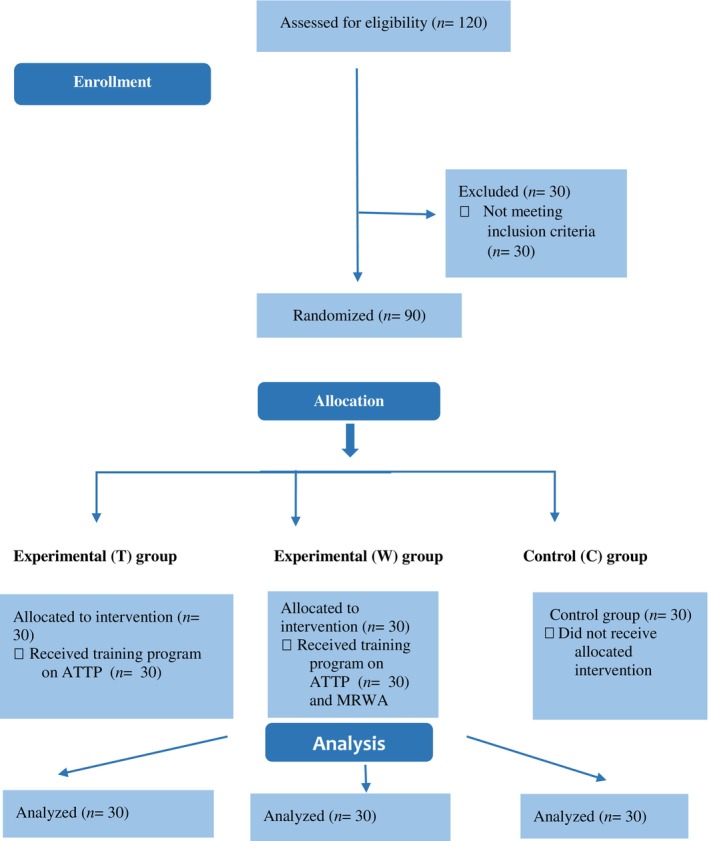
Aim: The purpose of this study was to determine the effects of the training and medication reminder wristwatch on treatment adherence in geriatric patients diagnosed with hypertension. Methods: In this study, which was conducted as a randomized clinical trial with a pretest‐posttest design, 90 patients were randomly divided into the training and medication reminder wristwatch (W) group ( n = 30) group, the training (T) group ( n = 30), and the control (C) group ( n = 30). All patients answered the data collection forms before and after the interventions. Results: By the end of the 12th week, the mean knowledge scores of the groups significantly differed from each other ( t = −13.207, P < 0.001). The mean Hypertension Compliance Assessment Scale score of the W group was found to be significantly lower ( t = 22.732, P < 0.001). The highest mean Medication Adherence Self‐Efficacy Scale–Short Form score was found in the W group ( t = −13.560, P < 0.001). In the posttest, the mean systolic blood pressure values of the patients were 142.7 ± 11.1 in the C group, 126.0 ± 13.0 mm Hg in the T group, and 120.0 ± 9.5 mm Hg in the W group (Kruskal–Wallis test = 38.065, P < 0.05). Conclusions: This study demonstrates that 12 weeks of a training program and the use of medication reminder wristwatches were effective in adherence to treatment. Geriatr Gerontol Int 2024; 24: 1189–1195 .
Overview
The claims and statistics of this paper haven’t been checked yet.
Run the check — free, no account needed. It reads the open-access text and checks the sources it cites.
Integrity signals
Registry
Cites
Statistics
Figures
Verification
Claims the paper makes
The claims and statistics of this paper haven’t been checked yet.
Run the check — free, no account needed. It reads the open-access text and checks the sources it cites.
Claims other papers make about this one
Each is checked against this paper’s own text: does it say what the citing paper says it does?
The cited source doesn’t support the claim as written.
In the citing paper
“Solmaz et al. reported SMS reminders increased medication adherence by 20% and dietary compliance by 15% in cardiovascular patients (p < 0.01) [18].”
From Multilevel Interventions to Improve Medication Adherence in Older Adults: A Systematic Review and Meta-Analysis of Cognitive, Digital, Behavioral, and Socioeconomic Strategies (2015–2025) (2026) · cites this paper as [18]
Checked by a reasoning model — may be wrong.
Experimental — accuracy not yet measuredThe source backs part of the claim, not all of it — or backs it for a different population, condition or comparison.
In the citing paper
“Solmaz et al. reported SMS reminders increased medication adherence by 20% and dietary compliance by 15% in cardiovascular patients (p < 0.01) [18].”
From Multilevel Interventions to Improve Medication Adherence in Older Adults: A Systematic Review and Meta-Analysis of Cognitive, Digital, Behavioral, and Socioeconomic Strategies (2015–2025) (2026) · cites this paper as [18]
Experimental — accuracy not yet measured
Self-check
Percentages, sums and reported differences re-computed from the paper’s own numbers.
The self-check needs the paper’s full text.
Citations
Cites
No references could be resolved yet.
Research works printed but not linked: 32
- Dinnocenzio C, 2020, Improving hypertension self‐management in older adults, Am J Nurs, 15, 15
- Thuy LT, 2020, Factors explaining medication adherence of older adults with hypertension: a cross‐sectional study, Pac Rim Int J Nurs Res, 24, 306
- Hacıhasanoglu R, 2009, Treatment adherence affecting factors in hypertension, TAF Prev Med Bull, 8, 167
- 10.3389/fcvm.2020.00049 · DOI
- Canan Demirbag B, 2012, The knowledge, attitude and behavior related to using drugs reflected by the group of elderly, Ank Med J, 11, 1
- 10.1161/CIRCOUTCOMES.117.003659 · DOI
- 10.1016/j.ijnurstu.2013.10.010 · DOI
- 10.1007/s13670-019-0270-8 · DOI
- 10.1186/s40885-020-00158-8 · DOI
- 10.1111/jch.13098 · DOI
- Aydan S, 2016, Quantified self and wearable technology in healthcare: possible benefits, current situation and suggestions, Hacettepe J Health Administration, 19, 325
- 10.1016/j.jbi.2016.09.001 · DOI
- 10.15420/ecr.2019.02 · DOI
- 10.26650/FNJN427146 · DOI
- 10.1080/03007995.2018.1549026 · DOI
- 10.1001/jamanetworkopen.2020.0255 · DOI · Paper page
- Kankaya H, 2017, The medication adherence self‐efficacy in elderly hypertensive patients, J Ege University Nurs Fac, 33, 1
- Kling JM, 2021, Relevance of sex differences in adherence to cardiovascular medications, Mayo Clin Proc, 96, 1442
- Burnier M, 2020, Assessing adherence to antihypertensive medications: pitfalls of measurement methods and combinational polytherapy, Curr Hypertens Rep, 22, 59
- Ivers NM, 2012, Impact of high quality vs. lower quality risk of bias on the estimated effects of randomized controlled trials of quality improvement interventions: meta‐epidemiological study, BMJ, 344
- 10.1016/j.apnr.2015.03.001 · DOI
- Bangurah SS, 2017, Hypertension in the faith community a four‐week, nurse led, diet/exercise intervertion, J Clin Nurs, 34, 225
- 10.1111/j.1751-7176.2008.07572.x · DOI · Paper page
- Demirezen E, 2006, Antihypertensive Medication Adherence in Hypertensive Turkish Patients Living in Turkey and Germany
- 10.1016/S0895-4356(03)00053-2 · DOI
- Hacıhasanoğlu R, 2012, Validity of the turkish version of the medication adherence self‐efficacy scale‐short form in hypertensive patients, Anatol J Cardiol, 12, 241
- 10.2147/PPA.S195446 · DOI
- 10.1186/s13690-019-0349-x · DOI
- Fava SMCL, 2015, The influence of selfmeasured pressure on the adhrence to systemıc blood hypertensıon treatment, J Nurs UFPE, 9, 1230
- Farahmand F, 2019, Effectiveness of a self‐care education program on hypertension management in older adults discharged from cardiac‐internal wards, ARYA Atheroscler, 15, 44
- Sutipan P, 2018, Effects of self‐management program on healthy lifestyle behaviors among older adults with hypertension, TJBS, 13, 38
- 10.1186/s13063-017-2063-8 · DOI
Cited by
Sorted by citations
Mehany, O., Artner, A., Sebők, S., Hankó, B., & Zelkó, R. (2026) · Journal of Clinical Medicine · doi:10.3390/jcm15052069 · Cited by 6
Metadata
- Authors
- Solmaz, T., & Altay, B.
- Affiliations
- Tokat Gaziosmanpaşa Üniversitesi (TR)
- Ondokuz Mayıs University (TR)
- Corresponding author
- Solmaz, Tuğba
- Venue
- Geriatrics & Gerontology International
- Publisher
- Wiley
- Published
- 2024-10-15
- Volume
- 24
- Issue
- 11
- Pages
- 1189-1195
- ISSN
- 1444-1586 (ISSN-L)
- 1447-0594
- PMC
- PMC11844235
- OpenAlex
- W4403406348
- Cited by
- 8
- References
- 0
- Citations by year
- 2026: 6 · 2025: 2
- FWCI
- 4.44
- Type
- journal article
- Language
- en
- Open access
- hybrid
- doi.org
- Licence
- Locations
- Geriatrics and gerontology international/Geriatrics & gerontology international (publishedVersion, cc-by-nc)
- PubMed Central (publishedVersion, cc-by-nc)
- PubMed (publishedVersion)
- Funders
- Ondokuz Mayis Üniversitesi (PYO.SBF.1904.20.001)
- Topics
- Health Sciences › Medicine › Family Practice › Medication Adherence and Compliance
- Health Sciences › Health Professions › Pharmacy › Pharmacy and Medical Practices
- Health Sciences › Medicine › Cardiology and Cardiovascular Medicine › Blood Pressure and Hypertension Studies
- Keywords
- hypertension, medication adherence, elderly patients, patient education, medication self-efficacy, blood pressure control, older adults
- MeSH terms
- Aged, Aged, 80 and over, Antihypertensive Agents, Female, Humans, Hypertension, Male, Middle Aged, Patient Education as Topic, Reminder Systems, Medication Adherence
About these checks
Registry, retraction, Cites and statistics results are computed, not judged, with one exception: a printed reference that no index lists is read once by a model before it counts as a citation error. Claims are extracted by a model and kept only when their quote appears verbatim in the text; each cited source is then checked, with a model’s help, for whether it says what the claim relies on. Those verdicts can be wrong — read the claim’s quote and the cited source before relying on one.
Statistics and arithmetic are recomputed, not judged.
Confidence bands are shown only for fields calibrated on our annotated test set. None is calibrated yet, so no band is shown.
What counts as a claim ›How we measure confidence ›How we check this ›
Are you an author, or do you see a problem with this page? Request a review
