

Clinical manifestations of interstitial cystitis and bladder pain syndrome: Analysis of a patient registry in Japan
The DOI matches its Crossref record; 5 of the 5 references it cites were found in a registry or an index.
Abstract
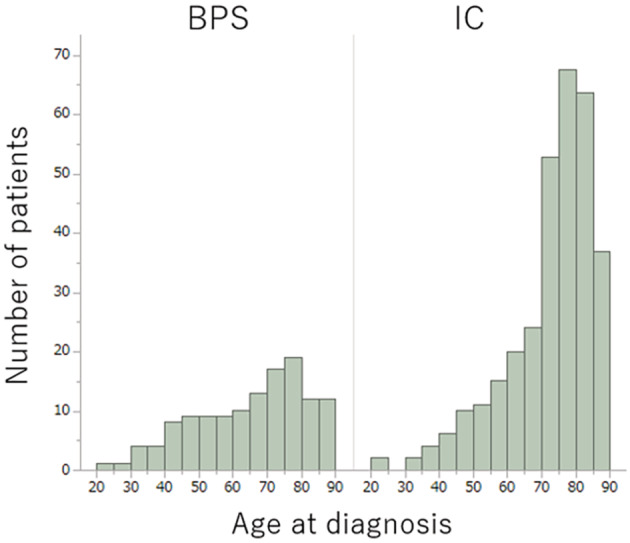
Objective: To describe clinical manifestations of patients with interstitial cystitis and bladder pain syndrome (IC/BPS) using a patient registry in Japan. Methods: This retrospective cohort study utilized a patient registry supported by the Japanese Ministry of Health, Labor, and Welfare. Patients were classified as IC or BPS based on cystoscopic findings. Data on demographics, comorbidities, symptom severity, pain intensity, and bladder function were collected and we evaluated the differences in clinical characteristics between IC and BPS, and used multivariate analysis to search for additional factors that might contribute to pain. Result: A data set comprising 529 patients was obtained from 14 university hospitals. 66.5% of the cases were classified as IC and 33.5% as BPS. IC patients were significantly aged and female‐dominant. Comorbidities such as autoimmune diseases were more prevalent in IC patients. All of the symptom severity, quality of life impairment, and bladder function were significantly worse in patients with IC. Urinary frequency and maximum voided volume on the Frequency‐volume chart were 18.8 times and 15.0 times, and 160.9 and 214.1 mL, respectively. Bladder capacity under anesthesia was 293.8 and 472.6 mL, respectively. Maximum voided volume and the number of Hunner lesions were significant predictors of pain in IC patients. Conclusion: The analysis revealed clinical manifestations of IC/BPS using the largest cohort in Japan. The results indicated higher age, higher female proportion, and higher symptomatic and functional severity in IC patients compared to BPS.
Overview
The claims and statistics of this paper haven’t been checked yet.
Free: it reads the open-access text and checks the first 5 claims that cite a source we can check. Create a free account to check every claim.
Integrity signals
Registry
Cites
Statistics
Figures
Verification
Claims the paper makes
The claims and statistics of this paper haven’t been checked yet.
Free: it reads the open-access text and checks the first 5 claims that cite a source we can check. Create a free account to check every claim.
Claims other papers make about this one
Each is checked against this paper’s own text: does it say what the citing paper says it does?
The source backs part of the claim, not all of it — or backs it for a different population, condition or comparison.
In the citing paper
“Most existing studies examine these conditions using predefined symptom lists or questionnaire-based assessments9,10.”
From Pain-centered symptom-language co-occurrence networks differ between interstitial cystitis/bladder pain syndrome and fibromyalgia in Reddit patient discourse (2026) · cites this paper as [10]
Experimental — accuracy not yet measured
Self-check
Percentages, sums and reported differences re-computed from the paper’s own numbers.
The self-check needs the paper’s full text.
Citations
Cites
van de Merwe, J. P., Nordling, J., Bouchelouche, P., Bouchelouche, K., Cervigni, M., Daha, L. K., Elneil, S., Fall, M., Hohlbrugger, G., Irwin, P., et al. (2008) · European Urology · doi:10.1016/j.eururo.2007.09.019 · Cited by 952
Clinical guidelines for interstitial cystitis/bladder pain syndrome
Homma, Y., Akiyama, Y., Tomoe, H., Furuta, A., Ueda, T., Maeda, D., Lin, A. T., Kuo, H., Lee, M., Oh, S., et al. (2020) · International Journal of Urology · doi:10.1111/iju.14234 · Cited by 234
Self-citationAkiyama, Y., Luo, Y., Hanno, P. M., Maeda, D., & Homma, Y. (2020) · International Journal of Urology · doi:10.1111/iju.14229 · Cited by 179
Self-citationGuideline of guidelines: bladder pain syndrome
Malde, S., Palmisani, S., Al‐Kaisy, A., & Sahai, A. (2018) · BJU International · doi:10.1111/bju.14399 · Cited by 126
McKernan, L. C., Walsh, C. G., Reynolds, W. S., Crofford, L. J., Dmochowski, R. R., & Williams, D. A. (2018) · Neurourology and Urodynamics · doi:10.1002/nau.23421 · Cited by 103
Research works printed but not linked: 18
- Clemens JQ, Link CL, Eggers PW, Kusek JW, Nyberg LM, McKinlay JB. Prevalence of painful bladder symptoms and effect on quality of life in black, Hispanic and white men and women. J Urol. 2007; 177: 1390– 1394. 17382739 · DOI · Paper page
- Rothrock NE, Lutgendorf SK, Kreder KJ. Coping strategies in patients with interstitial cystitis: relationships with quality of life and depression. J Urol. 2003; 169: 233– 236. 12478143 · DOI · Paper page
- Maeda D, Akiyama Y, Morikawa T, Kunita A, Ota Y, Katoh H, et al. Hunner‐type (classic) interstitial cystitis: a distinct inflammatory disorder characterized by pancystitis, with frequent expansion of clonal B‐cells and epithelial denudation. PLoS One. 2015; 10: e0143316. 26587589 PMC4654580 · DOI
- Akiyama Y, Sonehara K, Maeda D, Katoh H, Naito T, Yamamoto K, et al. Genome‐wide association study identifies risk loci within the major histocompatibility complex region for Hunner‐type interstitial cystitis. Cell Rep Med. 2023; 4: 101114. 37467720 PMC10394254 · DOI
- Clemens JQ, Clauw DJ, Kreder K, Krieger JN, Kusek JW, Lai HH, et al. Comparison of baseline urological symptoms in men and women in the MAPP research cohort. J Urol. 2015; 193: 1554– 1558. 25463989 PMC4454891 · DOI · Paper page
- Yamada Y, Nomiya A, Niimi A, Igawa Y, Ito T, Tomoe H, et al. A survey on clinical practice of interstitial cystitis in Japan. Transl Androl Urol. 2015; 4: 486– 490. 26816847 PMC4708551
- Simon LJ, Landis JR, Erickson DR, Nyberg LM. The interstitial cystitis data base study: concepts and preliminary baseline descriptive statistics. Urology. 1997; 49: 64– 75. 9146004 · DOI · Paper page
- Yeh H, Jhang J, Kuo Y, Kuo H. Long‐term outcome and symptom improvement in patients with interstitial cystitis/bladder pain syndrome with or without regular follow‐up and treatment. Neurourol Urodyn. 2019; 38: 1985– 1993. 31310370 · DOI
- Ahn ST, Jeong HG, Park TY, Kim JW, Park HS, Moon DG, et al. Differences in urodynamic parameters according to the presence of a Hunner lesion in women with interstitial cystitis/bladder pain syndrome. Int Neurourol J. 2018; 22: S55– S61. 29385787 PMC5798639 · DOI
- Logadottir Y, Fall M, Kåbjörn‐Gustafsson C, Peeker R. Clinical characteristics differ considerably between phenotypes of bladder pain syndrome/interstitial cystitis. Scand J Urol Nephrol. 2012; 46: 365– 370. 22607036 · DOI
- Akiyama Y, Yao JR, Kreder KJ, O'Donnell MA, Lutgendorf SK, Lyu D, et al. Autoimmunity to urothelial antigen causes bladder inflammation, pelvic pain, and voiding dysfunction: a novel animal model for Hunner‐type interstitial cystitis. Am J Physiol Renal Physiol. 2021; 320: F174– F182. 33308017 PMC7948122 · DOI
- Weiss JP, Blaivas JG, Jones M, Wang JT, Guan Z. Age related pathogenesis of nocturia in patients with overactive bladder. J Urol. 2007; 178: 548– 551. 17570424 · DOI
- Grover S, Srivastava A, Lee R, Tewari AK, Te AE. Role of inflammation in bladder function and interstitial cystitis. Ther Adv Urol. 2011; 3: 19– 33. 21789096 PMC3126088 · DOI · Paper page
- Bassaly R, Downes K, Hart S. Dietary consumption triggers in interstitial cystitis/bladder pain syndrome patients. Female Pelvic Med Reconstr Surg. 2011; 17: 36– 39. 22453670 · DOI
- Friedlander JI, Shorter B, Moldwin RM. Diet and its role in interstitial cystitis/bladder pain syndrome (IC/BPS) and comorbid conditions. BJU Int. 2012; 109: 1584– 1591. 22233286 · DOI · Paper page
- Lai HH, Vetter J, Song J, Andriole GL, Colditz GA, Sutcliffe S. Management of symptom flares and patient‐reported flare triggers in interstitial cystitis/bladder pain syndrome (IC/BPS)—findings from one site of the MAPP research network. Urology. 2019; 126: 24– 33. 30682464 PMC6874838 · DOI
- Akiyama Y, Niimi A, Nomiya A, Yamada Y, Nakagawa T, Fujimura T, et al. Extent of Hunner lesions: the relationships with symptom severity and clinical parameters in Hunner type interstitial cystitis patients. Neurourol Urodyn. 2018; 37: 1441– 1447. 29315774 · DOI
- Guerios SD, Wang ZY, Bjorling DE. Nerve growth factor mediates peripheral mechanical hypersensitivity that accompanies experimental cystitis in mice. Neurosci Lett. 2006; 392: 193– 197. 16203088 · DOI
Cited by
Okui, N., Ichino, K., Ide, H., Matsushita, K., Ikehata, Y., Okui, M., & Horie, S. (2026) · Scientific Reports · doi:10.1038/s41598-026-58586-9
Metadata
- Authors
- Niimi, A., Akiyama, Y., Tomonori, Y., Furuta, A., Matsuo, T., Tomoe, H., Kakizaki, H., Matsukawa, Y., Ogawa, T., Mitsui, T., Masumori, N., Inamura, S., Enomoto, Y., Nomiya, A., Maeda, D., Igawa, Y., Kume, H., & Homma, Y.
- Venue
- International Journal of Urology
- Publisher
- Wiley
- Published
- 2024-10-18
- Volume
- 32
- Issue
- 1
- Pages
- 103-109
- ISSN
- 0919-8172
- 1442-2042
- PMC
- PMC11730405
- Cited by
- 13
- References
- 5
- Language
- en
- Update notices
- correction (2025-05-14)
About these checks
Registry, retraction, Cites and statistics results are computed, not judged, with one exception: a printed reference that no index lists is read once by a model before it counts as a citation error. Claims are extracted by a model and kept only when their quote appears verbatim in the text; each cited source is then checked, with a model’s help, for whether it says what the claim relies on. Those verdicts can be wrong — read the claim’s quote and the cited source before relying on one.
Statistics and arithmetic are recomputed, not judged.
Confidence bands are shown only for fields calibrated on our annotated test set. None is calibrated yet, so no band is shown.
What counts as a claim ›How we measure confidence ›How we check this ›
Are you an author, or do you see a problem with this page? Request a review
Data sources
Bibliographic data: Semantic Scholar, OpenAlex, Crossref.
Contains information from the Semantic Scholar Academic Graph Datasets, made available under the ODC Attribution License (ODC-BY 1.0).
Semantic Scholar’s data is described in: Kinney, R., et al. (2023). The Semantic Scholar Open Data Platform. arXiv:2301.10140.
