

The DOI matches its Crossref record.
Safety of anti‐immunoglobulin E therapy with omalizumab in allergic patients at risk of geohelminth infection
Abstract
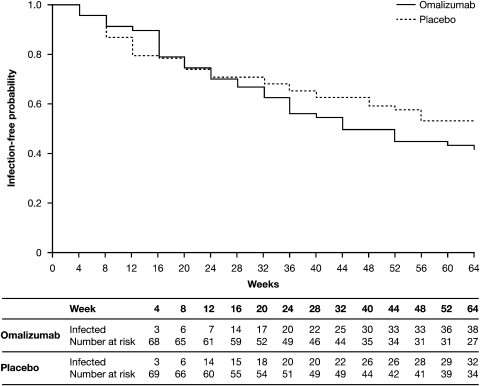
Summary: Background Although the role of immunoglobulin E (IgE) in immunity against helminth parasites is unclear, there is concern that therapeutic antibodies that neutralize IgE (anti‐IgE) may be unsafe in subjects at risk of helminth infection. Objective We conducted an exploratory study to investigate the safety of omalizumab (anti‐IgE) in subjects with allergic asthma and/or perennial allergic rhinitis at high risk of intestinal helminth infection. The primary safety outcome was risk of infections with intestinal helminths during anti‐IgE therapy. Methods A randomized, double‐blind, placebo‐controlled trial was conducted in 137 subjects (12–30 years) at high risk of geohelminth infection. All subjects received pre‐study anthelmintic treatment, followed by 52 weeks' treatment with omalizumab or placebo. Results Of the omalizumab subjects 50% (34/68) experienced at least one intestinal geohelminth infection compared with 41% (28/69) of placebo subjects [odds ratio (OR) 1.47, 95% confidence interval (CI) 0.74–2.95, one‐sided P= 0.14; OR (adjusted for study visit, baseline infection status, gender and age) 2.2 (0.94–5.15); one‐sided P =0.035], providing some evidence for a potential increased incidence of geohelminth infection in subjects receiving omalizumab. Omalizumab therapy was well tolerated, and did not appear to be associated with increased morbidity attributable to intestinal helminths as assessed by clinical and laboratory adverse events, maximal helminth infection intensities and additional anthelmintic requirements. Time to first infection (OR 1.30, 95% CI 0.79–2.15, one‐sided P =0.15) was similar between treatment groups. Infection severity and response to anthelmintics appeared to be unaffected by omalizumab therapy. Conclusions In this exploratory study of allergic subjects at high risk of helminth infections, omalizumab therapy appeared to be safe and well tolerated, but may be associated with a modest increase in the incidence of geohelminth infection.
Overview
The claims and statistics of this paper haven’t been checked yet.
Run the check — free, no account needed. It reads the open-access text and checks the sources it cites.
Integrity signals
Registry
Cites
Statistics
Figures
Verification
Claims the paper makes
The claims and statistics of this paper haven’t been checked yet.
Run the check — free, no account needed. It reads the open-access text and checks the sources it cites.
Claims other papers make about this one
Each is checked against this paper’s own text: does it say what the citing paper says it does?
In the citing paper
“A multicenter randomized controlled trial of omalizumab for the treatment of asthma and rhinitis was safe in a population at risk for STH infections, although there was a modest increase in geohelminth infection.74”
From Global issues in allergy and immunology: Parasitic infections and allergy (2017) · cites this paper as [74]
Self-check
Percentages, sums and reported differences re-computed from the paper’s own numbers.
The self-check needs the paper’s full text.
Citations
Cites
No references could be resolved yet.
Research works printed but not linked: 27
- 10.1038/nrmicro962 · DOI
- Bundy DAP, 2004, The global epidemiology of infectious diseases, 243
- Jarrett EE, 1982, Production and activities of IgE in helminth infection, Prog Allergy, 31, 178
- Cooper PJ, 2002, IgE and anti‐IgE therapy in asthma and allergic disease, lung biology in health and disease, 54
- 10.1111/j.0105-2896.2004.00192.x · DOI · Paper page
- 10.1128/CMR.14.4.689-703.2001 · DOI
- 10.1016/S1081-1206(10)62175-8 · DOI
- 10.1183/09031936.02.00278102 · DOI
- 10.1067/mai.2001.117880 · DOI
- 10.1111/j.1365-2222.2004.1916.x · DOI
- 10.1016/S1081-1206(10)62170-9 · DOI
- 10.1183/09031936.01.00092101 · DOI
- Vignola AM, 2004, Efficacy and tolerability of anti‐immunoglobulin E therapy with omalizumab in patients with concomitant allergic asthma and persistent allergic rhinitis, SOLAR, 59, 709
- MacGlashan DW, 1997, Down‐regulation of Fc(epsilon)RI expression on human basophils during in vivo treatment of atopic patients with anti‐IgE antibody, J Immunol, 158, 1438, 10.4049/jimmunol.158.3.1438 · DOI
- 10.2165/00003495-199753050-00004 · DOI
- 10.1080/00034983.1957.11685790 · DOI
- 10.4269/ajtmh.2001.65.610 · DOI
- Belizario VY, 2003, A comparison of the efficacy of single doses of albendazole, ivermectin, and diethylcarbamazine alone or in combinations against Ascaris and Trichuris spp, Bull World Health Organ, 81, 35
- 10.1067/mai.2003.1348 · DOI
- 10.1164/rccm.200211-1320OC · DOI
- 10.1159/000237225 · DOI
- Butterworth AE, 1996, Immunity and morbidity in Schistosoma mansoni infection, quantitative aspects, 55, 109
- 10.1126/science.8009216 · DOI
- Bell RG., 1996, IgE, allergies and helminth parasites, a new perspective on an old conundrum, 74, 337
- Moqbel R, 1990, Parasites and allergy, evidence for a ‘cause and effect’ relationship, 20, 611
- Finkelman FD, 1997, Cytokine regulation of host defense against parasitic gastrointestinal nematodes, lessons from studies with rodent models, 15, 505
- 10.1128/CMR.17.1.208-217.2004 · DOI
Cited by
Sorted by citations
Global issues in allergy and immunology: Parasitic infections and allergy
Cruz, A. A., Cooper, P. J., Figueiredo, C. A., Alcantara-Neves, N. M., Rodrigues, L. C., & Barreto, M. L. (2017) · Journal of Allergy and Clinical Immunology · doi:10.1016/j.jaci.2017.09.005 · Cited by 82
Self-citationUnderstanding the Type 2 Immunity: An Evolving View Beyond Allergic Diseases
Jiménez‐Saiz, R., Iborra, S., Blanco, C., González‐Pérez, R., Nuñez‐Borque, E., Zeyneloglu, C., Babayev, H., Göksel, O., Göksel, T., Khaitov, M., et al. (2026) · Allergy · doi:10.1111/all.70512 · Cited by 2
Metadata
- Authors
- Cruz, A. A., Lima, F., Sarinho, E., Ayre, G., Martin, C., Fox, H., & Cooper, P. J.
- Venue
- Clinical & Experimental Allergy
- Publisher
- Wiley
- Published
- 2007-01-23
- Volume
- 37
- Issue
- 2
- Pages
- 197-207
- ISSN
- 0954-7894
- 1365-2222
- PMC
- PMC1859973
- Cited by
- 111
- References
- 0
- Language
- en
About these checks
Registry, retraction, Cites and statistics results are computed, not judged, with one exception: a printed reference that no index lists is read once by a model before it counts as a citation error. Claims are extracted by a model and kept only when their quote appears verbatim in the text; each cited source is then checked, with a model’s help, for whether it says what the claim relies on. Those verdicts can be wrong — read the claim’s quote and the cited source before relying on one.
Statistics and arithmetic are recomputed, not judged.
Confidence bands are shown only for fields calibrated on our annotated test set. None is calibrated yet, so no band is shown.
What counts as a claim ›How we measure confidence ›How we check this ›
Are you an author, or do you see a problem with this page? Request a review
