

The DOI matches its Crossref record; 3 of the 3 references it cites were found in a registry or an index.
Association between visceral adiposity index and risk of prediabetes: A meta‐analysis of observational studies
Open accessAbstract
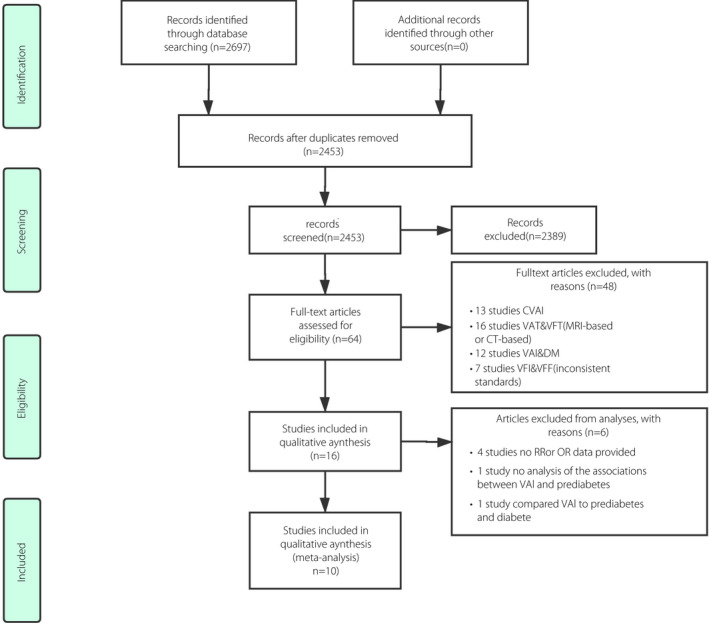
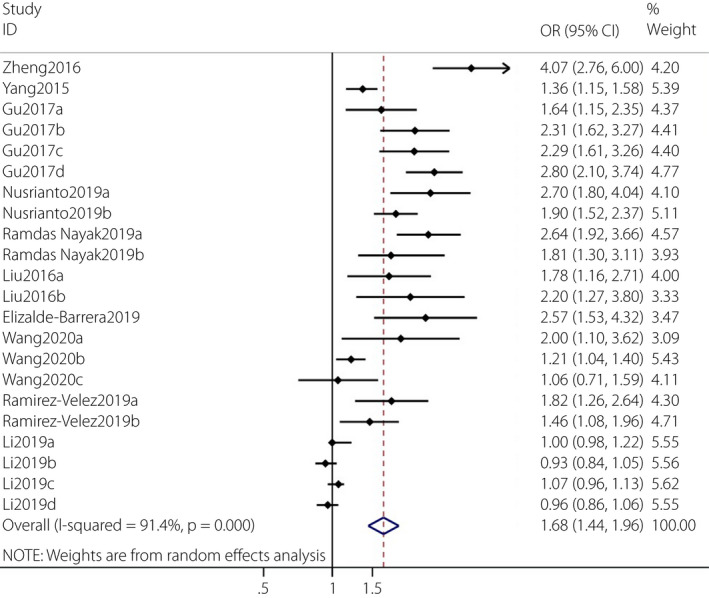
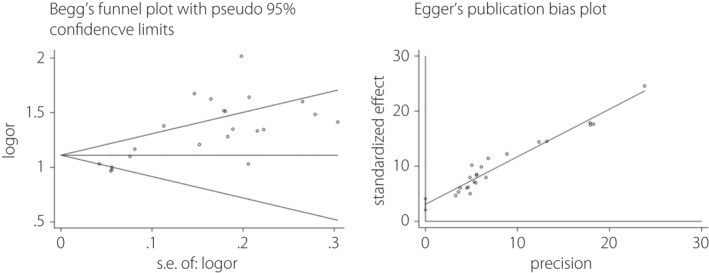
Background and Objective: Epidemiological studies suggested that the association between the visceral adiposity index (VAI) and the risk of prediabetes is inconsistent. Whether VAI is a useful predictor of prediabetes remains unclear. Up until April 2021, there had been no systematic review on this topic. In this meta‐analysis, the available observational epidemiological evidence was synthesized to identify the association between VAI and prediabetes risk. Methods: PubMed, EMBASE, and Cochrane databases in any language were searched systematically from the earliest available online indexing year to April 2021 for relevant observational studies published on the association between VAI and the risk of prediabetes. A random effects model was used to combine quantitatively the odds ratios (ORs) and 95% confidence intervals (CIs). Results: Ten relevant studies (2 cohort study, 2 case‐control studies, and 6 cross‐sectional studies) involving 112,603 participants were identified. Compared with the highest VAI, the lowest level of VAI was associated with an increased risk of prediabetes. The pooled OR of VAI for prediabetes was 1.68 (95% CI: 1.44–1.96), with significant heterogeneity across the included studies (P = 0.000, I2 = 91.4%). Exclusion of any single study did not materially alter the combined risk estimate. Conclusions: Integrated epidemiological evidence supports the hypothesis that VAI is a lipid combined anthropometric index and may be a risk factor for prediabetes. VAI may be related to a high risk of prediabetes. However, it should be noted that the included studies have a publication bias and there was significant heterogeneity between our pooled estimate.
Overview
The claims and statistics of this paper haven’t been checked yet.
Run the check — free, no account needed. It reads the open-access text and checks the sources it cites.
Integrity signals
Registry
Cites
Statistics
Figures
Verification
Claims the paper makes
The claims and statistics of this paper haven’t been checked yet.
Run the check — free, no account needed. It reads the open-access text and checks the sources it cites.
Claims other papers make about this one
Each is checked against this paper’s own text: does it say what the citing paper says it does?
The source backs part of the claim, not all of it — or backs it for a different population, condition or comparison.
In the citing paper
“The VAI is an established marker of abdominal obesity and IR, integrating WC, triglyceride (TG) levels, and high-density lipoprotein cholesterol (HDL-C) to predict metabolic risk.”
From Visceral and Dysfunctional Adiposity Indices as Predictors of Insulin Resistance and Metabolic Syndrome in Women with Polycystic Ovary Syndrome: A Cross-Sectional Study (2025) · cites this paper as [11]
Experimental — accuracy not yet measuredThe source backs part of the claim, not all of it — or backs it for a different population, condition or comparison.
In the citing paper
“Similarly, the DAI has been developed as a more specific measure of adipose tissue dysfunction by combining WC, BMI, TG levels, and HDL-C [9,10,11].”
From Visceral and Dysfunctional Adiposity Indices as Predictors of Insulin Resistance and Metabolic Syndrome in Women with Polycystic Ovary Syndrome: A Cross-Sectional Study (2025) · cites this paper as [11]
Experimental — accuracy not yet measured
Self-check
Percentages, sums and reported differences re-computed from the paper’s own numbers.
The self-check needs the paper’s full text.
Citations
Cites
Prediabetes: a high-risk state for diabetes development
Tabák, A. G., Herder, C., Rathmann, W., Brunner, E. J., & Kivimäki, M. (2012) · The Lancet · doi:10.1016/s0140-6736(12)60283-9 · Cited by 2,958
Impaired Fasting Glucose and Impaired Glucose Tolerance
Nathan, D. M., Davidson, M. B., DeFronzo, R. A., Heine, R. J., Henry, R. R., Pratley, R., & Zinman, B. (2007) · Diabetes Care · doi:10.2337/dc07-9920 · Cited by 1,396
Lemieux, I., Pascot, A., Couillard, C., Lamarche, B., Tchernof, A., Alméras, N., Bergeron, J., Gaudet, D., Tremblay, G., Prud’homme, D., et al. (2000) · Circulation · doi:10.1161/01.cir.102.2.179 · Cited by 937
Research works printed but not linked: 47
- 10.1177/1559827615619159 · DOI
- 10.1111/j.1464-5491.2007.02068.x · DOI · Paper page
- 10.2337/dc06-1392 · DOI
- 10.1001/jama.2017.7596 · DOI
- 10.1001/jama.2013.168118 · DOI
- Huang Y, 2016, Association between prediabetes and risk of cardiovascular disease and all cause mortality: systematic review and meta‐analysis, BMJ, 355, 15953
- 10.2215/CJN.07891109 · DOI · Paper page
- 10.1056/NEJMoa1008862 · DOI · Paper page
- 10.1016/S0140-6736(10)60484-9 · DOI · Paper page
- 10.1111/j.1365-2265.2009.03727.x · DOI
- 10.1097/MCO.0000000000000485 · DOI
- 10.1038/s41591-019-0563-7 · DOI
- 10.2337/dc09-1825 · DOI · Paper page
- 10.5551/jat.12.295 · DOI
- 10.2337/dc09-0412 · DOI
- 10.2337/diacare.29.01.06.dc05-1805 · DOI
- 10.1016/S0002-9149(02)02378-0 · DOI
- 10.1001/jama.283.15.2008 · DOI · Paper page
- RostomA DubéC CranneyA et al.Celiac Disease.Agency for Healthcare Research and Quality (US) Rockville MD. (Evidence Reports/Technology Assessments No. 104.) Appendix D. Quality Assessment Forms. Available from:https://www.ncbi.nlm.nih.gov/books/NBK35156/Accessed September 2004.
- 10.1186/s12967-016-1020-8 · DOI
- 10.1002/dmrr.2615 · DOI
- 10.1055/s-0043-120440 · DOI
- 10.1016/j.diabres.2019.107798 · DOI
- 10.3390/nu11112654 · DOI
- 10.1159/000446121 · DOI
- 10.1016/j.diabres.2019.05.019 · DOI
- 10.1002/dmrr.3424 · DOI
- 10.1016/j.dsx.2020.06.045 · DOI
- 10.1089/met.2019.0078 · DOI
- 10.1038/ijo.2013.181 · DOI · Paper page
- 10.1371/journal.pone.0114112 · DOI
- 10.1111/eci.12030 · DOI
- 10.1001/2012.jama.11132 · DOI
- 10.1016/j.jcjd.2016.02.008 · DOI
- 10.1038/s41598-017-14251-w · DOI
- Kumpatla S, 2011, (2011) Visceral Adiposity Index and pattern of dyslipidaemia at different stages of glucose intolerance‐a study from India, Diabetes Met Syndr, 5, 17
- 10.1038/s41598-021-82053-2 · DOI
- 10.1016/j.jcmg.2014.07.017 · DOI · Paper page
- 10.1259/bjr.20170808 · DOI
- 10.1186/s12933-018-0721-0 · DOI
- 10.3390/nu12072064 · DOI
- 10.1111/dom.13513 · DOI
- 10.3346/jkms.2019.34.e7 · DOI
- 10.1016/j.mce.2009.08.018 · DOI
- 10.3390/ijms18102145 · DOI
- 10.1007/s11695-010-0103-5 · DOI
- 10.1210/jc.2012-1518 · DOI
Cited by
Sorted by citations
Keyif, B., & Yavuzcan, A. (2025) · Medicina · doi:10.3390/medicina61030424 · Cited by 11
“Similarly, the DAI has been developed as a more specific measure of adipose tissue dysfunction by combining WC, BMI, TG levels, and HDL-C [9–11].”
Metadata
- Authors
- Wang, D., Fang, R., Han, H., Zhang, J., Chen, K., Fu, X., He, Q., & Yang, Y.
- Affiliations
- Hangzhou Normal University (CN)
- Hunan University of Traditional Chinese Medicine (CN)
- Zhejiang Chinese Medical University (CN)
- Hunan University of Medicine (CN)
- Hangzhou Hospital of Traditional Chinese Medicine (CN)
- Corresponding author
- Yang, Yong
- Venue
- Journal of Diabetes Investigation
- Publisher
- Wiley
- Published
- 2021-10-21
- Volume
- 13
- Issue
- 3
- Pages
- 543-551
- ISSN
- 2040-1116 (ISSN-L)
- 2040-1124
- PMC
- PMC8902389
- OpenAlex
- W3203879450
- Cited by
- 25
- References
- 3
- Citations by year
- 2025: 6 · 2024: 7 · 2023: 5 · 2022: 6 · 2021: 1
- FWCI
- 0.73
- Type
- journal article
- Language
- en
- Open access
- gold
- doi.org
- Licence
- Locations
- Journal of Diabetes Investigation (publishedVersion, cc-by-nc)
- PubMed Central (publishedVersion, cc-by-nc)
- PubMed (publishedVersion)
- DOAJ (DOAJ: Directory of Open Access Journals) (submittedVersion, cc-by-sa)
- Funders
- State Administration of Traditional Chinese Medicine of the People's Republic of China
- Hangzhou Normal University
- Topics
- Health Sciences › Medicine › Endocrinology, Diabetes and Metabolism › Diabetes, Cardiovascular Risks, and Lipoproteins
- Health Sciences › Medicine › Physiology (medical) › Body Composition Measurement Techniques
- Health Sciences › Medicine › Cardiology and Cardiovascular Medicine › Cardiovascular Disease and Adiposity
- Keywords
- visceral adiposity index, prediabetes, visceral fat, abdominal obesity, anthropometric index, diabetes risk factors
- MeSH terms
- Cross-Sectional Studies, Humans, Prediabetic State, Risk Factors, Cohort Studies, Intra-Abdominal Fat, Adiposity, Observational Studies as Topic
About these checks
Registry, retraction, Cites and statistics results are computed, not judged, with one exception: a printed reference that no index lists is read once by a model before it counts as a citation error. Claims are extracted by a model and kept only when their quote appears verbatim in the text; each cited source is then checked, with a model’s help, for whether it says what the claim relies on. Those verdicts can be wrong — read the claim’s quote and the cited source before relying on one.
Statistics and arithmetic are recomputed, not judged.
Confidence bands are shown only for fields calibrated on our annotated test set. None is calibrated yet, so no band is shown.
What counts as a claim ›How we measure confidence ›How we check this ›
Are you an author, or do you see a problem with this page? Request a review
