

Worker visibility and firms' retention policies
The DOI matches its Crossref record; 39 of the 39 references it cites were found in a registry or an index.
Abstract
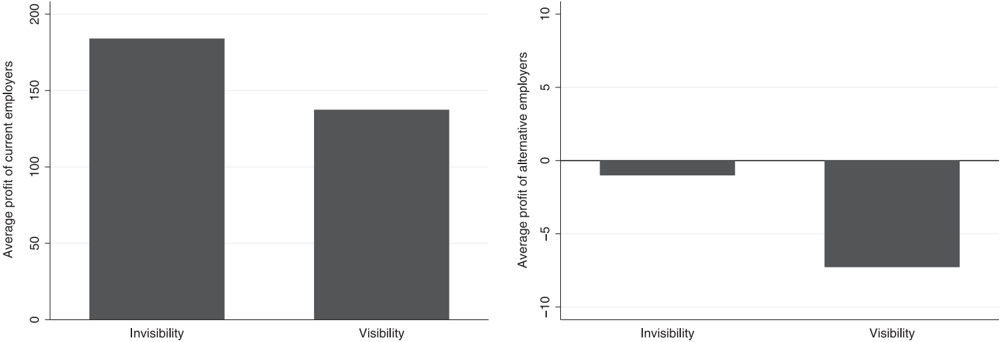
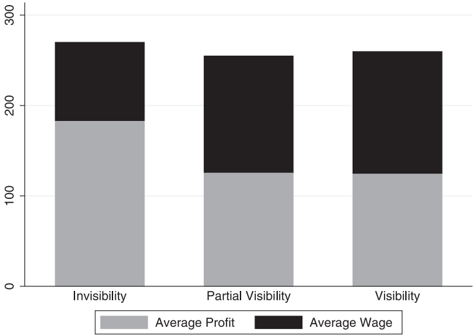
In the last two decades, the widespread use of web‐based social networks has led to a higher visibility of workers to the labor market. We theoretically and experimentally analyze the consequences of such increased labor market transparency for the efficiency of job assignments, the wages of workers, and firm profits. Our theoretical results show that higher visibility of workers increases the efficiency of job assignments, leads to a redistribution of income between workers of different ability, and increases overall surplus. Our experimental findings generally support the theoretical results with the exception that increased visibility leads to higher worker turnover such that surplus does not increase.
Overview
The claims and statistics of this paper haven’t been checked yet.
Free: it reads the open-access text and checks the first 5 claims that cite a source we can check. Create a free account to check every claim.
Integrity signals
Registry
Cites
Statistics
Figures



























Verification
Claims the paper makes
The claims and statistics of this paper haven’t been checked yet.
Free: it reads the open-access text and checks the first 5 claims that cite a source we can check. Create a free account to check every claim.
Claims other papers make about this one
Each is checked against this paper’s own text: does it say what the citing paper says it does?
In the citing paper
“Underrepresented employees, in turn, would likely find these visible assignments beneficial since they are being granted access to positions with more status and influence (e.g., Merton 1968, Ragins et al. 1998, Dato et al. 2021).”
From Included but undermined: How representation goals backfire (2025) · cites this paper as Dato et al. 2021
Self-check
Percentages, sums and reported differences re-computed from the paper’s own numbers.
The self-check needs the paper’s full text.
Citations
Cites
z-Tree: Zurich toolbox for ready-made economic experiments
Fischbacher, U. (2007) · Experimental Economics · doi:10.1007/s10683-006-9159-4 · Cited by 9,510
Cognitive Reflection and Decision Making
Frederick, S. (2005) · Journal of Economic Perspectives · doi:10.1257/089533005775196732 · Cited by 5,256
INDIVIDUAL RISK ATTITUDES: MEASUREMENT, DETERMINANTS, AND BEHAVIORAL CONSEQUENCES
Dohmen, T., Falk, A., Huffman, D., Sunde, U., Schupp, J., & Wagner, G. G. (2011) · Journal of the European Economic Association · doi:10.1111/j.1542-4774.2011.01015.x · Cited by 3,896
Goldfarb, A., & Tucker, C. (2019) · Journal of Economic Literature · doi:10.1257/jel.20171452 · Cited by 2,744
The strategy versus the direct-response method: a first survey of experimental comparisons
Brandts, J., & Charness, G. (2011) · Experimental Economics · doi:10.1007/s10683-011-9272-x · Cited by 711
hroot: Hamburg Registration and Organization Online Tool
Bock, O., Baetge, I., & Nicklisch, A. (2014) · European Economic Review · doi:10.1016/j.euroecorev.2014.07.003 · Cited by 675
Job Assignments, Signalling, and Efficiency
Waldman, M. (1984) · The RAND Journal of Economics · doi:10.2307/2555679 · Cited by 518
Relational Contracts and the Nature of Market Interactions
Brown, M., Falk, A., & Fehr, E. (2004) · Econometrica · doi:10.1111/j.1468-0262.2004.00511.x · Cited by 461
A Theory of Wage and Promotion Dynamics Inside Firms
Gibbons, R., & Waldman, M. (1999) · The Quarterly Journal of Economics · doi:10.1162/003355399556287 · Cited by 460
Eyster, E., & Rabin, M. (2005) · Econometrica · doi:10.1111/j.1468-0262.2005.00631.x · Cited by 405
Research works printed but not linked: 7
- Baron, J., & Kreps, D. (1999). Strategic human resources. New York, NY: John Wiley & Sons.
- Bernhardt, D., & Scoones, D. (1993). Promotion, turnover, and preemptive wage offers. American Economic Review, 83, 771-791.
- Flyverbom, M. (2016). Transparency: Mediation and the management of visibilities. International Journal of Communication, 10, 110-122.
- Flyverbom, M., Leonardi, P., Stohl, C., & Stohl, M. (2016). The management of visibilities in the digital age. International Journal of Communication, 10, 98-109.
- Lawton, A. (2016). The invisible librarian: A librarian's guide to increasing visibility and impact. Oxford: Chandors Publishing.
- Lazear, E. (1986). Raids and offer matching. Research in Labor Economics, 8, 141-165.
- Selten, R. (1967). Die strategiemethode zur erforschung des eingeschränkt rationalen verhaltens im rahmen eines oligopolexperiments. In H. Sauermann (Ed.), Beiträge zur experimentellen Wirtschaftsforschung (pp. 136-168). Tübingen: Mohr.
Cited by
Included but undermined: How representation goals backfire
Osborne, M. R., Roberson, J. W., & Tost, L. (2025) · doi:10.31234/osf.io/cse5r_v2
Metadata
- Authors
- Dato, S., Grunewald, A., & Kräkel, M.
- Affiliations
- Institute for Applied Microeconomics University of Bonn Bonn Germany
- Department of Economics Frankfurt School of Finance and Management Frankfurt Germany
- Venue
- Journal of Economics & Management Strategy
- Publisher
- Wiley
- Published
- 2020-11-19
- Volume
- 30
- Issue
- 1
- Pages
- 168-202
- ISSN
- 1058-6407
- 1530-9134
- Cited by
- 7
- References
- 39
- Language
- en
- Funders
- Deutsche Forschungsgemeinschaft (SFB/TR 15)
About these checks
Registry, retraction, Cites and statistics results are computed, not judged, with one exception: a printed reference that no index lists is read once by a model before it counts as a citation error. Claims are extracted by a model and kept only when their quote appears verbatim in the text; each cited source is then checked, with a model’s help, for whether it says what the claim relies on. Those verdicts can be wrong — read the claim’s quote and the cited source before relying on one.
Statistics and arithmetic are recomputed, not judged.
Confidence bands are shown only for fields calibrated on our annotated test set. None is calibrated yet, so no band is shown.
What counts as a claim ›How we measure confidence ›How we check this ›
Are you an author, or do you see a problem with this page? Request a review
How to cite
Cite CoChat for the checks on this page, and the paper for its own findings.
- This page
- CoChat. (2026). Citation check: Worker visibility and firms' retention policies. https://app.cochat.ai/papers/10.1111/jems.12404
- The paper
- Dato, S., Grunewald, A., & Kräkel, M. (2021). Worker visibility and firms' retention policies. Journal of Economics & Management Strategy. https://doi.org/10.1111/jems.12404
Data sources
Bibliographic data: Semantic Scholar, OpenAlex, Crossref.
Contains information from the Semantic Scholar Academic Graph Datasets, made available under the ODC Attribution License (ODC-BY 1.0).
Semantic Scholar’s data is described in: Kinney, R., et al. (2023). The Semantic Scholar Open Data Platform. arXiv:2301.10140.
