

Regulation of corticotropin‐releasing hormone neuronal network activity by noradrenergic stress signals
Open accessThe DOI matches its Crossref record; 60 of the 61 references it cites were found in a registry or an index.
Abstract
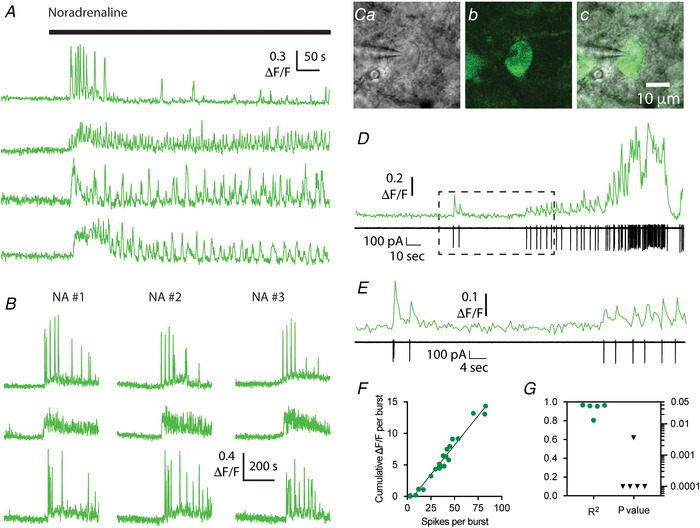
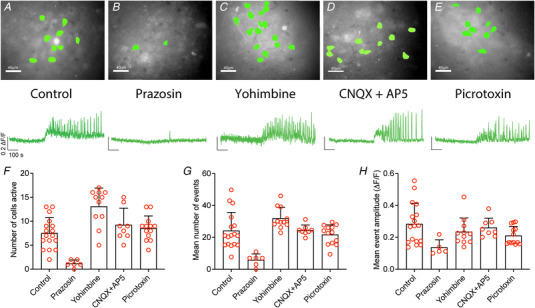
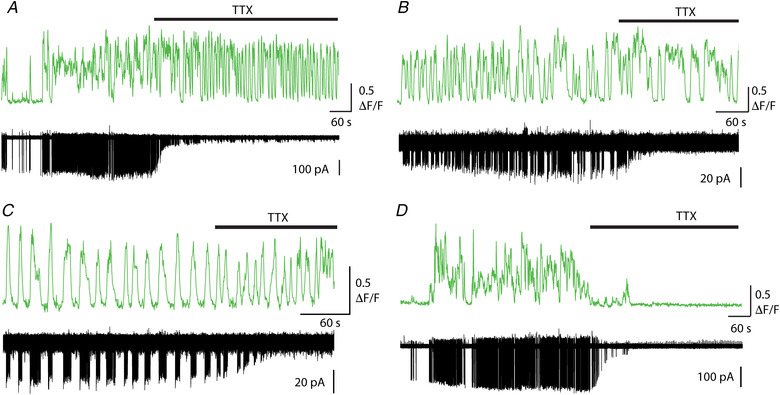
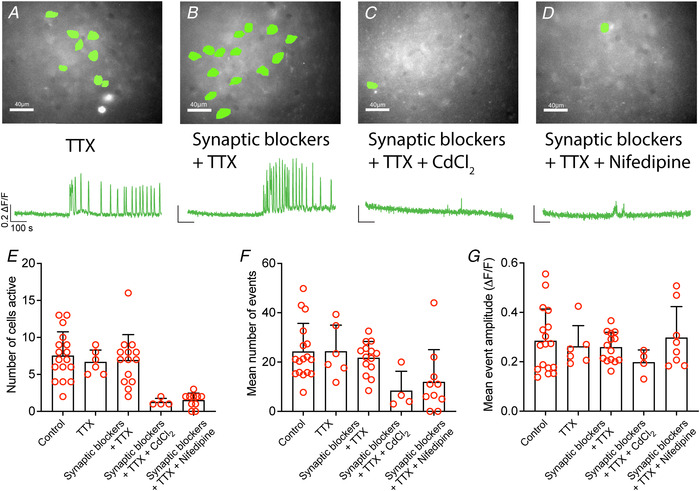
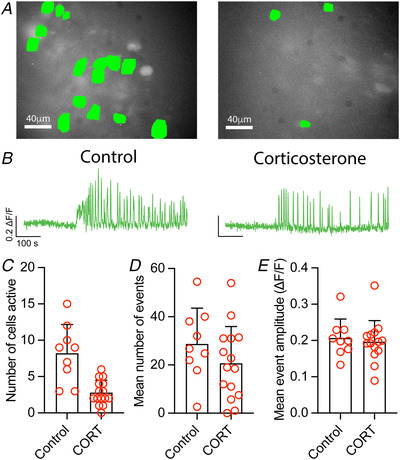
Noradrenaline is a neurotransmitter released in response to homeostatic challenge and activates the hypothalamic–pituitary–adrenal axis via stimulation of corticotropin‐releasing hormone (CRH) neurons. Here we investigated the mechanism through which noradrenaline regulates activity within the CRH neuronal network. Using a combination of in vitro GCaMP6f Ca 2+imaging and electrophysiology, we show that noradrenaline induces a robust increase in excitability in a proportion of CRH neurons with many neurons displaying a bursting mode of activity. Noradrenaline‐induced activation required α 1‐adrenoceptors and L‐type voltage‐gated Ca 2+channels, but not GABA/glutamate synaptic transmission or sodium action potentials. Exposure of mice to elevated corticosterone levels was able to suppress noradrenaline‐induced activation. These results provide further insight into the mechanisms by which noradrenaline regulates CRH neural network activity and hence stress responses.image Key points: GCaMP6f Ca 2+imaging and on‐cell patch‐clamp recordings reveal that corticotropin‐releasing hormone neurons are activated by noradrenaline with many neurons displaying a bursting mode of activity. Noradrenaline‐induced activation requires α 1‐adrenoceptors. Noradrenaline‐induced Ca 2+elevations persist after blocking GABA A, AMPA, NMDA receptors and voltage‐gated Na+channels. Noradrenaline‐induced Ca 2+elevations require L‐type voltage‐gated Ca 2+channels. Corticosterone suppresses noradrenaline‐induced excitation.
Overview
The claims and statistics of this paper haven’t been checked yet.
Free: it reads the open-access text and checks the first 5 claims that cite a source we can check. Create a free account to check every claim.
Integrity signals
Registry
Cites
Statistics
Figures
Verification
Claims the paper makes
The claims and statistics of this paper haven’t been checked yet.
Free: it reads the open-access text and checks the first 5 claims that cite a source we can check. Create a free account to check every claim.
Claims other papers make about this one
Each is checked against this paper’s own text: does it say what the citing paper says it does?
The source backs part of the claim, not all of it — or backs it for a different population, condition or comparison.
In the citing paper
“Prior acute brain slice studies in the hypothalamus have reported that exposure to > 5-10 µM NA is required to modulate neuronal excitability24,30,31 although these concentrations are likely to be supraphysiological.”
From Brainstem noradrenergic modulation of the kisspeptin neuron GnRH pulse generator in mice (2025) · cites this paper as [30]
Experimental — accuracy not yet measured
Self-check
Percentages, sums and reported differences re-computed from the paper’s own numbers.
The self-check needs the paper’s full text.
Citations
Cites
A resource of Cre driver lines for genetic targeting of GABAergic neurons in cerebral cortex
Taniguchi, H., He, M., Wu, P., Kim, S., Paik, R., Sugino, K., Kvitsani, D., Fu, Y., Lu, J., Lin, Y., et al. (2011) · Neuron · doi:10.1016/j.neuron.2011.07.026 · Cited by 1,828
Sawchenko, P. E., & Swanson, L. W. (1982) · Brain Research Reviews · doi:10.1016/0165-0173(82)90010-8 · Cited by 1,140
Madisen, L., Garner, A. R., Shimaoka, D., Chuong, A. S., Klapoetke, N. C., Li, L., van der Bourg, A., Niino, Y., Egolf, L., Monetti, C., et al. (2015) · Neuron · doi:10.1016/j.neuron.2015.02.022 · Cited by 1,114 · cited 2×
“Both Crh-IRES-Cre (Taniguchi et al., 2011) (stock no. 012704) and Ai95D (Madisen et al., 2015)(stock no. 024105) were originally obtained from The Jackson Laboratory (Bar Harbor, ME, USA).”
MethodCunningham, E. T., & Sawchenko, P. E. (1988) · Journal of Comparative Neurology · doi:10.1002/cne.902740107 · Cited by 727
Dayas, C. V., Buller, K. M., Crane, J. W., Xu, Y., & Day, T. A. (2001) · European Journal of Neuroscience · doi:10.1046/j.0953-816x.2001.01733.x · Cited by 513
Dendritic integration: 60 years of progress
Stuart, G. J., & Spruston, N. (2015) · Nature Neuroscience · doi:10.1038/nn.4157 · Cited by 484
Activity-Dependent Regulation of Synapses by Retrograde Messengers
Regehr, W. G., Carey, M. R., & Best, A. R. (2009) · Neuron · doi:10.1016/j.neuron.2009.06.021 · Cited by 285
Jackson, M. B., Konnerth, A., & Augustine, G. J. (1991) · Proceedings of the National Academy of Sciences · doi:10.1073/pnas.88.2.380 · Cited by 282
Karatsoreos, I. N., Bhagat, S. M., Bowles, N. P., Weil, Z. M., Pfaff, D. W., & McEwen, B. S. (2010) · Endocrinology · doi:10.1210/en.2009-1436 · Cited by 260 · cited 1×
“This non-invasive method has previously been used to chronically elevate plasma corticosterone levels in mice (Bittar et al., 2019; Gourley et al., 2013; Karatsoreos et al., 2010).”
Method
Cited by
Items 101–200 of 227
Aterosclerosis y protección de la pared vascular
Colonnese, A., & Panzironi, R. (2026) · doi:10.68559/lsh.libro.17.es
Athérosclérose et protection de la paroi vasculaire
Colonnese, A., & Panzironi, R. (2026) · doi:10.68559/lsh.libro.17.fr
Aterosclerosi e protezione della parete vascolare
Colonnese, A., & Panzironi, R. (2026) · doi:10.68559/lsh.libro.17.it
Alzheimer et fragilité du métabolisme cérébral
Colonnese, A., & Panzironi, R. (2026) · doi:10.68559/lsh.libro.15.fr
Alzheimer und die Fragilität des zerebralen Stoffwechsels
Colonnese, A., & Panzironi, R. (2026) · doi:10.68559/lsh.libro.15.de
Alzheimer y fragilidad del metabolismo cerebral
Colonnese, A., & Panzironi, R. (2026) · doi:10.68559/lsh.libro.15.es
Alzheimer e fragilità del metabolismo cerebrale
Colonnese, A., & Panzironi, R. (2026) · doi:10.68559/lsh.libro.15.it
Omega 3 e composizione delle membrane cellulari
Colonnese, A., & Panzironi, R. (2026) · doi:10.68559/lsh.libro.27.it
Omega-3 und die Zusammensetzung der Zellmembranen
Colonnese, A., & Panzironi, R. (2026) · doi:10.68559/lsh.libro.27.de
Insulin signaling and the cell's ability to adapt
Colonnese, A., & Panzironi, R. (2026) · doi:10.68559/lsh.libro.4
Le signal insulinique et la capacité d'adaptation cellulaire
Colonnese, A., & Panzironi, R. (2026) · doi:10.68559/lsh.libro.4.fr
Il segnale insulinico e la capacità della cellula di adattarsi
Colonnese, A., & Panzironi, R. (2026) · doi:10.68559/lsh.libro.4.it
Das Insulinsignal und die Anpassungsfähigkeit der Zelle
Colonnese, A., & Panzironi, R. (2026) · doi:10.68559/lsh.libro.4.de
Fumo e circuiti che mantengono la dipendenza
Colonnese, A., & Panzironi, R. (2026) · doi:10.68559/lsh.libro.20.it
Smoking and the circuits that maintain addiction
Colonnese, A., & Panzironi, R. (2026) · doi:10.68559/lsh.libro.20
Glycémie et insuline dans la réponse au repas
Colonnese, A., & Panzironi, R. (2026) · doi:10.68559/lsh.libro.2.fr
Glicemia e insulina nella risposta al pasto
Colonnese, A., & Panzironi, R. (2026) · doi:10.68559/lsh.libro.2.it
Blutzucker und Insulin als Reaktion auf die Mahlzeit
Colonnese, A., & Panzironi, R. (2026) · doi:10.68559/lsh.libro.2.de
Variabilità glicemica e alterazioni che precedono il diabete
Colonnese, A., & Panzironi, R. (2026) · doi:10.68559/lsh.libro.3.it
Glykämische Variabilität und Veränderungen im Vorfeld eines Diabetes
Colonnese, A., & Panzironi, R. (2026) · doi:10.68559/lsh.libro.3.de
Variabilidad glucémica y alteraciones que preceden a la diabetes
Colonnese, A., & Panzironi, R. (2026) · doi:10.68559/lsh.libro.3.es
Ernährungsqualität in der täglichen Prävention
Colonnese, A., & Panzironi, R. (2026) · doi:10.68559/lsh.libro.18.de
La calidad alimentaria en la prevención diaria
Colonnese, A., & Panzironi, R. (2026) · doi:10.68559/lsh.libro.18.es
Dietary quality in daily prevention
Colonnese, A., & Panzironi, R. (2026) · doi:10.68559/lsh.libro.18
La qualité alimentaire dans la prévention au quotidien
Colonnese, A., & Panzironi, R. (2026) · doi:10.68559/lsh.libro.18.fr
Estrés crónico y regulación del metabolismo
Colonnese, A., & Panzironi, R. (2026) · doi:10.68559/lsh.libro.22.es
Stress cronico e regolazione del metabolismo
Colonnese, A., & Panzironi, R. (2026) · doi:10.68559/lsh.libro.22.it
Soziale Beziehungen und biologische Reaktionen auf Einsamkeit
Colonnese, A., & Panzironi, R. (2026) · doi:10.68559/lsh.libro.21.de
Social relationships and biological responses to loneliness
Colonnese, A., & Panzironi, R. (2026) · doi:10.68559/lsh.libro.21
Chronic stress and metabolic regulation
Colonnese, A., & Panzironi, R. (2026) · doi:10.68559/lsh.libro.22
Relaciones sociales y respuestas biológicas a la soledad
Colonnese, A., & Panzironi, R. (2026) · doi:10.68559/lsh.libro.21.es
Stress chronique et régulation du métabolisme
Colonnese, A., & Panzironi, R. (2026) · doi:10.68559/lsh.libro.22.fr
La vitamine C entre intégrité des tissus et réponse cellulaire
Colonnese, A., & Panzironi, R. (2026) · doi:10.68559/lsh.libro.26.fr
Vitamina C entre la integridad de los tejidos y la respuesta celular
Colonnese, A., & Panzironi, R. (2026) · doi:10.68559/lsh.libro.26.es
Vitamina C tra integrità dei tessuti e risposta cellulare
Colonnese, A., & Panzironi, R. (2026) · doi:10.68559/lsh.libro.26.it
Vitamin C: between tissue integrity and cellular response
Colonnese, A., & Panzironi, R. (2026) · doi:10.68559/lsh.libro.26
Diabete di tipo 1 e perdita delle cellule pancreatiche
Colonnese, A., & Panzironi, R. (2026) · doi:10.68559/lsh.libro.13.it
Diabetes tipo 1 y pérdida de células pancreáticas
Colonnese, A., & Panzironi, R. (2026) · doi:10.68559/lsh.libro.13.es
Typ-1-Diabetes und Verlust von Pankreaszellen
Colonnese, A., & Panzironi, R. (2026) · doi:10.68559/lsh.libro.13.de
Diabète de type 1 et perte des cellules pancréatiques
Colonnese, A., & Panzironi, R. (2026) · doi:10.68559/lsh.libro.13.fr
Tumors and the organization of the metabolic microenvironment
Colonnese, A., & Panzironi, R. (2026) · doi:10.68559/lsh.libro.16
Tumori e organizzazione del microambiente metabolico
Colonnese, A., & Panzironi, R. (2026) · doi:10.68559/lsh.libro.16.it
Tumores y organización del microambiente metabólico
Colonnese, A., & Panzironi, R. (2026) · doi:10.68559/lsh.libro.16.es
Alimentation et changements de nos habitudes
Colonnese, A., & Panzironi, R. (2026) · doi:10.68559/lsh.libro.1.fr
Alimentación y cambios en nuestros hábitos
Colonnese, A., & Panzironi, R. (2026) · doi:10.68559/lsh.libro.1.es
Nutrition and changes in our habits
Colonnese, A., & Panzironi, R. (2026) · doi:10.68559/lsh.libro.1
Diabetes de tipo 2 y deterioro metabólico progresivo
Colonnese, A., & Panzironi, R. (2026) · doi:10.68559/lsh.libro.14.es
Diabete di tipo 2 e progressivo deterioramento metabolico
Colonnese, A., & Panzironi, R. (2026) · doi:10.68559/lsh.libro.14.it
Colonnese, A., & Panzironi, R. (2026) · doi:10.68559/lsh.libro.35.es
Colonnese, A., & Panzironi, R. (2026) · doi:10.68559/lsh.libro.35.it
Colonnese, A., & Panzironi, R. (2026) · doi:10.68559/lsh.libro.35.fr
Colonnese, A., & Panzironi, R. (2026) · doi:10.68559/lsh.libro.35
Tribulus terrestris: Eigenschaften, Nahrungsergänzung und detaillierte Behandlung von Erkrankungen
Colonnese, A., & Panzironi, R. (2026) · doi:10.68559/lsh.2026.236.de
Tribulus terrestris: propiedades, suplementación y patologías tratadas en profundidad
Colonnese, A., & Panzironi, R. (2026) · doi:10.68559/lsh.2026.236.es
Tribulus terrestris: properties, supplementation, and in-depth analysis of treated conditions
Colonnese, A., & Panzironi, R. (2026) · doi:10.68559/lsh.2026.236
Tribulus terrestris: proprietà, integrazione e patologie trattate approfondite
Colonnese, A., & Panzironi, R. (2026) · doi:10.68559/lsh.2026.236.it
Tribulus terrestris : propriétés, supplémentation et pathologies traitées en profondeur
Colonnese, A., & Panzironi, R. (2026) · doi:10.68559/lsh.2026.236.fr
Bewegung und der Wechsel zwischen Belastung und Erholung
Colonnese, A., & Panzironi, R. (2026) · doi:10.68559/lsh.libro.19.de
Movimiento y alternancia entre trabajo y recuperación
Colonnese, A., & Panzironi, R. (2026) · doi:10.68559/lsh.libro.19.es
Micronutriments et adéquation nutritionnelle
Colonnese, A., & Panzironi, R. (2026) · doi:10.68559/lsh.libro.24.fr
Colonnese, A., & Panzironi, R. (2026) · doi:10.68559/lsh.libro.32.it
Melatonina e coordinamento dei ritmi biologici
Colonnese, A., & Panzironi, R. (2026) · doi:10.68559/lsh.libro.28.it
Hashimoto et lien entre immunité et fonction thyroïdienne
Colonnese, A., & Panzironi, R. (2026) · doi:10.68559/lsh.libro.12.fr
Colonnese, A., & Panzironi, R. (2026) · doi:10.68559/lsh.libro.31.de
Colonnese, A., & Panzironi, R. (2026) · doi:10.68559/lsh.libro.33.it
Colonnese, A., & Panzironi, R. (2026) · doi:10.68559/lsh.libro.31.es
Colonnese, A., & Panzironi, R. (2026) · doi:10.68559/lsh.libro.34.fr
Melatonina y coordinación de los ritmos biológicos
Colonnese, A., & Panzironi, R. (2026) · doi:10.68559/lsh.libro.28.es
Intestin et maintien de la barrière immunitaire
Colonnese, A., & Panzironi, R. (2026) · doi:10.68559/lsh.libro.10.fr
Hashimoto y la relación entre inmunidad y función tiroidea
Colonnese, A., & Panzironi, R. (2026) · doi:10.68559/lsh.libro.12.es
Vitamin D und die Regulierung zellulärer Funktionen
Colonnese, A., & Panzironi, R. (2026) · doi:10.68559/lsh.libro.25.de
Vitamina D y regulación de las funciones celulares
Colonnese, A., & Panzironi, R. (2026) · doi:10.68559/lsh.libro.25.es
Lupus et complexité de la tolérance immunitaire
Colonnese, A., & Panzironi, R. (2026) · doi:10.68559/lsh.libro.9.fr
Colonnese, A., & Panzironi, R. (2026) · doi:10.68559/lsh.libro.33.de
Intestino y mantenimiento de la barrera inmunitaria
Colonnese, A., & Panzironi, R. (2026) · doi:10.68559/lsh.libro.10.es
Psoriasi e segnali che attraversano la pelle
Colonnese, A., & Panzironi, R. (2026) · doi:10.68559/lsh.libro.8.it
Vitamine D et régulation des fonctions cellulaires
Colonnese, A., & Panzironi, R. (2026) · doi:10.68559/lsh.libro.25.fr
Vitamina D e regolazione delle funzioni cellulari
Colonnese, A., & Panzironi, R. (2026) · doi:10.68559/lsh.libro.25.it
Hashimoto e intreccio tra immunità e funzione tiroidea
Colonnese, A., & Panzironi, R. (2026) · doi:10.68559/lsh.libro.12.it
Micronutrienti e adeguatezza della nutrizione
Colonnese, A., & Panzironi, R. (2026) · doi:10.68559/lsh.libro.24.it
Micronutrients and nutritional adequacy
Colonnese, A., & Panzironi, R. (2026) · doi:10.68559/lsh.libro.24
Psoriasis et signaux traversant la peau
Colonnese, A., & Panzironi, R. (2026) · doi:10.68559/lsh.libro.8.fr
Magnesio e funzionamento delle reazioni metaboliche
Colonnese, A., & Panzironi, R. (2026) · doi:10.68559/lsh.libro.29.it
Multiple Sklerose und Schutz des Nervensystems
Colonnese, A., & Panzironi, R. (2026) · doi:10.68559/lsh.libro.11.de
The gut and maintenance of the immune barrier
Colonnese, A., & Panzironi, R. (2026) · doi:10.68559/lsh.libro.10
Rheumatoid arthritis and joint response metabolism
Colonnese, A., & Panzironi, R. (2026) · doi:10.68559/lsh.libro.7
Esclerosis múltiple y protección del sistema nervioso
Colonnese, A., & Panzironi, R. (2026) · doi:10.68559/lsh.libro.11.es
Lupus y la complejidad de la tolerancia inmunitaria
Colonnese, A., & Panzironi, R. (2026) · doi:10.68559/lsh.libro.9.es
Colonnese, A., & Panzironi, R. (2026) · doi:10.68559/lsh.libro.31.it
Vitamin D and the regulation of cellular functions
Colonnese, A., & Panzironi, R. (2026) · doi:10.68559/lsh.libro.25
The dialogue between metabolism and inflammation
Colonnese, A., & Panzironi, R. (2026) · doi:10.68559/lsh.libro.5
Mélatonine et coordination des rythmes biologiques
Colonnese, A., & Panzironi, R. (2026) · doi:10.68559/lsh.libro.28.fr
De la señal nerviosa a la respuesta hormonal
Colonnese, A., & Panzironi, R. (2026) · doi:10.68559/lsh.libro.23.es
Sclerosi multipla e protezione del sistema nervoso
Colonnese, A., & Panzironi, R. (2026) · doi:10.68559/lsh.libro.11.it
Il dialogo tra metabolismo e infiammazione
Colonnese, A., & Panzironi, R. (2026) · doi:10.68559/lsh.libro.5.it
Darm und Aufrechterhaltung der Immunbarriere
Colonnese, A., & Panzironi, R. (2026) · doi:10.68559/lsh.libro.10.de
Hashimoto and the interplay between immunity and thyroid function
Colonnese, A., & Panzironi, R. (2026) · doi:10.68559/lsh.libro.12
Sclérose en plaques et protection du système nerveux
Colonnese, A., & Panzironi, R. (2026) · doi:10.68559/lsh.libro.11.fr
Micronutrientes y adecuación nutricional
Colonnese, A., & Panzironi, R. (2026) · doi:10.68559/lsh.libro.24.es
Mikronährstoffe und angemessene Ernährung
Colonnese, A., & Panzironi, R. (2026) · doi:10.68559/lsh.libro.24.de
Metadata
- Authors
- Gouws, J. M., Sherrington, A., Zheng, S., Kim, J. S., & Iremonger, K. J.
- Affiliations
- University of Otago (NZ)
- Corresponding author
- Iremonger, Karl J.
- Venue
- The Journal of Physiology
- Publisher
- Wiley
- Published
- 2022-09-12
- Volume
- 600
- Issue
- 19
- Pages
- 4347-4359
- ISSN
- 0022-3751 (ISSN-L)
- 1469-7793
- PMC
- PMC9825848
- OpenAlex
- W4293567401
- Cited by
- 36
- References
- 61
- Citations by year
- 2026: 31 · 2025: 2 · 2024: 2 · 2023: 1
- FWCI
- 0.74
- Type
- journal article
- Language
- en
- Open access
- hybrid
- doi.org
- Licence
- Locations
- The Journal of Physiology (publishedVersion, cc-by-nc)
- PubMed Central (publishedVersion, cc-by-nc)
- PubMed (publishedVersion)
- Funders
- University of Otago
- Royal Society Te Apārangi (UOO1701)
- Topics
- Life Sciences › Neuroscience › Behavioral Neuroscience › Stress Responses and Cortisol
- Life Sciences › Neuroscience › Cellular and Molecular Neuroscience › Neuroscience and Neuropharmacology Research
- Life Sciences › Neuroscience › Endocrine and Autonomic Systems › Neuroscience of respiration and sleep
- Keywords
- corticotropin-releasing hormone neurons, norepinephrine, hypothalamic-pituitary-adrenal axis, stress response, neuronal network activity, neuronal excitability, burst firing, alpha1-adrenoceptors, L-type calcium channels, corticosterone, calcium imaging, GCaMP6f
- MeSH terms
- Animals, Corticosterone, Corticotropin-Releasing Hormone, Glutamates, Hypothalamo-Hypophyseal System, Neurons, Norepinephrine, Pituitary-Adrenal System, Sodium, Receptors, N-Methyl-D-Aspartate, Receptors, Adrenergic, alpha-1, alpha-Amino-3-hydroxy-5-methyl-4-isoxazolepropionic Acid, Mice
About these checks
Registry, retraction, Cites and statistics results are computed, not judged, with one exception: a printed reference that no index lists is read once by a model before it counts as a citation error. Claims are extracted by a model and kept only when their quote appears verbatim in the text; each cited source is then checked, with a model’s help, for whether it says what the claim relies on. Those verdicts can be wrong — read the claim’s quote and the cited source before relying on one.
Statistics and arithmetic are recomputed, not judged.
Confidence bands are shown only for fields calibrated on our annotated test set. None is calibrated yet, so no band is shown.
What counts as a claim ›How we measure confidence ›How we check this ›
Are you an author, or do you see a problem with this page? Request a review
Data sources
Bibliographic data: Semantic Scholar, OpenAlex, Crossref.
Contains information from the Semantic Scholar Academic Graph Datasets, made available under the ODC Attribution License (ODC-BY 1.0).
Semantic Scholar’s data is described in: Kinney, R., et al. (2023). The Semantic Scholar Open Data Platform. arXiv:2301.10140.
