

The DOI matches its Crossref record; 6 of the 6 references it cites were found in a registry or an index; none of the 37 sources its claims cite is checked for support yet.
Relatos visuales misionales de los cuerpos indígenas: vergüenza y civilización en Chocó, Colombia 1909-1930
Open accessAbstract
En este artículo se analizan retratos fotográficos tomados a la población indígena de la comunidad embera (catío y chamí), habitante del Chocó, que fue objeto de evangelización por parte de la Misión del Inmaculado Corazón de María, las Hermanas de la Presentación (Quibdó) y las Siervas del Santísimo Sacramento (Istmina) desde comienzos del siglo XX. A partir de imágenes, de narrativas de la misión y de cifras de estadísticas disponibles en las fuentes primarias, se identifican y analizan los significados que los misioneros dieron al proceso de civilización a través de la evangelización.
Overview
CoChat Summary
TL;DR
The article analyzes Claretian missionary photographs and reports from Chocó, Colombia (1909–1930) to show how visual and textual narratives used shame and the savage/civilized binary to mold indigenous bodies, especially women’s, into Catholic, civilized citizens. It argues these images served both as records of missionary work and as devices of cultural assimilation, while also registering resistance and leaving indigenous intimate life largely invisible.
Key findings
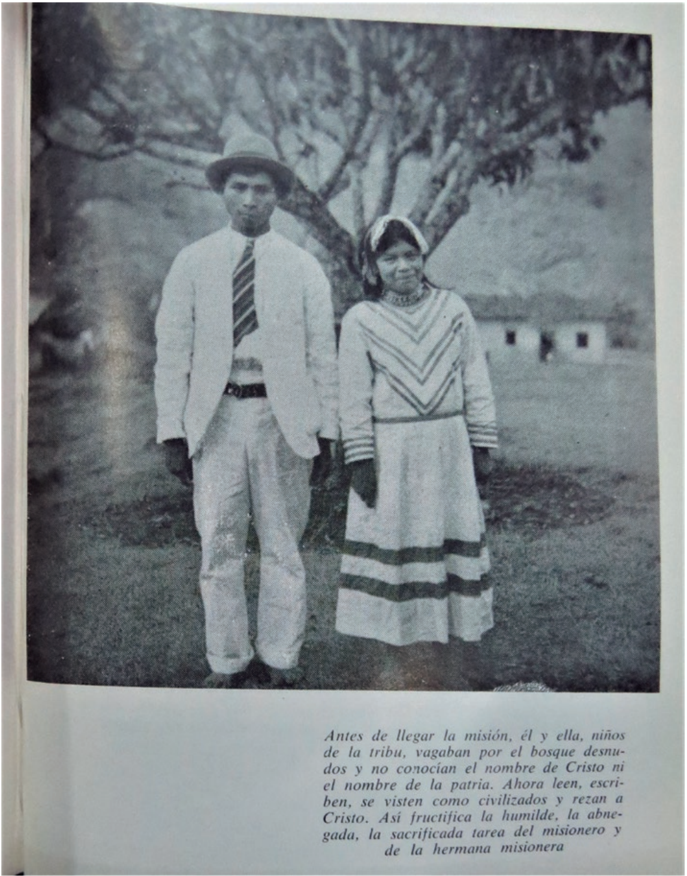
- Missionary visual narratives framed indigenous bodies through shame and a moral differentiation between “salvaje” and “civilizado”; shame produced fear and vulnerability and facilitated social control, inscribing native populations into the Colombian national project.
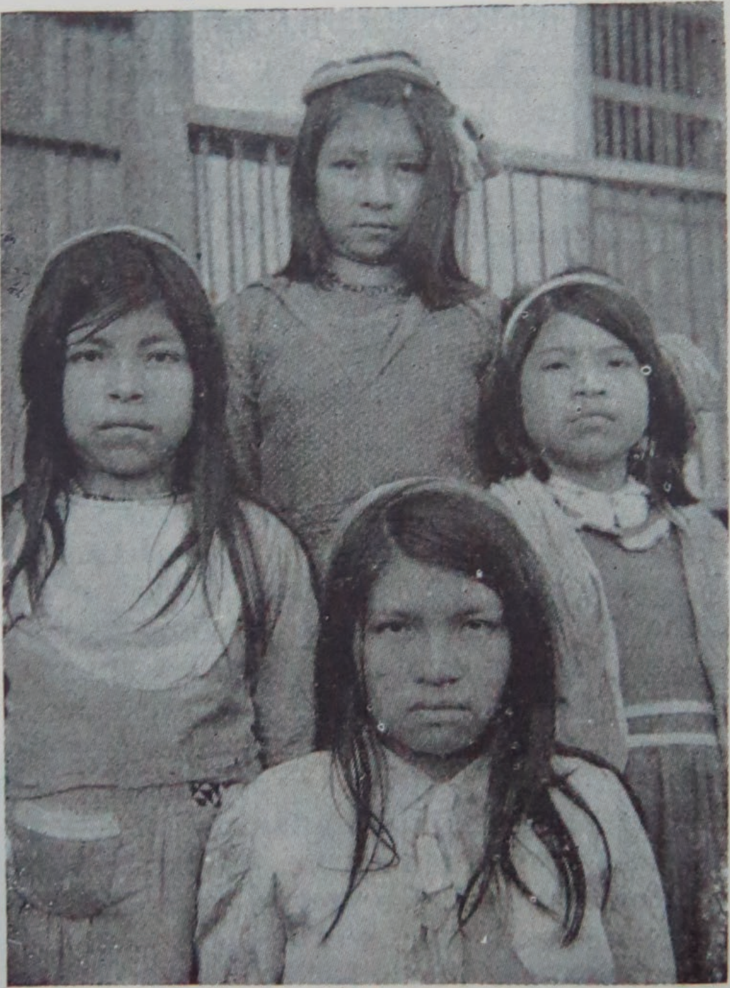
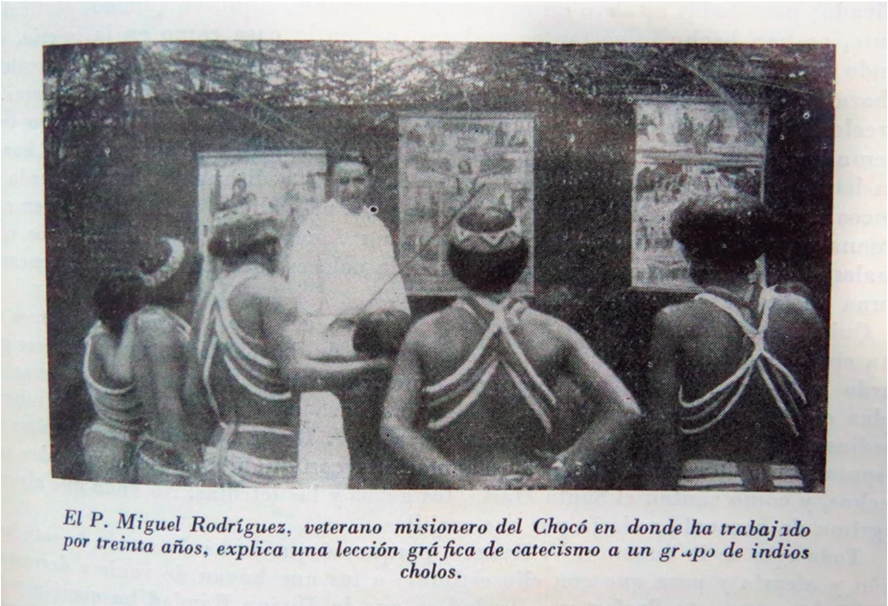
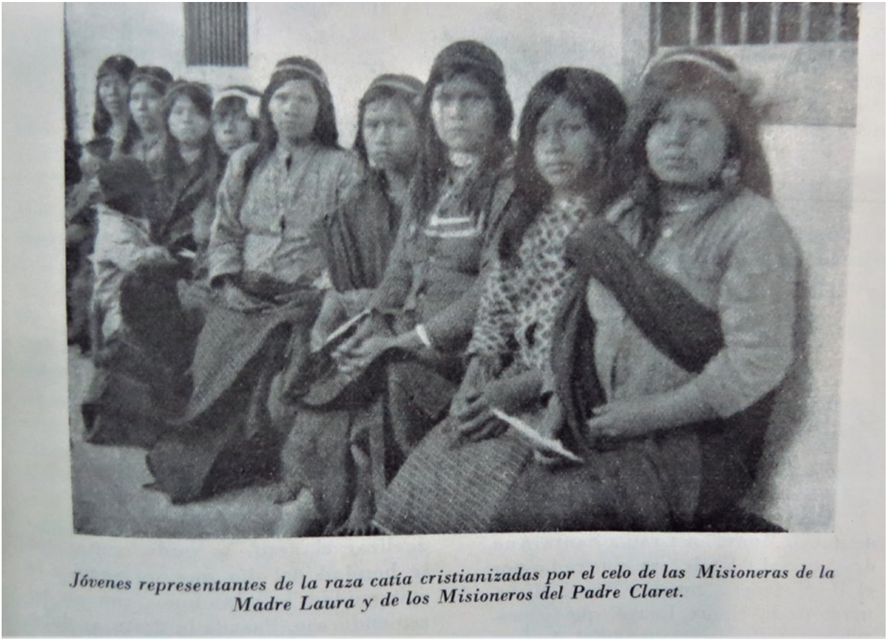
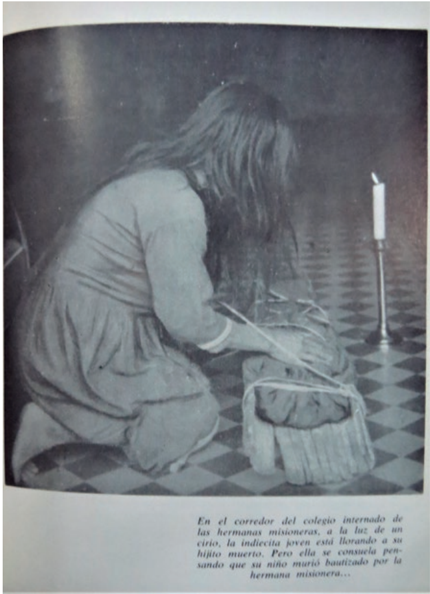
- Photographs of women ca. 1920–1930 show a transformation toward an “urbanized” and spiritualized body: long hair with ribbons, long dresses and shawls, books/catechism, and studio-like poses; images were used as testimonies of missionary work and for teaching catechism.
- Mission reports claim large-scale ritual incorporation: Table 1 for 1911/1912 lists baptisms 3,983/3,287; confirmations 1,497/1,716; communions 33,888/39,383; marriages 404/232; burials 203/293. Prefect Juan Gil estimated 100,000 inhabitants in Chocó (10,000 whites, 20,000 mulatos, 50,000 negros, 20,000 indios), contrasted with censuses of 1905 (54,176) and 1912 (68,127; Quibdó 15,756).
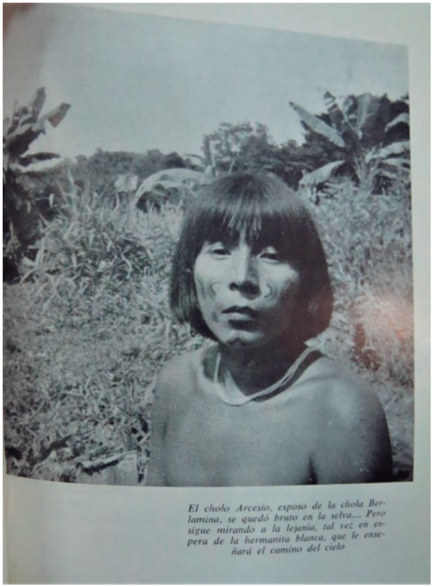
- Resistance appears, for example, in the case of Arsecio, labeled “bruto en la selva” in a 1924 caption, who resisted religious and educational practices; the article notes evangelization was not total or complete and that some indigenous people resisted.
Methods
- Historical and visual analysis of the Claretian mission in Chocó, 1909–1930, contextualized by the Regeneración, the 1887 Concordato, and the Conservative Hegemony.
- Primary sources include mission memoirs and reports (Atucha, Gil, Gutiérrez, Mesa, Fernández), official reports, and photographs ca. 1920–1930 (Figures 1–6); both textual and visual narratives are examined.
- Qualitative interpretation draws on sociology of the body and emotions and civilization theory (Elias, Le-Breton, Bourdieu, Nussbaum, among others), focusing on shame, corporal representation, and gender.
Limitations
- Stated: the population’s own narrative is difficult to access and permits only approximations; the degree of imposture in photographic poses cannot be precisely determined; the meaning of women’s facial gestures remains to be identified; the article cannot address all ways civilizational language entered politics.
- Stated/evident: reliance on missionary sources and photographs means indigenous voices and intimate life are largely mediated or invisible (“qué ocurre tras la puerta cerrada”); some photographs lack photographer information; mission statistics are inconsistent with censuses and sometimes inflated, as the article notes.
- Evident from the text: the study is qualitative and case-specific, so its findings are not generalizable beyond this mission and region.
Model-written summary. Check it against the paper before relying on it.
Integrity signals
Registry
Cites
Statistics
Figures
Verification
Claims the paper makes
55 Own interpretation · 35 Sources not found · 15 Own result · 5 Not checked yet · 5 No basis given
In the paper
“la cual valoraban como una colaboración para «elevar el nivel cultural de los nativos»”
What the sources say
- Not matchedcites [48]
Couldn’t be matched to a paper in Crossref, so it can’t be checked.
plain- Asserted: passes — The authors put it forward as true.
- Checkable: passes — It can be checked against evidence.
- Load-bearing: passes — The paper’s conclusions depend on it.
- Based: passes — The paper gives a reason why it holds.
- Not matched
In the paper
“una formación específica entendida en un fundamento religioso, ya que, sin este, la cultura era «un barniz postizo y caedizo»”
What the sources say
- Not matchedcites [48]
Couldn’t be matched to a paper in Crossref, so it can’t be checked.
plainstates a cause- Asserted: passes — The authors put it forward as true.
- Checkable: passes — It can be checked against evidence.
- Load-bearing: passes — The paper’s conclusions depend on it.
- Based: passes — The paper gives a reason why it holds.
- Not matched
A result the paper states — it cites no source for it, so there is none to check. The quote shows it is in the paper.
In the paper
“pero esta última se diferenciaba de las primeras por el grado de civilización alcanzado en sus costumbres religiosas católicas y en sus prácticas productivas.”
plainstates an association- Asserted: passes — The authors put it forward as true.
- Checkable: passes — It can be checked against evidence.
- Load-bearing: passes — The paper’s conclusions depend on it.
- Based: passes — The paper gives a reason why it holds.
A result the paper reports from its own data — it cites no other source for it, so there is none to check. The quote shows it is in the paper.
In the paper
“Por lo general se utilizan planos cerrados.”
plain- Asserted: passes — The authors put it forward as true.
- Checkable: passes — It can be checked against evidence.
- Load-bearing: unclear — It is unclear whether the paper’s conclusions depend on it.
- Based: passes — The paper gives a reason why it holds.
A result the paper states — it cites no source for it, so there is none to check. The quote shows it is in the paper.
In the paper
“también implicó la reacción de muchos de los habitantes que, como el indígena Arsecio (Figura 1), se resistieron a participar de las prácticas religiosas y educativas de los y las misioneras.”
plainSingle case- Asserted: passes — The authors put it forward as true.
- Checkable: passes — It can be checked against evidence.
- Load-bearing: passes — The paper’s conclusions depend on it.
- Based: passes — The paper gives a reason why it holds.
26 more claims
Create a free account to see all 115 claims and every source verdict.
- Probably not a substantial claim. 62
- It may state two separate claims as one. 56
Claims other papers make about this one
Each is checked against this paper’s own text: does it say what the citing paper says it does?
In the citing paper
“Como indica Martínez (2017) las misiones ejercían control social sobre los territorios, tanto entre las comunidades indígenas y afrodescendientes del territorio colombiano como entre la población colona que allí habitaba, pero esta última se diferenciaba de las primeras por el grado de civilización alcanzado en sus costumbres religiosas católicas y en sus prácticas productivas.”
From Relaciones interétnicas en el chocó colombiano. Indígenas y afrocolombianos en el panorama de la investigación (2020) · cites this paper as Martínez 2017
Self-check
Percentages, sums and reported differences re-computed from the paper’s own numbers.
Each contradiction between two passages listed here was confirmed by an independent check.
Rated minor: it would not touch a result — a value no result rests on, a p-value that stays on the same side of the significance level, or a conflict that is clerical, resolved elsewhere in the paper, or outside its own findings.
In the paper
§ Bibliografía
“Citado en Mariona Visa Barbosa, «Una metodología sociológica y narrativa para el análisis de relatos fotográficos», Estudios sobre el mensaje periodístico 18, n.° especial (2012): 929-939.”
§ References
“Visa Barbosa, Mariana. «Una metodología socio- lógica y narrativa para el análisis de relatos fo- tográficos». Estudios sobre el mensaje periodístico 18, n.° especial (2012): 929-939.”
Rated minor: it would not touch a result — a value no result rests on, a p-value that stays on the same side of the significance level, or a conflict that is clerical, resolved elsewhere in the paper, or outside its own findings.
In the paper
§ Abstract
“Eduardo Restrepo, «El giro a la biodiversidad en la imaginación del Pacífico colombiano», Revista Estudios del Pacífico colombiano, n.° 1 (2013): 171-199.”
§ References
“Restrepo, Eduardo. «El giro a la biodiversidad en la imaginación del Pacífico colombiano». Revista Estudios del Pacíf ico colombiano, n.° 1 (2015): 171-199.”
Citations
Cites
Las formas elementales de la vida religiosa
Durkheim, E. (1982) · Alianza Editorial eBooks · Cited by 895
Nussbaum, M. C. (2006) · Katz Editores eBooks · doi:10.2307/j.ctvm7bdp8 · Cited by 174
Historia de los censos en Colombia
Rueda, J. O., Jorge Bustamante, R., & de Estadística, C. D. A. N. (2012) · Cited by 4
O índio na fotografia brasileira: incursões sobre a imagem e o meio
de Tacca, F. (2011) · História, Ciências, Saúde-Manguinhos · doi:10.1590/s0104-59702011000100012
Restrepo, N. (2006) · Tabula Rasa · doi:10.25058/20112742.272
Una metodología sociológica y narrativa para el análisis de relatos fotográficos
Barbosa, M. V. (2012) · Estudios sobre el Mensaje Periodístico · doi:10.5209/rev_esmp.2012.v18.40971
Research works printed but not linked: 4
- Cano, Miguel Darío. «Comentario sobre La Re- vista Misiones». Historik II, n.° 4 (2011): 1-5.
- Martínez, Alexandra. «Retratos de Mujer: Imá- genes en la prensa caleña a comienzos del si- glo XX». Revista Maguaré 30, n.° 1 (2016): 71-102.
- Restrepo, Eduardo. «El giro a la biodiversidad en la imaginación del Pacífico colombiano». Revista Estudios del Pacíf ico colombiano, n.° 1 (2015): 171-199.
- Villamizar, Carlos. «Colombia/Nueva Granada». En Diccionario político y social del mundo iberoameri- cano. Civilización, editado por Joao Feres Júnior. Madrid: Universidad del País Vasco, 2014. Cómo citar este artículo Martínez, Alexandra. «Relatos visuales misiona- les de los cuerpos indígenas: vergüenza y civiliza- ción en Chocó, Colombia 1909-1930». Memoria y Sociedad 21, n.° 43 (2017): 66-85. https://doi. org/10.11144/Javeriana.mys21-43.rvmc
Cited by
Martínez, A., & Benavides, A. C. P. (2022) · Boletim do Museu Paraense Emílio Goeldi Ciências Humanas · doi:10.1590/2178-2547-bgoeldi-2021-0048 · Cited by 3
Self-citationCampamentos “en el ojo del huracán”. Entre la estigmatización y otras “habit-habilidades”
Caro, L. C. M. (2021) · Si Somos Americanos · doi:10.4067/s0719-09482021000200095 · Cited by 2
Voces historiográficas: misiones católicas y protestantes en América del Sur, siglos XIX y XX
Fischer, T., Hernández, M. G., & Benavides, A. C. P. (2024) · Anuario Colombiano de Historia Social y de la Cultura · doi:10.15446/achsc.v52n1.117629 · Cited by 2
Martínez, C. G. (2024) · theses.fr (ABES) · doi:10.70675/3dc37732z211bz4c68zb790z41518715a0ce
Fernández Álvarez, Ó. (2020) · Gazeta De Antropología · doi:10.30827/digibug.64882
Metadata
- Authors
- Martínez, A.
- Affiliations
- Pontificia Universidad Javeriana (CO)
- Corresponding author
- Martínez, Alexandra
- ORCID
- Martínez, Alexandra
- Venue
- Memoria Y Sociedad
- Published
- 2017-12-31
- Volume
- 21
- Issue
- 43
- ISSN
- 0122-5197 (ISSN-L)
- 2248-6992
- OpenAlex
- W2784518600
- Cited by
- 4
- References
- 4
- Citations by year
- 2024: 2 · 2022: 1 · 2021: 1
- FWCI
- 0.00
- Type
- journal article
- Language
- es
- Open access
- diamond
- doi.org
- Locations
- Memoria y Sociedad (publishedVersion, cc-by)
- LA Referencia (Red Federada de Repositorios Institucionales de Publicaciones Científicas) (publishedVersion, cc-by)
- LA Referencia (Red Federada de Repositorios Institucionales de Publicaciones Científicas) (publishedVersion, other-oa)
- Repositorio Institucional (Pontificia Universidad Javeriana) (submittedVersion, cc-by)
- LA Referencia (Red Federada de Repositorios Institucionales de Publicaciones Científicas) (submittedVersion, cc-by)
- Dialnet (Universidad de la Rioja) (submittedVersion)
- Topics
- Social Sciences › Anthropology › Indigenous Cultures and History
- Social Sciences › Arts and Humanities › History › Latin American history and culture
- Social Sciences › Cultural Studies › Indigenous Studies in Latin America
- Keywords
- indigenous peoples, visual narrative, missionary photography, evangelism, civilization, shame, Embera, Chocó, colonialism
About these checks
Registry, retraction, Cites and statistics results are computed, not judged, with one exception: a printed reference that no index lists is read once by a model before it counts as a citation error. Claims are extracted by a model and kept only when their quote appears verbatim in the text; each cited source is then checked, with a model’s help, for whether it says what the claim relies on. Those verdicts can be wrong — read the claim’s quote and the cited source before relying on one.
A language model drew the claims from the paper on 2026-11-10, under version 3 of the claim definition (model deepseek-v4.1-flash, prompt extract-v3).
A second model labelled each claim on 2026-11-10 (model jev-1.13-20260917, definition revision gold-guideline-v0.2).
Statistics and arithmetic are recomputed, not judged.
Confidence bands are shown only for fields calibrated on our annotated test set. None is calibrated yet, so no band is shown.
What counts as a claim ›How we measure confidence ›How we check this ›
Are you an author, or do you see a problem with this page? Request a review
Data sources
Bibliographic data: Semantic Scholar, OpenAlex, Crossref.
Contains information from the Semantic Scholar Academic Graph Datasets, made available under the ODC Attribution License (ODC-BY 1.0).
Semantic Scholar’s data is described in: Kinney, R., et al. (2023). The Semantic Scholar Open Data Platform. arXiv:2301.10140.
