

The DOI matches its Crossref record; 1 of the 1 references it cites were found in a registry or an index.
Defining the quantum workforce landscape: a review of global quantum education initiatives
Open accessAbstract
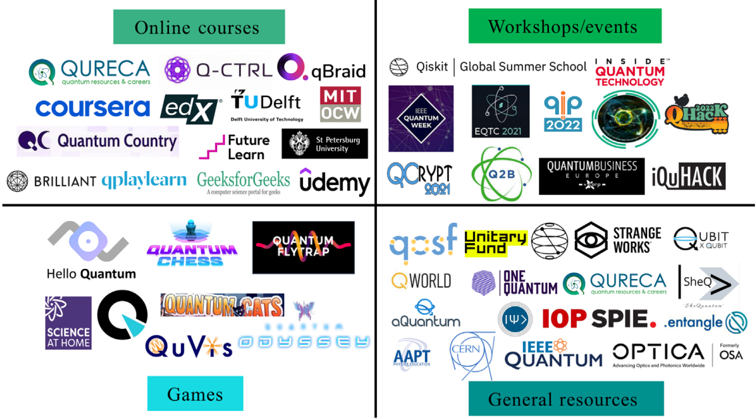
Rapid advances in quantum technology have exacerbated the shortage of a diverse, inclusive, and sustainable quantum workforce. National governments and industries are developing strategies for education, training, and workforce development to accelerate the commercialization of quantum technologies. We report the existing state of the quantum workforce as well as several learning pathways to nurture the talent pipeline between academia and industry. We provide a comprehensive guide to various educational initiatives accessible throughout the world, such as online courses, conferences, seminars, games, and community-focused networks, that facilitate quantum training and upskill the talent needed to develop a better quantum future.
Overview
The claims and statistics of this paper haven’t been checked yet.
Run the check — free, no account needed. It reads the open-access text and checks the sources it cites.
Integrity signals
Registry
Cites
Statistics
Figures
Verification
Claims the paper makes
The claims and statistics of this paper haven’t been checked yet.
Run the check — free, no account needed. It reads the open-access text and checks the sources it cites.
Claims other papers make about this one
Each is checked against this paper’s own text: does it say what the citing paper says it does?
In the citing paper
“Hands-on experience is undoubtedly a great asset for entering the quantum industry, as reported by companies [5–13], a trend that has been observed both in interview studies and in the structure of educational programs [8].”
From The quantum technology job market: data driven analysis of 3641 job posts (2026) · cites this paper as [12]
Self-check
Percentages, sums and reported differences re-computed from the paper’s own numbers.
The self-check needs the paper’s full text.
Citations
Cites
Superconducting qubit to optical photon transduction
Mirhosseini, M., Sipahigil, A., Kalaee, M., & Painter, O. (2020) · Nature · doi:10.1038/s41586-020-3038-6 · Cited by 486
Research works printed but not linked: 20
- J. Preskill, "Quantum computing in the NISQ era and beyond," Quantum 2, 79 (2018). · DOI · Paper page
- S. Mugel et al., "Dynamic portfolio optimization with real datasets using quantum processors and quantum-inspired tensor networks," Phys. Rev. Res. 4, 013006 (2022). · DOI
- S. Yarkoni et al., "Quantum shuttle: traffic navigation with quantum computing," arXiv:2006.14162 (2020). · arXiv
- A. Venegas-Gomez, "The quantum ecosystem and its future workforce," PhotonicsViews 17, 34-38 (2020). · DOI
- A. Asfaw et al., "Building a quantum engineering undergraduate program," arXiv 2108.01311 (2021). · arXiv
- M. F. J. Fox, B. M. Zwickl, and H. J. Lewandowski, "Preparing for the quantum revolution: what is the role of higher education?" Phys. Rev. Phys. Educ. Res. 16, 020131 (2020). · DOI · Paper page
- C. D. Aiello et al., "Achieving a quantum smart workforce," Quantum Sci. Technol. 6, 030501 (2021). · DOI · Paper page
- A. Acín et al., "The quantum technologies roadmap: a European Community view," New J. Phys. 20, 080201 (2018). · DOI
- C. Hughes et al., "Assessing the needs of the quantum industry," arXiv 2109.03601 (2021). · arXiv
- E. Edwards et al., "Panel discussion: workforce development in quantum science and technology," OSA Quantum 2.0 Conference, 2020, https://www.optica-opn.org/home/ newsroom/2020/september/how_to_build_a_quantum-ready_workforce/.
- C. L. Friedrichs et al., "An analysis of quantum computing courses worldwide," Proceedings of Seidenberg Student Faculty Research Day, 2021, https://csis.pace.edu/ ctappert/srd/a5.pdf.
- A. S. Dzurak et al., "Development of an undergraduate quantum engineering degree," arXiv 2110.12598 (2021). · arXiv
- J. K. Perron et al., "Quantum undergraduate education and scientific training," arXiv:2109.13850 (2021). · arXiv
- G. P. Nodarse, "Quantum technology impact: the necessary workforce for developing quantum software," 2020, http://ceur-ws.org/Vol-2561/paper1.pdf.
- "IEEE Quantum," https://quantum.ieee.org/.
- "European Quantum Technologies Conference (EQTC)," https://www.eqtc.org/.
- "Conference series on quantum information processing," https://qipconference.org/.
- American Physical Society, "APS Physics march meeting," https://march.aps.org/.
- L. Nita et al., "The challenge and opportunities of quantum literacy for future education and transdisciplinary problem-solving," Res. Sci. Technol. Educ., 1-17 (2021). · DOI
- S.-Y. Hou et al., "SpinQ Gemini: a desktop quantum computing platform for education and research," EPJ Quantum Technol. 8, 20 (2021). 100. "SheQuantum," https://shequantum.org/. 101. "The Unconventional Computing Lab," https://unconventionalcomputing.org/. 102. "Brazil Quantum," https://linktr.ee/brazilquantum 103. "aQuantum," https://www.aquantum.es/. 104. "Quantum Curious," https://quantumcurious.org/ 105. "Entangle by the quantum insider," https://thequantuminsider.com/entangle.html. 106. "Quantum Computing Stack Exchange," https://quantumcomputing.stackexchange.com/. 107. "Strangeworks: one platform, all the quantum," https://strangeworks.com/. 108. American Association of Physics Teachers, https://aapt.org/. 109. "CERN quantum technology initiative," https://quantum.cern/. 110. "IOP quantum science," https://iopscience.iop.org/page/quantum-science. 111. "QPARC Quantum Practical Application Research Community," https://www.qparc .qunasys.com/. 112. "QuSTEAM convergent undergraduate education in quantum science, technology, engi- neering, arts and mathematics," https://qusteam.org/. 113. "InstituteQ: the Finnish Quantum Institute," https://instituteq.fi/. 114. "QuSoft: research center for quantum software," https://www.qusoft.org/. · DOI
Cited by
Sorted by citations
Quantum technology master’s: a shortcut to the quantum industry?
Goorney, S., Muñoz, B., & Sherson, J. (2025) · EPJ Quantum Technology · doi:10.1140/epjqt/s40507-024-00299-x · Cited by 3
The quantum technology job market: data driven analysis of 3641 job posts
Goorney, S., Karydi, E., Muñoz, B., Santesson, O., Seskir, Z. C., Tudoran, A. A., & Sherson, J. (2026) · EPJ Quantum Technology · doi:10.1140/epjqt/s40507-026-00477-z · Cited by 1
Metadata
- Authors
- Kaur, M., & Venegas-Gomez, A.
- Affiliations
- QURECA Ltd.
- Corresponding author
- Kaur, Maninder
- Venue
- Optical Engineering
- Publisher
- SPIE-Intl Soc Optical Eng
- Published
- 2022-05-19
- Volume
- 61
- Issue
- 08
- Pages
- 1-16
- ISSN
- 0091-3286 (ISSN-L)
- 1560-2303
- OpenAlex
- W4280583859
- Cited by
- 98
- References
- 1
- Citations by year
- 2026: 18 · 2025: 27 · 2024: 27 · 2023: 21 · 2022: 5
- FWCI
- 6.58
- Type
- journal article
- Language
- en
- Open access
- hybrid
- doi.org
- Licence
- cc-by
- Locations
- Optical Engineering (publishedVersion, cc-by)
- arXiv (Cornell University) (submittedVersion)
- arXiv (Cornell University) (cc-by)
- Topics
- Physical Sciences › Physics and Astronomy › Atomic and Molecular Physics, and Optics › Quantum Information and Cryptography
- Physical Sciences › Computer Science › Artificial Intelligence › Quantum Computing Algorithms and Architecture
- Social Sciences › Education › Engineering Education and Curriculum Development
- Keywords
- quantum workforce, quantum education, talent pipeline, academia-industry collaboration, online courses, diversity and inclusion
About these checks
Registry, retraction, Cites and statistics results are computed, not judged, with one exception: a printed reference that no index lists is read once by a model before it counts as a citation error. Claims are extracted by a model and kept only when their quote appears verbatim in the text; each cited source is then checked, with a model’s help, for whether it says what the claim relies on. Those verdicts can be wrong — read the claim’s quote and the cited source before relying on one.
Statistics and arithmetic are recomputed, not judged.
Confidence bands are shown only for fields calibrated on our annotated test set. None is calibrated yet, so no band is shown.
What counts as a claim ›How we measure confidence ›How we check this ›
Are you an author, or do you see a problem with this page? Request a review
How to cite
Cite CoChat for the checks on this page, and the paper for its own findings.
- This page
- CoChat. (2026). Citation check: Defining the quantum workforce landscape: a review of global quantum education initiatives. https://app.cochat.ai/papers/10.1117/1.oe.61.8.081806
- The paper
- Kaur, M., & Venegas-Gomez, A. (2022). Defining the quantum workforce landscape: a review of global quantum education initiatives. Optical Engineering. https://doi.org/10.1117/1.oe.61.8.081806
