

Quantum technology master’s: a shortcut to the quantum industry?
Open accessThe DOI matches its Crossref record; 24 of the 24 references it cites were found in a registry or an index.
Abstract
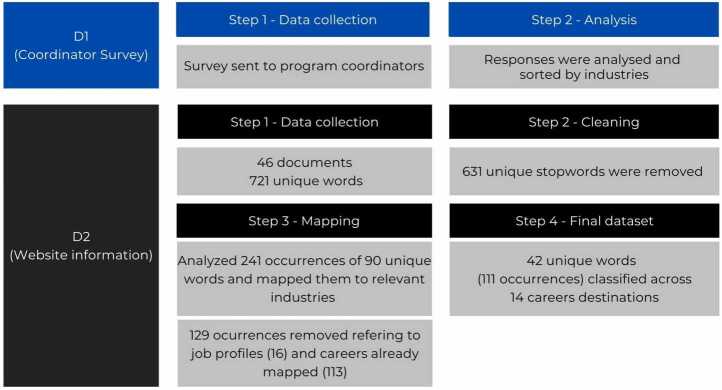
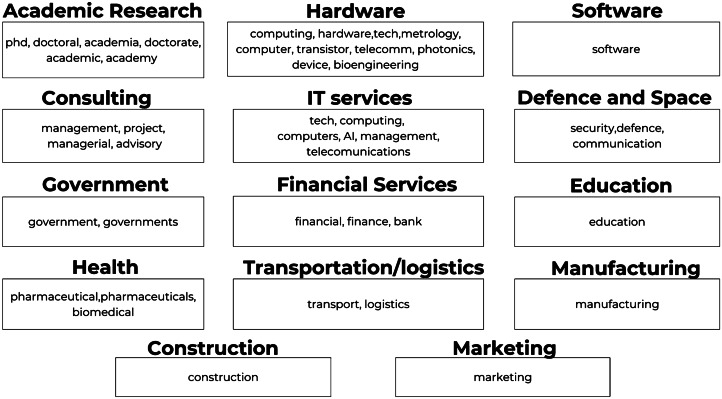
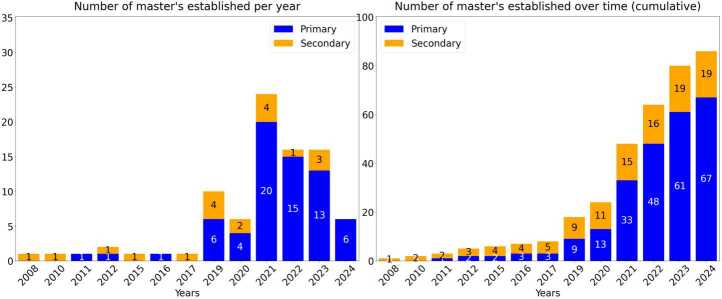
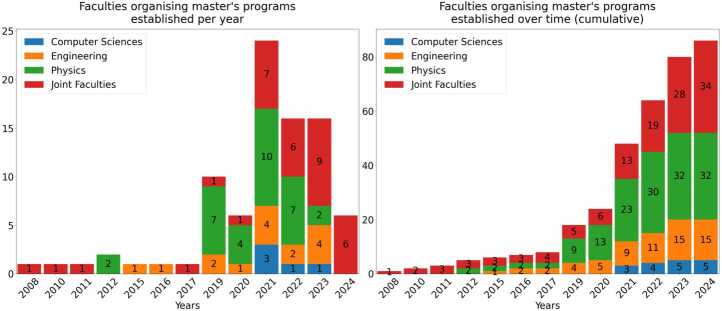
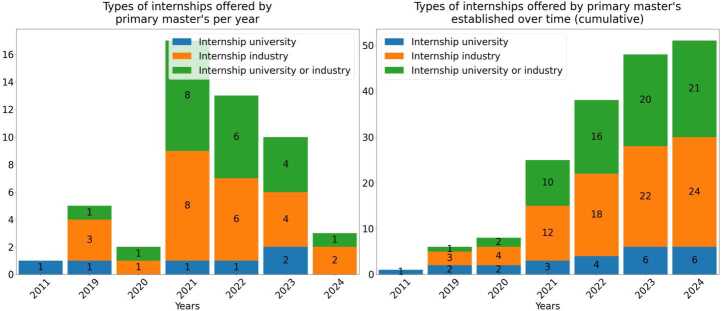
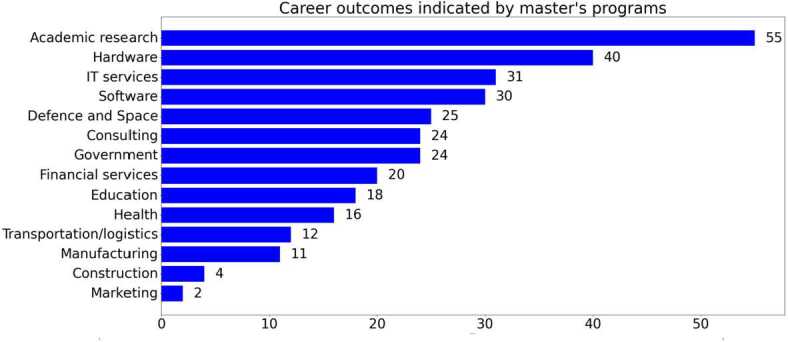
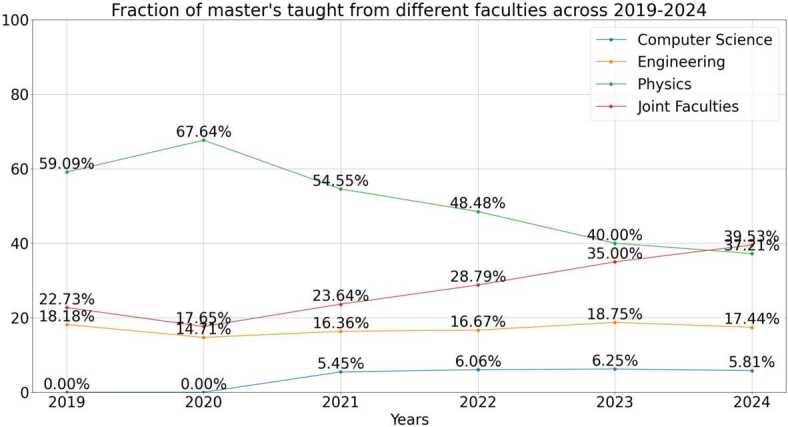
In this article, we investigate a growing trend in the worldwide Quantum Technology (QT) education landscape, that of the development of master’s programs, intended to provide graduates with the knowledge and skills to take a job in the quantum industry, while serving a much shorter timeline than a doctoral degree. Through a global survey, we identified 86 master’s programs, with substantial growth since 2021. Over time master’s have become increasingly interdisciplinary, organised by multiple faculties or through joint degree programs, and offer more hands-on experiences such as internships in companies. Information from program organisers and websites suggests that the intended career destinations of their graduates are a diverse range of industries, and therefore master’s programs may be a boon to the industrialisation of quantum technologies. Finally, we identify a range of national efforts to grow the quantum workforce of many countries, “quantum program enhancements”, which augment the content of existing study programs with quantum content. This may further contribute to the growth and viability of master’s programs as a route to the quantum industry.
Overview
The claims and statistics of this paper haven’t been checked yet.
Free: it reads the open-access text and checks the first 5 claims that cite a source we can check. Create a free account to check every claim.
Integrity signals
Registry
Cites
Statistics
Figures
Verification
Claims the paper makes
The claims and statistics of this paper haven’t been checked yet.
Free: it reads the open-access text and checks the first 5 claims that cite a source we can check. Create a free account to check every claim.
Claims other papers make about this one
Each is checked against this paper’s own text: does it say what the citing paper says it does?
The source backs part of the claim, not all of it — or backs it for a different population, condition or comparison.
In the citing paper
“Interdisciplinary jobs in QT are increasing in number [5–7]”
From The quantum technology job market: data driven analysis of 3641 job posts (2026) · cites this paper as [7]
Experimental — accuracy not yet measuredThe source backs part of the claim, not all of it — or backs it for a different population, condition or comparison.
In the citing paper
“It is clear that the quantum industry of the USA is actively establishing a presence in the EU, either to tap into the EU talent pool of graduates, where the EU is academically excelling [7], or to expand global operations.”
From The quantum technology job market: data driven analysis of 3641 job posts (2026) · cites this paper as [7]
Experimental — accuracy not yet measuredThe cited source says what the claim attributes to it.
In the citing paper
“As the number of educational opportunities increases, the fraction of graduates able to take up roles in the quantum industry, without the time commitment of a PhD, will likely increase [7].”
From The quantum technology job market: data driven analysis of 3641 job posts (2026) · cites this paper as [7]
The cited source says what the claim attributes to it.
In the citing paper
“Hands-on experience is undoubtedly a great asset for entering the quantum industry, as reported by companies [5–13], a trend that has been observed both in interview studies and in the structure of educational programs [8].”
From The quantum technology job market: data driven analysis of 3641 job posts (2026) · cites this paper as [7]
The cited source says what the claim attributes to it.
In the citing paper
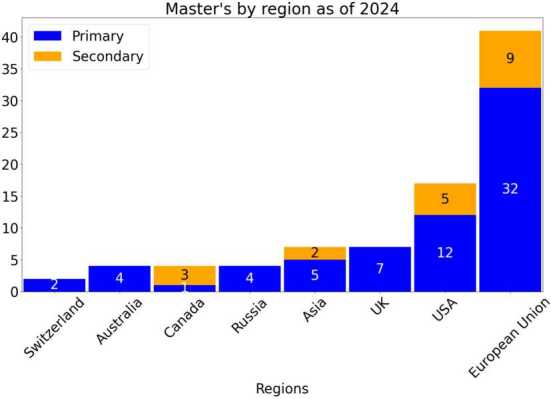
“This may indicate that the value of a master’s is higher in Europe, potentially relating to the significantly higher number of master’s programs in the EU [7].”
From The quantum technology job market: data driven analysis of 3641 job posts (2026) · cites this paper as [7]
Self-check
Percentages, sums and reported differences re-computed from the paper’s own numbers.
The self-check needs the paper’s full text.
Citations
Cites
Quantum supremacy using a programmable superconducting processor
Arute, F., Arya, K., Babbush, R., Bacon, D., Bardin, J. C., Barends, R., Biswas, R., Boixo, S., Brandao, F. G. S. L., Buell, D. A., et al. (2019) · Nature · doi:10.1038/s41586-019-1666-5 · Cited by 7,720
Preparing for the quantum revolution: What is the role of higher education?
Fox, M. F. J., Zwickl, B. M., & Lewandowski, H. J. (2020) · Physical Review Physics Education Research · doi:10.1103/physrevphyseducres.16.020131 · Cited by 155
Building a Quantum Engineering Undergraduate Program
Oliver, W. D. (2022) · DSpace@MIT (Massachusetts Institute of Technology) · Cited by 127
Assessing the Needs of the Quantum Industry
Hughes, C., Finke, D., German, D.-A., Merzbacher, C., Vora, P. M., & Lewandowski, H. J. (2022) · IEEE Transactions on Education · doi:10.1109/te.2022.3153841 · Cited by 117
Achieving a quantum smart workforce
Aiello, C. D., Awschalom, D. D., Bernien, H., Brower, T., Brown, K. R., Brun, T. A., Caram, J. R., Chitambar, E., Di Felice, R., Edmonds, K. M., et al. (2021) · Quantum Science and Technology · doi:10.1088/2058-9565/abfa64 · Cited by 115
Defining the quantum workforce landscape: a review of global quantum education initiatives
Kaur, M., & Venegas-Gomez, A. (2022) · Optical Engineering · doi:10.1117/1.oe.61.8.081806 · Cited by 98
Building a quantum‐ready ecosystem
Purohit, A., Kaur, M., Seskir, Z. C., Posner, M. T., & Venegas‐Gomez, A. (2023) · IET Quantum Communication · doi:10.1049/qtc2.12072 · Cited by 88
Quantum information research in China
Zhang, Q., Xu, F., Li, L., Liu, N.-L., & Pan, J.-W. (2019) · Quantum Science and Technology · doi:10.1088/2058-9565/ab4bea · Cited by 86
Future quantum workforce: Competences, requirements, and forecasts
Greinert, F., Müller, R., Bitzenbauer, P., Ubben, M. S., & Weber, K.-A. (2023) · Physical Review Physics Education Research · doi:10.1103/physrevphyseducres.19.010137 · Cited by 68
Meyer, J. C., Passante, G., Pollock, S. J., & Wilcox, B. R. (2022) · Physical Review Physics Education Research · doi:10.1103/physrevphyseducres.18.010150 · Cited by 66
Research works printed but not linked: 2
- Tauch C, Rauhvargers A. Survey on master’s degrees and joint degrees in Europe. 2002.
- Nations U. International year of quantum science and technology. International year of quantum science and technology [Internet]. 2024. Available from: https://quantum2025.org.
Cited by
Outcomes from a workshop on a national center for quantum education
Barnes, E., Bennett, M. B., Boltasseva, A. E., Borish, V., Brown, B., Carr, L. D., Ceballos, R. R., Dukes, F., Easton, E. W., Economou, S. E., et al. (2025) · EPJ Quantum Technology · doi:10.1140/epjqt/s40507-025-00343-4 · Cited by 15
“While the workshop and findings are tailored to the US, this paper could support the development a framework for other global contexts, recognizing that there are significant differences in education and governance systems worldwide [15–18].”
Piña, A. R., El-Adawy, S., Verostek, M., Boyle, B. T., Cacheiro, M., Lawler, M., Pradeep, N., Watts, E., West, C. G., Lewandowski, H. J., et al. (2025) · Physical Review Physics Education Research · doi:10.1103/pstt-46b9 · Cited by 21
“Unlike the work of Meyer et al. [40], which reported on QISE education at all levels, Goorney et al. [44] reported exclusively on the graduate level to explore whether master ’ s programs can provide an easy transition to industry.”
InfluentialThe quantum technology job market: data driven analysis of 3641 job posts
Goorney, S., Karydi, E., Muñoz, B., Santesson, O., Seskir, Z. C., Tudoran, A. A., & Sherson, J. (2026) · EPJ Quantum Technology · doi:10.1140/epjqt/s40507-026-00477-z · Cited by 1
Self-citation
Metadata
- Authors
- Goorney, S., Muñoz, B., & Sherson, J.
- Affiliations
- Aarhus University (DK)
- Corresponding author
- Goorney, Simon
- Sherson, Jacob
- Venue
- EPJ Quantum Technology
- Published
- 2025-01-07
- Volume
- 12
- Issue
- 1
- Pages
- 2-2
- ISSN
- 2196-0763 (ISSN-L)
- 2662-4400
- PMC
- PMC11706872
- OpenAlex
- W4406142578
- Cited by
- 3
- References
- 23
- Citations by year
- 2026: 1 · 2025: 2
- FWCI
- 1.23
- Type
- journal article
- Language
- en
- Open access
- gold
- doi.org
- Licence
- cc-by
- creativecommons.org/licenses/by/4.0 (tdm)
- creativecommons.org/licenses/by/4.0 (vor)
- Locations
- EPJ Quantum Technology (publishedVersion, cc-by)
- PubMed Central (publishedVersion, cc-by)
- PubMed (publishedVersion)
- Funders
- European Health and Digital Executive Agency (101084035)
- HORIZON EUROPE European Research Council (101070193)
- Copenhagen University
- Topics
- Social Sciences › Education › Engineering Education and Curriculum Development
- Social Sciences › Education › Higher Education and Employability
- Physical Sciences › Computer Science › Information Systems › Information Systems Education and Curriculum Development
- Keywords
- master's degree program, quantum workforce, quantum industry, interdisciplinary degree programs, joint degree programs, internships, national education policy
About these checks
Registry, retraction, Cites and statistics results are computed, not judged, with one exception: a printed reference that no index lists is read once by a model before it counts as a citation error. Claims are extracted by a model and kept only when their quote appears verbatim in the text; each cited source is then checked, with a model’s help, for whether it says what the claim relies on. Those verdicts can be wrong — read the claim’s quote and the cited source before relying on one.
Statistics and arithmetic are recomputed, not judged.
Confidence bands are shown only for fields calibrated on our annotated test set. None is calibrated yet, so no band is shown.
What counts as a claim ›How we measure confidence ›How we check this ›
Are you an author, or do you see a problem with this page? Request a review
How to cite
Cite CoChat for the checks on this page, and the paper for its own findings.
- This page
- CoChat. (2026). Citation check: Quantum technology master’s: a shortcut to the quantum industry? https://app.cochat.ai/papers/10.1140/epjqt/s40507-024-00299-x
- The paper
- Goorney, S., Muñoz, B., & Sherson, J. (2025). Quantum technology master’s: a shortcut to the quantum industry? EPJ Quantum Technology. https://doi.org/10.1140/epjqt/s40507-024-00299-x
Data sources
Bibliographic data: Semantic Scholar, OpenAlex, Crossref.
Contains information from the Semantic Scholar Academic Graph Datasets, made available under the ODC Attribution License (ODC-BY 1.0).
Semantic Scholar’s data is described in: Kinney, R., et al. (2023). The Semantic Scholar Open Data Platform. arXiv:2301.10140.
