

The DOI matches its Crossref record; the references it cites are not checked yet.
Consonantal F0 perturbation in American English involves multiple mechanisms
Open accessAbstract
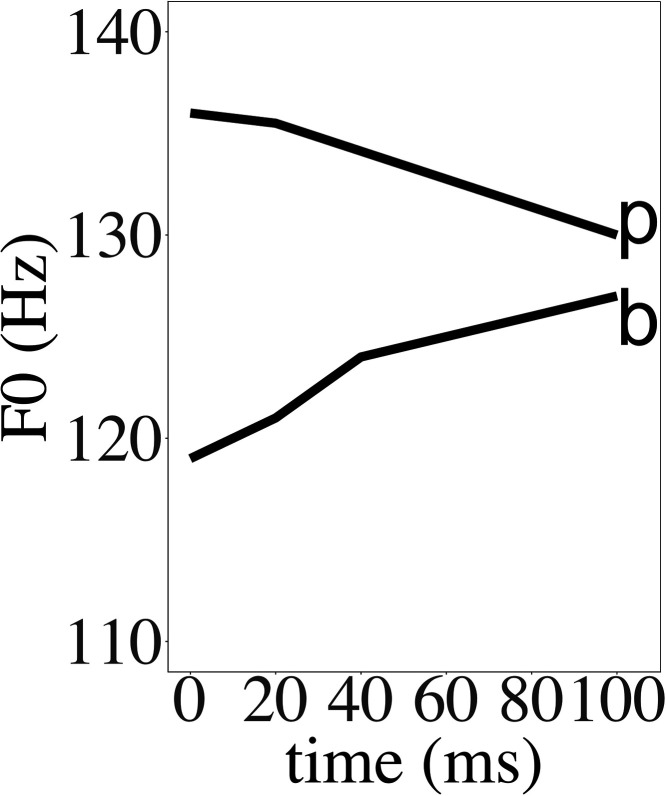
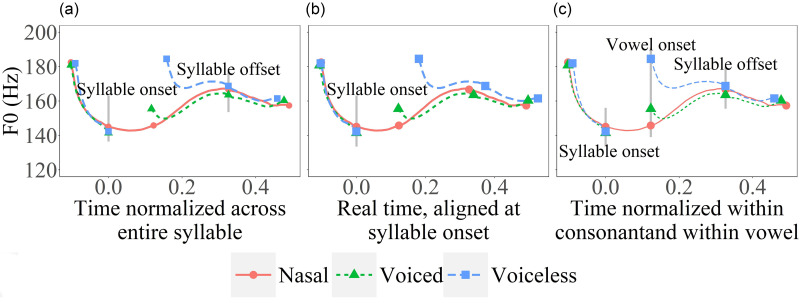
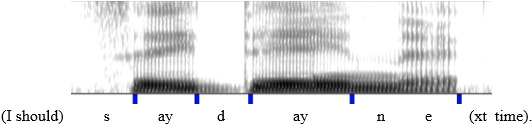
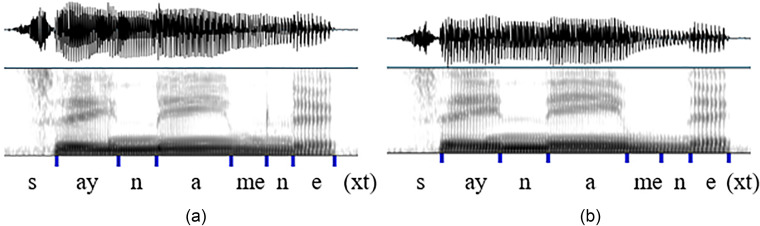
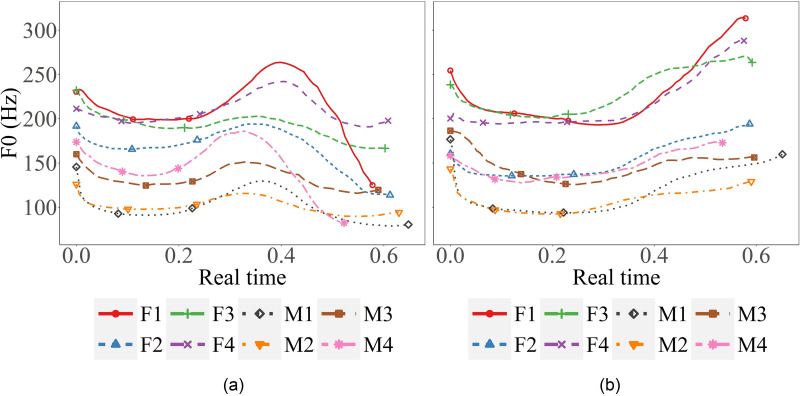
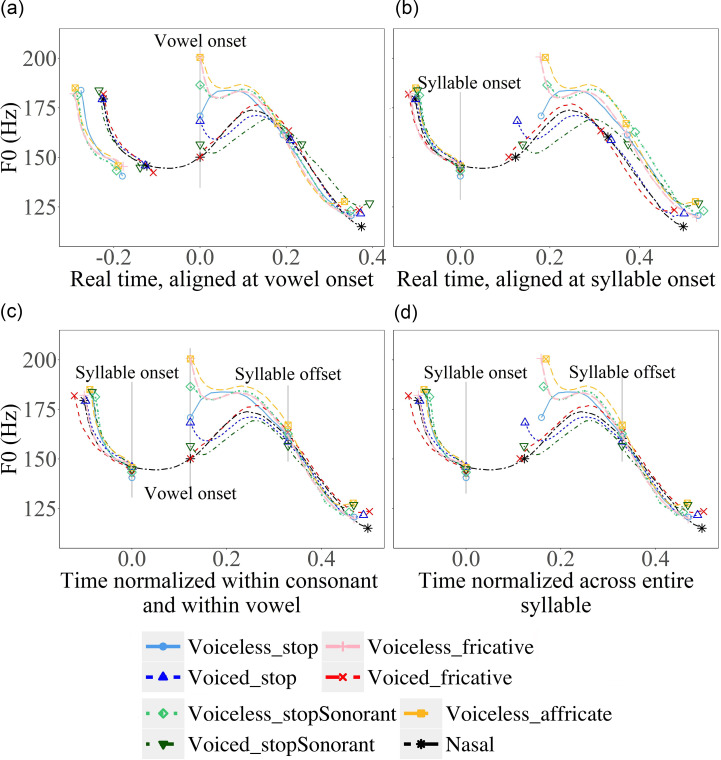
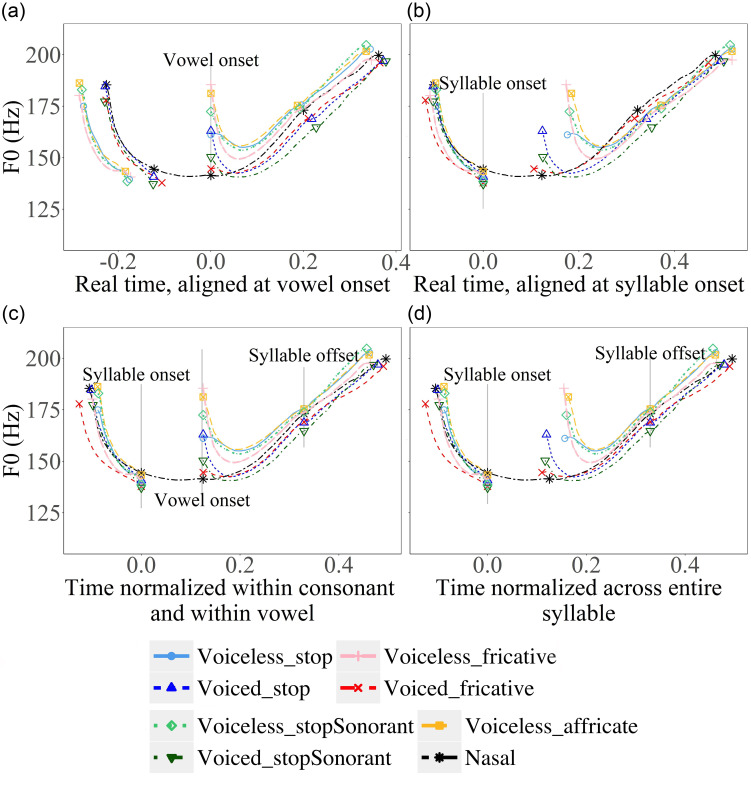
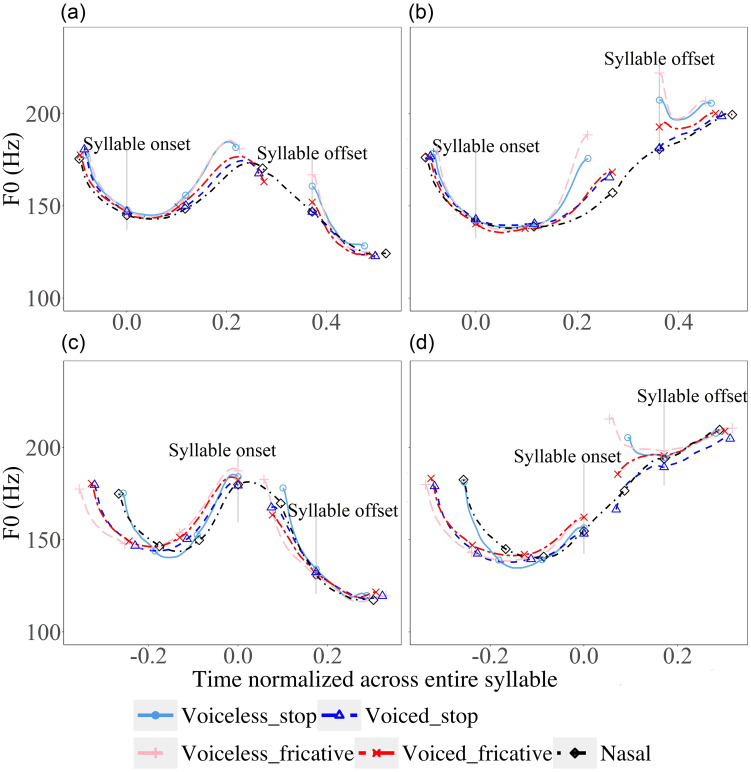
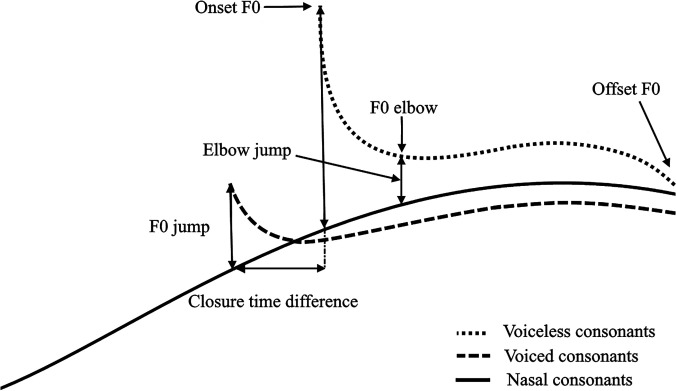
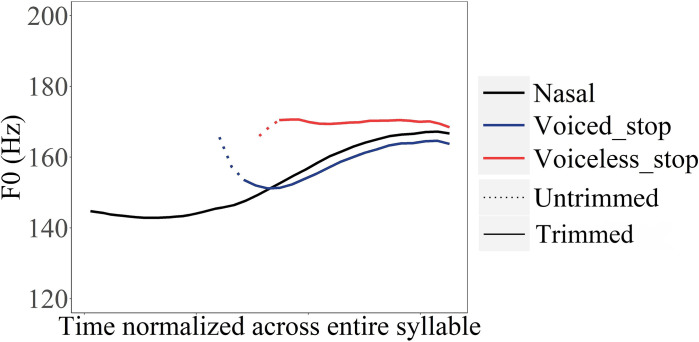
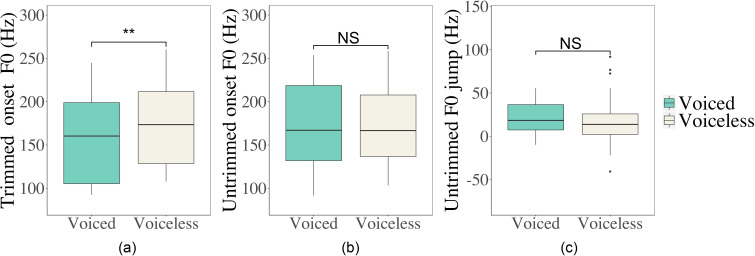
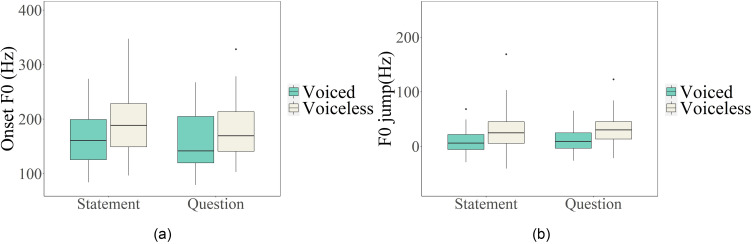
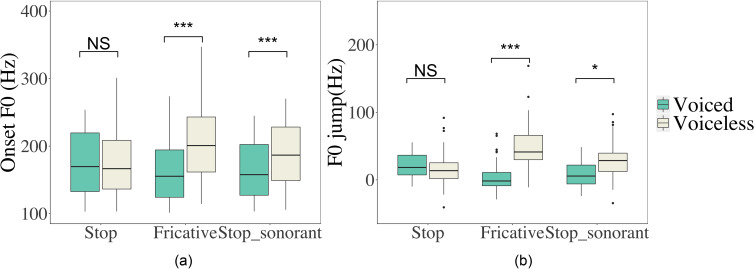
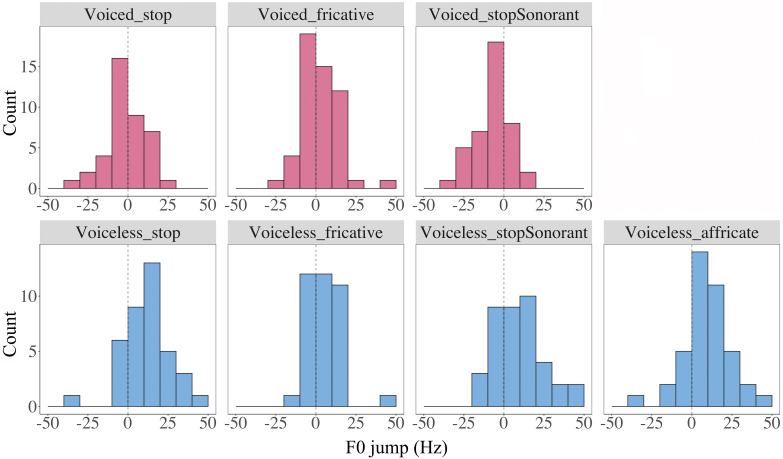
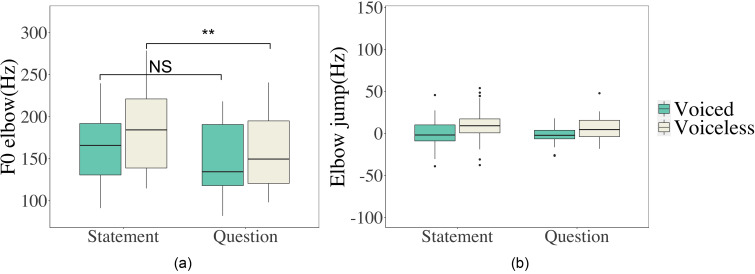
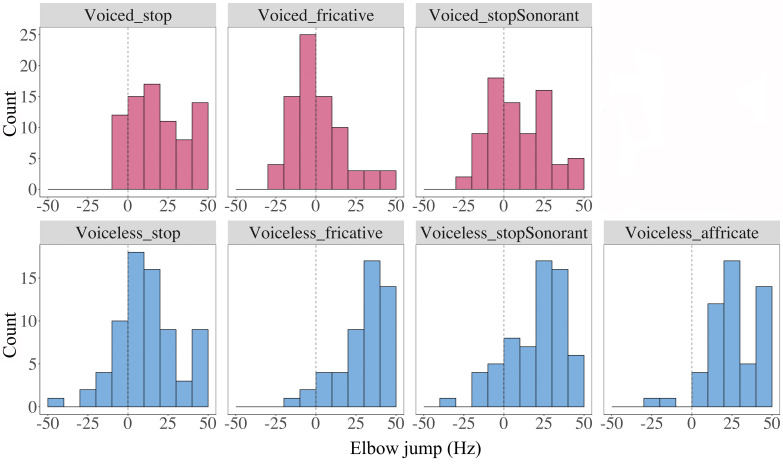
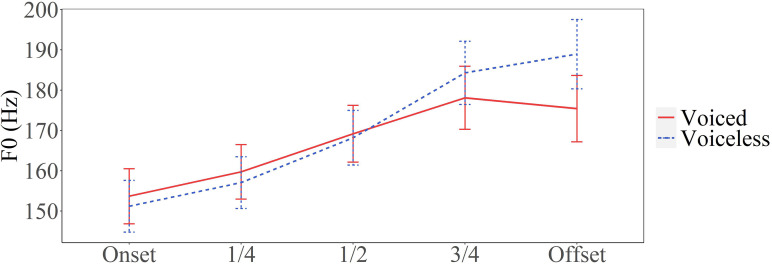
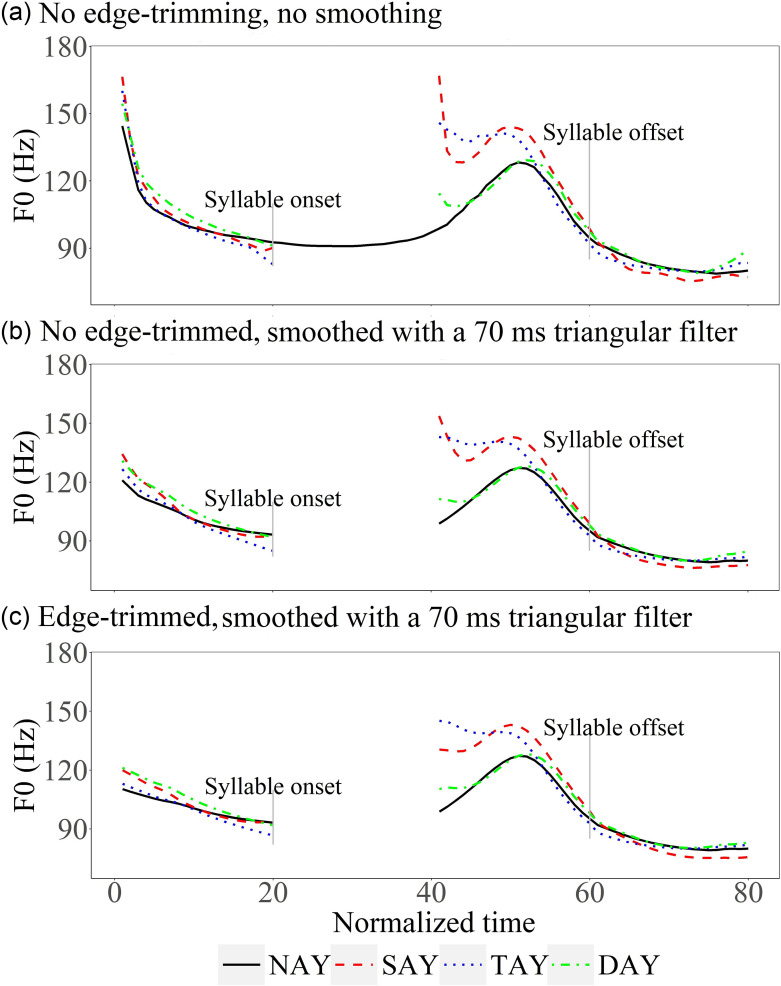
In this study, we revisit consonantal perturbation of F0 in English, taking into particular consideration the effect of alignment of F0 contours to segments and the F0 extraction method in the acoustic analysis. We recorded words differing in consonant voicing, manner of articulation, and position in syllable, spoken by native speakers of American English in both statements and questions. In the analysis, we compared methods of F0 alignment and found that the highest F0 consistency occurred when F0 contours were time-normalized to the entire syllable. Applying this method, along with using syllables with nasal consonants as the baseline and a fine-detailed F0 extraction procedure, we identified three distinct consonantal effects: a large but brief (10–40 ms) F0 raising at voice onset regardless of consonant voicing, a smaller but longer-lasting F0 raising effect by voiceless consonants throughout a large proportion of the following vowels, and a small lowering effect of around 6 Hz by voiced consonants, which was not found in previous studies. Additionally, a brief anticipatory effect was observed before a coda consonant. These effects are imposed on a continuously changing F0 curve that is either rising-falling or falling-rising, depending on whether the carrier sentence is a statement or a question.
Overview
The claims and statistics of this paper haven’t been checked yet.
Run the check — free, no account needed. It reads the open-access text and checks the sources it cites.
Integrity signals
Registry
Cites
Statistics
Figures

Verification
Claims the paper makes
The claims and statistics of this paper haven’t been checked yet.
Run the check — free, no account needed. It reads the open-access text and checks the sources it cites.
Self-check
Percentages, sums and reported differences re-computed from the paper’s own numbers.
The self-check needs the paper’s full text.
Citations
The citation lists haven’t been fetched yet
References 48 · Cited by 21
Research works printed but not linked: 50
- 1978, Correlation analysis of physiological factors controlling fundamental frequency, J. Acoust. Soc. Am., 63, 211, 10.1121/1.381716 · DOI
- 2013, Random effects structure for confirmatory hypothesis testing: Keep it maximal, J. Mem. Lang., 68, 255, 10.1016/j.jml.2012.11.001 · DOI · Paper page
- 2015, Fitting linear mixed-effects models using lme4, J. Stat. Softw., 67, 1, 10.18637/jss.v067.i01 · DOI · Paper page
- 1975, Control of pharyngeal cavity size for English voiced and voiceless stops, J. Acoust. Soc. Am., 57, 456, 10.1121/1.380468 · DOI
- 1996, Bifurcations in excised larynx experiments, J. Voice, 10, 129, 10.1016/S0892-1997(96)80039-7 · DOI
- 2011, How does phonology guide phonetics in segment–F0 interaction?, J. Phon., 39, 612, 10.1016/j.wocn.2011.04.001 · DOI
- 2017, Statistical modelling of phonetic and phonologised perturbation effects in tonal and non-tonal languages, Speech Commun., 88, 17, 10.1016/j.specom.2017.01.006 · DOI
- 2016, Variability in the implementation of voicing in American English obstruents, J. Phon., 54, 35, 10.1016/j.wocn.2015.09.003 · DOI
- Dixit, R. P. (1975). “ Neuromuscular aspects of laryngeal control, with special reference to Hindi,” Ph.D. thesis, University of Texas at Austin, Austin, TX.
- 2018, Acoustics of tone in Indian Punjabi, Trans. Philos. Soc., 116, 509, 10.1111/1467-968X.12135 · DOI
- 1974, Measuring larynx movement using the thyroumbrometer, J. Phon., 2, 327, 10.1016/S0095-4470(19)31302-6 · DOI
- 1996, A biomechanical laryngeal model of voice F0 and glottal width control, J. Acoust. Soc. Am, 100, 3794, 10.1121/1.417218 · DOI
- 1958, Experiments in the perception of stress, Lang. Speech, 1, 126, 10.1177/002383095800100207 · DOI
- 2019, Plosive (de-)voicing and f0 perturbations in Tokyo Japanese: Positional variation, cue enhancement, and contrast recovery, J. Phon., 77, 10932, 10.1016/j.wocn.2019.100932 · DOI · Paper page
- 1970, Pitch as a voicing cue, J. Acoust. Soc. Am., 47, 613, 10.1121/1.1911936 · DOI
- 1971, A note on laryngeal features, MIT Q. Prog. Rep., 101, 198
- 2009, Effects of obstruent consonants on fundamental frequency at vowel onset in English, J. Acoust. Soc. Am., 125, 425, 10.1121/1.3021306 · DOI · Paper page
- 2002, A quasiarticulatory approach to controlling acoustic source parameters in a Klatt-type formant synthesizer using HLsyn, J. Acoust. Soc. Am., 112, 1158, 10.1121/1.1498851 · DOI
- 2019, The Historical Phonology of Tibetan, Burmese, and Chinese
- 1960, Vocal pitch variation related to changes in vocal fold length, J. Speech Lang. Hear. Res., 3, 150, 10.1044/jshr.0302.156 · DOI
- Fromkin, 1978, Consonant types, vowel quality, and tone, 77
- 1979, Phonetic explanation for the development of tones, Language, 55, 37, 10.2307/412518 · DOI
- 1961, On vowel duration in English, J. Acoust. Soc. Am, 33, 1174, 10.1121/1.1908941 · DOI
- 1953, The influence of consonant environment upon the secondary acoustical characteristics of vowels, J. Acoust. Soc. Am., 25, 105, 10.1121/1.1906982 · DOI
- Gussenhoven, 2007, Segmental influences on F0: Automatic or controlled, 171
- 2016, Effects of obstruent voicing on vowel F0: Evidence from ‘true voicing’ languages, J. Acoust. Soc. Am, 140, 2400, 10.1121/1.4962445 · DOI · Paper page
- 2020, Elicitation context does not drive F0 lowering following voiced stops: Evidence from French and Italian, J. Acoust. Soc. Am., 148, EL147, 10.1121/10.0001698 · DOI
- 1982, F0 in the production of fortis and lenis plosives, Phonetica, 39, 199, 10.1159/000261663 · DOI
- Kingston, 1990, Macro and micro F0 in the synthesis of intonation, 115, 10.1017/CBO9780511627736 · DOI
- 1967, Three Areas of Experimental Phonetics
- Hyman, 1973, Segmental and suprasegmental influences on fundamental frequency contours, 15
- 1961, Some basic considerations in the analysis of intonation, J. Acoust. Soc. Am., 33, 419, 10.1121/1.1908681 · DOI
- 2013, Morpheme-like prosodic functions: Evidence from acoustic analysis and computational modeling, J. Speech Sci., 3, 85, 10.20396/joss.v3i1.15041 · DOI
- 1989, The cricothyroid muscle in voicing control, J. Acoust. Soc. Am., 85, 1314, 10.1121/1.397462 · DOI
- 1995, Vocal tract aerodynamics in /aCa/ utterances: Measurements, Speech Commun., 16, 49, 10.1016/0167-6393(94)00049-G · DOI
- 2002, Measurement of characteristic leap interval between chest and falsetto registers, J. Voice, 16, 8, 10.1016/S0892-1997(02)00066-8 · DOI
- 1984, Fundamental frequency as an acoustic correlate of stop consonant voicing, J. Acoust. Soc. Am., 75, 224, 10.1121/1.390399 · DOI
- 2009, Modeling tone and intonation in Mandarin and English as a process of target approximation, J. Acoust. Soc. Am, 125, 405, 10.1121/1.3037222 · DOI
- 1986, F0 segmental cues depend on intonation: The case of the rise after voiced stops, Phonetica, 43, 76, 10.1159/000261762 · DOI
- 1994, Principles of Voice Production
- 1983, Enlargement of the supraglottal cavity and its relation to stop consonant voicing, J. Acoust. Soc. Am., 73, 1322, 10.1121/1.389236 · DOI
- 1998, Consistency of tone-syllable alignment across different syllable structures and speaking rates, Phonetica, 55, 179, 10.1159/000028432 · DOI
- 1999, Effects of tone and focus on the formation and alignment of F0 contours, J. Phon., 27, 55, 10.1006/jpho.1999.0086 · DOI
- Katz, 2019, Prosody, tone and intonation, 314, 10.4324/9780429056253 · DOI
- 2006, Tonal alignment, syllable structure and coarticulation: Toward an integrated model, Ital. J. Linguist., 18, 125
- 2014, Toward invariant functional representations of variable surface fundamental frequency contours: Synthesizing speech melody via model-based stochastic learning, Speech Commun., 57, 181, 10.1016/j.specom.2013.09.013 · DOI
- 2002, Maximum speed of pitch change and how it may relate to speech, J. Acoust. Soc. Am, 111, 1399, 10.1121/1.1445789 · DOI
- 2001, Pitch targets and their realization: Evidence from Mandarin Chinese, Speech Commun., 33, 319, 10.1016/S0167-6393(00)00063-7 · DOI
- 2005, Phonetic realization of focus in English declarative intonation, J. Phon., 33, 159, 10.1016/j.wocn.2004.11.001 · DOI
- 1968, Speech and Hearing Science: Anatomy and Physiology
Metadata
- Authors
- Xu, Y., & Xu, A.
- Affiliations
- University College London (GB)
- Corresponding author
- Xu, Anqi
- Venue
- The Journal of the Acoustical Society of America
- Publisher
- Acoustical Society of America (ASA)
- Published
- 2021-04-01
- Volume
- 149
- Issue
- 4
- Pages
- 2877-2895
- ISSN
- 0001-4966 (ISSN-L)
- PMC
- PMC8087449
- OpenAlex
- W3159284836
- Cited by
- 21
- References
- 48
- Citations by year
- 2026: 5 · 2025: 5 · 2024: 5 · 2023: 2 · 2022: 4
- FWCI
- 2.65
- Type
- journal article
- Language
- en
- Open access
- hybrid
- doi.org
- Licence
- Locations
- The Journal of the Acoustical Society of America (publishedVersion, cc-by)
- PubMed Central (publishedVersion, cc-by)
- PubMed (publishedVersion)
- UCL Discovery (University College London) (submittedVersion)
- Funders
- National Institute on Deafness and Other Communication Disorders (R01 DC03902)
- Leverhulme Trust (RPG-2019-241)
- Topics
- Social Sciences › Psychology › Experimental and Cognitive Psychology › Phonetics and Phonology Research
- Health Sciences › Health Professions › Speech and Hearing › Voice and Speech Disorders
- Social Sciences › Linguistics and Language › Linguistic Variation and Morphology
- Keywords
- American English, fundamental frequency, voice onset, voiceless consonants, voiced consonants, nasal consonants, coda consonants, prosody
- MeSH terms
- Acoustics, Language, Nose, Phonetics, Speech Acoustics, Time Factors, United States
About these checks
Registry, retraction, Cites and statistics results are computed, not judged, with one exception: a printed reference that no index lists is read once by a model before it counts as a citation error. Claims are extracted by a model and kept only when their quote appears verbatim in the text; each cited source is then checked, with a model’s help, for whether it says what the claim relies on. Those verdicts can be wrong — read the claim’s quote and the cited source before relying on one.
Statistics and arithmetic are recomputed, not judged.
Confidence bands are shown only for fields calibrated on our annotated test set. None is calibrated yet, so no band is shown.
What counts as a claim ›How we measure confidence ›How we check this ›
Are you an author, or do you see a problem with this page? Request a review
How to cite
Cite CoChat for the checks on this page, and the paper for its own findings.
- This page
- CoChat. (2026). Citation check: Consonantal F0 perturbation in American English involves multiple mechanisms. https://app.cochat.ai/papers/10.1121/10.0004239
- The paper
- Xu, Y., & Xu, A. (2021). Consonantal F0 perturbation in American English involves multiple mechanisms. The Journal of the Acoustical Society of America. https://doi.org/10.1121/10.0004239
