

Sea level fingerprinting of the Bering Strait flooding history detects the source of the Younger Dryas climate event
Open accessThe DOI matches its Crossref record; 41 of the 41 references it cites were found in a registry or an index; none of the 45 sources its claims cite is checked for support yet.
Abstract
Two-phased flooding of Bering Strait is reconciled by melting North American ice saddle during Younger Dryas.
Overview
CoChat Summary
TL;DR
The paper uses gravitationally self-consistent relative sea-level modeling to reconcile conflicting Bering Strait flooding records by proposing a sea-level stillstand from 13 to 11.5 ka caused by melting of the Cordilleran/western Laurentide ice saddle. This meltwater pulse may have initiated the Younger Dryas.
Key findings
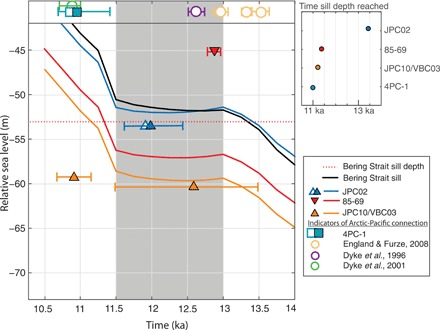
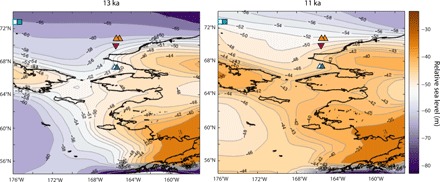
- The GI-31 ice model predicts relative sea level at the Bering Strait sill exceeds present-day sill depth at ~13.3 ka, with −51.6 m at 13 ka, remains near −50.3 m until 11.5 ka, then rises rapidly; total inundation does not occur until 11.5 ka. This reconciles early Pacific species dispersal (~13.3 ka) with later sediment-core evidence (~11.5 ka).
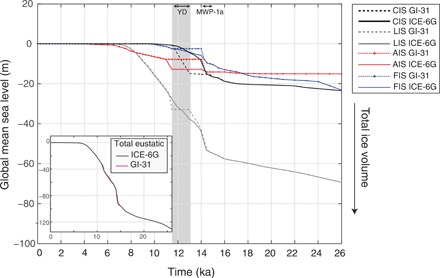
- GI-31 sources 14.3 m of GMSL rise from the CIS/western LIS from 13 to 11.5 ka, giving a total North American ice GMSL rate of 9.5 m/ka versus 9.2 m/ka for ICE-6G. A freshwater flux of 0.11 Sv over 13–11.5 ka may have freshened the subpolar North Atlantic and initiated Younger Dryas cooling.
- Sensitivity tests: older scenario GI-34 yields 12.6 m GMSL loss and 1.7 m RSL rise at the sill; younger scenario GI-30 yields 15.1 m and 1.2 m, respectively. Earth-model variations change the total 13–11.5 ka sea-level rise by less than 0.7 m.
- Standard ICE-6G predicts the Bering Strait reaches present-day sill depth at 11.5 ka, consistent with sediment cores but inconsistent with evidence for an earlier connection at 13.3 ka.
Methods
- Relative sea-level calculations use the Kendall et al. pseudo-spectral algorithm with spherical harmonic truncation at degree and order 256, including load-induced Earth rotation changes, evolving shorelines, and migration of grounded, marine-based ice. The adopted Earth model has a 48-km lithosphere and upper/lower mantle viscosities of 5 × 10²⁰ and 5 × 10²¹ Pa·s.
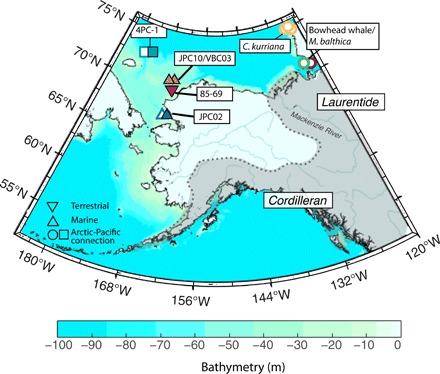
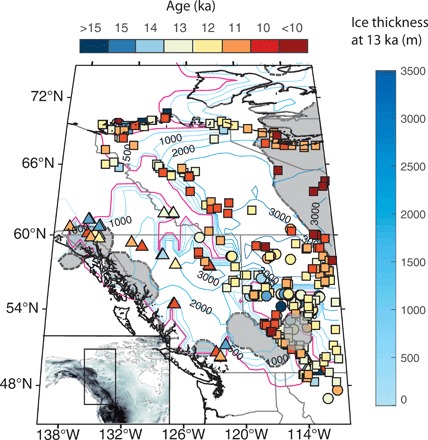
- The GI-31 ice history modifies ICE-6G by delaying ice loss in the CIS/western LIS west of 110°W, preserving the 15-ka ice distribution there until 13 ka, constrained by a compilation of 818 radiocarbon, luminescence, and cosmogenic ages and by far-field GMSL constraints. Radiocarbon dates were recalibrated with ΔR = 320 ± 50 years for post-inundation Canadian Arctic dates and ΔR = 250 ± 200 years for Arctic-side Bering Strait dates between 12,000 and 10,000 ¹⁴C years, using Marine13 or Intcal13.
- Predicted relative sea level at the Bering Strait sill and at core sites is compared with observational constraints; sensitivity tests vary ice-melt scenarios and Earth-model parameters.
Limitations
- Paper-stated: radiocarbon reservoir ages north of the Bering Strait are uncertain, with published ranges of ~450–900 years (ΔR 50–500). A higher value at 4PC-1 could make the inferred sea-level rise as young as 10 ka, while a younger reservoir age in the Canadian Archipelago could make the first Pacific fauna as old as 14 ka; the paper states it is unlikely plausible changes could collapse the date spread to a single value.
- Paper-stated: ICE-6G was not tuned to fit most proglacial lake shoreline and site-specific relative sea-level records, so GI-31 based on it would not be expected to fit those datasets; the supplement uses NAICE to show that the required delay in saddle melting does not introduce a misfit.
- Evident from the text: GI-31 is a hypothetical alternate ice history, not a unique solution; predictions depend on the adopted Earth viscosity profile and ice-melt geometry, and the JPC10 flooding surface was not directly dated.
Model-written summary. Check it against the paper before relying on it.
Integrity signals
Registry
Cites
Statistics
Figures
Verification
Claims the paper makes
0 Valid · 0 Not valid · 28 Not checked · 30 Own results and interpretations
A result the paper reports from its own data — it cites no other source for it, so there is none to check. The quote shows it is in the paper.
In the paper
“Our inferred ice-melting scenarios source substantial meltwater from the retreat between the CIS and LIS from 13 to 11.5 ka ago in the region west of 110°W, potentially initiated by marine retreat of the ice sheet (fig. S16).”
§ Sea level fingerprinting of the Bering Strait flooding history detects the source of the Younger Dryas climate event > CONCLUSION
hedgedstates a possible cause- Asserted: passes — The authors put it forward as true.
- Checkable: passes — It can be checked against evidence.
- Load-bearing: passes — The paper’s conclusions depend on it.
- Based: passes — The paper gives a reason why it holds.
- Rests on an assumption not shown here.
A result the paper reports from its own data — it cites no other source for it, so there is none to check. The quote shows it is in the paper.
In the paper
“The only source of meltwater from 13 to 11.5 ka ago in the GI-31 ice model is the CIS/western LIS (Fig. 3, black dashed line).”
§ Sea level fingerprinting of the Bering Strait flooding history detects the source of the Younger Dryas climate event > RESULTS > Refining ice melt histories and reconstructing local sea level
plain- Asserted: passes — The authors put it forward as true.
- Checkable: passes — It can be checked against evidence.
- Load-bearing: passes — The paper’s conclusions depend on it.
- Based: passes — The paper gives a reason why it holds.
- Rests on an assumption not shown here.
A result the paper states — it cites no source for it, so there is none to check. The quote shows it is in the paper.
In the paper
“We found that while the Earth model modulates the amplitude of relative sea level, the total sea level rise from 13 to 11.5 ka ago is robust, varying by less than 0.7 m.”
§ Sea level fingerprinting of the Bering Strait flooding history detects the source of the Younger Dryas climate event > DISCUSSION > Sensitivity tests
plain- Asserted: passes — The authors put it forward as true.
- Checkable: passes — It can be checked against evidence.
- Load-bearing: unclear — It is unclear whether the paper’s conclusions depend on it.
- Based: passes — The paper gives a reason why it holds.
- Rests on an assumption not shown here.
A result the paper states — it cites no source for it, so there is none to check. The quote shows it is in the paper.
In the paper
“GI-31 predicts a first breach of the sill by 13 ka ago.”
§ Sea level fingerprinting of the Bering Strait flooding history detects the source of the Younger Dryas climate event > DISCUSSION
plainstates a cause- Asserted: passes — The authors put it forward as true.
- Checkable: passes — It can be checked against evidence.
- Load-bearing: passes — The paper’s conclusions depend on it.
- Based: passes — The paper gives a reason why it holds.
- Rests on an assumption not shown here.
A result the paper reports from its own data — it cites no other source for it, so there is none to check. The quote shows it is in the paper.
In the paper
“We note that relative sea level varies substantially (>10 m) throughout the Bering Shelf region because of the strong gradient in gravitational and deformation effects in the near field of the CIS/western LIS region (fig. S5).”
§ Sea level fingerprinting of the Bering Strait flooding history detects the source of the Younger Dryas climate event > RESULTS > Refining ice melt histories and reconstructing local sea level
plainstates a cause- Asserted: passes — The authors put it forward as true.
- Checkable: passes — It can be checked against evidence.
- Load-bearing: passes — The paper’s conclusions depend on it.
- Based: passes — The paper gives a reason why it holds.
- Rests on an assumption not shown here.
19 more claims
Create a free account to see all 58 claims and to verify the 45 references still open.
- It may state two separate claims as one. 27
- Probably not a substantial claim. 8
Claims other papers make about this one
Each is checked against this paper’s own text: does it say what the citing paper says it does?
In the citing paper
“The Bering Strait flooded most recently between 13 and 11 ka during sea-level rise caused by the melting of ice sheets (11, 12).”
From The Bering Strait was flooded 10,000 years before the Last Glacial Maximum (2023) · cites this paper as [11]
In the citing paper
“Relative sea level at the Bering Strait (RSLBeSt) is affected by global mean sea level (GMSL) and the solid Earth response to the growth and decay of ice sheets through the process of glacial isostatic adjustment (11).”
From The Bering Strait was flooded 10,000 years before the Last Glacial Maximum (2023) · cites this paper as [11]
In the citing paper
“Farmer et al. (8) showed that western Arctic δ15NN.p. recorded the most recent postglacial flooding of the Bering Strait, which has been dated by independent methods to 13 to 11 ka (e.g., refs. (11) and (12)) (Fig. 2D).”
From The Bering Strait was flooded 10,000 years before the Last Glacial Maximum (2023) · cites this paper as [11]
In the citing paper
“This reflects the subaerial exposure of the Bering Strait and thus formation of the Bering Land Bridge, with a terrestrial connection persisting through the LGM (11, 12, 14, 17).”
From The Bering Strait was flooded 10,000 years before the Last Glacial Maximum (2023) · cites this paper as [11]
In the citing paper
“Because the melt and growth history of the proximal Cordilleran Ice Sheet (CIS), and especially its rapid collapse events, can have a first-order effect on Bering Strait relative sea level (11), it is also essential to consider possible CIS geometries in modeling Bering Strait relative sea level.”
From The Bering Strait was flooded 10,000 years before the Last Glacial Maximum (2023) · cites this paper as [11]
1 more claim about this paper
Create a free account to see every claim other papers make about this one.
Self-check
Percentages, sums and reported differences re-computed from the paper’s own numbers.
Each contradiction between two passages listed here was confirmed by an independent check.
Rated minor: it would not touch a result — a value no result rests on, a p-value that stays on the same side of the significance level, or a conflict that is clerical, resolved elsewhere in the paper, or outside its own findings.
In the paper
“a total of 10.6 GMSL from 15 to 13 ka ago at a mean rate of 6.1 m/ka”
§ Sea level fingerprinting of the Bering Strait flooding history detects the source of the Younger Dryas climate event > RESULTS > Refining ice melt histories and reconstructing local sea level
Reported 6.1 · recomputed 5.3
Rated minor: it would not touch a result — a value no result rests on, a p-value that stays on the same side of the significance level, or a conflict that is clerical, resolved elsewhere in the paper, or outside its own findings.
In the paper
§ Sea level fingerprinting of the Bering Strait flooding history detects the source of the Younger Dryas climate event > INTRODUCTION > Observations of Bering Strait resubmergence
“10.9 ± 0.1 and 12.6 + 0.1/−0.9 (1σ) cal ka ago”
§ Sea level fingerprinting of the Bering Strait flooding history detects the source of the Younger Dryas climate event > INTRODUCTION > Observations of Bering Strait resubmergence
“| Dyke et al. (9) | Dyke et al. (9) | | | Macomabalthica | | 11,400 | 100 | 320 | 50 | 12,600 | 90 | 110 | Marine13 |”
Rated minor: it would not touch a result — a value no result rests on, a p-value that stays on the same side of the significance level, or a conflict that is clerical, resolved elsewhere in the paper, or outside its own findings.
In the paper
§ Sea level fingerprinting of the Bering Strait flooding history detects the source of the Younger Dryas climate event > INTRODUCTION > Observations of Bering Strait resubmergence
“13.0 ± 0.1, 13.3 ± 0.6, and 13.5 ± 0.1 (1σ) cal ka ago”
§ Sea level fingerprinting of the Bering Strait flooding history detects the source of the Younger Dryas climate event > INTRODUCTION > Observations of Bering Strait resubmergence
“| England and Furze (7) | England and Furze (7) | | | C. kurriana | | 12,170 | 25 | 320 | 50 | 13,320 | 60 | 60 | Marine13 |”
Citations
Cites
IntCal13 and Marine13 radiocarbon age calibration curves 0–50,000 years cal BP
Reimer, P. J., Bard, E., Bayliss, A., Beck, J. W., Blackwell, P. G., Ramsey, C. B., Buck, C. E., Cheng, H., Edwards, R. L., Friedrich, M., et al. (2013) · Radiocarbon · doi:10.2458/azu_js_rc.55.16947 · Cited by 14,591
Space geodesy constrains ice age terminal deglaciation: The global ICE‐6G_C (VM5a) model
Peltier, W. R., Argus, D. F., & Drummond, R. (2015) · Journal of Geophysical Research: Solid Earth · doi:10.1002/2014jb011176 · Cited by 1,470
Transient Simulation of Last Deglaciation with a New Mechanism for Bølling-Allerød Warming
Liu, Z., Otto-Bliesner, B. L., He, F., Brady, E. C., Tomas, R., Clark, P. U., Carlson, A. E., Lynch-Stieglitz, J., Curry, W., Brook, E., et al. (2009) · Science · doi:10.1126/science.1171041 · Cited by 1,221
An outline of North American deglaciation with emphasis on central and northern Canada
Dyke, A. S. (2004) · Developments in Quaternary Sciences · doi:10.1016/s1571-0866(04)80209-4 · Cited by 1,037
Mitrovica, J. X., & Forte, A. M. (2004) · Earth and Planetary Science Letters · doi:10.1016/j.epsl.2004.06.005 · Cited by 651
Self-citationKendall, R. A., Mitrovica, J. X., & Milne, G. A. (2005) · Geophysical Journal International · doi:10.1111/j.1365-246x.2005.02553.x · Cited by 461
Self-citationLife and times of the Bering Land Bridge
Elias, S. A., Short, S. K., Nelson, C. H., & Birks, H. H. (1996) · Nature · doi:10.1038/382060a0 · Cited by 294
Identification of Younger Dryas outburst flood path from Lake Agassiz to the Arctic Ocean
Murton, J. B., Bateman, M. D., Dallimore, S. R., Teller, J. T., & Yang, Z. (2010) · Nature · doi:10.1038/nature08954 · Cited by 287
Deglacial rapid sea level rises caused by ice-sheet saddle collapses
Gregoire, L. J., Payne, A. J., & Valdes, P. J. (2012) · Nature · doi:10.1038/nature11257 · Cited by 259
Chronology of the Holocene transgression at the North Siberian margin
Bauch, H. A., Mueller-Lupp, T., Taldenkova, E., Spielhagen, R. F., Kassens, H., Grootes, P. M., Thiede, J., Heinemeier, J., & Petryashov, V. V. (2001) · Global and Planetary Change · doi:10.1016/s0921-8181(01)00116-3 · Cited by 254
Cited by
The timing and effect of the earliest human arrivals in North America
Becerra‐Valdivia, L., & Higham, T. (2020) · Nature · doi:10.1038/s41586-020-2491-6 · Cited by 147
Peopling of the Americas as inferred from ancient genomics
Willerslev, E., & Meltzer, D. J. (2021) · Nature · doi:10.1038/s41586-021-03499-y · Cited by 131
A reconciled solution of Meltwater Pulse 1A sources using sea-level fingerprinting
Lin, Y., Hibbert, F. D., Whitehouse, P. L., Woodroffe, S. A., Purcell, A., Shennan, I., & Bradley, S. L. (2021) · Nature Communications · doi:10.1038/s41467-021-21990-y · Cited by 126
The role of Northeast Pacific meltwater events in deglacial climate change
Praetorius, S. K., Condron, A., Mix, A. C., Walczak, M. H., McKay, J. L., & Du, J. (2020) · Science Advances · doi:10.1126/sciadv.aay2915 · Cited by 76
Self-citationMulti-proxy constraints on Atlantic circulation dynamics since the last ice age
Pöppelmeier, F., Jeltsch‐Thömmes, A., Lippold, J. A., Joos, F., & Stocker, T. F. (2023) · Nature Geoscience · doi:10.1038/s41561-023-01140-3 · Cited by 107
Arctic Ocean stratification set by sea level and freshwater inputs since the last ice age
Farmer, J. R., Sigman, D. M., Granger, J., Underwood, O. M., Fripiat, F., Cronin, T. M., Martínez-García, A., & Haug, G. H. (2021) · Nature Geoscience · doi:10.1038/s41561-021-00789-y · Cited by 57
The Bering Strait was flooded 10,000 years before the Last Glacial Maximum
Farmer, J. R., Pico, T., Underwood, O. M., Cleveland Stout, R., Granger, J., Cronin, T. M., Fripiat, F., Martínez-García, A., Haug, G. H., & Sigman, D. M. (2023) · Proceedings of the National Academy of Sciences · doi:10.1073/pnas.2206742119 · Cited by 69
Self-citationNeodymium isotopes as a paleo-water mass tracer: A model-data reassessment
Pöppelmeier, F., Lippold, J. A., Blaser, P., Gutjahr, M., Frank, M., & Stocker, T. F. (2022) · Quaternary Science Reviews · doi:10.1016/j.quascirev.2022.107404 · Cited by 57
First Peoples in a New World: Populating Ice Age America
Meltzer, D. J. (2021) · doi:10.1017/9781108632867 · Cited by 45
The opening and closure of oceanic seaways during the Cenozoic: pacemaker of global climate change?
Bahr, A., Kaboth‐Bahr, S., & Karas, C. (2022) · Geological Society London Special Publications · doi:10.1144/sp523-2021-54 · Cited by 39
Pöppelmeier, F., Scheen, J., Jeltsch‐Thömmes, A., & Stocker, T. F. (2021) · Climate of the past · doi:10.5194/cp-17-615-2021 · Cited by 37
The importance of Canadian Arctic Archipelago gateways for glacial expansion in Scandinavia
Löfverström, M., Thompson, D. M., Otto‐Bliesner, B. L., & Brady, E. C. (2022) · Nature Geoscience · doi:10.1038/s41561-022-00956-9 · Cited by 35
Wu, J., Stein, R., Fahl, K., Syring, N., Nam, S., Hefter, J., Mollenhauer, G., & Geibert, W. (2020) · Communications Earth & Environment · doi:10.1038/s43247-020-00028-z · Cited by 34
Daniels, W., Russell, J. M., Morrill, C., Longo, W. M., Giblin, A. E., Holland-Stergar, P., Welker, J. M., Wen, X., Hu, A., & Huang, Y. (2021) · Quaternary Science Reviews · doi:10.1016/j.quascirev.2021.107130 · Cited by 33
Ice and ocean constraints on early human migrations into North America along the Pacific coast
Praetorius, S., Alder, J. R., Condron, A., Mix, A. C., Walczak, M. H., Caissie, B., & Erlandson, J. M. (2023) · Proceedings of the National Academy of Sciences · doi:10.1073/pnas.2208738120 · Cited by 29
Self-citationYoung, J. M., Reyes, A. V., & FROESE, D. G. (2020) · Quaternary Science Reviews · doi:10.1016/j.quascirev.2020.106714 · Cited by 25
Kelleher, R., JENNINGS, A. E., Andrews, J. T., Brooks, N. K. S., Marchitto, T., Feng, S., Woelders, L., Normandeau, A., Jenner, K. A., Bennett, R., et al. (2022) · Arctic Antarctic and Alpine Research · doi:10.1080/15230430.2022.2110689 · Cited by 20
Deglacial Land-Ocean Linkages at the Alaskan Continental Margin in the Bering Sea
Wang, R., Kühn, G., Gong, X., Biskaborn, B. K., Gersonde, R., Lembke‐Jene, L., Lohmann, G., Tiedemann, R., & Diekmann, B. (2021) · Frontiers in Earth Science · doi:10.3389/feart.2021.712415 · Cited by 19
Song, T., Hillaire‐Marcel, C., de Vernal, A., Liu, Y., Wang, W., & Huang, Y. (2021) · Marine Geology · doi:10.1016/j.margeo.2021.106698 · Cited by 19
Łącka, M., Michalska, D., Pawłowska, J., Szymańska, N., Szczuciński, W., Forwick, M., & Zajączkowski, M. (2020) · Scientific Reports · doi:10.1038/s41598-020-72747-4 · Cited by 18
Mann, D. H., & Gaglioti, B. V. (2024) · Earth-Science Reviews · doi:10.1016/j.earscirev.2024.104782 · Cited by 17
Godbout, P., Brouard, É., & Roy, M. (2023) · Scientific Data · doi:10.1038/s41597-023-02566-5 · Cited by 16
Late Quaternary environmental change in eastern Beringia
Monteath, A. J., Edwards, M. E., Froese, D., Anderson, L., Gaglioti, B. V., Cocker, S. L., Brigham-Grette, J., Wooller, M. J., Finney, B., & Abbott, M. B. (2025) · Quaternary Science Reviews · doi:10.1016/j.quascirev.2025.109527 · Cited by 13
Pico, T., Robel, A., Powell, E., Mix, A. C., & Mitrovica, J. X. (2019) · Geophysical Research Letters · doi:10.1029/2019gl084789 · Cited by 7
Self-citationDulfer, H. E., Margold, M., Engel, Z., Braucher, R., & Aster Team (2021) · Quaternary Research · doi:10.1017/qua.2020.122 · Cited by 12
The Search for Ice Age Americans: The Path from Paleoliths to Paleoindians
Meltzer, D. J. (2021) · Cambridge University Press eBooks · doi:10.1017/9781108632867.005 · Cited by 9
Glacial isostatic adjustment directed incision of the Channeled Scabland by Ice Age megafloods
Pico, T., David, S. R., Larsen, I. J., Mix, A. C., Lehnigk, K. E., & Lamb, M. P. (2022) · Proceedings of the National Academy of Sciences · doi:10.1073/pnas.2109502119 · Cited by 9
Self-citationDetlef, H., Sosdian, S., Belt, S. T., Smik, L., Lear, C. H., Kender, S., Pearce, C., & Hall, I. R. (2020) · Quaternary Science Reviews · doi:10.1016/j.quascirev.2020.106549 · Cited by 9
Sun, J., Wang, L., Peng, Z., Zhenyan, F., & Chen, C. (2022) · Pure and Applied Geophysics · doi:10.1007/s00024-022-03123-8 · Cited by 8
Prehistoric global migration of vanishing gut microbes with humans
Carter, M. M., Liu, Z., Olm, M. R., Martin, M., Sprockett, D. D., Ghadermazi, P., Trumble, B. C., Kaplan, H. S., Stieglitz, J., Rodríguez, D. E., et al. (2026) · Nature · doi:10.1038/s41586-026-11106-1 · Cited by 6
Neiva, J., Assis, J. F., Fragkopoulou, E., Pearson, G. A., RAIMONDI, P. T., Anderson, L., Krause‐Jensen, D., Marbà, N., Want, A., Selivanova, O. N., et al. (2024) · Frontiers in Ecology and Evolution · doi:10.3389/fevo.2024.1356987 · Cited by 6
Zhang, R., Pei, W., Wang, Y., Wang, X., Wang, J., Li, T., Russell, J. M., Zhang, F., Liu, Z., Guan, M., et al. (2023) · Global and Planetary Change · doi:10.1016/j.gloplacha.2023.104099 · Cited by 4
Kodama, S. T., Pico, T., Finnegan, N. J., Lapôtre, M. G. A., & Willenbring, J. K. (2023) · Geophysical Research Letters · doi:10.1029/2023gl103995 · Cited by 4
Self-citationConverging evidence constrains Late Pleistocene Bering Land Bridge history
Wanket, C., Kodama, S. T., Oppenheimer, J., Cocker, S. L., Steigerwald, E., FROESE, D. G., Shapiro, B., Pico, T., & Farmer, J. R. (2025) · Quaternary Science Advances · doi:10.1016/j.qsa.2025.100292 · Cited by 3
Self-citationChen, D., Tian, Y., Wang, Z., & Zhao, X. (2023) · Journal of Asian Earth Sciences · doi:10.1016/j.jseaes.2023.105851 · Cited by 3
Methane flux from Beringian coastal wetlands for the past 20,000 years
Fuchs, M., Jones, M. C., Gowan, E. J., Frolking, S., Anthony, K. W., Grosse, G., Jones, B., O’Donnell, J. A., Brosius, L., & Treat, C. C. (2024) · Quaternary Science Reviews · doi:10.1016/j.quascirev.2024.108976 · Cited by 2
Geochemical evidence for the origin of late Quaternary loess, Seward Peninsula, Alaska
Muhs, D. R., & Pigati, J. S. (2025) · Arctic Antarctic and Alpine Research · doi:10.1080/15230430.2025.2564571 · Cited by 2
Gateway to the arctic: Defining the eastern channel of the Bering Strait
Zimmermann, M., Woodgate, R. A., & Prescott, M. M. (2023) · Progress In Oceanography · doi:10.1016/j.pocean.2023.103052 · Cited by 2
Jones, M. C., Anderson, L., Caissie, B., Harning, D. J., & Ager, T. A. (2025) · Arctic Antarctic and Alpine Research · doi:10.1080/15230430.2025.2557062 · Cited by 1
Zhamoida, V. A., Sergeev, A. Y., Budanov, L., Ryabchuk, D. V., Геннадьевич, Г. А., Neevin, I., & Mustafin, M. A. (2024) · Regional Geology and Metallogeny · doi:10.52349/0869-7892_2024_100_95-114 · Cited by 1
Nelson, C. H., Morales‐Ocaña, C., & Escutia, C. (2024) · Geological Society London Special Publications · doi:10.1144/sp553-2023-147 · Cited by 1
Do, S. D., Lee, Y., & Rhee, J. (2026) · Scientific Reports · doi:10.1038/s41598-026-59110-9 · Cited by 1
Pico, T., Kodama, S. T., Vigilia, C., & Robel, A. A. (2025) · Quaternary Science Reviews · doi:10.1016/j.quascirev.2025.109427 · Cited by 1
Self-citationClovis Adaptations and Pleistocene Megafaunal Extinctions
Meltzer, D. J. (2021) · Cambridge University Press eBooks · doi:10.1017/9781108632867.010
Meltzer, D. J. (2021) · Cambridge University Press eBooks · doi:10.1017/9781108632867.002
Meltzer, D. J. (2021) · Cambridge University Press eBooks · doi:10.1017/9781108632867.015
Meltzer, D. J. (2021) · Cambridge University Press eBooks · doi:10.1017/9781108632867.001
Meltzer, D. J. (2021) · Cambridge University Press eBooks · doi:10.1017/9781108632867.013
Meltzer, D. J. (2021) · Cambridge University Press eBooks · doi:10.1017/9781108632867.007
What Do You Do When No One’s Been There Before?
Meltzer, D. J. (2021) · Cambridge University Press eBooks · doi:10.1017/9781108632867.009
Glaciers, Climates and Environments of Ice Age North America
Meltzer, D. J. (2021) · Cambridge University Press eBooks · doi:10.1017/9781108632867.004
Who, from Where, When, and How? The Search for Consensus
Meltzer, D. J. (2021) · Cambridge University Press eBooks · doi:10.1017/9781108632867.008
Ascertaining Archaeological Evidence of Antiquity
Meltzer, D. J. (2021) · Cambridge University Press eBooks · doi:10.1017/9781108632867.006
Settling in: Late Paleoindians and the Waning Ice Age
Meltzer, D. J. (2021) · Cambridge University Press eBooks · doi:10.1017/9781108632867.011
Meltzer, D. J. (2021) · Cambridge University Press eBooks · doi:10.1017/9781108632867.012
Meltzer, D. J. (2021) · Cambridge University Press eBooks · doi:10.1017/9781108632867.014
Meltzer, D. J. (2021) · Cambridge University Press eBooks · doi:10.1017/9781108632867.003
Wang, F., Fu, W., Wu, Y., Sun, S., Zhao, M., Ren, P., Liu, Y., & Shi, X. (2026) · Paleoceanography and Paleoclimatology · doi:10.1029/2026pa005554
Wei, Q., Liu, N., Cao, L., Kang, X., Abramov, A. V., Biao, D., Lissovsky, A. A., Han, X., Shan, W., & Ge, D. (2026) · Journal of Systematics and Evolution · doi:10.1111/jse.70105
GLACIAL ISOSTATIC ADJUSTMENT DIRECTED INCISION OF THE CHANNELED SCABLAND BY ICE-AGE MEGAFLOODS
Sciences, C. G. &. P., Pico, T., Lamb, M. P., Larsen, I. J., David, S. R., & Mix, A. C. (2020) · Abstracts with programs - Geological Society of America · doi:10.1130/abs/2020am-356575
Self-citationNonlinear transport across the Bering Strait with sill depth shoalingPreprint
Fendrock, M., Farmer, J. R., & Condron, A. (2025) · ESS Open Archive · doi:10.22541/essoar.175767456.62933729/v1
Song, T. (2023) · Archipel (Université du Québec à Montréal)
Wu, J. (2021) · Media (https://www.suub.uni-bremen.de/) · doi:10.26092/elib/1175
Lyle, M. W., & Lyle, A. O. (2026) · doi:10.5194/egusphere-2026-3515
Late Quaternary Bering Strait opening recorded by Nd isotopes in western Arctic sediments
Song, T., de Vernal, A., Hillaire‐Marcel, C., 戎钰芬, Liu, Y., & Montero‐Serrano, J. (2026) · Global and Planetary Change · doi:10.1016/j.gloplacha.2026.105716
Metadata
- Authors
- Pico, T., Mitrovica, J. X., & Mix, A. C.
- Affiliations
- California Institute of Technology (US)
- Harvard University (US)
- Oregon State University (US)
- Corresponding author
- Pico, T.
- Venue
- Science Advances
- Published
- 2020-02-28
- Volume
- 6
- Issue
- 9
- Pages
- eaay2935-eaay2935
- ISSN
- 2375-2548 (ISSN-L)
- PMC
- PMC7043918
- OpenAlex
- W3008432456
- Cited by
- 66
- References
- 41
- Citations by year
- 2026: 6 · 2025: 7 · 2024: 5 · 2023: 8 · 2022: 7 · 2021: 25 · 2020: 7
- FWCI
- 3.32
- Type
- journal article
- Language
- en
- Open access
- gold
- doi.org
- Licence
- cc-by
- Locations
- Science Advances (publishedVersion, cc-by)
- Europe PMC (PubMed Central) (publishedVersion, cc-by)
- PubMed Central (publishedVersion, cc-by)
- PubMed (publishedVersion)
- CaltechAUTHORS (California Institute of Technology) (submittedVersion, cc-by)
- Funders
- National Science Foundation (GRFP)
- Topics
- Physical Sciences › Earth and Planetary Sciences › Atmospheric Science › Geology and Paleoclimatology Research
- Physical Sciences › Earth and Planetary Sciences › Oceanography › Marine and environmental studies
- Physical Sciences › Earth and Planetary Sciences › Earth-Surface Processes › Geological formations and processes
- Keywords
- Younger Dryas, deglaciation, ice sheet melting, Laurentide Ice Sheet, Cordilleran Ice Sheet, land bridge, freshwater discharge, Last Glacial Maximum, sea level rise
About these checks
Registry, retraction, Cites and statistics results are computed, not judged, with one exception: a printed reference that no index lists is read once by a model before it counts as a citation error. Claims are extracted by a model and kept only when their quote appears verbatim in the text; each cited source is then checked, with a model’s help, for whether it says what the claim relies on. Those verdicts can be wrong — read the claim’s quote and the cited source before relying on one.
A language model drew the claims from the paper on 2026-11-24, under version 3 of the claim definition (model deepseek-v4.1-flash, prompt extract-v3).
A second model labelled each claim on 2026-11-24 (model jev-1.13-20260917, definition revision gold-guideline-v0.2).
Statistics and arithmetic are recomputed, not judged.
Confidence bands are shown only for fields calibrated on our annotated test set. None is calibrated yet, so no band is shown.
What counts as a claim ›How we measure confidence ›How we check this ›
Are you an author, or do you see a problem with this page? Request a review
Data sources
Bibliographic data: Semantic Scholar, OpenAlex, Crossref.
Contains information from the Semantic Scholar Academic Graph Datasets, made available under the ODC Attribution License (ODC-BY 1.0).
Semantic Scholar’s data is described in: Kinney, R., et al. (2023). The Semantic Scholar Open Data Platform. arXiv:2301.10140.
