

Humans experienced abrupt environmental changes at White Sands during the Last Glacial Maximum
Open accessThe DOI matches its Crossref record; 67 of the 68 references it cites were found in a registry or an index, and 1 are not checked yet; none of the 74 sources its claims cite is checked for support yet.
Abstract
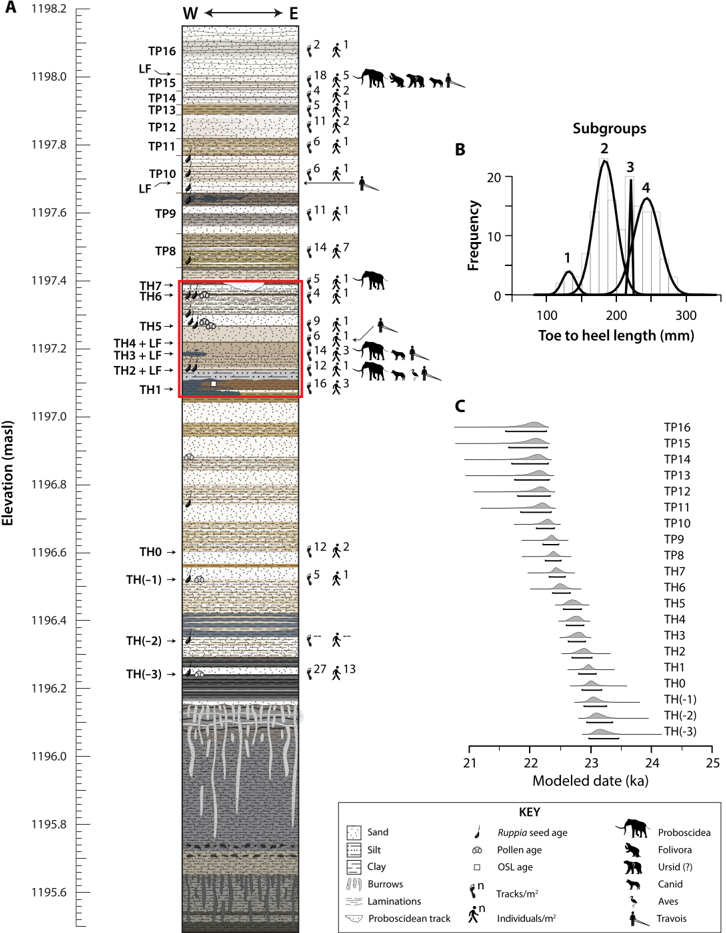
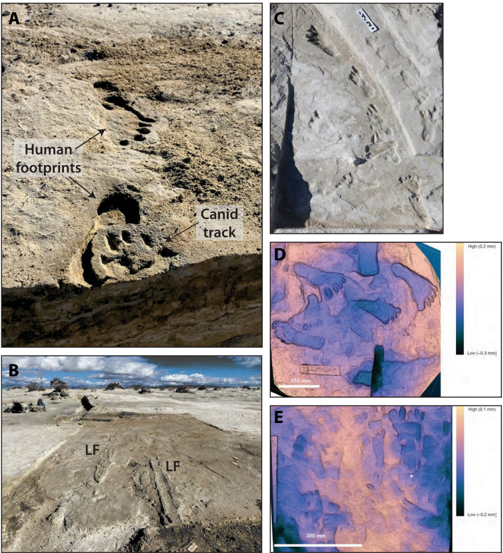
Expanded excavations at White Sands National Park have unearthed 20 stratigraphic horizons containing in situ human footprints, megafaunal trackways, and linear features created by travois. Advances in radiocarbon dating of conifer pollen, combined with ages of aquatic seeds, refines the chronology of the footprint-bearing sequence to between 23.5 and 21.7 thousand years ago (ka). Biomarker, pollen, and stratigraphic evidence indicate a complete overturning of the environment from a perennial lake to a playa and capture a large aridification episode coincident with Dansgaard-Oeschger event 2 at 23.2 ka, which shrank pluvial Lake Otero and allowed people to traverse the former shoreline area for nearly two millennia. This well-dated and highly resolved paleoclimate record provides compelling evidence that humans in North America experienced marked environmental changes during the Last Glacial Maximum.
Checked 2026-11-23 · 1 reference not checked yet
Overview
CoChat Summary
TL;DR
Expanded excavations at White Sands Locality 2 document 20 footprint-bearing horizons and refine the human footprint chronology to 23.5–21.7 ka. Multiproxy records show a complete lake-to-playa transition and abrupt aridity at 23.2 ka during Dansgaard-Oeschger event 2, which humans experienced during the Last Glacial Maximum.
Key findings
- Excavations identified 20 discrete stratigraphic horizons/packages with in situ human footprints, megafaunal trackways (Proboscidea, Folivora, Carnivora, rare Aves), and linear features interpreted as travois; 152 human footprints were measured, yielding four pooled age/stature subgroups: <4 years (n = 8), 6.3 ± 0.1 years (n = 72), 11.8 ± 0.2 years (n = 12), and at least 13.8 ± 0.2 years (male) or 14.6 ± 0.2 years (female) (n = 60). No evidence for congregation or habitation was found; the travois features support a transit site.
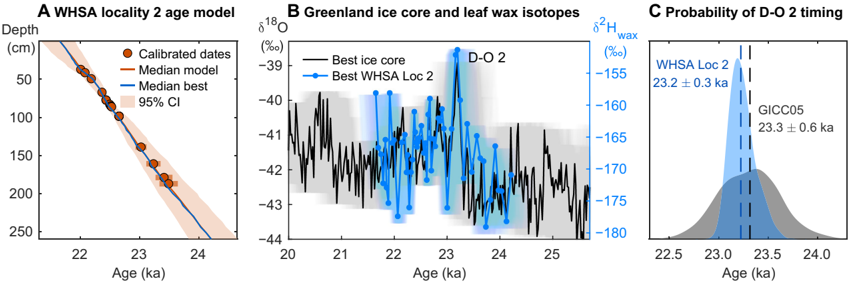
- The footprint-bearing sequence is constrained to 23.5–21.7 ka. New radiocarbon ages include 11 Ruppia seed ages from 24.87 ± 0.34 ka to 21.58 ± 0.33 ka and three conifer pollen ages from 23.44 ± 0.43 ka to 22.71 ± 0.33 ka; age model 4 gave the strongest correlation with Greenland δ18O (r = 0.40, P = 0.03) and an age of 23.2 ± 0.3 ka (2σ) for D-O 2.
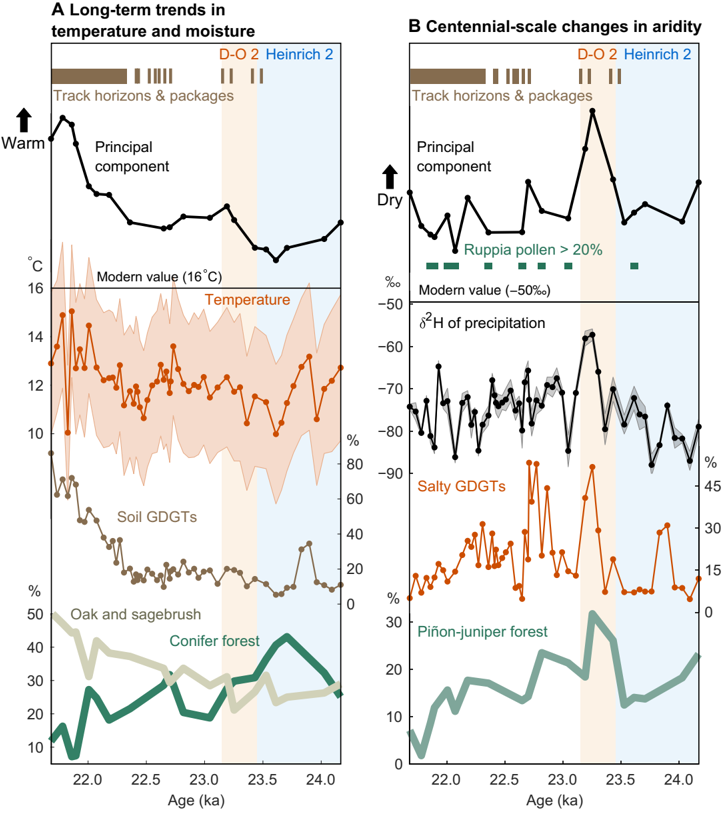
- Biomarker, pollen, and stratigraphic evidence indicate a complete environmental overturning from a perennial lake to a playa, with a large aridification episode coincident with D-O 2 at 23.2 ka that shrank pluvial Lake Otero and allowed people to traverse the former shoreline area for nearly two millennia.
- PCA isolated two modes: PC1 (39% of variance) describes long-term warming and drying; PC2 (20%) captures centennial-scale precipitation/aridity changes. D-O 2 marks extreme short-lived aridity, a spike in salty GDGTs, piñon-juniper expansion, and a permanent shift to lake margin/wet playa; the earliest track horizon, TH(−3), occurs during D-O 2.
Methods
- The main trench was extended to 25 m and exposed nearly 2.7 vertical m of stratigraphy; 20 footprint-bearing horizons/packages were documented, tracks were captured in 3D with 40–150 oblique photographs, and footprint lengths were measured from 3D models.
- Radiocarbon dating used Ruppia seeds and conifer pollen, with a new procedural blank from >110 ka Ziegler Reservoir pollen, flow cytometry to isolate up to ~75,000 pollen grains per sample, four age models, and calibration with OxCal v.4.4.4 and IntCal20; δ2Hwax data were compared with Greenland ice core δ18O.
- Paleoenvironmental reconstruction combined biomarkers (δ2Hwax, GDGTs, MBT′5Me, BIGMaC), pollen, ostracode assemblages, and XRD mineralogy; PCA with varimax rotation was run on combined pollen and biomarker data (n = 20).
Limitations
- The paper states that small numbers of tracks on individual horizons hampered biometric estimates, so track data were pooled; MNI values are described as crude approximations only and should not be used for population estimates, and trackmaker age estimates are approximations only because of footprint/foot-length differences and intratrackway variability.
- The paper states that no artifacts were recovered and that there is no evidence for congregation or habitation at WHSA Locality 2.
- The text acknowledges previous challenges to the age estimates but argues the chronology and supporting evidence remain conclusive; it also notes that model 4 age uncertainties average ~250 years (2σ), while the GICC05 ice core chronology has a maximum counting error of ~500–600 years (2σ) during this interval.
Model-written summary. Check it against the paper before relying on it.
Integrity signals
Registry
Cites
Statistics
Figures
Verification
Claims the paper makes
0 Valid · 1 Not valid · 40 Not checked · 88 Own results and interpretations
A result the paper reports from its own data — it cites no other source for it, so there is none to check. The quote shows it is in the paper.
In the paper
“The leading principal component of our analysis (PC1; 39% of the variance; fig. S25) describes a long-term gradual shift in the depositional environment from a deeper lake to shallower water body that is supported by the lithology of the sedimentary sequence (Fig. 4A).”
§ Humans experienced abrupt environmental changes at White Sands during the Last Glacial Maximum > RESULTS AND DISCUSSION > The climate and environment of White Sands during the LGM
plainstates an association- Asserted: passes — The authors put it forward as true.
- Checkable: passes — It can be checked against evidence.
- Load-bearing: unclear — It is unclear whether the paper’s conclusions depend on it.
- Based: passes — The paper gives a reason why it holds.
In the paper
“The late glacial warming at White Sands differs from the average evolution of temperature change in the Northern Hemisphere, which shows progressively colder conditions from ∼23 to 18 ka with deglacial warming occurring thereafter (30).”
§ Humans experienced abrupt environmental changes at White Sands during the Last Glacial Maximum > RESULTS AND DISCUSSION > The climate and environment of White Sands during the LGM
What the sources say
- Not checked yetcites [30] M. B. Osman, J. E. Tierney, J. Zhu, R. Tardif, G. J. Hakim, J. King, C. J. Poulsen, Globally resolved surface temperatures since the Last Glacial Maximum. Nature 599, 239– 244 (2021). 34759364 source
plain- Asserted: passes — The authors put it forward as true.
- Checkable: passes — It can be checked against evidence.
- Load-bearing: passes — The paper’s conclusions depend on it.
- Based: passes — The paper gives a reason why it holds.
A result the paper reports from its own data — it cites no other source for it, so there is none to check. The quote shows it is in the paper.
In the paper
“Expanded excavations at White Sands National Park have unearthed 20 stratigraphic horizons containing in situ human footprints, megafaunal trackways, and linear features created by travois.”
§ Humans experienced abrupt environmental changes at White Sands during the Last Glacial Maximum > Abstract
plain- Asserted: passes — The authors put it forward as true.
- Checkable: passes — It can be checked against evidence.
- Load-bearing: passes — The paper’s conclusions depend on it.
- Based: passes — The paper gives a reason why it holds.
- Rests on an assumption not shown here.
A result the paper reports from its own data — it cites no other source for it, so there is none to check. The quote shows it is in the paper.
In the paper
“Biomarker, pollen, and stratigraphic evidence indicate a complete overturning of the environment from a perennial lake to a playa”
§ Humans experienced abrupt environmental changes at White Sands during the Last Glacial Maximum > Abstract
hedged- Asserted: passes — The authors put it forward as true.
- Checkable: passes — It can be checked against evidence.
- Load-bearing: passes — The paper’s conclusions depend on it.
- Based: passes — The paper gives a reason why it holds.
None of the sources cited for this claim have been checked yet.
In the paper
“At 23.2 ka, extreme but short-lived aridity prevailed at White Sands, as well as other localities in the southwestern US [e.g., (20, 38, 39)] in response to D-O 2.”
§ Humans experienced abrupt environmental changes at White Sands during the Last Glacial Maximum > RESULTS AND DISCUSSION > The climate and environment of White Sands during the LGM
What the sources say
- Not checked yetcites [20] K. B. Springer, C. R. Manker, J. S. Pigati, Dynamic response of desert wetlands to abrupt climate change. Proc. Natl. Acad. Sci. U.S.A. 112, 14522– 14526 (2015). PMC4664373 26554007 source
- Not checked yetcites [38] K. B. Springer, J. S. Pigati, C. R. Manker, S. A. Mahan, “The Las Vegas formation” (Professional Paper 1839, US Geological Survey, 2018); 10.3133/pp1839. source
- Not checked yetcites [39] K. B. Springer, J. S. Pigati, Climatically driven displacement on the Eglington fault, Las Vegas, Nevada, USA. Geology 48, 574– 578 (2020). source
plainstates a cause- Asserted: passes — The authors put it forward as true.
- Checkable: passes — It can be checked against evidence.
- Load-bearing: passes — The paper’s conclusions depend on it.
- Based: passes — The paper gives a reason why it holds.
47 more claims
Create a free account to see all 129 claims and to verify the 68 references still open.
- It may state two separate claims as one. 53
- Probably not a substantial claim. 40
- The quote only partly states this claim. 1
Citations
Cites
The IntCal20 Northern Hemisphere Radiocarbon Age Calibration Curve (0–55 cal kBP)
Reimer, P. J., Austin, W. E. N., Bard, E., Bayliss, A., Blackwell, P. G., Bronk Ramsey, C., Butzin, M., Cheng, H., Edwards, R. L., Friedrich, M., et al. (2020) · Radiocarbon · doi:10.1017/rdc.2020.41 · Cited by 7,900
Flexible paleoclimate age-depth models using an autoregressive gamma process
Blaauw, M., & Christen, J. A. (2011) · Bayesian Analysis · doi:10.1214/11-ba618 · Cited by 4,502
Clark, P. U., Dyke, A. S., Shakun, J. D., Carlson, A. E., Clark, J., Wohlfarth, B., Mitrovica, J. X., Hostetler, S. W., & McCabe, A. M. (2009) · Science · doi:10.1126/science.1172873 · Cited by 3,277
Hemming, S. R. (2004) · Reviews of Geophysics · doi:10.1029/2003rg000128 · Cited by 1,526
Sachse, D., Billault, I., Bowen, G. J., Chikaraishi, Y., Dawson, T. E., Feakins, S. J., Freeman, K. H., Magill, C. R., McInerney, F. A., van der Meer, M. T. J., et al. (2012) · Annual Review of Earth and Planetary Sciences · doi:10.1146/annurev-earth-042711-105535 · Cited by 1,016
The Greenland Ice Core Chronology 2005, 15–42ka. Part 1: constructing the time scale
Andersen, K. K., Svensson, A., Johnsen, S. J., Rasmussen, S. O., Bigler, M., Röthlisberger, R., Ruth, U., Siggaard-Andersen, M.-L., Peder Steffensen, J., & Dahl-Jensen, D. (2006) · Quaternary Science Reviews · doi:10.1016/j.quascirev.2006.08.002 · Cited by 801
Performance of catalytically condensed carbon for use in accelerator mass spectrometry
Vogel, J. S., Southon, J. R., Nelson, D. E., & Brown, T. A. (1984) · Nuclear Instruments and Methods in Physics Research Section B: Beam Interactions with Materials and Atoms · doi:10.1016/0168-583x(84)90529-9 · Cited by 695
Jonge, C. D., Hopmans, E. C., Zell, C. I., Kim, J.-H., Schouten, S., & Damsté, J. S. S. (2014) · Geochimica et Cosmochimica Acta · doi:10.1016/j.gca.2014.06.013 · Cited by 690
Huguet, C., Hopmans, E. C., Febo-Ayala, W., Thompson, D. H., Sinninghe Damsté, J. S., & Schouten, S. (2006) · Organic Geochemistry · doi:10.1016/j.orggeochem.2006.05.008 · Cited by 630
The effect of improved chromatography on GDGT-based palaeoproxies
Hopmans, E. C., Schouten, S., & Sinninghe Damsté, J. S. (2016) · Organic Geochemistry · doi:10.1016/j.orggeochem.2015.12.006 · Cited by 605
Globally resolved surface temperatures since the Last Glacial Maximum
Osman, M. B., Tierney, J. E., Zhu, J., Tardif, R., Hakim, G. J., King, J., & Poulsen, C. J. (2021) · Nature · doi:10.1038/s41586-021-03984-4 · Cited by 574 · cited 1×
“The late glacial warming at White Sands differs from the average evolution of temperature change in the Northern Hemisphere, which shows progressively colder conditions from ∼ 23 to 18 ka with deglacial warming occurring thereafter ( 30 ).”
Self-citationThe Neotoma Paleoecology Database, a multiproxy, international, community-curated data resource
Williams, J. W., Grimm, E. C., Blois, J. L., Charles, D. F., Davis, E. B., Goring, S. J., Graham, R. W., Smith, A. J., Anderson, M., Arroyo-Cabrales, J., et al. (2018) · Quaternary Research · doi:10.1017/qua.2017.105 · Cited by 431
Self-citationIsotope-Ratio and Background Corrections for Accelerator Mass Spectrometry Radiocarbon Measurements
Donahue, D. J., Linick, T. W., & Jull, A. J. T. (1990) · Radiocarbon · doi:10.1017/s0033822200040121 · Cited by 424
Variable winter moisture in the southwestern United States linked to rapid glacial climate shifts
Asmerom, Y., Polyak, V. J., & Burns, S. J. (2010) · Nature Geoscience · doi:10.1038/ngeo754 · Cited by 328
Collapse of the California Current During Glacial Maxima Linked to Climate Change on Land
Herbert, T. D., Schuffert, J. D., Andreasen, D., Heusser, L., Lyle, M., Mix, A., Ravelo, A. C., Stott, L. D., & Herguera, J. C. (2001) · Science · doi:10.1126/science.1059209 · Cited by 312
Controls on the D/H ratios of plant leaf waxes in an arid ecosystem
Feakins, S. J., & Sessions, A. L. (2010) · Geochimica et Cosmochimica Acta · doi:10.1016/j.gca.2010.01.016 · Cited by 312
14C Background Levels in An Accelerator Mass Spectrometry System
Vogel, J. S., Nelson, D. E., & Southon, J. R. (1987) · Radiocarbon · doi:10.1017/s0033822200043733 · Cited by 286
Evidence of humans in North America during the Last Glacial Maximum
Bennett, M. R., Bustos, D., Pigati, J. S., Springer, K. B., Urban, T. M., Holliday, V. T., Reynolds, S. C., Budka, M., Honke, J. S., Hudson, A. M., et al. (2021) · Science · doi:10.1126/science.abg7586 · Cited by 239
Self-citationA standard protocol for documenting modern and fossil ichnological data
Falkingham, P. L., Bates, K. T., Avanzini, M., Bennett, M., Bordy, E. M., Breithaupt, B. H., Castanera, D., Citton, P., Díaz‐Martínez, I., Farlow, J. O., et al. (2018) · Palaeontology · doi:10.1111/pala.12373 · Cited by 226
Self-citationDearing Crampton-Flood, E., Tierney, J. E., Peterse, F., Kirkels, F. M. S. A., & Sinninghe Damsté, J. S. (2020) · Geochimica et Cosmochimica Acta · doi:10.1016/j.gca.2019.09.043 · Cited by 225
Self-citationA global Bayesian temperature calibration for lacustrine brGDGTs
Martínez‐Sosa, P., Tierney, J. E., Stefanescu, I. C., Crampton-Flood, E. D., Shuman, B. N., & Routson, C. (2021) · Geochimica et Cosmochimica Acta · doi:10.1016/j.gca.2021.04.038 · Cited by 212
Self-citationHendy, I. L., Kennett, J. P., Roark, E. B., & Ingram, B. L. (2002) · Quaternary Science Reviews · doi:10.1016/s0277-3791(01)00138-x · Cited by 189
Understanding the variability in freshwater radiocarbon reservoir offsets: a cautionary tale
Keaveney, E. M., & Reimer, P. J. (2012) · Journal of Archaeological Science · doi:10.1016/j.jas.2011.12.025 · Cited by 166
Dissolution enables dolomite crystal growth near ambient conditions
Kim, J., Kimura, Y., Puchala, B., Yamazaki, T., Becker, U., & Sun, W. (2023) · Science · doi:10.1126/science.adi3690 · Cited by 138
Stute, M., Clark, J. F., Schlosser, P., Broecker, W. S., & Bonani, G. (1995) · Quaternary Research · doi:10.1006/qres.1995.1021 · Cited by 137
Corrections for contamination background in AMS 14C measurements
Brown, T. A., & Southon, J. R. (1997) · Nuclear Instruments and Methods in Physics Research Section B: Beam Interactions with Materials and Atoms · doi:10.1016/s0168-583x(96)00676-3 · Cited by 118 · cited 1×
“Corrections of the measured carbon isotopic ratios are required in radiocarbon dating because a small amount of contaminant 14 C (usually modern) is introduced to samples during chemical pretreatment, CO 2 extraction, graphitization, and/or the AMS measurement ( 54 – 56 ).”
Wang, H., Liu, W., He, Y., Zhou, A., Zhao, H., Liu, W., Cao, Y., Hu, J., Meng, B., Jiang, J., et al. (2021) · Geochimica et Cosmochimica Acta · doi:10.1016/j.gca.2021.05.004 · Cited by 116
Eastoe, C. J., & Dettman, D. L. (2016) · Chemical Geology · doi:10.1016/j.chemgeo.2016.03.022 · Cited by 90
Archaeal lipids record paleosalinity in hypersaline systems
Turich, C., & Freeman, K. H. (2011) · Organic Geochemistry · doi:10.1016/j.orggeochem.2011.06.002 · Cited by 84
Allen, B. D., & Anderson, R. Y. (2000) · Geological Society of America Bulletin · doi:10.1130/0016-7606(2000)112<1444:achrro>2.0.co;2 · Cited by 75
Ice-sheet modulation of deglacial North American monsoon intensification
Bhattacharya, T., Tierney, J. E., Addison, J. A., & Murray, J. W. (2018) · Nature Geoscience · doi:10.1038/s41561-018-0220-7 · Cited by 72
Self-citationWestern U.S. lake expansions during Heinrich stadials linked to Pacific Hadley circulation
McGee, D., Moreno-Chamarro, E., Marshall, J., & Galbraith, E. D. (2018) · Science Advances · doi:10.1126/sciadv.aav0118 · Cited by 69
Independent age estimates resolve the controversy of ancient human footprints at White Sands
Pigati, J. S., Springer, K. B., Honke, J. S., Wahl, D., Champagne, M. R., Zimmerman, S. R. H., Gray, H. J., Santucci, V. L., Odess, D., Bustos, D., et al. (2023) · Science · doi:10.1126/science.adh5007 · Cited by 68
Self-citationMartínez‐Sosa, P., Tierney, J. E., Pérez-Ángel, L. C., Stefanescu, I. C., Guo, J., Kirkels, F., Sepúlveda, J., Peterse, F., Shuman, B. N., & Reyes, A. V. (2023) · Paleoceanography and Paleoclimatology · doi:10.1029/2023pa004611 · Cited by 47
Self-citationDynamic response of desert wetlands to abrupt climate change
Springer, K. B., Manker, C. R., & Pigati, J. S. (2015) · Proceedings of the National Academy of Sciences · doi:10.1073/pnas.1513352112 · Cited by 46
Self-citationWalking in mud: Remarkable Pleistocene human trackways from White Sands National Park (New Mexico)
Bennett, M. R., Bustos, D., Odess, D., Urban, T. M., Lallensack, J. N., Budka, M., Santucci, V. L., Martinez, P., Wiseman, A. L. A., & Reynolds, S. C. (2020) · Quaternary Science Reviews · doi:10.1016/j.quascirev.2020.106610 · Cited by 38
Self-citationHatala, K. G., Harcourt‐Smith, W. E. H., Gordon, A. D., Zimmer, B. W., Richmond, B. G., Pobiner, B. L., Green, D. J., Metallo, A., Rossi, V., & Liutkus-Pierce, C. M. (2020) · Scientific Reports · doi:10.1038/s41598-020-64095-0 · Cited by 36
A geochronologic framework for the Ziegler Reservoir fossil site, Snowmass Village, Colorado
Mahan, S. A., Gray, H. J., Pigati, J. S., Wilson, J., Lifton, N. A., Paces, J. B., & Blaauw, M. (2014) · Quaternary Research · doi:10.1016/j.yqres.2014.03.004 · Cited by 36
Self-citationAncient human footprints in C iur‐ I zbuc C ave, R omania
Webb, D., Robu, M., Moldovan, O. T., Constantin, S., Tomus, B., & Neag, I. (2014) · American Journal of Physical Anthropology · doi:10.1002/ajpa.22561 · Cited by 32
Smith, A. J., & Delorme, L. D. (2010) · Ecology and Classification of North American Freshwater Invertebrates · doi:10.1016/b978-0-12-374855-3.00019-4 · Cited by 32
Self-citationScott, J. J., Buatois, L. A., & Mángano, M. G. (2012) · Developments in Sedimentology · doi:10.1016/b978-0-444-53813-0.00013-7 · Cited by 32
Identification of Pine Pollen of Late Quaternary Age from the Chuska Mountains, New Mexico
HANSEN, B. S., & CUSHING, E. J. (1973) · Geological Society of America Bulletin · doi:10.1130/0016-7606(1973)84<1181:ioppol>2.0.co;2 · Cited by 31
Tabor, C., Lofverstrom, M., Oster, J., Wortham, B., de Wet, C., Montañez, I., Rhoades, A., Zarzycki, C., He, C., & Liu, Z. (2021) · Quaternary Science Reviews · doi:10.1016/j.quascirev.2021.107255 · Cited by 28
Oviatt, C. G., Madsen, D. B., Rhode, D., & Davis, L. G. (2023) · Quaternary Research · doi:10.1017/qua.2022.38 · Cited by 24
Reading Prehistoric Human Tracks: Methods & Material
Pastoors, A., & Lenssen-Erz, T. (2021) · Springer eBooks · doi:10.1007/978-3-030-60406-6 · Cited by 22
Haynes, C. V. (2022) · PaleoAmerica · doi:10.1080/20555563.2022.2039861 · Cited by 21
Comment on “Evidence of humans in North America during the Last Glacial Maximum”
Madsen, D. B., Davis, L. G., Rhode, D., & Oviatt, C. G. (2022) · Science · doi:10.1126/science.abm4678 · Cited by 20
Response to Comment on “Evidence of humans in North America during the Last Glacial Maximum”
Pigati, J. S., Springer, K. B., Bennett, M. R., Bustos, D., Urban, T. M., Holliday, V. T., Reynolds, S. C., & Odess, D. (2022) · Science · doi:10.1126/science.abm6987 · Cited by 20
Self-citationMenking, K. M., Polyak, V. J., Anderson, R. Y., & Asmerom, Y. (2018) · Quaternary Science Reviews · doi:10.1016/j.quascirev.2018.09.030 · Cited by 20
Comparison of three methods for the methylation of aliphatic and aromatic compounds
Lee, H., Feakins, S. J., Lu, Z., Schimmelmann, A., Sessions, A. L., Tierney, J. E., & Williams, T. J. (2017) · Rapid Communications in Mass Spectrometry · doi:10.1002/rcm.7947 · Cited by 20
Self-citationTracking regional and global teleconnections recorded by western North American speleothem records
Oster, J. L., & Kelley, N. P. (2016) · Quaternary Science Reviews · doi:10.1016/j.quascirev.2016.07.009 · Cited by 17
Pigati, J. S., Springer, K. B., Holliday, V. T., Bennett, M. R., Bustos, D. F., Urban, T. M., Reynolds, S. C., & Odess, D. (2022) · PaleoAmerica · doi:10.1080/20555563.2022.2039863 · Cited by 17
Self-citationOster, J. L., Macarewich, S., Lofverstrom, M., de Wet, C., Montañez, I., Lora, J. M., Skinner, C., & Tabor, C. (2023) · Science Advances · doi:10.1126/sciadv.adj2225 · Cited by 15
Rachal, D. M., Dello-Russo, R., & Cuba, M. (2024) · Quaternary Research · doi:10.1017/qua.2023.74 · Cited by 14
Unresolved: Persistent Problems with the White Sands Locality 2 Geochronology
Rhode, D., Neudorf, C. M., Rachal, D., Davis, L. G., Madsen, D. B., & Dello-Russo, R. (2024) · PaleoAmerica · doi:10.1080/20555563.2024.2345979 · Cited by 14
Holliday, V. T., Windingstad, J. D., Bright, J., Phillips, B. G., Butler, J. B., Breslawski, R., & Bowman, J. E. (2025) · Science Advances · doi:10.1126/sciadv.adv4951 · Cited by 13
Wiseman, A. L. A., & Groote, I. D. (2021) · The Anatomical Record · doi:10.1002/ar.24833 · Cited by 13
Rachal, D. M., Zeigler, K., Dello-Russo, R., & Solfisburg, C. (2021) · Quaternary Science Advances · doi:10.1016/j.qsa.2021.100024 · Cited by 12
Rachal, D. M., Mead, J. I., Dello‐Russo, R., & Cuba, M. T. (2022) · Geoarchaeology · doi:10.1002/gea.21937 · Cited by 12
When is enough, enough? Questions of sampling in vertebrate ichnology
Belvedere, M., Budka, M., Wiseman, A. L. A., & Bennett, M. R. (2021) · Palaeontology · doi:10.1111/pala.12566 · Cited by 9
Self-citationDigital Technology for Forensic Footwear Analysis and Vertebrate Ichnology
Bennett, M. R., & Budka, M. (2019) · doi:10.1007/978-3-319-93689-5 · Cited by 9
Self-citationThe Geochronology of White Sands Locality 2 is Resolved
Pigati, J. S., Springer, K. B., Gray, H. J., Bennett, M. R., & Bustos, D. (2024) · PaleoAmerica · doi:10.1080/20555563.2024.2376298 · Cited by 8
Self-citationClimatically driven displacement on the Eglington fault, Las Vegas, Nevada, USA
Springer, K. B., & Pigati, J. S. (2020) · Geology · doi:10.1130/g47162.1 · Cited by 8
Self-citationHudson, A. M., Quade, J., Holliday, V. T., Fenerty, B., Bright, J. E., Gray, H. J., & Mahan, S. A. (2023) · Quaternary Science Reviews · doi:10.1016/j.quascirev.2023.108110 · Cited by 7
Inferences from Footprints: Archaeological Best Practice
Bennett, M. R., & Reynolds, S. C. (2021) · Springer eBooks · doi:10.1007/978-3-030-60406-6_2 · Cited by 7
Self-citationBennett, M. R., Urban, T. M., Bustos, D. F., Reynolds, S. C., Jolie, E. A., Strehlau, H. C., Odess, D., Springer, K. B., & Pigati, J. S. (2025) · Quaternary Science Advances · doi:10.1016/j.qsa.2025.100274 · Cited by 5
Self-citationSpringer, K. B., Pigati, J. S., Manker, C. R., & Mahan, S. A. (2018) · Professional Paper · doi:10.3133/pp1839 · Cited by 5
Self-citationBeljaars (1997) · doi:10.1175/1520-0442(1997)010
Research works printed but not linked: 3
- W. Ebisuzaki, A method to estimate the statistical significance of a correlation when the data are serially correlated. J. Climate 10, 2147– 2153 (1997). · doi:10.1175/1520-0442(1997)010<2147:amtets>2.0.co;2
- B. F. Jacobs, Identification of pine pollen from the southwestern United States. AASP Contrib. Ser. 16, 155– 168 (1985).
- A. J. Smith, D. J. Horne, “Ostracoda of the Nearctic,” in Ecology and General Biology: Thorp and Covich’s Freshwater Invertebrates, J. Thorp, D. C. Rogers, Eds. (Academic Press, 2016), vol. 2, chap. 16, pp. 477-513.
Cited by
Tracks of Coincidence: How Climate and Human Presence Shape the Fossil Footprint Record
Bennett, M. R., & Reynolds, S. C. (2026) · Fossil Studies · doi:10.3390/fossils4030022
Self-citation
Metadata
- Authors
- Springer, K. B., Pigati, J. S., Tierney, J. E., Honke, J. S., Jiménez-Moreno, G., Bustos, D., Urban, T. M., Odess, D., Jolie, E. A., Smith, A. J., Hunt, A. J., Martinez, P. J., Santucci, V. L., Reynolds, S. C., & Bennett, M. R.
- Affiliations
- United States Geological Survey (US)
- University of Arizona (US)
- Departamento de Estratigrafía y Paleontología, Universidad de Granada, Granada, Spain.
- National Park Service (US)
- Cornell University (US)
- University of Alaska Fairbanks (US)
- Kent State University (US)
- Bournemouth University (GB)
- Corresponding author
- Springer, Kathleen B.
- Pigati, Jeffrey S.
- ORCID
- Venue
- Science Advances
- Published
- 2026-10-16
- Volume
- 12
- Issue
- 42
- Pages
- eaeh0707-eaeh0707
- ISSN
- 2375-2548 (ISSN-L)
- PMC
- PMC13666055
- OpenAlex
- W7221808568
- Cited by
- 1
- References
- 67
- Citations by year
- 2026: 1
- FWCI
- 7.22
- Type
- journal article
- Language
- en
- Open access
- gold
- doi.org
- Locations
- Science Advances (publishedVersion, cc-by)
- PubMed Central (publishedVersion, cc-by)
- PubMed (publishedVersion)
- Funders
- National Science Foundation
- U.S. Geological Survey
- National Park Service
- Western National Parks Association
- Arts and Humanities Research Council (AH/X001326/1)
- Thomas R. Brown Distinguished Chair in Integrative Science
- Topics
- Social Sciences › Anthropology › Pleistocene-Era Hominins and Archaeology
- Physical Sciences › Earth and Planetary Sciences › Atmospheric Science › Geology and Paleoclimatology Research
- Social Sciences › Archeology › Archaeology and ancient environmental studies
- Keywords
- Last Glacial Maximum, human footprint, aridification, paleoclimate, conifer pollen, radiocarbon chronology, paleoenvironmental change, human-nature relationship, North American prehistory
- MeSH terms
- Sand, Environment, Fossils, Humans, Pollen, Radiometric Dating
About these checks
Registry, retraction, Cites and statistics results are computed, not judged, with one exception: a printed reference that no index lists is read once by a model before it counts as a citation error. Claims are extracted by a model and kept only when their quote appears verbatim in the text; each cited source is then checked, with a model’s help, for whether it says what the claim relies on. Those verdicts can be wrong — read the claim’s quote and the cited source before relying on one.
A language model drew the claims from the paper on 2026-11-23, under version 3 of the claim definition (model deepseek-v4.1-flash, prompt extract-v3).
A second model labelled each claim on 2026-11-23 (model jev-1.13-20260917, definition revision gold-guideline-v0.2).
Statistics and arithmetic are recomputed, not judged.
Confidence bands are shown only for fields calibrated on our annotated test set. None is calibrated yet, so no band is shown.
What counts as a claim ›How we measure confidence ›How we check this ›
Are you an author, or do you see a problem with this page? Request a review
Data sources
Bibliographic data: Semantic Scholar, OpenAlex, Crossref.
Contains information from the Semantic Scholar Academic Graph Datasets, made available under the ODC Attribution License (ODC-BY 1.0).
Semantic Scholar’s data is described in: Kinney, R., et al. (2023). The Semantic Scholar Open Data Platform. arXiv:2301.10140.
