

The DOI matches its Crossref record; 127 of the 128 references it cites were found in a registry or an index.
Plastics: Environmental and Biotechnological Perspectives on Microbial Degradation
Open accessAbstract
Plastics are widely used in the global economy, and each year, at least 350 to 400 million tons are being produced. Due to poor recycling and low circular use, millions of tons accumulate annually in terrestrial or marine environments. Today it has become clear that plastic causes adverse effects in all ecosystems and that microplastics are of particular concern to our health.
Overview
The claims and statistics of this paper haven’t been checked yet.
Run the check — free, no account needed. It reads the open-access text and checks the sources it cites.
Integrity signals
Registry
Cites
Statistics
Figures
Verification
Claims the paper makes
The claims and statistics of this paper haven’t been checked yet.
Run the check — free, no account needed. It reads the open-access text and checks the sources it cites.
Claims other papers make about this one
Each is checked against this paper’s own text: does it say what the citing paper says it does?
In the citing paper
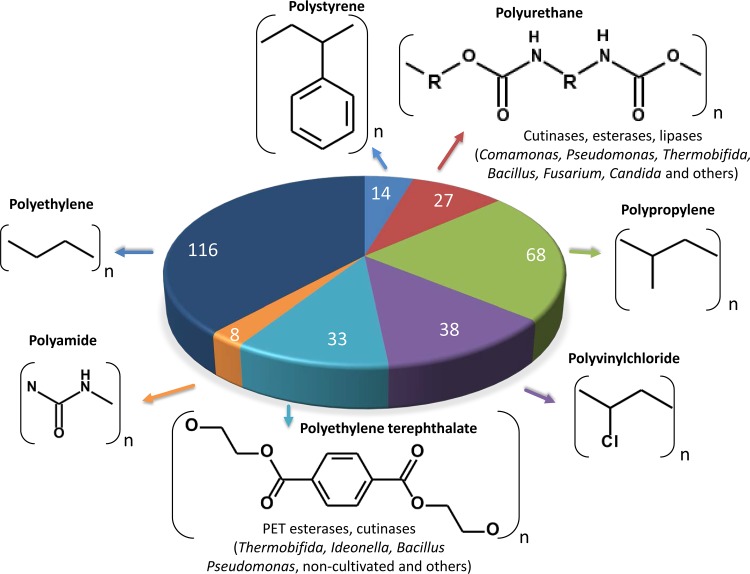
“Polyurethane-degrading enzymes have already been reviewed two decades ago, 122 and PA degrading microbes have been described decades ago, too (though the functioning/enzymes of PA-degradation are still unconstrained).123,124”
From The fate of plastic in the ocean environment – a minireview (2021) · cites this paper as [123]
Self-check
Percentages, sums and reported differences re-computed from the paper’s own numbers.
The self-check needs the paper’s full text.
Citations
Cites
MEGA6: Molecular Evolutionary Genetics Analysis version 6.0.
Tamura, K., Stecher, G., Peterson, D., Filipski, A., & Kumar, S. (2013) · Molecular biology and evolution · doi:10.1093/molbev/mst197 · Cited by 41,174
Production, use, and fate of all plastics ever made
Geyer, R., Jambeck, J. R., & Law, K. L. (2017) · Science Advances · doi:10.1126/sciadv.1700782 · Cited by 18,606
Plastic waste inputs from land into the ocean
Jambeck, J. R., Geyer, R., Wilcox, C., Siegler, T. R., Perryman, M., Andrady, A., Narayan, R., & Law, K. L. (2015) · Science · doi:10.1126/science.1260352 · Cited by 13,163
T-coffee: a novel method for fast and accurate multiple sequence alignment 1 1Edited by J. Thornton
Notredame, C., Higgins, D. G., & Heringa, J. (2000) · Journal of Molecular Biology · doi:10.1006/jmbi.2000.4042 · Cited by 6,964
Encyclopedia of polymer science and technology
(2003) · Choice Reviews Online · doi:10.5860/choice.41-0674 · Cited by 5,100
The pollution of the marine environment by plastic debris: a review.
Derraik, J. G. B. (2002) · Marine Pollution Bulletin · doi:10.1016/s0025-326x(02)00220-5 · Cited by 4,042
A bacterium that degrades and assimilates poly(ethylene terephthalate)
Yoshida, S., Hiraga, K., Takehana, T., Taniguchi, I., Yamaji, H., Maeda, Y., Toyohara, K., Miyamoto, K., Kimura, Y., & Oda, K. (2016) · Science · doi:10.1126/science.aad6359 · Cited by 3,367
Plastic debris in the open ocean
Cózar, A., Echevarría, F., González-Gordillo, J. I., Irigoien, X., Úbeda, B., Hernández-León, S., Palma, Á. T., Navarro, S., García-de-Lomas, J., Ruiz, A., et al. (2014) · Proceedings of the National Academy of Sciences · doi:10.1073/pnas.1314705111 · Cited by 3,133
Microplastics as an emerging threat to terrestrial ecosystems
Machado, A. A. D. S., Kloas, W., Zarfl, C., Hempel, S., & Rillig, M. C. (2017) · Global Change Biology · doi:10.1111/gcb.14020 · Cited by 2,468
Ollis, D. L., Cheah, E., Cygler, M., Dijkstra, B. W., Frolow, F., Franken, S. M., Harel, M., Remington, S. J., Silman, I., Schrag, J. D., et al. (1992) · Protein Engineering Design and Selection · doi:10.1093/protein/5.3.197 · Cited by 2,156
Research works printed but not linked: 2
- Ellen MacArthur Foundation. 2017. The new plastics economy: rethinking the future of plastics and catalysing action. Ellen MacArthur Foundation, Cowes, United Kingdom.
- 10.1016/S0378-1097(02)00473-1 · DOI
Cited by
Sorted by citations
Items 801–900 of 944
The Role of Microbial Communities in Bioremediation of Plastic Waste
Mounya, K. S., Kumaravel, S., Mohamed, M. A., & Shikha, M. S. (2025) · International Journal of Integrative Studies (IJIS) · doi:10.63856/ijis.v1i3.39-55
Role of Single Cell Proteins in Bioremediation
Noor, A. A., & Anshika (2025) · Environmental science and engineering · doi:10.1007/978-3-031-77884-1_4
Shah, F., & Mishra, S. (2025) · Springer eBooks · doi:10.1007/978-981-96-3945-8_12
Manisha, Kumar, D., & Prabhat, V. K. (2025) · Global Conference on AI Research and Emerging Developments (G-CARED) · doi:10.63169/gcared2025.p5
Environmental risks of plastics pollutants and their mycoremediation strategies
Mahmoud, G. A., Badawy, M. S. E. M., Bougafa, F. H. E., Barakat, H. M., & Ahmed, L. I. (2025) · Elsevier eBooks · doi:10.1016/b978-0-443-23796-6.00007-9
Chell, S., Mondal, M., Ghorui, U. K., Dey, U., Chakrabortty, S., Das, K., & Puppala, H. (2025) · Physics and Chemistry of the Earth Parts A/B/C · doi:10.1016/j.pce.2025.104000
Investigating Plastic-Degrading Potential of Environmental Microbes in Polluted Ecosystems
Kumar, M., Thakur, B., Puneet, P., Singh, G., & Kaur, H. (2025) · International Journal of Scientific Research in Science and Technology · doi:10.32628/ijsrst25123138
Erzurum Ovasındaki Mikroplastiklerin Tespit Edilmesi
Aydın, H., Özer, P., Aldağ, S., Çobanoğlu, Ş., & Yazıcı, A. (2025) · Sinop Üniversitesi Fen Bilimleri Dergisi · doi:10.33484/sinopfbd.1564062
Espinal, J. A. V., García, J. A., Alcantara, G. C., Chimal, G. Á., González, D. A. M., & Echeona, K. A. (2025) · Multidisciplinary Journal of Sciences Discoveries and Society · doi:10.71068/w0tapa42
Ramirez, A. F. V., & Ramírez, N. Z. (2025) · Ingenierías USBmed · doi:10.21500/20275846.6531
Metatranscriptome profile of agricultural microbial communities enriched for plastitrophy
Olabemiwo, F. A., Huang, Y., Thompson, M., Omar, H., Kalra, S., Arevalo, P., Nazzaro, V., & Cohan, F. M. (2025) · mLife · doi:10.1002/mlf2.70023
Polyethylene Terephthalate (PET) degrading soil bacteria: an overview
Dapapa, L. K. M., Mangubat, M. C. T., Que, J. T. C., & Balendres, M. A. (2025) · Journal of Experimental Sciences · doi:10.25081/jes.2025.v16.9520
Palanisamy, R., Subramanian, S. K., Kangeswaren, M., Asiedu, S. K., Perumal, V., Chozhan, K., & Ravi, M. S. (2025) · Journal of Cleaner Production · doi:10.1016/j.jclepro.2025.146206
Frescura, J. M., Frosio, T., Santillán, J. Y., & Rojas, N. L. (2025) · Environmental Technology · doi:10.1080/09593330.2025.2553868
Novel Soil Bacteria of the Genus Streptomyces Hydrolyzing Industrial Aromatic Polymeric Compounds
Kolomytseva, M. P., Chernykh, A. M., Egorova, A. D., Gorina, S. Y., Shestakova, K. A., Renfeld, Z. V., Sybachin, A. V., Gaidina, A. S., Karlov, S. S., Belova, N. A., et al. (2025) · Journal of Polymers and the Environment · doi:10.1007/s10924-025-03676-4
Plastic degradation by the biodegradation method using biodegradation bacteria
(2025) · International Research Journal of Modernization in Engineering Technology and Science · doi:10.56726/irjmets82854
Chiarello, F., Angelini, R., Becerril, D., Cimino, A., Ceccarelli, C., Pietrantonio, F. D., Fasolato, C., Fioretti, D., Iurescia, S., Laureti, S., et al. (2025) · European Conference on Games Based Learning · doi:10.34190/ecgbl.19.1.3961
Mardi, L., Lahmamsi, H., Chadli, C., Radouane, N., Seghyar, F., Dra, A., Imache, A. E., Ezrari, S., & Lairini, S. (2025) · Water Air & Soil Pollution · doi:10.1007/s11270-025-08633-4
Characterization of Biodegradable Plastic-Producing Bacteria Isolates from Atlantic Ocean
Fayemi, S. O., Kotun, B. C., Fatunbi, O. A., Oda, O., & Ayedun, J. S. (2025) · Environmental contamination remediation and management · doi:10.1007/978-3-031-95547-1_3
Microbial Degradation of Microplastics
Perpetuini, G., & Tofalo, R. (2025) · Springer eBooks · doi:10.1007/978-3-031-99774-7_10
Rice Bran Biorefinery: A Zero-Waste Approach to Bioactive Oil and Biopolymer Production
Navajas-Preciado, B., Martillanes, S., Galván, A., Rocha-Pimienta, J., Ramírez, R., & Delgado, J. (2025) · Sustainability · doi:10.3390/su172210219
Bioremediation of microplastics in different water systems
Mujtaba, G., Qayyum, H., Khan, H., Ullah, A., Shah, M. U. H., Hasnain, S. M. W. U., Daud, M., Abidin, M. Z., & Abdullah, B. (2025) · Elsevier eBooks · doi:10.1016/b978-0-443-33829-8.00004-x
Mitigation strategies for micronanoplastics
Rajendran, D., Athulya, P. A., & Chandrasekaran, N. (2025) · Elsevier eBooks · doi:10.1016/b978-0-443-24782-8.00006-6
Varshini, K. P., Balakumar, S., & Mahesh, N. (2025) · De Gruyter eBooks · doi:10.1515/9783111673431-003
Yang, J., Zhang, Y., Peng, J., Huang, X., Li, J., Yi, T., & Jian, X. (2025) · International Journal of Environmental Health Research · doi:10.1080/09603123.2025.2604162
Teng, M., Li, Y., Zhao, X., White, J. C., Zhao, L., Sun, J., Zhu, W., & Wu, F. (2024) · Figshare · doi:10.6084/m9.figshare.24636712
Teng, M., Li, Y., Zhao, X., White, J. C., Zhao, L., Sun, J., Zhu, W., & Wu, F. (2023) · Figshare · doi:10.6084/m9.figshare.24636478
Heyde, S. A. H., Bååth, J. A., Westh, P., Nørholm, M. H. H., & Jensen, K. (2021) · Figshare · doi:10.6084/m9.figshare.14525975
Additional file 1 of Growing a circular economy with fungal biotechnology: a white paper
Meyer, V., Basenko, E. Y., Benz, J. P., Braus, G. H., Caddick, M. X., Csukai, M., de Vries, R. P., Endy, D., Frisvad, J. C., Gunde‐Cimerman, N., et al. (2020) · Figshare · doi:10.6084/m9.figshare.12096300
Biodegradasi Jenis Polimer PET Dan HDPE dengan Variasi Konsentrasi dan Masa Inkubasi Eco-Enzyme
Lutvianti, R., Hafsan, H., Rukmana, R., & Latif, U. T. A. (2025) · Filogeni Jurnal Mahasiswa Biologi · doi:10.24252/filogeni.v5i3.57118
Biological Effects of Microplastics: A Review.
Shehab, Z. N., Farhhan, A. F., & Ahmad, R. N. (2025) · Mağallaẗ ʻulūm al-rāfidayn · doi:10.33899/rsci.v34i4.56048
Nithyanandam, R., Prasath, K. G., Divyadharshini, Abhi, & Sri, G. (2025) · Journal of environmental chemical engineering · doi:10.1016/j.jece.2025.120894
Ceylan, E., Nalçaoğlu, A., Çolak, D. N., Beldüz, A. O., İnan, K., Kahriman, N., & Çanakçı, S. (2025) · Journal of Apitherapy and Nature · doi:10.35206/jan.1749818
Ecosystem functions of freshwater biofilms: Progress and prospects
Gao, H., Khan, S., Wang, Y., & Wu, N. (2026) · Water Biology and Security · doi:10.1016/j.watbs.2025.100539
Khayri, M. M., Alsahoo, H. N. A., Latif, A. S., & Ajmi, R. N. (2025) · Obat · doi:10.61132/obat.v3i6.1834
Iheanetu, O. U., & Priscilla, A. (2025) · NIPES Journal of Science and Technology Research · doi:10.37933/nipes/7.4.2025.si251
Ma, H., Khusnutdinova, A. N., Chernikova, T. N., Ferrer, M., Yakunin, A. F., Golyshina, O. V., & Golyshin, P. N. (2026) · Applied Microbiology and Biotechnology · doi:10.1007/s00253-026-13726-z
Becerra, D., Rodríguez-Caballero, G., Sáez, L. P., Moreno‐Vivián, C., Olaya‐Abril, A., Luque‐Almagro, V. M., & Roldán, M. D. (2026) · Microplastics · doi:10.3390/microplastics5010032
Discovering Novel PETase Enzymes for Enhanced PET Plastic Degradation Using in Silico ApproachesPreprint
Patil, B., Attar, A., Kumar, A., & Giri, S. (2026) · bioRxiv (Cold Spring Harbor Laboratory) · doi:10.64898/2026.02.12.705489
Denim Dream: Recycling Post-Consumer Jeans into Low-Density Water-Repellent Cellulose Foams
Uslar, D., Priks, H., Levin, K. J., Lopes, L. P., & Tamm, T. (2026) · Circular Economy and Sustainability · doi:10.1007/s43615-026-00740-6
Nguyen, H. C., & Ben-Nissan, B. (2026) · Materials and Emerging Technologies for Sustainability · doi:10.1142/s3060932126300039
Nature’s Cleanup Crew: Microbial Contributions to Plastic Degradation
Cherian, T. (2026) · Elsevier eBooks · doi:10.1016/b978-0-443-41630-9.00019-7
Microbial enzymatic remediation of synthetic plastic pollutants: a present and future perspective
Prabhu, N., Rajamehala, M., Chozhavendhan, S., & Gajendran, T. (2026) · Elsevier eBooks · doi:10.1016/b978-0-443-41630-9.00017-3
Febria, F. A., Aziz, R., Mariana, L., Hidayat, H., Kinabu, R. A. F., & Putra, A. (2026) · Journal of Ecological Engineering · doi:10.12911/22998993/214721
Wang, W., Yao, S., Liu, Z., & Liu, X. (2026) · Polymers · doi:10.3390/polym18060695
Dong, J., Li, G., Ran, J., Li, Z., Xue, S., Zhou, D., Zhang, W., & Zheng, Z. (2026) · Land · doi:10.3390/land15030495
Gómez, J. M. O., Naranjo, E., Orts, Á., Martin, L., Gómez, I., Tejada, M., Parrado, J., & Castaño, A. (2026) · SSRN Electronic Journal · doi:10.2139/ssrn.6468186
The Role of Microbial Communities in Bioremediation of Plastic Waste
Khadse, S. (2026) · International Journal of Integrative Studies (IJIS) · doi:10.63856/grf2y181
Zhang, L., Guo, Y., Liu, H., Qiu, A., Zhang, J., You, S., Su, R., & Qi, W. D. (2026) · Process Biochemistry · doi:10.1016/j.procbio.2026.04.003
Application of Fungi in Waste Water Treatment in Bioremediation of Plastics and Microplastics
Kumar, A., Kaur, S., Saroha, B., Dutt, N., Singh, P., Negi, D. S., & Bahadur, I. (2026) · Springer water · doi:10.1007/978-3-032-01955-4_4
Ko, Y., Ghatge, S., Yang, Y., Ho, C. T., Han, D., Lee, S., & Hur, H.-G. (2026) · Journal of Environmental Management · doi:10.1016/j.jenvman.2026.129628
Zhao, H., Che, W., Tan, X., Shen, Y., Xu, Y., & Man, Y. (2026) · Journal of Hazardous Materials · doi:10.1016/j.jhazmat.2026.142136
Chieftaincy and Tribal Disputes: The Role of Indigenous Knowledge Transfer
-, F. A. A., & Michael, M. (2026) · Advanced International Journal of Multidisciplinary Research · doi:10.62127/aijmr.2026.v04i02.1292
(2026) · doi:10.1128/aem.01698-25
Self-citationFaber, A., Politan, R. J., Nicol, A., Valle, S. D., Jenkins, B., Flematti, G. R., & Fritz, G. (2026) · Applied Microbiology and Biotechnology · doi:10.1007/s00253-026-13831-z
ACHNASYA, J. F., Pangastuti, A., & Sari, S. L. A. (2026) · Biodiversitas Journal of Biological Diversity · doi:10.13057/biodiv/d270325
Sundarbans mangrove microbiota as agents for low-density polyethylene degradation
Banerjee, S., Bisui, S., Ram, S. S., Kanungo, I., & Aich, A. (2026) · Journal of Environmental Management · doi:10.1016/j.jenvman.2026.129956
Gogoi, P., Valan, J. A., Manoj, G. D., Jagadeesh, M. K., & kumar, Y. V. S. P. (2026) · Progress in Rubber Plastics and Recycling Technology · doi:10.1177/14777606261453661
Sun, R., Wu, C., Song, X., Wang, D., Shan, Y., Yh, M., Hu, H., Ren, X., Chen, Z., Luo, J., et al. (2026) · Journal of environmental chemical engineering · doi:10.1016/j.jece.2026.123255
Jung, S.-Y., Kim, M., Yun, S.-D., Son, H. F., & Yeom, S. (2026) · Journal of Microbiology and Biotechnology · doi:10.4014/jmb.2604.04057
A holistic remedy to the plastic era through a high–performance photocatalytic system
Sharma, V., Lal, A. S., Saravanan, P., & Kishi, N. (2026) · Materials and Emerging Technologies for Sustainability · doi:10.1142/s3060932126300040
Pěnčík, O., Černý, M., Tomeková, J., Vodová, M., Cao, H.-A., Kučerík, J., Hrabalová, V., Molnárová, K., Treml, J., Koláčková, M., et al. (2026) · Research Square · doi:10.21203/rs.3.rs-9204313/v1
Kefela, T., Li, D., Werfhorst, L. C. V. D., Reynolds, R. M., Behrens, R., Floyd, Y., Brown, J. L., Smith, J., O’Malley, M., & Holden, P. A. (2026) · Applied and Environmental Microbiology · doi:10.1128/aem.02490-25
Biofilm formation and PAH migration in HDPE drinking water pipes
Fadel, H. A. (2026) · Applied Water Science · doi:10.1007/s13201-025-02700-1
Vivekanandan, K., Kandasamy, S., Sigamani, S., Gopal, K., & Kaliyannan, G. (2026) · Process Safety and Environmental Protection · doi:10.1016/j.psep.2026.109104
Fungal Degradation of Plastics: A Review
Alobaydy, O. (2026) · مجلة بحوث مستقبلية. · doi:10.61704/pr.606
Polyethylene degradation by Klebsiella pneumoniae with thermostable lipase and lignolytic enzymes
Ogunjemite Oluwadamilola, E., & Onoruoiza, M. A. (2025) · Journal of Environmental Science Ecology and Chemistry · doi:10.58985/jesec.2025.v02i01.03
Ogunjemite, O. E., Onile, O. S., & Fadahunsi, A. I. (2026) · Journal of applied science and environmental management · doi:10.4314/jasem.v30i4.28
Saorin, F., Camlofski, T., Oliveira, J., da Silva, A. O., Porto, M., Mattioli, M. P., Krüger, R. H., & Peixoto, J. (2026) · Sustainable Microbiology · doi:10.1093/sumbio/qvag027
Wang, J., Delavar, M. A., & Han, Y. (2026) · Global Environmental Change Advances · doi:10.1016/j.gecadv.2026.100036
Pishan, M., Sazegari, S., Niazi, A., Majdinasab, M., Zinati, Z., & Eskandari, M. H. (2026) · Scientific Reports · doi:10.1038/s41598-026-59639-9
Kalaivani, R., Ajith, A. K., & Ruban, P. (2026) · International Journal of Latest Technology in Engineering Management & Applied Science · doi:10.51583/ijltemas.2026.150500286
Polyvinyl Chloride (PVC)‐Based Biocomposites and Bionanocomposites
Panda, S. K., Visakh, P. M., & Ayrılmış, N. (2026) · Wiley eBooks · doi:10.1002/9781394214983.ch1
Biodegradation of Polyvinyl Chloride (PVC)‐Based Different Fiber Bionanocomposites
Changmai, U., Sahana, S. K., Duarah, R., & Phukan, T. (2026) · Wiley eBooks · doi:10.1002/9781394214983.ch8
López, W. S., Vera, M., Mahecha-Rubiano, Y. R., Castellanos-González, S., Sánchez, K. A., & Castellanos, D. G. (2026) · Journal of Polymer Engineering · doi:10.1515/polyeng-2025-0160
Thanh, N. T., Hoang, N. X., Viet, L. H., & Ngan, N. H. (2026) · Elsevier eBooks · doi:10.1016/b978-0-443-45248-2.00034-1
Phale, P. S., Papade, S. E., Ghodke, V. M., Saha, B. K., & Dhamale, T. (2026) · Applied Microbiology and Biotechnology · doi:10.1007/s00253-026-13916-9
Ogunjemite Oluwadamilola, E. (2025) · Journal of Environmental Science Ecology and Chemistry · doi:10.58985/jesec.2025.v02i02.14
Jahnavi, S., Devendu, K. V., Saha, S., Dey, P., & Osborne, W. J. (2026) · Archives of Toxicology · doi:10.1007/s00204-026-04495-9
Jo, H.-M., Kim, J., Yoo, H.-J., Oh, J.-S., Lim, Y., Choi, J.-H., & Kim, H. (2026) · Chemical Engineering Journal · doi:10.1016/j.cej.2026.179503
Biodegradation of plastics by the phosphorus-solubilising cyanobacterium Chroococcus sp.
Wijaya, D., Lalung, J., Muhammad, S. A., Convey, P., Rashd, J. A., Chuan, L. H., Kurniawan, A., & Huda, N. (2026) · Journal of Applied Phycology · doi:10.1007/s10811-026-03959-w
Source, dynamic, and environmental impact of microplastic in aquatic ecosystem: A review
Radha, N., Sreelal, G., Murugan, S., Ramkumar, S., & Panneerselvam, B. (2026) · Physics and Chemistry of the Earth Parts A/B/C · doi:10.1016/j.pce.2026.104651
Ngwu, T. A., Dayo, D., Akpe, V., & Cock, I. E. (2026) · Pharmacognosy Communications · doi:10.5530/pc.2026.3.15
Budil, J., Martinez‐Lozano, L. A., & Buron-Moles, G. (2026) · Springer eBooks · doi:10.1007/978-3-319-60063-5_21-1
Gupta, A., Turaga, R. K., Kalaskar, P., Kushwaha, S., Gad, S., Kotkondawar, A. V., & Doriya, K. (2026) · Critical Insights in Biotechnology · doi:10.1080/29932238.2026.2702217
Vijande, C., Fuentes-González, C., Lazzari, M., Lema, J. M., & Balboa, S. (2026) · Microbial Ecology · doi:10.1007/s00248-026-02839-7
A versatile Bacillus esterase reveals a carboxylesterase blueprint for PET intermediate degradation
Bounabi, H., Yahiaoui, B., Gasmi, M., Mechouche, M. S., Bäse, N., Gurschke, M., Molitor, R., Pérez-García, P., & Streit, W. R. (2026) · Applied Microbiology and Biotechnology · doi:10.21203/rs.3.rs-10295921/v1
Self-citationMadhu, K., Narwat, N., Kaur, S., Thakur, B., & Puri, P. (2026) · Environmental Quality Management · doi:10.1002/tqem.70430
Recent progress in the separation of micro- and nanoplastics from water
Favas, A. P. M., Juraij, K., & Sujith, A. (2026) · Journal of environmental chemical engineering · doi:10.1016/j.jece.2026.124348
Soni, K., Chaurasia, P., Singh, S., Singh, S., Singh, A. K., Chand, S. K., Yatirajula, S. K., Chand, S., Nayak, J. K., & Palaniappan, A. R. (2026) · Microplastics · doi:10.3390/microplastics5030149
Gómez, J. M. O., Orts, Á., Naranjo, E., Martin, L., Parrado, J., Gómez, I., Castaño, A., & Tejada, M. (2026) · SSRN Electronic Journal · doi:10.2139/ssrn.7197878
Kachhadia, R., Shrivastav, S., Chavada, H., Roy, S., & Kulkarni, M. (2026) · Research Square · doi:10.21203/rs.3.rs-10523119/v1
Microbial Degradation of Synthetic Microfibres in Soil and Water
Rodríguez-Delgado, M. M., Luna-Moreno, D., Kaushik, G., Canovi, C., Villarreal-Chiu, J. F., & Cedillo-González, E. I. (2026) · Springer eBooks · doi:10.1007/978-3-032-17004-0_14
Sahoo, S. J., Mallik, S., Behera, B., Sahoo, S., Mishra, R., & Mohanty, J. N. (2026) · Springer eBooks · doi:10.1007/978-3-032-17004-0_15
The Molecular Identification of Bacteria in Plastic Waste at the Pasir Bajing Garut Landfill
Kristianti, T., Muthmainnah, R., Junita, F., & Aisyah, I. (2026) · Florea Jurnal Biologi dan Pembelajarannya · doi:10.25273/florea.v13i2.24635
Leveraging Microbes for Sustainable Development Goal 14 Progress
Aurora, R., & Balmonte, J. P. (2026) · Environmental Microbiology Reports · doi:10.1111/1758-2229.70399
Nazir, M., Rehman, A., Ibrahim, A. H., Al-Rawi, S. S., Akmal, M., Iram, G., Manzoor, F., Aziz, S., Zafar, M. S., & Iqbal, M. A. (2026) · Biodegradation · doi:10.1007/s10532-026-10356-0
Lee, S. Y., Hwang, S., Cho, I., Lee, H., Lee, J., Koo, D., Kim, J.-W., & Cho, K. (2026) · Biodegradation · doi:10.1007/s10532-026-10359-x
Rivera-Jacinto, M., Rodríguez-Ulloa, C., Briones‐Ramírez, S. R., Quispe‐Cruz, B., Carrasco‐Tarrillo, S., Leonardo, D. A., & Cárdenas, J. P. (2026) · MicrobiologyOpen · doi:10.1002/mbo3.70376
Metadata
- Authors
- Danso, D., Chow, J., & Streit, W. R.
- Affiliations
- Universität Hamburg (DE)
- Corresponding author
- Streit, Wolfgang R.
- Venue
- Applied and Environmental Microbiology
- Publisher
- American Society for Microbiology
- Published
- 2019-10
- Volume
- 85
- Issue
- 19
- ISSN
- 0099-2240 (ISSN-L)
- 1098-5336
- PMC
- PMC6752018
- OpenAlex
- W2974748521
- Cited by
- 918
- References
- 128
- Citations by year
- 2026: 149 · 2025: 140 · 2024: 148 · 2023: 155 · 2022: 140 · 2021: 123 · 2020: 58 · 2019: 5
- FWCI
- 3.42
- Type
- journal article
- Language
- en
- Open access
- hybrid
- doi.org
- Licence
- Locations
- Applied and Environmental Microbiology (publishedVersion, cc-by)
- PubMed Central (publishedVersion, cc-by)
- PubMed (publishedVersion)
- Funders
- Bundesministerium für Bildung und Forschung (FKZ 031A565)
- EC | Horizon 2020 Framework Programme (FKZ 031B0571B)
- Topics
- Physical Sciences › Environmental Science › Pollution › Microplastics and Plastic Pollution
- Physical Sciences › Environmental Science › Pollution › Microbial bioremediation and biosurfactants
- Physical Sciences › Materials Science › Biomaterials › biodegradable polymer synthesis and properties
- Keywords
- plastic biodegradation, plastic pollution, microplastics, polyethylene terephthalate, polyurethane, plastic-degrading enzymes, high molecular weight polymers, plastic recycling, metagenomics, biocatalysts, marine plastic pollution
- MeSH terms
- Biodegradation, Environmental, Biotechnology, Environmental Monitoring, Enzymes, Plastics, Ecosystem, Metagenome, Recycling, Microbiota
About these checks
Registry, retraction, Cites and statistics results are computed, not judged, with one exception: a printed reference that no index lists is read once by a model before it counts as a citation error. Claims are extracted by a model and kept only when their quote appears verbatim in the text; each cited source is then checked, with a model’s help, for whether it says what the claim relies on. Those verdicts can be wrong — read the claim’s quote and the cited source before relying on one.
Statistics and arithmetic are recomputed, not judged.
Confidence bands are shown only for fields calibrated on our annotated test set. None is calibrated yet, so no band is shown.
What counts as a claim ›How we measure confidence ›How we check this ›
Are you an author, or do you see a problem with this page? Request a review
