

The DOI matches its Crossref record; 57 of the 57 references it cites were found in a registry or an index.
Molecular dissection of the chromosome partitioning protein RocS and regulation by phosphorylation
Open accessPublished version of a preprint
Abstract
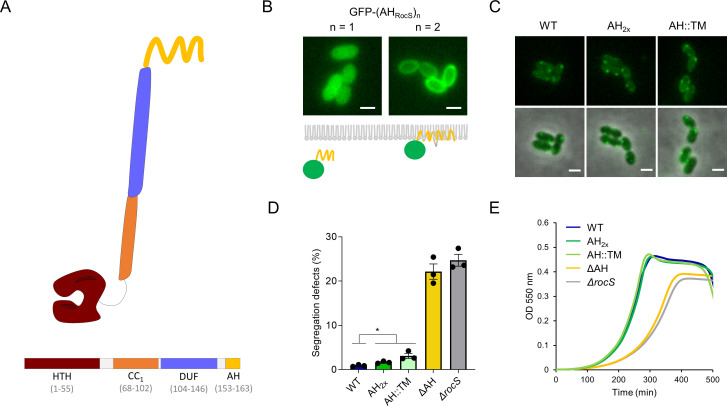
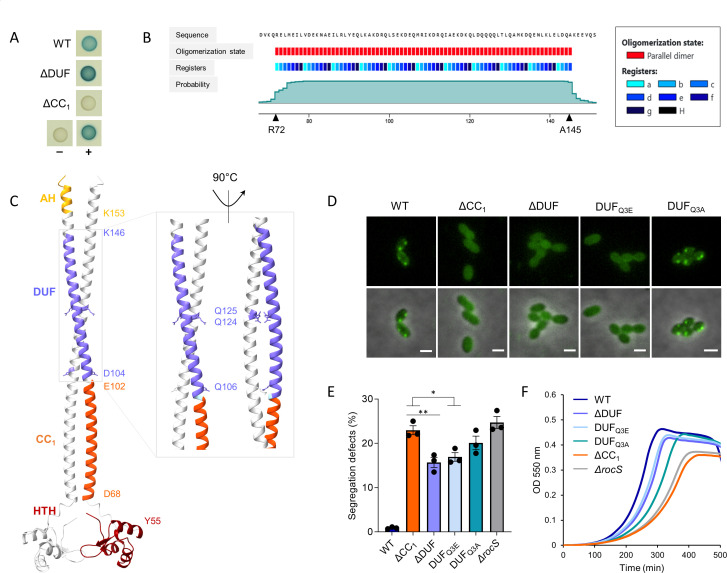
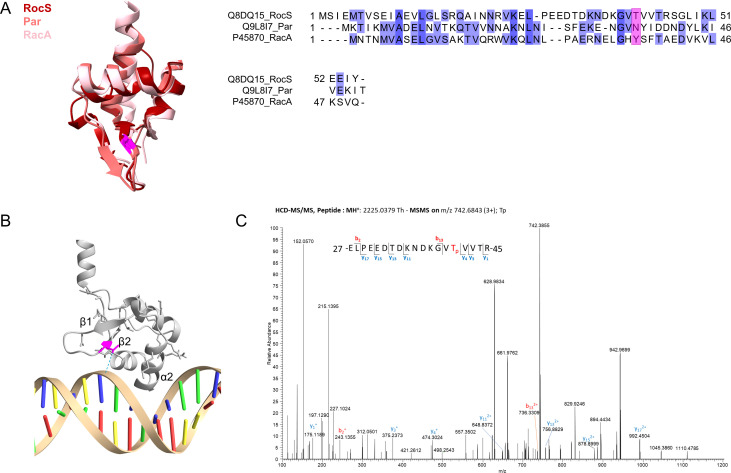
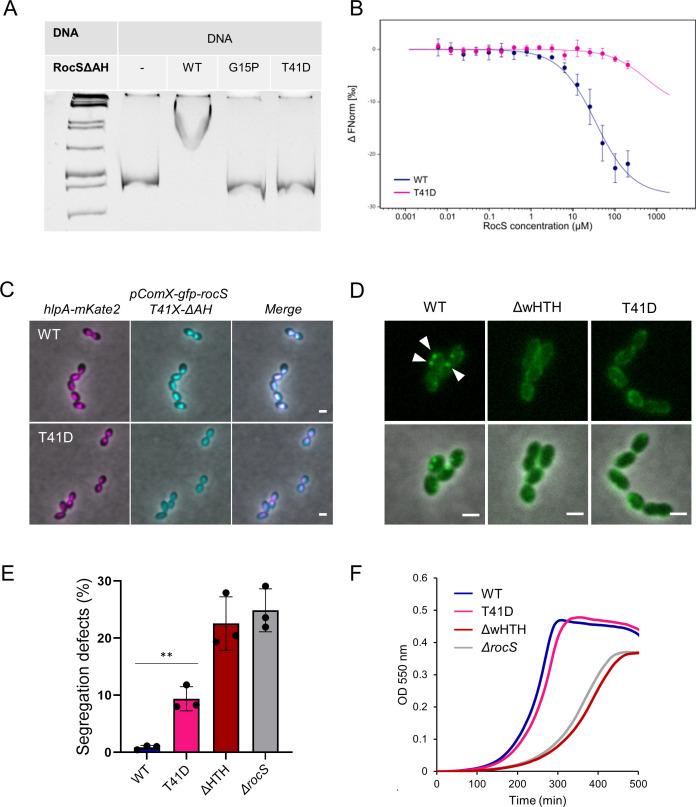
Chromosome segregation in bacteria is a critical process ensuring that each daughter cell receives an accurate copy of the genetic material during cell division. Active segregation factors, such as the ParABS system or SMC complexes, are usually essential for this process, but they are surprisingly dispensable in Streptococcus pneumoniae . Rather, chromosome segregation in S. pneumoniae relies on the protein Regulator of Chromosome Segregation (RocS), although the molecular mechanisms involved remain elusive. By combining genetics, in vivo imaging, and biochemical approaches, we dissected the molecular features of RocS involved in chromosome segregation. We investigated the respective functions of the three RocS domains, specifically the C-terminal amphipathic helix (AH), the N-terminal DNA-binding domain (DBD), and the coiled-coil domain (CCD) separating the AH and the DBD. Notably, we found that a single AH is not sufficient for membrane binding and that RocS requires prior oligomerization to interact with the membrane. We further demonstrated that this self-interaction was driven by the N-terminal part of the CCD. On the other hand, we revealed that the C-terminal part of the CCD corresponds to a domain of unknown function (DUF 536) and is defined by three conserved glutamines, which play a crucial role in RocS-mediated chromosome segregation. Finally, we showed that the DBD is phosphorylated by the unique serine-threonine kinase of S. pneumoniae StkP and that mimicking this phosphorylation abrogated RocS binding to DNA. Overall, this study offers new insights into chromosome segregation in Streptococci and paves the way for a deeper understanding of RocS-like proteins in other bacteria. IMPORTANCE: Bacteria have evolved a variety of mechanisms to properly segregate their genetic material during cell division. In this study, we performed a molecular dissection of the chromosome partitioning protein Regulator of Chromosome Segregation (RocS), a pillar element of chromosome segregation in S. pneumoniae that is also generally conserved in the Streptococcaceae family. Our systematic investigation sheds light on the molecular features required for successful pneumococcal chromosome segregation and the regulation of RocS by phosphorylation. In addition, our study also revealed that RocS shares functional domains with the Par protein, involved in an atypical plasmid segregation system. Therefore, we expect that our findings may serve to extend our understanding of RocS and RocS-like proteins while broadening the repertoire of partitioning systems used in bacteria.
Overview
The claims and statistics of this paper haven’t been checked yet.
Run the check — free, no account needed. It reads the open-access text and checks the sources it cites.
Integrity signals
Registry
Cites
Statistics
Figures
Verification
Claims the paper makes
The claims and statistics of this paper haven’t been checked yet.
Run the check — free, no account needed. It reads the open-access text and checks the sources it cites.
Self-check
Percentages, sums and reported differences re-computed from the paper’s own numbers.
The self-check needs the paper’s full text.
Citations
Cites
MAFFT Multiple Sequence Alignment Software Version 7: Improvements in Performance and Usability
Katoh, K., & Standley, D. M. (2013) · Molecular Biology and Evolution · doi:10.1093/molbev/mst010 · Cited by 46,209
Highly accurate protein structure prediction with AlphaFold
Jumper, J., Evans, R., Pritzel, A., Green, T., Figurnov, M., Ronneberger, O., Tunyasuvunakool, K., Bates, R., Žídek, A., Potapenko, A., et al. (2021) · Nature · doi:10.1038/s41586-021-03819-2 · Cited by 43,764
Accurate structure prediction of biomolecular interactions with AlphaFold 3
Abramson, J., Adler, J., Dunger, J., Evans, R., Green, T., Pritzel, A., Ronneberger, O., Willmore, L., Ballard, A. J., Bambrick, J., et al. (2024) · Nature · doi:10.1038/s41586-024-07487-w · Cited by 15,861
Jalview Version 2—a multiple sequence alignment editor and analysis workbench
Waterhouse, A. M., Procter, J. B., Martin, D. M. A., Clamp, M., & Barton, G. J. (2009) · Bioinformatics · doi:10.1093/bioinformatics/btp033 · Cited by 10,235
UCSF ChimeraX: Structure visualization for researchers, educators, and developers
Pettersen, E. F., Goddard, T. D., Huang, C. C., Meng, E. C., Couch, G. S., Croll, T. I., Morris, J. H., & Ferrin, T. E. (2021) · Protein Science · doi:10.1002/pro.3943 · Cited by 9,514
Pfam: The protein families database in 2021
Mistry, J., Chuguransky, S., Williams, L., Qureshi, M., Salazar, G. A., Sonnhammer, E. L. L., Tosatto, S. C. E., Paladin, L., Raj, S., Richardson, L. J., et al. (2021) · Nucleic Acids Research · doi:10.1093/nar/gkaa913 · Cited by 7,452
Letunic, I., & Bork, P. (2024) · Nucleic Acids Research · doi:10.1093/nar/gkae268 · Cited by 4,497
A bacterial two-hybrid system based on a reconstituted signal transduction pathway
Karimova, G., Pidoux, J., Ullmann, A., & Ladant, D. (1998) · Proceedings of the National Academy of Sciences · doi:10.1073/pnas.95.10.5752 · Cited by 1,661
MicrobeJ, a tool for high throughput bacterial cell detection and quantitative analysis
Ducret, A., Quardokus, E. M., & Brun, Y. V. (2016) · Nature Microbiology · doi:10.1038/nmicrobiol.2016.77 · Cited by 1,010
Self-citationThe many faces of the helix-turn-helix domain: Transcription regulation and beyond
ARAVIND, L., ANANTHARAMAN, V, BALAJI, S., BABU, M., & IYER, L. (2005) · FEMS Microbiology Reviews · doi:10.1016/j.femsre.2004.12.008 · Cited by 700
Metadata
- Authors
- Demuysere, M., Ducret, A., & Grangeasse, C.
- Affiliations
- Centre National de la Recherche Scientifique (FR)
- Corresponding author
- Grangeasse, Christophe
- Venue
- Journal of Bacteriology
- Publisher
- American Society for Microbiology
- Published
- 2024-10-24
- Volume
- 206
- Issue
- 10
- Pages
- e0029124-e0029124
- ISSN
- 0021-9193 (ISSN-L)
- 1098-5530
- PMC
- PMC11500499
- OpenAlex
- W4402768642
- Cited by
- 1
- References
- 57
- Citations by year
- 2026: 1
- FWCI
- 0.26
- Type
- journal article
- Language
- en
- Open access
- hybrid
- doi.org
- Licence
- cc-by
- creativecommons.org/licenses/by/4.0/ (vor)
- journals.asm.org/non-commercial-tdm-license (tdm)
- Locations
- Journal of Bacteriology (publishedVersion, cc-by)
- bioRxiv (Cold Spring Harbor Laboratory) (acceptedVersion)
- PubMed Central (publishedVersion, cc-by)
- PubMed (publishedVersion)
- HAL (submittedVersion, cc-by)
- Funders
- European Commission (H2020, 955626)
- Centre National de la Recherche Scientifique (UMS344/US8)
- Université Claude Bernard Lyon 1
- Fondation Bettencourt Schueller
- Horizon 2020 Framework Programme (955626)
- HORIZON EUROPE Excellent Science
- H2020 Marie Skłodowska-Curie Actions (H2020, 955626)
- Topics
- Life Sciences › Biochemistry, Genetics and Molecular Biology › Genetics › Bacterial Genetics and Biotechnology
- Life Sciences › Biochemistry, Genetics and Molecular Biology › Cell Biology › Microtubule and mitosis dynamics
- Life Sciences › Biochemistry, Genetics and Molecular Biology › Molecular Biology › DNA Repair Mechanisms
- Keywords
- ROCS, chromosome segregation, Streptococcus pneumoniae, phosphorylation, amphipathic helix, coiled-coil domain, DNA-binding domain, protein oligomerization, membrane binding, PAR proteins, plasmid partitioning, Streptococcaceae
- MeSH terms
- Protein Domains, Bacterial Proteins, Chromosomes, Bacterial, Phosphorylation, Streptococcus pneumoniae, Gene Expression Regulation, Bacterial, Chromosome Segregation
About these checks
Registry, retraction, Cites and statistics results are computed, not judged, with one exception: a printed reference that no index lists is read once by a model before it counts as a citation error. Claims are extracted by a model and kept only when their quote appears verbatim in the text; each cited source is then checked, with a model’s help, for whether it says what the claim relies on. Those verdicts can be wrong — read the claim’s quote and the cited source before relying on one.
Statistics and arithmetic are recomputed, not judged.
Confidence bands are shown only for fields calibrated on our annotated test set. None is calibrated yet, so no band is shown.
What counts as a claim ›How we measure confidence ›How we check this ›
Are you an author, or do you see a problem with this page? Request a review
How to cite
Cite CoChat for the checks on this page, and the paper for its own findings.
- This page
- CoChat. (2026). Citation check: Molecular dissection of the chromosome partitioning protein RocS and regulation by phosphorylation. https://app.cochat.ai/papers/10.1128/jb.00291-24
- The paper
- Demuysere, M., Ducret, A., & Grangeasse, C. (2024). Molecular dissection of the chromosome partitioning protein RocS and regulation by phosphorylation. Journal of Bacteriology. https://doi.org/10.1128/jb.00291-24
Data sources
Bibliographic data: Semantic Scholar, OpenAlex, Crossref.
Contains information from the Semantic Scholar Academic Graph Datasets, made available under the ODC Attribution License (ODC-BY 1.0).
Semantic Scholar’s data is described in: Kinney, R., et al. (2023). The Semantic Scholar Open Data Platform. arXiv:2301.10140.
