

Clinical Performance of Aspergillus PCR for Testing Serum and Plasma: a Study by the European Aspergillus PCR Initiative
Open accessThe DOI matches its Crossref record; 16 of the 16 references it cites were found in a registry or an index.
Abstract
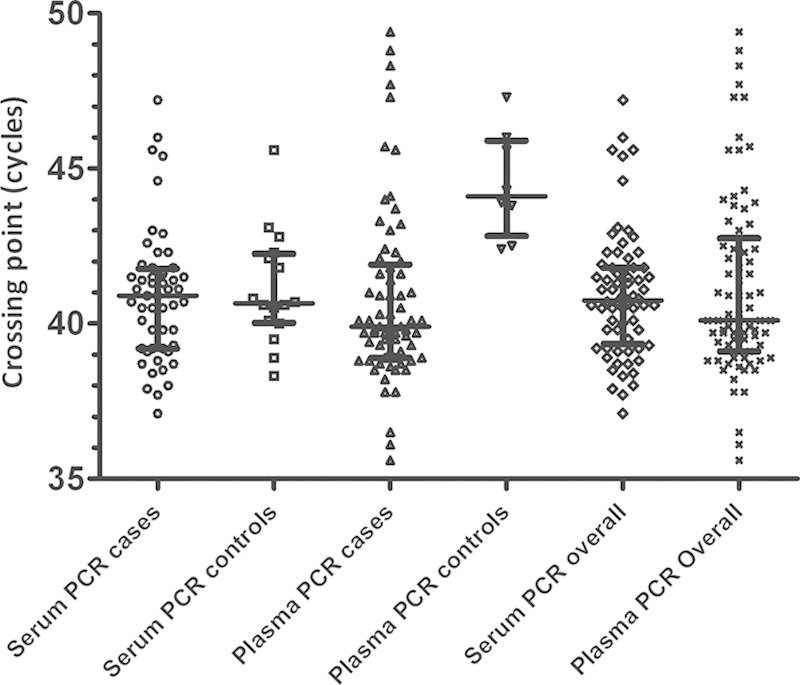
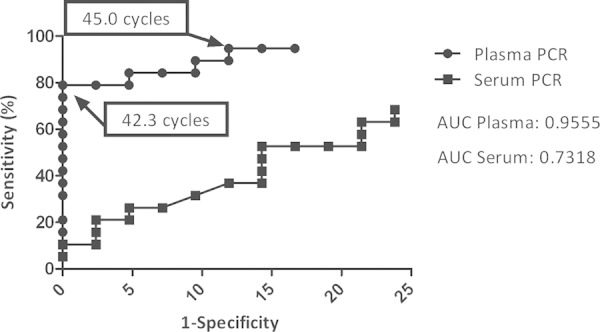
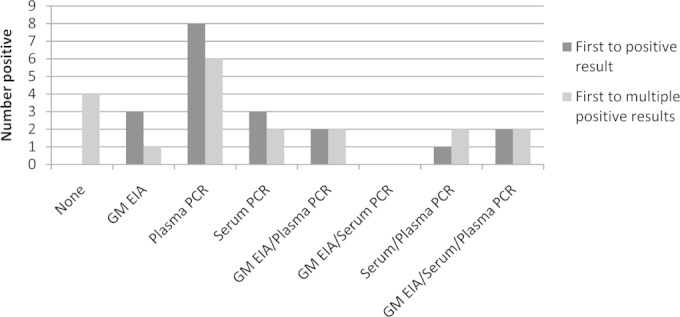
Aspergillus PCR testing of serum provides technical simplicity but with potentially reduced sensitivity compared to whole-blood testing. With diseases for which screening to exclude disease represents an optimal strategy, sensitivity is paramount. The associated analytical study confirmed that DNA concentrations were greater in plasma than those in serum. The aim of the current investigation was to confirm analytical findings by comparing the performance of Aspergillus PCR testing of plasma and serum in the clinical setting. Standardized Aspergillus PCR was performed on plasma and serum samples concurrently obtained from hematology patients in a multicenter retrospective anonymous case-control study, with cases diagnosed according to European Organization for Research and Treatment of Cancer/Invasive Fungal Infections Cooperative Group and the National Institute of Allergy and Infectious Diseases Mycoses Study Group (EORTC/MSG) consensus definitions (19 proven/probable cases and 42 controls). Clinical performance and clinical utility (time to positivity) were calculated for both kinds of samples. The sensitivity and specificity for Aspergillus PCR when testing serum were 68.4% and 76.2%, respectively, and for plasma, they were 94.7% and 83.3%, respectively. Eighty-five percent of serum and plasma PCR results were concordant. On average, plasma PCR was positive 16.8 days before diagnosis and was the earliest indicator of infection in 13 cases, combined with other biomarkers in five cases. On average, serum PCR was positive 10.8 days before diagnosis and was the earliest indicator of infection in six cases, combined with other biomarkers in three cases. These results confirm the analytical finding that the sensitivity of Aspergillus PCR using plasma is superior to that using serum. PCR positivity occurs earlier when testing plasma and provides sufficient sensitivity for the screening of invasive aspergillosis while maintaining methodological simplicity.
Overview
The claims and statistics of this paper haven’t been checked yet.
Free: it reads the open-access text and checks the first 5 claims that cite a source we can check. Create a free account to check every claim.
Integrity signals
Registry
Cites
Statistics
Figures
Verification
Claims the paper makes
The claims and statistics of this paper haven’t been checked yet.
Free: it reads the open-access text and checks the first 5 claims that cite a source we can check. Create a free account to check every claim.
Claims other papers make about this one
Each is checked against this paper’s own text: does it say what the citing paper says it does?
The source backs part of the claim, not all of it — or backs it for a different population, condition or comparison.
In the citing paper
“Many different protocols for PCR amplification have been published, but they remain heterogeneous, because they have been developed by specific laboratories (136–139) and have not been clinically validated (140).”
From Aspergillus fumigatus and Aspergillosis in 2019 (2019) · cites this paper as [136]
Experimental — accuracy not yet measured
Self-check
Percentages, sums and reported differences re-computed from the paper’s own numbers.
The self-check needs the paper’s full text.
Citations
Cites
De Pauw, B., Walsh, T. J., Donnelly, J. P., Stevens, D. A., Edwards, J. E., Calandra, T., Pappas, P. G., Maertens, J., Lortholary, O., Kauffman, C. A., et al. (2008) · Clinical Infectious Diseases · doi:10.1086/588660 · Cited by 4,917
Self-citationInterval estimation for the difference between independent proportions: comparison of eleven methods
Newcombe, R. G. (1998) · Statistics in Medicine · doi:10.1002/(sici)1097-0258(19980430)17:8<873::aid-sim779>3.0.co;2-i · Cited by 1,851
Aspergillus PCR: One Step Closer to Standardization
White, P. L., Bretagne, S., Klingspor, L., Melchers, W. J. G., McCulloch, E., Schulz, B., Finnstrom, N., Mengoli, C., Barnes, R. A., Donnelly, J. P., et al. (2010) · Journal of Clinical Microbiology · doi:10.1128/jcm.01767-09 · Cited by 296
Self-citationMorrissey, C. O., Chen, S. C.-A., Sorrell, T. C., Milliken, S., Bardy, P. G., Bradstock, K. F., Szer, J., Halliday, C. L., Gilroy, N. M., Moore, J., et al. (2013) · The Lancet Infectious Diseases · doi:10.1016/s1473-3099(13)70076-8 · Cited by 221
White, P. L., Linton, C. J., Perry, M. D., Johnson, E. M., & Barnes, R. A. (2006) · Clinical Infectious Diseases · doi:10.1086/499949 · Cited by 210 · cited 1×
“At PHW, the Aspergillus real-time PCR test was performed as a singleround assay using a Rotor-Gene Q high-resolution melting (HRM) instrument (Qiagen, United Kingdom) targeting the 28S rRNA gene, as previously described (11).”
MethodSelf-citationAguado, J. M., Vazquez, L., Fernandez-Ruiz, M., Villaescusa, T., Ruiz-Camps, I., Barba, P., Silva, J. T., Batlle, M., Solano, C., Gallardo, D., et al. (2015) · Clinical Infectious Diseases · doi:10.1093/cid/ciu833 · Cited by 158
Self-citationEvaluation of Aspergillus PCR Protocols for Testing Serum Specimens
White, P. L., Mengoli, C., Bretagne, S., Cuenca-Estrella, M., Finnstrom, N., Klingspor, L., Melchers, W. J. G., McCulloch, E., Barnes, R. A., Donnelly, J. P., et al. (2011) · Journal of Clinical Microbiology · doi:10.1128/jcm.05316-11 · Cited by 156
Self-citationPCR in Diagnosis of Invasive Aspergillosis: a Meta-Analysis of Diagnostic Performance
Arvanitis, M., Ziakas, P. D., Zacharioudakis, I. M., Zervou, F. N., Caliendo, A. M., & Mylonakis, E. (2014) · Journal of Clinical Microbiology · doi:10.1128/jcm.01365-14 · Cited by 148
Diagnosing Invasive Aspergillosis during Antifungal Therapy by PCR Analysis of Blood Samples
Lass-Flörl, C., Gunsilius, E., Gastl, G., Bonatti, H., Freund, M. C., Gschwendtner, A., Kropshofer, G., Dierich, M. P., & Petzer, A. (2004) · Journal of Clinical Microbiology · doi:10.1128/jcm.42.9.4154-4157.2004 · Cited by 106
Springer, J., Morton, C. O., Perry, M., Heinz, W. J., Paholcsek, M., Alzheimer, M., Rogers, T. R., Barnes, R. A., Einsele, H., Loeffler, J., et al. (2013) · Journal of Clinical Microbiology · doi:10.1128/jcm.03322-12 · Cited by 83 · cited 2×
“The sensitivity of serum PCR in this current study was comparable to that for serum in a previous study comparing whole-blood (WB) and serum PCR performance, whereas the current plasma PCR sensitivity was comparable to that of previous WB PCR (3).”
BackgroundResultSelf-citationWhite, P. L., Perry, M. D., Moody, A., Follett, S. A., Morgan, G., & Barnes, R. A. (2011) · Journal of Clinical Microbiology · doi:10.1128/jcm.00101-11 · Cited by 83 · cited 1×
“Consequently, degradation of the DNA target was a possibility (15).”
BackgroundSelf-citationMillon, L., Piarroux, R., Deconinck, E., Bulabois, C.-E., Grenouillet, F., Rohrlich, P., Costa, J.-M., & Bretagne, S. (2005) · Journal of Clinical Microbiology · doi:10.1128/jcm.43.10.5097-5101.2005 · Cited by 72 · cited 1×
“As a result, PCR positivity is often not reproducible, although it is still considered significant (14).”
BackgroundSelf-citationBarnes, R. A., Stocking, K., Bowden, S. J., Poynton, M., & White, P. L. (2013) · Journal of Infection · doi:10.1016/j.jinf.2013.04.020 · Cited by 62
Self-citationLoeffler, J., Mengoli, C., Springer, J., Bretagne, S., Cuenca-Estrella, M., Klingspor, L., Lagrou, K., Melchers, W. J. G., Morton, C. O., Barnes, R. A., et al. (2015) · Journal of Clinical Microbiology · doi:10.1128/jcm.00906-15 · Cited by 49
Self-citationMcCulloch, E., Ramage, G., Jones, B., Warn, P. A., Kirkpatrick, W. R., Patterson, T. F., & Williams, C. (2009) · Journal of Clinical Pathology · doi:10.1136/jcp.2008.063321 · Cited by 32 · cited 7×
“In an animal model study evaluating Aspergillus PCR testing on different blood fractions, the clot was found to contain the greatest concentration of Aspergillus DNA (8).”
BackgroundResultInfluentialWhite, P. L., Jones, T., Whittle, K., Watkins, J., & Barnes, R. A. (2013) · Clinical and Vaccine Immunology · doi:10.1128/cvi.00730-12 · Cited by 21 · cited 1×
“0398), and more cases were diagnosed (7).”
Self-citation
Cited by
Ullmann, A. J., Aguado, J. M., Arikan-Akdagli, S., Denning, D. W., Groll, A. H., Lagrou, K., Lass-Flörl, C., Lewis, R. E., Munoz, P., Verweij, P. E., et al. (2018) · Clinical Microbiology and Infection · doi:10.1016/j.cmi.2018.01.002 · Cited by 1,556
Self-citationAspergillus fumigatus and Aspergillosis in 2019
Latgé, J.-P., & Chamilos, G. (2019) · Clinical Microbiology Reviews · doi:10.1128/cmr.00140-18 · Cited by 1,400
Schmiedel, Y., & Zimmerli, S. (2016) · Swiss Medical Weekly · doi:10.4414/smw.2016.14281 · Cited by 218
Molecular diagnostics in medical mycology
Wickes, B. L., & Wiederhold, N. P. (2018) · Nature Communications · doi:10.1038/s41467-018-07556-5 · Cited by 188
Consensus guidelines for the diagnosis and management of invasive aspergillosis, 2021
Douglas, A. P., Smibert, O. C., Bajel, A., Halliday, C. L., Lavee, O., McMullan, B., Yong, M. K., van Hal, S. J., Chen, S. C. ‐., & the Australasian Antifungal Guidelines Steering Committee (2021) · Internal Medicine Journal · doi:10.1111/imj.15591 · Cited by 179
Metadata
- Authors
- White, P. L., Barnes, R. A., Springer, J., Klingspor, L., Cuenca-Estrella, M., Morton, C. O., Lagrou, K., Bretagne, S., Melchers, W. J. G., Mengoli, C., Donnelly, J. P., Heinz, W. J., & Loeffler, J.
- Affiliations
- Public Health Wales (GB)
- Cardiff University (GB)
- University of Würzburg (DE)
- Karolinska University Hospital (SE)
- Spanish National Centre for Microbiology, Instituto de Salud Carlos III, Madrid, Spain
- Western Sydney University (AU)
- Universitair Ziekenhuis Leuven (BE)
- Hôpital Saint-Louis (FR)
- Radboud University Nijmegen (NL)
- University of Padua (IT)
- Corresponding author
- White, P. Lewis
- ORCID
- Venue
- Journal of Clinical Microbiology
- Publisher
- American Society for Microbiology
- Published
- 2015-09
- Volume
- 53
- Issue
- 9
- Pages
- 2832-2837
- ISSN
- 0095-1137 (ISSN-L)
- 1098-660X
- PMC
- PMC4540904
- OpenAlex
- W2095635144
- Cited by
- 140
- References
- 16
- Citations by year
- 2026: 9 · 2025: 11 · 2024: 14 · 2023: 7 · 2022: 6 · 2021: 10 · 2020: 9 · 2019: 19 · 2018: 16 · 2017: 19 · 2016: 17 · 2015: 3
- FWCI
- 14.29
- Type
- journal article
- Language
- en
- Open access
- hybrid
- doi.org
- Licence
- cc-by-nc-sa
- creativecommons.org/licenses/by-nc-sa/3.0/ (vor)
- journals.asm.org/non-commercial-tdm-license (tdm)
- Locations
- Journal of Clinical Microbiology (publishedVersion, cc-by-nc-sa)
- Europe PMC (PubMed Central) (publishedVersion, cc-by-nc-sa)
- PubMed Central (publishedVersion, cc-by-nc-sa)
- PubMed (publishedVersion)
- ORCA Online Research @Cardiff (Cardiff University) (acceptedVersion)
- Radboud Repository (Radboud University) (submittedVersion)
- Radboud Repository (Radboud University) (submittedVersion, other-oa)
- Funders
- Pfizer
- Gilead Sciences
- Astellas Pharma
- Topics
- Health Sciences › Medicine › Infectious Diseases › Antifungal resistance and susceptibility
- Health Sciences › Medicine › Oncology › Neutropenia and Cancer Infections
- Life Sciences › Biochemistry, Genetics and Molecular Biology › Molecular Biology › Fungal and yeast genetics research
- Keywords
- Aspergillus PCR, invasive aspergillosis, sensitivity and specificity, early infection detection, hematologic patients, time to positivity
- MeSH terms
- Adult, Aged, Aspergillosis, Aspergillus, DNA, Fungal, Female, Humans, Male, Middle Aged, Plasma, Retrospective Studies, Sensitivity and Specificity, Specimen Handling, Time Factors, Case-Control Studies, Polymerase Chain Reaction, Molecular Diagnostic Techniques, Young Adult
About these checks
Registry, retraction, Cites and statistics results are computed, not judged, with one exception: a printed reference that no index lists is read once by a model before it counts as a citation error. Claims are extracted by a model and kept only when their quote appears verbatim in the text; each cited source is then checked, with a model’s help, for whether it says what the claim relies on. Those verdicts can be wrong — read the claim’s quote and the cited source before relying on one.
Statistics and arithmetic are recomputed, not judged.
Confidence bands are shown only for fields calibrated on our annotated test set. None is calibrated yet, so no band is shown.
What counts as a claim ›How we measure confidence ›How we check this ›
Are you an author, or do you see a problem with this page? Request a review
Data sources
Bibliographic data: Semantic Scholar, OpenAlex, Crossref.
Contains information from the Semantic Scholar Academic Graph Datasets, made available under the ODC Attribution License (ODC-BY 1.0).
Semantic Scholar’s data is described in: Kinney, R., et al. (2023). The Semantic Scholar Open Data Platform. arXiv:2301.10140.
