

The DOI matches its Crossref record; 57 of the 57 references it cites were found in a registry or an index.
Student engagement declines in stem undergraduates during COVID-19-driven remote learning
Open accessAbstract
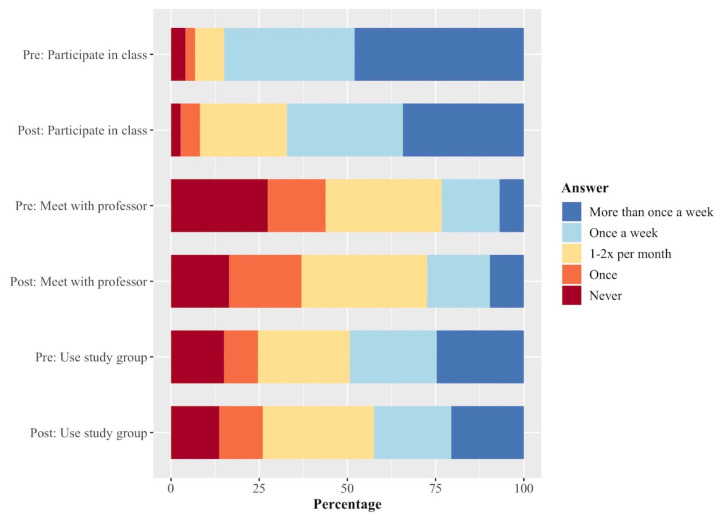
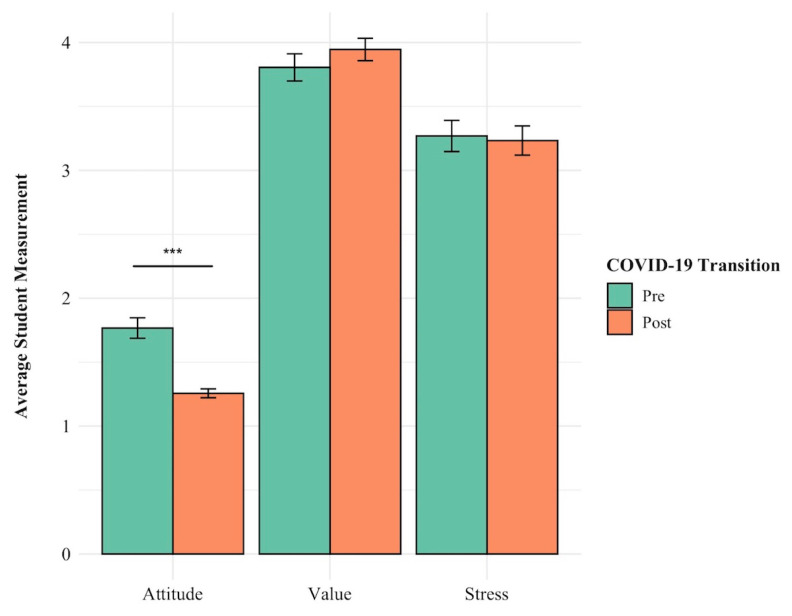
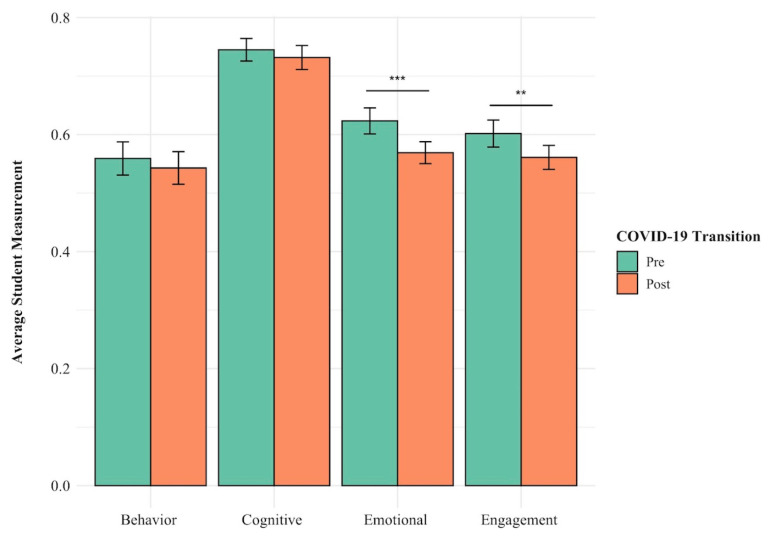
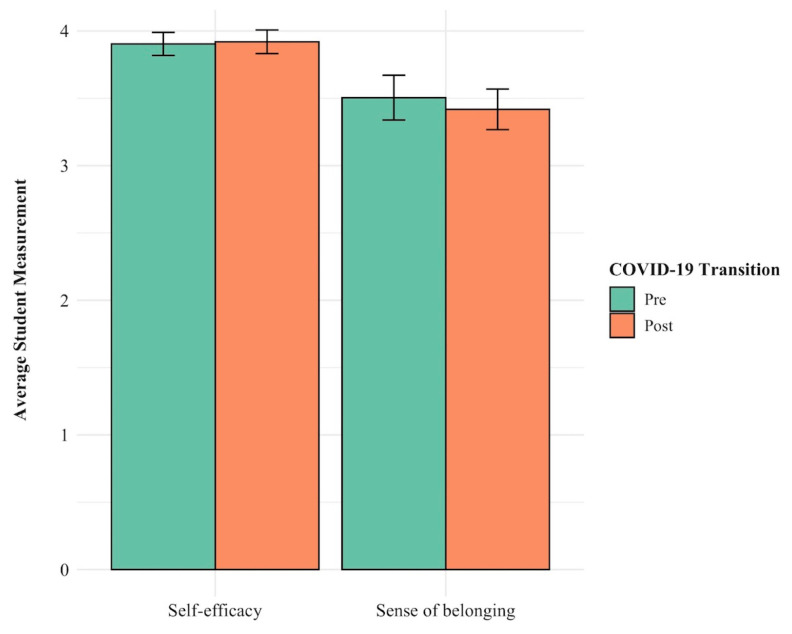
We examined how the shift in learning environment from in-person to online classes, due to the COVID-19 pandemic, impacted three constructs of student engagement: behavioral engagement, including students' frequency of participating in class discussions, meeting with instructors, and studying with peers outside of class; cognitive engagement, including students' sense of belonging and self-efficacy; and emotional engagement, including students' attitudes toward science, their perceived value of the course, and their stress. Seventy-three undergraduate STEM students from across the country completed five-point Likert-style surveys in these areas of student engagement, both prior to their science course transitioning online and at the end of the spring 2020 semester. We found that while overall behavioral engagement did not change, students participated less frequently in class discussions but met with professors more often outside of class. We saw no significant change in cognitive engagement, indicating that while students' sense of belonging and self-efficacy ideally increases over the course of the semester, in this case, it did not. Most alarmingly, we found a significant decrease in emotional engagement, with students reporting a drastic decline in positive attitudes toward science. Students' reported stress levels remained unchanged, and students reported a slight increase in their perceived value of the science course they were taking. These data shed light on how the transition to online learning had an overall negative impact on undergraduate student engagement in science courses.
Overview
The claims and statistics of this paper haven’t been checked yet.
Run the check — free, no account needed. It reads the open-access text and checks the sources it cites.
Integrity signals
Registry
Cites
Statistics
Figures
Verification
Claims the paper makes
The claims and statistics of this paper haven’t been checked yet.
Run the check — free, no account needed. It reads the open-access text and checks the sources it cites.
Claims other papers make about this one
Each is checked against this paper’s own text: does it say what the citing paper says it does?
In the citing paper
“These alternative media of communication were often accompanied by decreasing levels of engagement and satisfaction of learners (Wester et al., 2021; Hollister et al., 2022).”
From Proactive and reactive engagement of artificial intelligence methods for education: a review (2023) · cites this paper as Wester et al., 2021
Self-check
Percentages, sums and reported differences re-computed from the paper’s own numbers.
The self-check needs the paper’s full text.
Citations
Cites
Self-efficacy: The exercise of control
Bandura, A., Freeman, W. H., & Lightsey, R. (1999) · Journal of Cognitive Psychotherapy · doi:10.1891/0889-8391.13.2.158 · Cited by 46,835
Self-efficacy: the exercise of control
(1997) · Choice Reviews Online · doi:10.5860/choice.35-1826 · Cited by 24,451
The need to belong: Desire for interpersonal attachments as a fundamental human motivation.
Baumeister, R. F., & Leary, M. R. (1995) · Psychological Bulletin · doi:10.1037//0033-2909.117.3.497 · Cited by 23,245
School Engagement: Potential of the Concept, State of the Evidence
Fredricks, J. A., Blumenfeld, P. C., & Paris, A. H. (2004) · Review of Educational Research · doi:10.3102/00346543074001059 · Cited by 12,581 · cited 1×
“Behavioral engagement refers to the student ’ s participation in academic or social activities; cognitive engagement is de fi ned by a student ’ s ability to comprehend new ideas and master intellectually challenging skills; and emotional engagement includes emotional reactions, both positive and…”
Wang, C., Pan, R., Wan, X., Tan, Y., Xu, L., Ho, C. S., & Ho, R. C. (2020) · International Journal of Environmental Research and Public Health · doi:10.3390/ijerph17051729 · Cited by 9,923
A social-cognitive approach to motivation and personality.
Dweck, C. S., & Leggett, E. L. (1988) · Psychological Review · doi:10.1037/0033-295x.95.2.256 · Cited by 9,745 · cited 1×
“While a decrease in self-ef fi cacy as a result of increased stress and anxiety could have important impacts on student persistence and performance in classes (57), even a lack of change should be considered problematic when improvement is considered one of the basic unwritten goals of any course.”
Leaving College: Rethinking the Causes and Cures of Student Attrition
Bean, J. P., & Tinto, V. (1988) · The Journal of Higher Education · doi:10.2307/1982243 · Cited by 7,408
What Matters in College? Four Critical Years Revisited.
Feldman, K. A., & Astin, A. W. (1994) · The Journal of Higher Education · doi:10.2307/2943781 · Cited by 5,728
Holmes, E. A., O'Connor, R. C., Perry, V. H., Tracey, I., Wessely, S., Arseneault, L., Ballard, C., Christensen, H., Cohen Silver, R., Everall, I., et al. (2020) · The Lancet Psychiatry · doi:10.1016/s2215-0366(20)30168-1 · Cited by 5,715
Student Involvement: A Developmental Theory for Higher Education
Astin, A. W. (2014) · Routledge eBooks · doi:10.4324/9781315051888-15 · Cited by 5,251
Research works printed but not linked: 8
- Fox K Bryant G Lin N Srinivasan N. 2020. Time for Class – COVID-19 edition part 1: a national survey of faculty during COVID-19. https://www.everylearnereverywhere.org/wp-content/uploads/TimeforClass-COVID19-Part-1-NationalFacultySurvey-Final.pdf.
- Casey N. 4 April 2020. College made them feel equal. The virus exposed how unequal their lives are. The New York Times.
- Levin D. 8 April 2020. “I’m in high school again”: virus sends college students home to parents, and their rules. The New York Times.
- President’s Council of Advisors on Science and Technology. 2012. Engage to excel: producing one million additional college graduates with degrees in science, technology, engineering, and mathematics. Executive Office of the President, Washington, DC.
- 10.1037/0033-2909.117.3.497 · DOI · Paper page
- Thomas L. 2012. Building student engagement and belonging at a time of change in higher education. Paul Hamlyn Foundation, London, UK.
- Schwarzer R, Jerusalem M. 1995. Generalized self-efficacy scale, p 35–37. In Weinman J, Wright S, Johnston M, Measures in health psychology: a user’s portfolio. Causal and control beliefs. NFER-NELSON, Windsor, UK.
- Olave BJ. 2019. Self-efficacy and academic performance among college students: analyzing the effects of team-based learning. Master’s thesis California State University Long Beach CA.
Cited by
Sorted by citations
E-learning in health professions education during the COVID-19 pandemic: a systematic review
Naciri, A., Radid, M., Kharbach, A., & Chemsi, G. (2021) · Journal of Educational Evaluation for Health Professions · doi:10.3352/jeehp.2021.18.27 · Cited by 202
Meng, Q., & Zhang, Q. (2023) · Sustainability · doi:10.3390/su15075767 · Cited by 291
Impact of online learning on student's performance and engagement: a systematic review
Akpen, C. N., Asaolu, S., Atobatele, S., Okagbue, H., & Sampson, S. (2024) · Discover Education · doi:10.1007/s44217-024-00253-0 · Cited by 205
“Student engagement during online learning was reported in ten of the reviewed articles [2, 10, 12, 13, 18, 29, 35–37 , 41].”
Proactive and reactive engagement of artificial intelligence methods for education: a review
Mallik, S., & Gangopadhyay, A. (2023) · Frontiers in Artificial Intelligence · doi:10.3389/frai.2023.1151391 · Cited by 139
Gherghel, C., Yasuda, S., & Kita, Y. (2023) · Computers & Education · doi:10.1016/j.compedu.2023.104795 · Cited by 115
Wang, Y., Lu, S., & Harter, D. (2021) · IEEE Sensors Journal · doi:10.1109/jsen.2021.3105706 · Cited by 64
Dost, G. (2024) · International Journal of STEM Education · doi:10.1186/s40594-024-00472-9 · Cited by 89
Donham, C., Barron, H. A., Alkhouri, J. S., Kumarath, M. C., Alejandro, W., Menke, E., & Kranzfelder, P. (2022) · International Journal of STEM Education · doi:10.1186/s40594-022-00335-1 · Cited by 76
Effects of the COVID-19 Pandemic on Student Engagement in a General Chemistry Course
Wu, F., & Teets, T. S. (2021) · Journal of Chemical Education · doi:10.1021/acs.jchemed.1c00665 · Cited by 53
Walsh, L. L., Arango‐Caro, S., Wester, E. R., & Callis-Duehl, K. L. (2021) · CBE—Life Sciences Education · doi:10.1187/cbe.20-12-0277 · Cited by 52
Walsh, L. L., Lichti, D. A., Zambrano-Varghese, C. M., Borgaonkar, A. D., Sodhi, J. S., Moon, S., Wester, E. R., & Callis-Duehl, K. L. (2021) · International Journal for Educational Integrity · doi:10.1007/s40979-021-00089-3 · Cited by 61
Predictors of Learning Engagement in the Context of Online Learning During the COVID-19 Pandemic
Stan, M. M., Topală, I., Necşoi, D. V., & Cazan, A. (2022) · Frontiers in Psychology · doi:10.3389/fpsyg.2022.867122 · Cited by 58
Supriya, K., Mead, C., Anbar, A. D., Caulkins, J. L., Collins, J. P., Cooper, K. M., LePore, P. C., Lewis, T., Pate, A., Scott, R. A., et al. (2021) · Frontiers in Education · doi:10.3389/feduc.2021.759624 · Cited by 56
Vermeulen, E. J., & Volman, M. L. L. (2024) · Technology, Knowledge and Learning · doi:10.1007/s10758-023-09704-3 · Cited by 44
Student engagement during emergency remote teaching: A scoping review
Yang, D., Wang, H., Metwally, A. H. S., & Huang, R. (2023) · Smart Learning Environments · doi:10.1186/s40561-023-00240-2 · Cited by 54
Creating Student-centred Experiences: Using Design Thinking to Create Student Engagement
Grau, S. L., & Rockett, T. (2022) · The Journal of Entrepreneurship · doi:10.1177/09713557221107443 · Cited by 35
Why Did Students Report Lower Test Anxiety during the COVID-19 Pandemic?
Ewell, S. N., Josefson, C. C., & Ballen, C. J. (2022) · Journal of Microbiology and Biology Education · doi:10.1128/jmbe.00282-21 · Cited by 40
Online English Learning Engagement among Digital Natives: The Mediating Role of Self-Regulation
Wang, X., Hui, L., Jiang, X., & Chen, Y. (2022) · Sustainability · doi:10.3390/su142315661 · Cited by 33
Advancing global chemical education through interactive teaching tools
Ippoliti, F. M., Chari, J. V., & Garg, N. K. (2022) · Chemical Science · doi:10.1039/d2sc01881k · Cited by 33
Pollock, N. B. (2022) · AJP Advances in Physiology Education · doi:10.1152/advan.00074.2022 · Cited by 26
Why Students Struggle in Undergraduate Biology: Sources and Solutions
Tracy, C. B., Driessen, E. P., Beatty, A. E., Lamb, T., Pruett, J. E., Botello, J. D., Brittain, C., Ford, I. C., Josefson, C. C., Klabacka, R. L., et al. (2022) · CBE - Life Sciences Education · doi:10.1187/cbe.21-09-0289 · Cited by 24
Student Anxiety and Engagement with Online Instruction across Two Semesters of COVID-19 Disruptions
Pennino, E., Ishikawa, C., Hajra, S. G., Singh, N., & McDonald, K. (2022) · Journal of Microbiology and Biology Education · doi:10.1128/jmbe.00261-21 · Cited by 23
Wang, Y., Lu, S., & Harter, D. (2021) · IEEE Access · doi:10.1109/access.2021.3117780 · Cited by 22
Tomas, N., & Poroto, A. (2023) · Heliyon · doi:10.1016/j.heliyon.2023.e21321 · Cited by 34
Patall, E. A., Vite, A., Lee, D. J., & Zambrano, J. (2023) · Teaching and Teacher Education · doi:10.1016/j.tate.2023.104400 · Cited by 34
Becker, T. B., Fenton, J. I., Nikolai, M., Comstock, S. S., Swada, J., Weatherspoon, L., & Tucker, R. M. (2022) · AJP Advances in Physiology Education · doi:10.1152/advan.00079.2022 · Cited by 18
Vollmann, M., Scheepers, R. A., Nieboer, A. P., & Hilverda, F. (2022) · Frontiers in Psychology · doi:10.3389/fpsyg.2022.1056983 · Cited by 20
Who are we missing? Self‐selection bias in nonsuicidal self‐injury research
Robinson, K., Dayer, K., Mirichlis, S., Hasking, P. A., & Wilson, M. (2023) · Suicide and Life-Threatening Behavior · doi:10.1111/sltb.12987 · Cited by 16
Exploring the impact of gamification on engagement in a statistics classroom
Jack, E., Alexander, C. L., & Jones, E. M. (2024) · Teaching Mathematics and its Applications An International Journal of the IMA · doi:10.1093/teamat/hrae009 · Cited by 16
Kortemeyer, G., Dittmann-Domenichini, N., & Merki, C. (2025) · Discover Education · doi:10.1007/s44217-025-00500-y · Cited by 16
The Impact of COVID-19 on the CS Student Learning Experience
Siegel, A. A., Zarb, M., Anderson, E., Crane, B. G. C., Gao, A., Latulipe, C., Lovellette, E., McNeill, F., & Meharg, D. (2022) · ACM Conference on Innovation and Technology in Computer Science Education (ITiCSE) · doi:10.1145/3571785.3574126 · Cited by 16
Fu, L., & Qiu, Y. (2023) · European Journal of Psychology of Education · doi:10.1007/s10212-023-00759-5 · Cited by 22
Zhang, Y., & Zhang, X. (2024) · Acta Psychologica · doi:10.1016/j.actpsy.2024.104478 · Cited by 29
Yin, D., & Luo, L. (2024) · Frontiers in Psychology · doi:10.3389/fpsyg.2024.1246958 · Cited by 14
Cultivating scientific literacy and a sense of place through course‐based urban ecology research
Valliere, J. M. (2022) · Ecology and Evolution · doi:10.1002/ece3.8985 · Cited by 15
Riapina, N. E. (2021) · Communication Studies · doi:10.1080/10510974.2021.2011364 · Cited by 13
Richards, S. (2023) · Medical Science Educator · doi:10.1007/s40670-023-01762-7 · Cited by 16
Alshamrani, K. M., Ghulam, E. M., Alattas, M., Aljaddani, H., Alhakami, M., Nufaiei, Z. F. A., & Althaqafy, M. S. (2023) · Frontiers in Medicine · doi:10.3389/fmed.2023.1257589 · Cited by 15
Aviran, E., & Blonder, R. (2023) · Journal of Science Education and Technology · doi:10.1007/s10956-023-10060-1 · Cited by 12
Wu, R., & Yu, Z. (2023) · Education and Information Technologies · doi:10.1007/s10639-023-12222-5 · Cited by 17
Addressing Test Anxiety Using Game-Based Assessment
Bonefont, V., Carbino, B., & Zakerzadeh, R. (2022) · Biomedical Engineering Education · doi:10.1007/s43683-022-00082-3 · Cited by 11
Using memes to promote student engagement and classroom community during remote learning
Tu, K. J., Sun, A., & Levin, D. M. (2022) · Biochemistry and Molecular Biology Education · doi:10.1002/bmb.21700 · Cited by 11
Pandemic-Driven Online Teaching—The Natural Setting for a Flipped Classroom?
Lai, V. K. (2021) · Journal of Biomechanical Engineering · doi:10.1115/1.4052109 · Cited by 11
Grineski, S. E., Morales, D. X., Collins, T. W., Nadybal, S. M., & Trego, S. (2022) · International Journal of Environmental Research and Public Health · doi:10.3390/ijerph19116534 · Cited by 10
Johnson, M. D. L., & Knox, C. J. (2022) · Journal of Microbiology and Biology Education · doi:10.1128/jmbe.00335-21 · Cited by 10
Narla, A. V., Edwards, M. M., Bullard, E. M., Petrie, K. L., & Heinrichsen, E. T. (2024) · Journal for STEM Education Research · doi:10.1007/s41979-024-00135-y · Cited by 11
A Systematic Review of STEM Interventions in Rural Education: July 2013 to June 2023
Gan, Y. T., Ng, K. H., Chandesa, T., Chai, X. Y., August, A. L., & Lee, K. W. (2024) · Journal for STEM Education Research · doi:10.1007/s41979-024-00140-1 · Cited by 9
King, S. M. (2022) · Journal of Chemical Education · doi:10.1021/acs.jchemed.2c00862 · Cited by 11
Undergraduate Learning in the COVID-19 Pandemic: Lessons Learned and Ways Forward
Kajjimu, J., Dreifuss, H. M., Tagg, A., Dreifuss, B. A., & Bongomin, F. (2023) · Advances in Medical Education and Practice · doi:10.2147/amep.s395445 · Cited by 9
Craig, B., & Hsu, J. L. (2024) · Active Learning in Higher Education · doi:10.1177/14697874241230992 · Cited by 11
Zeidan, M., Huang, X., Xiao, L., & Zhao, R.-K. (2022) · Journal of Learning Development in Higher Education · doi:10.47408/jldhe.vi24.888 · Cited by 9
Aarntzen, L., Nieuwenhuis, M., Endedijk, M., van Veelen, R., & Kelders, S. M. (2023) · Sustainability · doi:10.3390/su151914267 · Cited by 10
Canlas, I. P. (2024) · International Journal of Science Education · doi:10.1080/09500693.2024.2354943 · Cited by 11
Thibaut, D., & Schroeder, K. T. (2022) · Journal of Chemical Education · doi:10.1021/acs.jchemed.1c01126 · Cited by 8
Guo, Y., Yue, F., Lu, X.-Y., Sun, F.-Y., Hu, X.-L., & Jia, Y.-N. (2024) · Scientific Reports · doi:10.1038/s41598-024-75769-4 · Cited by 7
We Can’t Fail Again: Arguments for Professional Development in the Wake of COVID-19
Walsh, L. L., Bills, R. J., Lo, S. M., Walter, E. M., Weintraub, B. E., & Withers, M. D. (2022) · Journal of Microbiology and Biology Education · doi:10.1128/jmbe.00323-21 · Cited by 7
González, A., Achiardi, O. A., Valencia, M., & Cabello‐Verrugio, C. (2023) · Advances in experimental medicine and biology · doi:10.1007/978-3-031-26163-3_5 · Cited by 8
Jackson, J. M., Moreno, T. H., & Scoulas, J. M. (2023) · The Journal of Academic Librarianship · doi:10.1016/j.acalib.2023.102683 · Cited by 7
Garelnabi, M., Cowdin, M. A., Fang, Y. H., Shrestha, B., Ushio‐Fukai, M., Aikawa, E. R., Graham, G. N., Molema, G., Yanagisawa, H., & Aikawa, M. (2022) · Frontiers in Cardiovascular Medicine · doi:10.3389/fcvm.2022.863256 · Cited by 6
Guffey, H. E., Mrocko, A. L., Smith, B. K., & Spranger, M. D. (2023) · AJP Advances in Physiology Education · doi:10.1152/advan.00181.2022 · Cited by 7
Dunbar‐Wallis, A. K., Katcher, J., Moore, W., & Corwin, L. A. (2023) · Journal of Science Education and Technology · doi:10.1007/s10956-023-10078-5 · Cited by 6
Lee, H. Y., Park, S., Kim, E. H., Seo, J. A., Lim, H., & Lee, J. (2024) · CHI Conference on Human Factors in Computing Systems · doi:10.1145/3613904.3642845 · Cited by 6
Paired Online Laboratory Assessments: Formative Engagement and Summative Attainment
Coyte, E., & Lowry, R. B. (2024) · Journal of Chemical Education · doi:10.1021/acs.jchemed.4c00308 · Cited by 7
Arango‐Caro, S., Walsh, L. L., Wester, E. R., & Callis-Duehl, K. L. (2022) · Methods in physiology · doi:10.1007/978-3-030-95633-2_15 · Cited by 6
Hitch, G., & Zaman, S. (2023) · Frontiers in Psychiatry · doi:10.3389/fpsyt.2022.1078479 · Cited by 8
Van, K., Tasawar, S., Brendel, E. B. K., Law, C., Mahajan, A., Brownell‐Riddell, C., Diamond, N., Ritchie, K., & Monk, J. M. (2024) · FEBS Open Bio · doi:10.1002/2211-5463.13941 · Cited by 11
Andreadis, M., & Marshall, T. C. (2023) · Journal of American College Health · doi:10.1080/07448481.2023.2227723 · Cited by 9
Belongingness of Chilean Engineering Students: A Gender Perspective Approach
Becerra-Cid, M., Quezada-Espinoza, M., & Truyol, M. E. (2024) · ASEE Annual Conference & Exposition · doi:10.18260/1-2--42358 · Cited by 5
The Impact of Remote Experimentation on Student Engagement
Ghosh, O., & Kumar, B. (2025) · IGI Global eBooks · doi:10.4018/979-8-3693-8593-7.ch031 · Cited by 5
Brendel, E. B. K., Alzubi, A., Rai, S., Mariathasan, C., Snook, L. A., & Monk, J. M. (2024) · FEBS Open Bio · doi:10.1002/2211-5463.13938 · Cited by 7
Wester, E. R., Walsh, L. L., Arango‐Caro, S., Speth, E. B., & Callis-Duehl, K. L. (2025) · Journal of Microbiology and Biology Education · doi:10.1128/jmbe.00098-25 · Cited by 4
Amigud, A., & Pell, D. J. (2024) · Interactive Technology and Smart Education · doi:10.1108/itse-11-2023-0215 · Cited by 4
Wester, E. R., Walsh, L. L., Arango‐Caro, S., Speth, E. B., & Callis-Duehl, K. L. (2024) · Journal of Microbiology and Biology Education · doi:10.1128/jmbe.00093-24 · Cited by 6
da Silva, G. L. B., Versieux, L. M., Pires, A. C. M., & Mattos, A. M. (2025) · Annals of Botany · doi:10.1093/aob/mcaf183 · Cited by 5
Frederick, A., Monárrez, A., & Morales, D. X. (2023) · Journal of Women and Minorities in Science and Engineering · doi:10.1615/jwomenminorscieneng.2023045392 · Cited by 4
Manalo, F. K. B. (2024) · SEAQIS Journal of Science Education · doi:10.58249/sjse.v4i1.132 · Cited by 4
Remote-Only Research Experience Improves STEMM Self-Efficacy in Secondary School Students
Stainbrook, S. C. (2022) · The Journal of STEM Outreach · doi:10.15695/jstem/v5i1.02 · Cited by 4
Crossover of Engagement Among Academic Staff and Students During COVID-19
van der Ross, M. R., Olckers, C., & Schaap, P. (2023) · Psychology Research and Behavior Management · doi:10.2147/prbm.s416739 · Cited by 4
Pipette Olympics: An Engaging Exercise for Undergraduate Laboratory Training
Richter, T. A., Wilkinson, C. D., Griffiths, B. B., & Hunter, R. G. (2022) · Journal of Undergraduate Neuroscience Education · doi:10.59390/noyq7921 · Cited by 4
Students’ Engagement and Active Participation During the Pandemic
Santi, E. A., Gorghiu, G., & Pribeanu, C. (2022) · Informatica Economica · doi:10.24818/issn14531305/26.1.2022.01 · Cited by 4
Molder, A. L., Anderton, B. N., Howell, E. L., Goodwin, S. S., Behrman, S. L., & Ellefson, M. (2025) · Journal of Microbiology & Biology Education · doi:10.1128/jmbe.00084-25 · Cited by 4
Mendoza, J. R. P., Catapang, R. G., & Aquino, J. M. (2023) · International Journal of Learning Teaching and Educational Research · doi:10.26803/ijlter.22.12.15 · Cited by 3
Jayasekaran, S. R., & Anwar, S. (2024) · ASEE Annual Conference & Exposition · doi:10.18260/1-2--41040 · Cited by 3
The Use of Youtube to Enhance Students’ Participation in Distance Learning Mode
Manalu, C. (2022) · Indonesian Journal of Instructional Media and Model · doi:10.32585/ijimm.v4i1.2674 · Cited by 3
Ries, N., Wolf, K. D., Baier‐Mosch, F., Roth, A., & Kunter, M. (2024) · Learning Environments Research · doi:10.1007/s10984-024-09507-y · Cited by 3
D’Arcy, C. E., Lapsov, L., Navarro, V. I., Nevarez, D., & Olimpo, J. T. (2022) · AJP Advances in Physiology Education · doi:10.1152/advan.00168.2021 · Cited by 3
Ghosh, O., & Kumar, B. (2025) · Advances in computational intelligence and robotics book series · doi:10.4018/979-8-3373-2185-1.ch001 · Cited by 2
The perceived importance of active learning techniques in online STEM courses
Wart, M. V., McIntyre, M. M., Zhang, J., Medina, P. S., Ni, A. Y., & Njualem, L. A. (2025) · Computers and Education Open · doi:10.1016/j.caeo.2025.100309 · Cited by 8
Multi-group comparison of STEM education approaches
Tang, Y. M., Chan, Y. K., Wei, R., & Ho, G. T. S. (2025) · Learning and Instruction · doi:10.1016/j.learninstruc.2025.102305 · Cited by 2
Engaging minds, building competence: case-based e-learning in parasitology
Kirk, B., Abbas, G., Sukee, T., Gauci, C. G., Anstead, C. A., Harris, J., Bone, E. K., & Jabbar, A. (2026) · Trends in Parasitology · doi:10.1016/j.pt.2026.01.003 · Cited by 2
Foundations of Theoretical and Conceptual Frameworks for Inclusive Higher Education
Ghosh, O., & Kumar, B. (2026) · IGI Global eBooks · doi:10.4018/979-8-3373-6132-1.ch001 · Cited by 2
May, M. L., Williams, R. V., May, J. A., & Mommer, D. M. (2022) · Journal of Chemical Education · doi:10.1021/acs.jchemed.2c00137 · Cited by 2
Introduction to the Research Handbook on Disability and Entrepreneurship
Yousafzai, S., Ng, W., Sheikh, S., & Coogan, T. (2022) · Edward Elgar Publishing eBooks · doi:10.4337/9781789905649.00008 · Cited by 2
Wöbbekind, L., Voland, L., Yener, O., Bóte-Vericad, J.-J., Argudo, S., Urbano, C., & Mandl, T. (2023) · Education for Information · doi:10.3233/efi-230061 · Cited by 2
Fricker, A. D., Perri, K., & Abdelhaseib, M. U. (2023) · Education Sciences · doi:10.3390/educsci13070702 · Cited by 2
Is a Framework of Support Enough? Undergraduate Research for Online STEM Students
Faulconer, E. K., Terwilliger, B. A., Deters, R. W., & George, K. W. (2022) · The journal of college science teaching · doi:10.1080/0047231x.2022.12290553 · Cited by 2
Students’ Engagement in a Mathematical Investigation through Online Problem-Based Learning
Manalaysay, E. G. (2023) · International Journal on Studies in Education · doi:10.46328/ijonse.175 · Cited by 2
From Pedagogy to Andragogy to Heutagogy: Students Becoming Engineers
Ortega-Sánchez, C. (2023) · IEEE International Conference on Teaching, Assessment, and Learning for Engineering · doi:10.1109/tale56641.2023.10398316 · Cited by 2
Ashour, O. M., Seamon, A., Lopez, C. E., Ozden, S. G., DiFrancesca, D., & Tucker, C. S. (2024) · ASEE Annual Conference & Exposition · doi:10.18260/1-2--41016 · Cited by 2
Metadata
- Authors
- Wester, E. R., Walsh, L. L., Arango-Caro, S., & Callis-Duehl, K. L.
- Affiliations
- Donald Danforth Plant Science Center (US)
- Donald Danforth Plant Science Center, St. Louis, Missouri, USA 63132
- Corresponding author
- Callis-Duehl, Kristine L.
- Venue
- Journal of Microbiology & Biology Education
- Publisher
- American Society for Microbiology
- Published
- 2021-04-30
- Volume
- 22
- Issue
- 1
- ISSN
- 1935-7877 (ISSN-L)
- 1935-7885
- PMC
- PMC8046661
- OpenAlex
- W3154814883
- Cited by
- 182
- References
- 57
- Citations by year
- 2026: 12 · 2025: 32 · 2024: 37 · 2023: 45 · 2022: 44 · 2021: 12
- FWCI
- 60.67
- Type
- journal article
- Language
- en
- Open access
- gold
- doi.org
- Licence
- Locations
- Journal of Microbiology and Biology Education (publishedVersion, cc-by-nc-nd)
- PubMed Central (publishedVersion, cc-by-nc-nd)
- PubMed (publishedVersion)
- DOAJ (DOAJ: Directory of Open Access Journals) (submittedVersion, cc-by-sa)
- Topics
- Social Sciences › Education › Education during COVID-19 pandemic
- Social Sciences › Education › Online and Blended Learning
- Social Sciences › Education › Higher Education Research Studies
- Keywords
- student engagement, STEM undergraduates, COVID-19 pandemic, distance education, online learning, behavioral engagement, cognitive engagement, emotional engagement, sense of belonging, self-efficacy, attitudes toward science, student stress, instructor-student interaction
About these checks
Registry, retraction, Cites and statistics results are computed, not judged, with one exception: a printed reference that no index lists is read once by a model before it counts as a citation error. Claims are extracted by a model and kept only when their quote appears verbatim in the text; each cited source is then checked, with a model’s help, for whether it says what the claim relies on. Those verdicts can be wrong — read the claim’s quote and the cited source before relying on one.
Statistics and arithmetic are recomputed, not judged.
Confidence bands are shown only for fields calibrated on our annotated test set. None is calibrated yet, so no band is shown.
What counts as a claim ›How we measure confidence ›How we check this ›
Are you an author, or do you see a problem with this page? Request a review
