

Longitudinal Transcriptome Analysis Reveals a Sustained Differential Gene Expression Signature in Patients Treated for Acute Lyme Disease
Open accessThe DOI matches its Crossref record; 56 of the 56 references it cites were found in a registry or an index.
Abstract
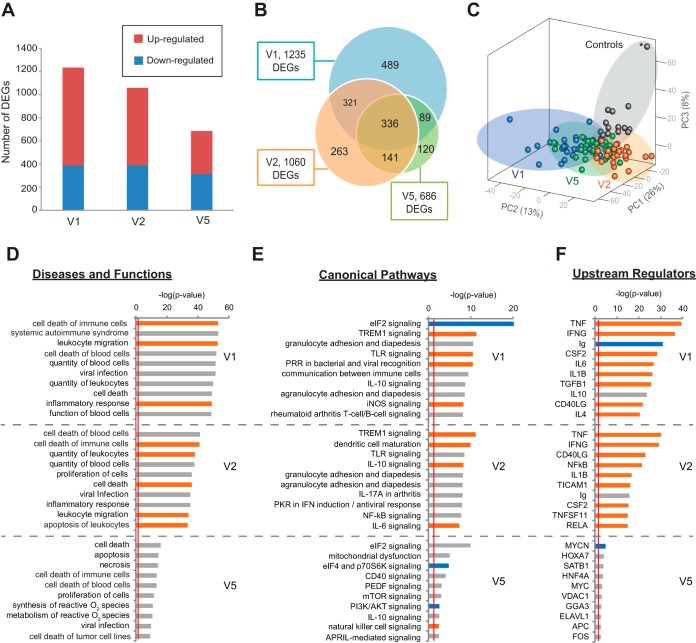
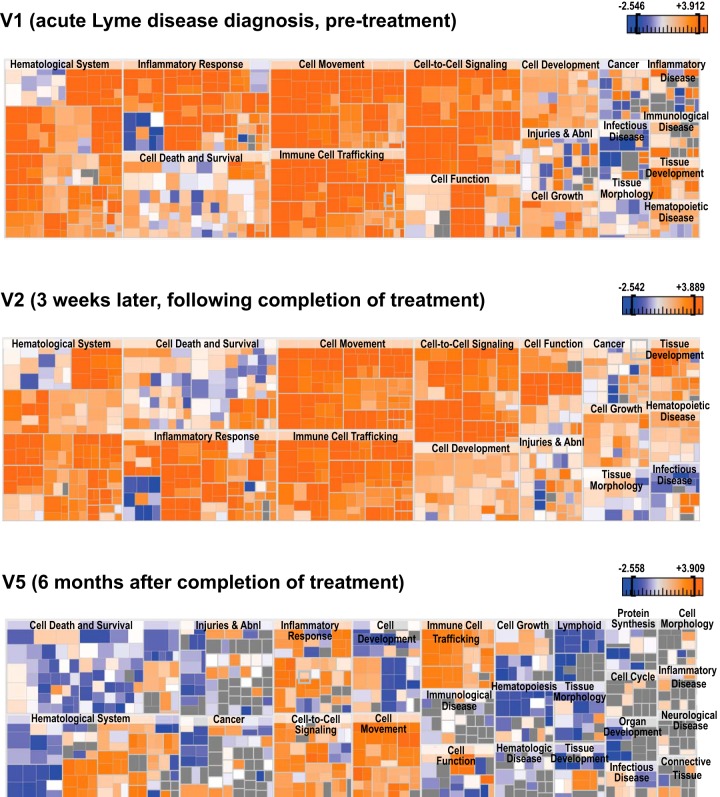
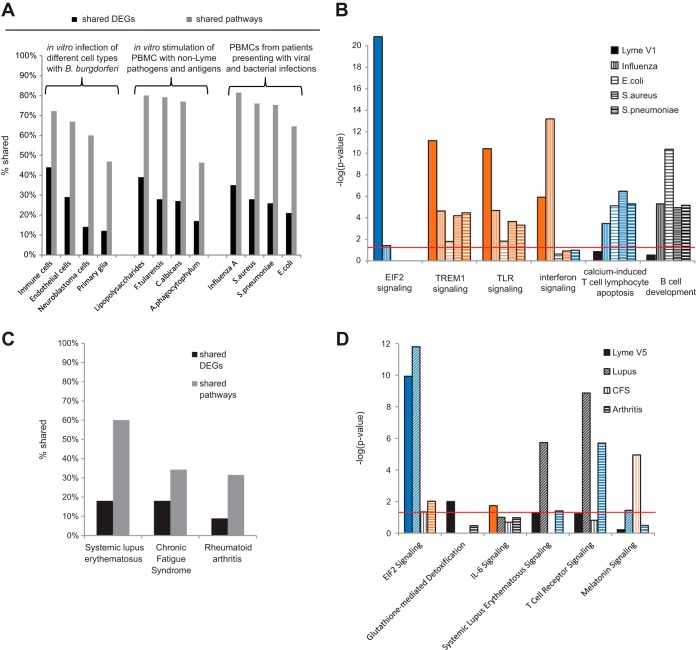
Lyme disease is a tick-borne illness caused by the bacterium Borrelia burgdorferi , and approximately 10 to 20% of patients report persistent symptoms lasting months to years despite appropriate treatment with antibiotics. To gain insights into the molecular basis of acute Lyme disease and the ensuing development of post-treatment symptoms, we conducted a longitudinal transcriptome study of 29 Lyme disease patients (and 13 matched controls) enrolled at the time of diagnosis and followed for up to 6 months. The differential gene expression signature of Lyme disease following the acute phase of infection persisted for at least 3 weeks and had fewer than 44% differentially expressed genes (DEGs) in common with other infectious or noninfectious syndromes. Early Lyme disease prior to antibiotic therapy was characterized by marked upregulation of Toll-like receptor signaling but lack of activation of the inflammatory T-cell apoptotic and B-cell developmental pathways seen in other acute infectious syndromes. Six months after completion of therapy, Lyme disease patients were found to have 31 to 60% of their pathways in common with three different immune-mediated chronic diseases. No differential gene expression signature was observed between Lyme disease patients with resolved illness to those with persistent symptoms at 6 months post-treatment. The identification of a sustained differential gene expression signature in Lyme disease suggests that a panel of selected human host-based biomarkers may address the need for sensitive clinical diagnostics during the “window period” of infection prior to the appearance of a detectable antibody response and may also inform the development of new therapeutic targets. IMPORTANCE Lyme disease is the most common tick-borne infection in the United States, and some patients report lingering symptoms lasting months to years despite antibiotic treatment. To better understand the role of the human host response in acute Lyme disease and the development of post-treatment symptoms, we conducted the first longitudinal gene expression (transcriptome) study of patients enrolled at the time of diagnosis and followed up for up to 6 months after treatment. Importantly, we found that the gene expression signature of early Lyme disease is distinct from that of other acute infectious diseases and persists for at least 3 weeks following infection. This study also uncovered multiple previously undescribed pathways and genes that may be useful in the future as human host biomarkers for diagnosis and that constitute potential targets for the development of new therapies.
Overview
The claims and statistics of this paper haven’t been checked yet.
Free: it reads the open-access text and checks the first 5 claims that cite a source we can check. Create a free account to check every claim.
Integrity signals
Registry
Cites
Statistics
Figures

Verification
Claims the paper makes
The claims and statistics of this paper haven’t been checked yet.
Free: it reads the open-access text and checks the first 5 claims that cite a source we can check. Create a free account to check every claim.
Claims other papers make about this one
Each is checked against this paper’s own text: does it say what the citing paper says it does?
The cited source says what the claim attributes to it.
In the citing paper
“Moreover, RNA-seq analyses of the human host can be used to identify novel or underappreciated host–microbial interactions directly from clinical samples, as previously shown for patients with Lyme disease68, dengue80 or malaria81.”
From Clinical metagenomics (2019) · cites this paper as [68]
In the citing paper
“Classification of genes by expression profiling using RNA-seq has been used to characterize several infections, including staphylococcal bacteraemia67, Lyme disease68, candidiasis69, tuberculosis (discriminating between latent and active disease risk)70–72 and influenza73–75.”
From Clinical metagenomics (2019) · cites this paper as [68]
Self-check
Percentages, sums and reported differences re-computed from the paper’s own numbers.
The self-check needs the paper’s full text.
Citations
Cites
limma powers differential expression analyses for RNA-sequencing and microarray studies
Ritchie, M. E., Phipson, B., Wu, D., Hu, Y., Law, C. W., Shi, W., & Smyth, G. K. (2015) · Nucleic Acids Research · doi:10.1093/nar/gkv007 · Cited by 40,458
Trapnell, C., Roberts, A., Goff, L., Pertea, G., Kim, D., Kelley, D. R., Pimentel, H., Salzberg, S. L., Rinn, J. L., & Pachter, L. (2012) · Nature Protocols · doi:10.1038/nprot.2012.016 · Cited by 12,116
Bolstad, B. M., Irizarry, R. A., Åstrand, M., & Speed, T. P. (2003) · Bioinformatics · doi:10.1093/bioinformatics/19.2.185 · Cited by 8,266
voom: precision weights unlock linear model analysis tools for RNA-seq read counts
Law, C. W., Chen, Y., Shi, W., & Smyth, G. K. (2014) · Genome Biology · doi:10.1186/gb-2014-15-2-r29 · Cited by 6,155
Causal analysis approaches in Ingenuity Pathway Analysis
Krämer, A., Green, J., Pollard, J., & Tugendreich, S. (2014) · Bioinformatics · doi:10.1093/bioinformatics/btt703 · Cited by 5,724 · cited 1×
“Avg age (yr) 52 (36–61) [20–71] 50 (42–61) [22–70] 0.”
Wormser, G. P., Dattwyler, R. J., Shapiro, E. D., Halperin, J. J., Steere, A. C., Klempner, M. S., Krause, P. J., Bakken, J. S., Strle, F., Stanek, G., et al. (2006) · Clinical Infectious Diseases · doi:10.1086/508667 · Cited by 2,087
Stanek, G., Wormser, G. P., Gray, J., & Strle, F. (2012) · The Lancet · doi:10.1016/s0140-6736(11)60103-7 · Cited by 1,237
Steere, A. C., Coburn, J., & Glickstein, L. (2004) · Journal of Clinical Investigation · doi:10.1172/jci200421681 · Cited by 788
(1995) · JAMA: The Journal of the American Medical Association · doi:10.1001/jama.1995.03530120023018 · Cited by 590
Gene expression patterns in blood leukocytes discriminate patients with acute infections
Ramilo, O., Allman, W., Chung, W., Mejias, A., Ardura, M., Glaser, C., Wittkowski, K. M., Piqueras, B., Banchereau, J., Palucka, A. K., et al. (2007) · Blood · doi:10.1182/blood-2006-02-002477 · Cited by 482
Research works printed but not linked: 1
- 10.1172/jci21681 · doi:10.1172/jci21681 · Paper page
Cited by
Chiu, C. Y., & Miller, S. A. (2019) · Nature Reviews Genetics · doi:10.1038/s41576-019-0113-7 · Cited by 1,620
Self-citationAlevin efficiently estimates accurate gene abundances from dscRNA-seq data
Srivastava, A., Malik, L., Smith, T., Sudbery, I., & Patro, R. (2019) · Genome Biology · doi:10.1186/s13059-019-1670-y · Cited by 273
Radolf, J. D., Strle, K., Lemieux, J. E., & Strle, F. (2020) · Current Issues in Molecular Biology · doi:10.21775/cimb.042.333 · Cited by 220
Recent Progress in Lyme Disease and Remaining Challenges
Bobe, J. R., Jutras, B. L., Horn, E. J., Embers, M. E., Bailey, A., Moritz, R. L., Zhang, Y., Soloski, M. J., Ostfeld, R. S., Marconi, R. T., et al. (2021) · Frontiers in Medicine · doi:10.3389/fmed.2021.666554 · Cited by 199
Self-citationNetwork Medicine in the Age of Biomedical Big Data
Sonawane, A. R., Weiss, S. T., Glass, K., & Sharma, A. (2019) · Frontiers in Genetics · doi:10.3389/fgene.2019.00294 · Cited by 186
Metadata
- Authors
- Bouquet, J., Soloski, M. J., Swei, A., Cheadle, C., Federman, S., Billaud, J.-N., Rebman, A. W., Kabre, B., Halpert, R., Boorgula, M., Aucott, J. N., & Chiu, C. Y.
- Affiliations
- Department of Laboratory Medicine, University of California, San Francisco, San Francisco, California, USA
- Johns Hopkins University (US)
- San Francisco State University (US)
- University of California, San Francisco (US)
- Qiagen Bioinformatics, Redwood City, California, USA
- Qiagen (United States) (US)
- Corresponding author
- Aucott, John N.
- Chiu, Charles Y.
- Venue
- mBio
- Publisher
- American Society for Microbiology
- Published
- 2016-03-02
- Volume
- 7
- Issue
- 1
- Pages
- e00100-16
- ISSN
- 2150-7511 (ISSN-L)
- 2161-2129
- PMC
- PMC4791844
- OpenAlex
- W2265193578
- Cited by
- 101
- References
- 56
- Citations by year
- 2026: 5 · 2025: 9 · 2024: 9 · 2023: 7 · 2022: 13 · 2021: 14 · 2020: 12 · 2019: 12 · 2018: 7 · 2017: 6 · 2016: 7
- FWCI
- 10.98
- Type
- journal article
- Language
- en
- Open access
- gold
- doi.org
- Licence
- cc-by
- creativecommons.org/licenses/by/4.0/ (vor)
- journals.asm.org/non-commercial-tdm-license (tdm)
- Locations
- mBio (publishedVersion, cc-by)
- Europe PMC (PubMed Central) (publishedVersion, cc-by)
- PubMed Central (publishedVersion, cc-by)
- PubMed (publishedVersion)
- DOAJ (DOAJ: Directory of Open Access Journals) (submittedVersion)
- DOAJ (DOAJ: Directory of Open Access Journals) (submittedVersion, cc-by-sa)
- eScholarship (California Digital Library) (submittedVersion)
- Funders
- Swartz Foundation
- Bay Area Lyme Foundation
- Stabler Foundation
- Lyme Research Alliance
- Lyme Disease Research Foundation, Inc.
- Office of Extramural Research, National Institutes of Health (HL105704, P30-AR05350)
- Abbott Laboratories
- Topics
- Life Sciences › Immunology and Microbiology › Parasitology › Vector-borne infectious diseases
- Health Sciences › Medicine › Infectious Diseases › Brucella: diagnosis, epidemiology, treatment
- Health Sciences › Medicine › Clinical Neurology › Long-Term Effects of COVID-19
- Keywords
- Lyme disease, Borrelia burgdorferi, post-treatment Lyme disease syndrome, differential gene expression, host immune response, Toll-like receptor signaling, persistent symptoms, host biomarkers, T cell apoptosis, B cell development, tick-borne diseases
- MeSH terms
- Adult, Animals, Female, Humans, Lyme Disease, Male, Middle Aged, United States, Biomarkers, Gene Expression Profiling, Borrelia burgdorferi, Metabolic Networks and Pathways, High-Throughput Nucleotide Sequencing, Transcriptome
About these checks
Registry, retraction, Cites and statistics results are computed, not judged, with one exception: a printed reference that no index lists is read once by a model before it counts as a citation error. Claims are extracted by a model and kept only when their quote appears verbatim in the text; each cited source is then checked, with a model’s help, for whether it says what the claim relies on. Those verdicts can be wrong — read the claim’s quote and the cited source before relying on one.
Statistics and arithmetic are recomputed, not judged.
Confidence bands are shown only for fields calibrated on our annotated test set. None is calibrated yet, so no band is shown.
What counts as a claim ›How we measure confidence ›How we check this ›
Are you an author, or do you see a problem with this page? Request a review
How to cite
Cite CoChat for the checks on this page, and the paper for its own findings.
- This page
- CoChat. (2026). Citation check: Longitudinal Transcriptome Analysis Reveals a Sustained Differential Gene Expression Signature in Patients Treated for Acute Lyme Disease. https://app.cochat.ai/papers/10.1128/mbio.00100-16
- The paper
- Bouquet, J., Soloski, M. J., Swei, A., Cheadle, C., Federman, S., Billaud, J.-N., Rebman, A. W., Kabre, B., Halpert, R., Boorgula, M., Aucott, J. N., & Chiu, C. Y. (2016). Longitudinal Transcriptome Analysis Reveals a Sustained Differential Gene Expression Signature in Patients Treated for Acute Lyme Disease. mBio. https://doi.org/10.1128/mbio.00100-16
Data sources
Bibliographic data: Semantic Scholar, OpenAlex, Crossref.
Contains information from the Semantic Scholar Academic Graph Datasets, made available under the ODC Attribution License (ODC-BY 1.0).
Semantic Scholar’s data is described in: Kinney, R., et al. (2023). The Semantic Scholar Open Data Platform. arXiv:2301.10140.
