

Epidermal Growth Factor Receptor-PI3K Signaling Controls Cofilin Activity To Facilitate Herpes Simplex Virus 1 Entry into Neuronal Cells
Open accessThe DOI matches its Crossref record; 75 of the 75 references it cites were found in a registry or an index.
Abstract
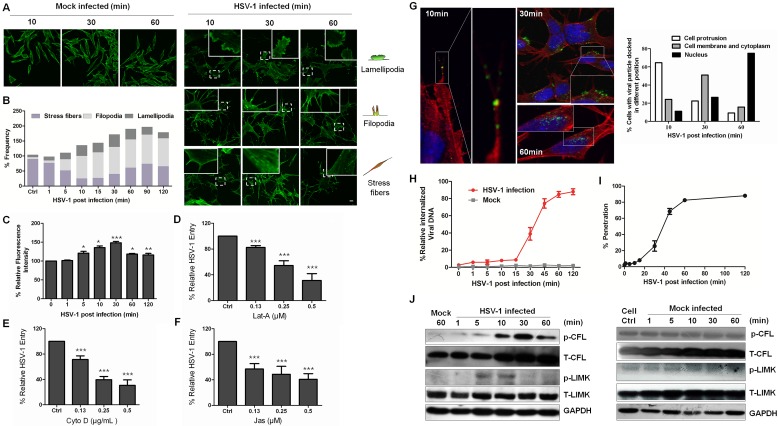
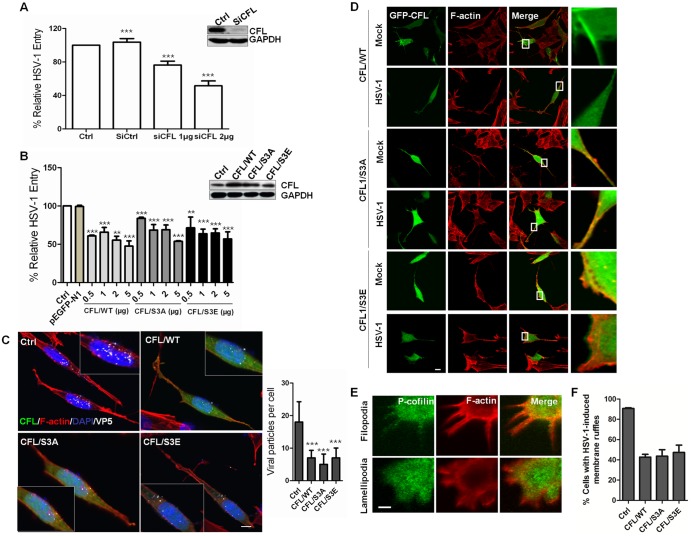
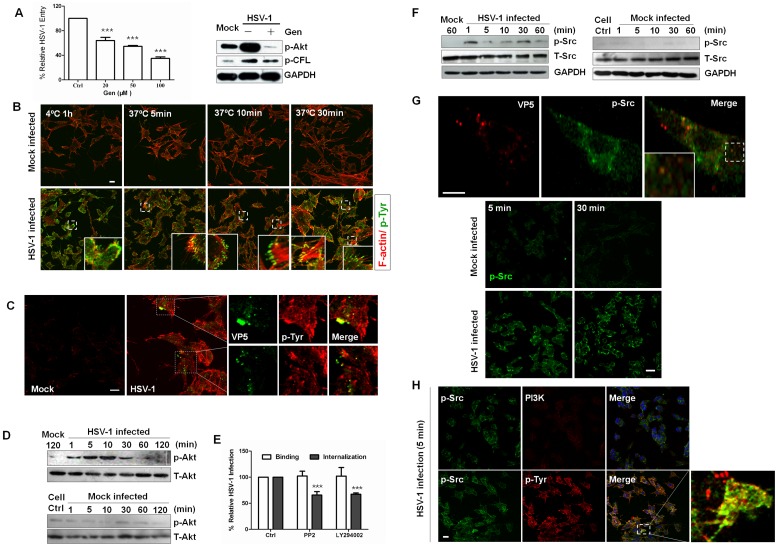
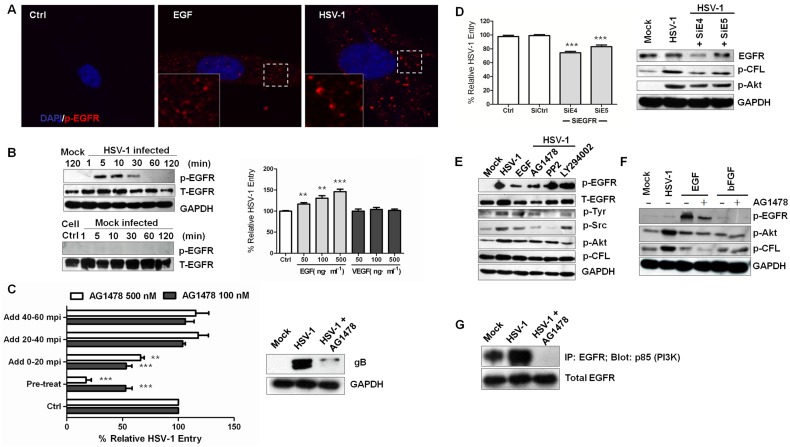
Herpes simplex virus type 1 (HSV-1) establishes latency in neurons and can cause severe disseminated infection with neurological impairment and high mortality. This neurodegeneration is thought to be tightly associated with virus-induced cytoskeleton disruption. Currently, the regulation pattern of the actin cytoskeleton and the involved molecular mechanisms during HSV-1 entry into neurons remain unclear. Here, we demonstrate that the entry of HSV-1 into neuronal cells induces biphasic remodeling of the actin cytoskeleton and an initial inactivation followed by the subsequent activation of cofilin, a member of the actin depolymerizing factor family that is critical for actin reorganization. The disruption of F-actin dynamics or the modulation of cofilin activity by mutation, knockdown, or overexpression affects HSV-1 entry efficacy and virus-mediated cell ruffle formation. Binding of the HSV-1 envelope initiates the epidermal growth factor receptor (EGFR)-phosphatidylinositide 3-kinase (PI3K) signaling pathway, which leads to virus-induced early cofilin phosphorylation and F-actin polymerization. Moreover, the extracellular signal-regulated kinase (ERK) kinase and Rho-associated, coiled-coil-containing protein kinase 1 (ROCK) are recruited as downstream mediators of the HSV-1-induced cofilin inactivation pathway. Inhibitors specific for those kinases significantly reduce the virus infectivity without affecting virus binding to the target cells. Additionally, lipid rafts are clustered to promote EGFR-associated signaling cascade transduction. We propose that HSV-1 hijacks cofilin to initiate infection. These results could promote a better understanding of the pathogenesis of HSV-1-induced neurological diseases. IMPORTANCE The actin cytoskeleton is involved in many crucial cellular processes and acts as an obstacle to pathogen entry into host cells. Because HSV-1 establishes lifelong latency in neurons and because neuronal cytoskeletal disruption is thought to be the main cause of HSV-1-induced neurodegeneration, understanding the F-actin remodeling pattern by HSV-1 infection and the molecular interactions that facilitate HSV-1 entry into neurons is important. In this study, we showed that HSV-1 infection induces the rearrangement of the cytoskeleton as well as the initial inactivation and subsequent activation of cofilin. Then, we determined that activation of the EGFR-PI3K-Erk1/2 signaling pathway inactivates cofilin and promotes F-actin polymerization. We postulate that by regulating actin cytoskeleton dynamics, cofilin biphasic activation could represent the specific cellular machinery usurped by pathogen infection, and these results will greatly contribute to the understanding of HSV-1-induced early and complex changes in host cells that are closely linked to HSV-1 pathogenesis.
Overview
The claims and statistics of this paper haven’t been checked yet.
Free: it reads the open-access text and checks the first 5 claims that cite a source we can check. Create a free account to check every claim.
Integrity signals
Registry
Cites
Statistics
Figures
Verification
Claims the paper makes
The claims and statistics of this paper haven’t been checked yet.
Free: it reads the open-access text and checks the first 5 claims that cite a source we can check. Create a free account to check every claim.
Self-check
Percentages, sums and reported differences re-computed from the paper’s own numbers.
The self-check needs the paper’s full text.
Citations
Cites
RHO GTPASES in neuronal morphogenesis
Luo, L. (2000) · Nature Reviews Neuroscience · doi:10.1038/35044547 · Cited by 986
HSV-1 ICP34.5 Confers Neurovirulence by Targeting the Beclin 1 Autophagy Protein
Orvedahl, A., Alexander, D., Tallóczy, Z., Sun, Q., Wei, Y., Zhang, W., Burns, D., Leib, D. A., & Levine, B. (2007) · Cell Host & Microbe · doi:10.1016/j.chom.2006.12.001 · Cited by 857 · cited 1×
“, Alzheimer’s disease), making them a proper candidate for elucidating the response of neuronal cells to HSV-1 infection and the molecular interaction promoting HSV-1 entry (7, 25).”
BackgroundMultiple neurotransmitter synthesis by human neuroblastoma cell lines and clones.
Biedler, J. L., Roffler-Tarlov, S. K., Schachner, M., & Freedman, L. S. (1978) · PubMed · Cited by 759
Lupberger, J., Zeisel, M. B., Xiao, F., Thumann, C., Fofana, I., Zona, L., Davis, C., Mee, C. J., Turek, M., Gorke, S., et al. (2011) · Nature Medicine · doi:10.1038/nm.2341 · Cited by 706
ADF/Cofilin: a functional node in cell biology
Bernstein, B. W., & Bamburg, J. R. (2010) · Trends in Cell Biology · doi:10.1016/j.tcb.2010.01.001 · Cited by 704 · cited 1×
“Actin-filament dynamics in cells are known to be modulated by cofilin, and the most important physiological function of cofilin is to sever and depolymerize actin filaments, thereby promoting actin dynamics (31).”
BackgroundHerpesviruses and heparan sulfate: an intimate relationship in aid of viral entry
Shukla, D., & Spear, P. G. (2001) · Journal of Clinical Investigation · doi:10.1172/jci13799 · Cited by 567 · cited 1×
“, herpes simplex encephalitis [HSE]) (6).”
Coyne, C. B., & Bergelson, J. M. (2006) · Cell · doi:10.1016/j.cell.2005.10.035 · Cited by 547 · cited 3×
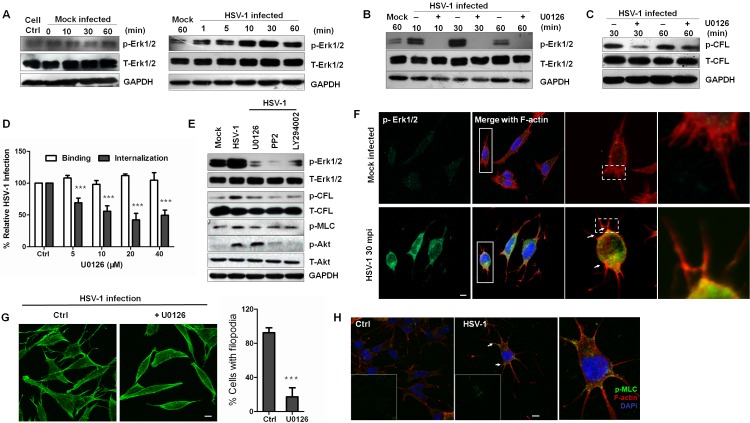
“In addition, Src-family kinases, which are involved in regulating changes in the cytoskeleton during the uptake of various invasive pathogens (12, 41, 42), and PI3K were activated early (Fig.”
BackgroundInfluenza virus propagation is impaired by inhibition of the Raf/MEK/ERK signalling cascade
Pleschka, S., Wolff, T., Ehrhardt, C., Hobom, G., Planz, O., Rapp, U. R., & Ludwig, S. (2001) · Nature Cell Biology · doi:10.1038/35060098 · Cited by 526
Herpesviruses and heparan sulfate: an intimate relationship in aid of viral entry
Shukla, D., & Spear, P. G. (2001) · Journal of Clinical Investigation · doi:10.1172/jci200113799 · Cited by 454
Localization of Epidermal Growth Factor-stimulated Ras/Raf-1 Interaction to Caveolae Membrane
Mineo, C., James, G. L., Smart, E. J., & Anderson, R. G. W. (1996) · Journal of Biological Chemistry · doi:10.1074/jbc.271.20.11930 · Cited by 447 · cited 1×
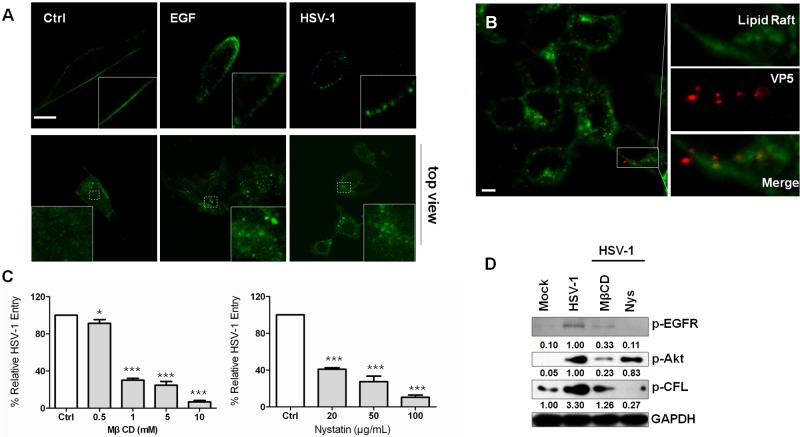
“Because EGFR is localized in lipid raft domains (47) and because lipid rafts may function to concentrate the receptors required for binding or inducing signal transduction upon the binding of the viral protein (48–51), we examined whether lipid rafts regulate HSV-1 entry.”
Background
Cited by
Items 101–133 of 133
Bai, G., Huang, X., & He, Y. (2026) · European Journal of Medicinal Chemistry · doi:10.1016/j.ejmech.2026.119092 · Cited by 1
Microtubule depolymerization limits porcine betacoronavirus PHEV replication
Zhou, Q., Lan, Y., Tang, Y., Guan, J., Zhao, K., Gao, F., He, W., & Li, Z. (2022) · Veterinary Microbiology · doi:10.1016/j.vetmic.2022.109448 · Cited by 1
Role of Lysosomes in HSV-Induced Pathogenesis
Ding, J., & Ding, L. (2023) · Future Microbiology · doi:10.2217/fmb-2023-0090 · Cited by 1
Fernandez, D. J., Cheng, S., Prins, R., Hamm‐Alvarez, S. F., & Kast, W. M. (2025) · Viruses · doi:10.3390/v17040542 · Cited by 1
Overlapped Pathways of Autism Genes and Cancer Genes are Targeted by Viruses
Christensen-Hutton, J. (2021) · Vaccines & Vaccination Open Access · doi:10.23880/vvoa-16000148
Microreview Lipid interactions during virus entry and infection
Mazzon, M., & Mercer, J. (2014)
Enhanced Functional Pathway Annotations for Differentially Expressed Gene Clusters
Liu, C.-C., Shih, T.-C., Pai, T., Hu, C., & Wang, L.-J. (2020) · Lecture notes in computer science · doi:10.1007/978-3-030-57821-3_34
Liu, C.-C., Shih, T.-C., Pai, T., Hu, C., & Tzou, W. (2021) · Journal of Computational Biology · doi:10.1089/cmb.2020.0556
“This virus establishes a quiescent or latent infection in peripheral neurons, actually causing severe infection with neurological impairment and high mortality (Harkness et al., 2014; Zheng et al., 2014).”
Wu, Z., Zeng, Y., Cheng, A., Sun, A., Wang, M., Chen, S., Liu, M., Zhu, D., Zhao, X., Wu, Y., et al. (2022) · Figshare · doi:10.6084/m9.figshare.20317773
Wu, Z., Zeng, Y., Cheng, A., Sun, A., Wang, M., Chen, S., Liu, M., Zhu, D., Zhao, X., Wu, Y., et al. (2022) · Figshare · doi:10.6084/m9.figshare.20317785
Wu, Z., Zeng, Y., Cheng, A., Sun, A., Wang, M., Chen, S., Liu, M., Zhu, D., Zhao, X., Wu, Y., et al. (2022) · Figshare · doi:10.6084/m9.figshare.20317779
Wu, Z., Zeng, Y., Cheng, A., Sun, A., Wang, M., Chen, S., Liu, M., Zhu, D., Zhao, X., Wu, Y., et al. (2022) · Figshare · doi:10.6084/m9.figshare.20317824
Wu, Z., Zeng, Y., Cheng, A., Sun, A., Wang, M., Chen, S., Liu, M., Zhu, D., Zhao, X., Wu, Y., et al. (2022) · Figshare · doi:10.6084/m9.figshare.20317803
Wu, Z., Zeng, Y., Cheng, A., Sun, A., Wang, M., Chen, S., Liu, M., Zhu, D., Zhao, X., Wu, Y., et al. (2022) · Figshare · doi:10.6084/m9.figshare.20317815
Wu, Z., Zeng, Y., Cheng, A., Sun, A., Wang, M., Chen, S., Liu, M., Zhu, D., Zhao, X., Wu, Y., et al. (2022) · Figshare · doi:10.6084/m9.figshare.20317776
Wu, Z., Zeng, Y., Cheng, A., Sun, A., Wang, M., Chen, S., Liu, M., Zhu, D., Zhao, X., Wu, Y., et al. (2022) · Figshare · doi:10.6084/m9.figshare.20317812
Wu, Z., Zeng, Y., Cheng, A., Sun, A., Wang, M., Chen, S., Liu, M., Zhu, D., Zhao, X., Wu, Y., et al. (2022) · Figshare · doi:10.6084/m9.figshare.20317806
Wu, Z., Zeng, Y., Cheng, A., Sun, A., Wang, M., Chen, S., Liu, M., Zhu, D., Zhao, X., Wu, Y., et al. (2022) · Figshare · doi:10.6084/m9.figshare.20317788
Wu, Z., Zeng, Y., Cheng, A., Sun, A., Wang, M., Chen, S., Liu, M., Zhu, D., Zhao, X., Wu, Y., et al. (2022) · Figshare · doi:10.6084/m9.figshare.20317818
Wu, Z., Zeng, Y., Cheng, A., Sun, A., Wang, M., Chen, S., Liu, M., Zhu, D., Zhao, X., Wu, Y., et al. (2022) · Figshare · doi:10.6084/m9.figshare.20317809
Wu, Z., Zeng, Y., Cheng, A., Sun, A., Wang, M., Chen, S., Liu, M., Zhu, D., Zhao, X., Wu, Y., et al. (2022) · Figshare · doi:10.6084/m9.figshare.20317821
Wu, Z., Zeng, Y., Cheng, A., Sun, A., Wang, M., Chen, S., Liu, M., Zhu, D., Zhao, X., Wu, Y., et al. (2022) · Figshare · doi:10.6084/m9.figshare.20317830
Wu, Z., Zeng, Y., Cheng, A., Sun, A., Wang, M., Chen, S., Liu, M., Zhu, D., Zhao, X., Wu, Y., et al. (2022) · Figshare · doi:10.6084/m9.figshare.20317782
Wu, Z., Zeng, Y., Cheng, A., Sun, A., Wang, M., Chen, S., Liu, M., Zhu, D., Zhao, X., Wu, Y., et al. (2022) · Figshare · doi:10.6084/m9.figshare.20317800
Wu, Z., Zeng, Y., Cheng, A., Sun, A., Wang, M., Chen, S., Liu, M., Zhu, D., Zhao, X., Wu, Y., et al. (2022) · Figshare · doi:10.6084/m9.figshare.20317791
Deng, L., Min, W., Guo, S., Deng, J., Wu, X., Tong, D., Yuan, A., & Yang, Q. (2024) · Figshare · doi:10.6084/m9.figshare.25052219
Wu, Z., Zeng, Y., Cheng, A., Sun, A., Wang, M., Chen, S., Mafeng, L., Zhu, D., Zhao, X., Wu, Y., et al. (2022) · Figshare · doi:10.6084/m9.figshare.20317794
Deng, L., Min, W., Guo, S., Deng, J., Wu, X., Tong, D., Yuan, A., & Yang, Q. (2024) · Figshare · doi:10.6084/m9.figshare.25052510
Deng, L., Min, W., Guo, S., Deng, J., Wu, X., Tong, D., Yuan, A., & Yang, Q. (2024) · Figshare · doi:10.6084/m9.figshare.26671788
Dines, M. C., Talukdar, P. K., Hicks, S. D., McKnight, C. A., Gloss, L. M., Shelden, E. A., & Konkel, M. E. (2026) · Frontiers in Microbiology · doi:10.3389/fmicb.2026.1854036
Cantos, R. S. R., Quiming, P. J. T., & Marcelino, J. K. S. (2026) · International Conference on Bioinformatics and Computational Biology (ICBCB) · doi:10.1109/icbcb69424.2026.11621527
“EGFR controls cell proliferation and survival and is exploited by viruses to enhance replication and disrupt host functions [20].”
No evidence of productive replication of two insect rhabdoviruses in mammalian cell lines
Touguchi, T., Nakahara, J., Tsukui, T., Katsuma, S., & Iwanaga, M. (2026) · Journal of Invertebrate Pathology · doi:10.1016/j.jip.2026.108762
Metadata
- Authors
- Zheng, K., Xiang, Y., Wang, X., Wang, Q., Zhong, M., Wang, S., Wang, X., Fan, J., Kitazato, K., & Wang, Y.
- Affiliations
- Jinan University (CN)
- Sun Yat-sen University (CN)
- Guangzhou Jinan Biomedicine Research and Development Center, National Engineering Research Center of Genetic Medicine, Jinan University, Guangzhou, People’s Republic of China
- University of Yamanashi (JP)
- Nagasaki University (JP)
- Venue
- mBio
- Publisher
- American Society for Microbiology
- Published
- 2014-02-28
- Volume
- 5
- Issue
- 1
- Pages
- e00958-13
- ISSN
- 2150-7511 (ISSN-L)
- 2161-2129
- PMC
- PMC3903278
- OpenAlex
- W2170752267
- Cited by
- 118
- References
- 75
- Citations by year
- 2026: 5 · 2025: 5 · 2024: 9 · 2023: 14 · 2022: 18 · 2021: 9 · 2020: 13 · 2019: 5 · 2018: 13 · 2017: 4 · 2016: 5 · 2015: 8 · 2014: 10
- FWCI
- 6.82
- Type
- journal article
- Language
- en
- Open access
- gold
- doi.org
- Licence
- cc-by-nc-sa
- creativecommons.org/licenses/by-nc-sa/3.0/ (vor)
- journals.asm.org/non-commercial-tdm-license (tdm)
- Locations
- mBio (publishedVersion, cc-by-nc-sa)
- Europe PMC (PubMed Central) (publishedVersion, cc-by-nc-sa)
- PubMed Central (publishedVersion, cc-by-nc-sa)
- PubMed (publishedVersion)
- Institutional Repositories DataBase (IRDB) (submittedVersion)
- DOAJ (DOAJ: Directory of Open Access Journals) (submittedVersion, cc-by-sa)
- Nagasaki University's Academic Output SITE (Nagasaki University) (submittedVersion, cc-by-nc-nd)
- Funders
- National Science Foundation
- National Natural Science Foundation of China
- Topics
- Health Sciences › Medicine › Infectious Diseases › Herpesvirus Infections and Treatments
- Life Sciences › Biochemistry, Genetics and Molecular Biology › Molecular Biology › Protein Kinase Regulation and GTPase Signaling
- Health Sciences › Medicine › Epidemiology › Cytomegalovirus and herpesvirus research
- Keywords
- herpes simplex virus type 1, cofilin, actin cytoskeleton remodeling, ERK1/2, ROCK1, F-actin polymerization, lipid rafts, neurodegeneration, viral latency, host-virus interaction, kinase inhibitors, antiviral therapy
- MeSH terms
- Actins, Cell Line, Humans, Neurons, Phosphorylation, Protein Processing, Post-Translational, Signal Transduction, Herpesvirus 1, Human, Phosphatidylinositol 3-Kinases, Actin Depolymerizing Factors, Virus Internalization, Host-Pathogen Interactions, ErbB Receptors
About these checks
Registry, retraction, Cites and statistics results are computed, not judged, with one exception: a printed reference that no index lists is read once by a model before it counts as a citation error. Claims are extracted by a model and kept only when their quote appears verbatim in the text; each cited source is then checked, with a model’s help, for whether it says what the claim relies on. Those verdicts can be wrong — read the claim’s quote and the cited source before relying on one.
Statistics and arithmetic are recomputed, not judged.
Confidence bands are shown only for fields calibrated on our annotated test set. None is calibrated yet, so no band is shown.
What counts as a claim ›How we measure confidence ›How we check this ›
Are you an author, or do you see a problem with this page? Request a review
Data sources
Bibliographic data: Semantic Scholar, OpenAlex, Crossref.
Contains information from the Semantic Scholar Academic Graph Datasets, made available under the ODC Attribution License (ODC-BY 1.0).
Semantic Scholar’s data is described in: Kinney, R., et al. (2023). The Semantic Scholar Open Data Platform. arXiv:2301.10140.
