

The DOI matches its Crossref record.
ATP-Dependent C–F Bond Cleavage Allows the Complete Degradation of 4-Fluoroaromatics without Oxygen
Abstract
Complete biodegradation of the abundant and persistent fluoroaromatics requires enzymatic cleavage of an arylic C–F bond, probably the most stable single bond of a biodegradable organic molecule. While in aerobic microorganisms defluorination of fluoroaromatics is initiated by oxygenases, arylic C–F bond cleavage has never been observed in the absence of oxygen. Here, an oxygen-independent enzymatic aryl fluoride bond cleavage is described during the complete degradation of 4-fluorobenzoate or 4-fluorotoluene to CO 2 and HF in the denitrifying Thauera aromatica : the ATP-dependent defluorination of 4-fluorobenzoyl-coenzyme A (4-F-BzCoA) to benzoyl-coenzyme A (BzCoA) and HF, catalyzed by class I BzCoA reductase (BCR). Adaptation to growth with the fluoroaromatics was accomplished by the downregulation of a promiscuous benzoate-CoA ligase and the concomitant upregulation of 4-F-BzCoA-defluorinating/dearomatizing BCR on the transcriptional level. We propose an unprecedented mechanism for reductive arylic C–F bond cleavage via a Birch reduction-like mechanism resulting in a formal nucleophilic aromatic substitution. In the proposed anionic 4-fluorodienoyl-CoA transition state, fluoride elimination to BzCoA is favored over protonation to a fluorinated cyclic dienoyl-CoA. IMPORTANCE Organofluorides are produced as pesticides, pharmaceuticals, and other chemicals and comprise approximately one quarter of all organic compounds in the pharmaceutical and agricultural sectors; they are considered a growing class of environmentally relevant persistent pollutants. Especially in the case of fluoroaromatics, biodegradation is hampered by the extreme stability of the arylic C–F bond. In aerobic microorganisms, degradation proceeds via oxygenase-dependent C–F bond cleavage reactions, whereas the enzymes involved in the degradation of fluoroaromatics at anoxic sites are unknown. Here we report a strategy for the complete biodegradation of a fluoroaromatic to CO 2 and HF in a denitrifying bacterium via activation to a CoA ester, followed by oxygen-independent arylic C–F bond cleavage catalyzed by an ATP-dependent enzyme. This reaction, in conjunction with a transcriptional adaptation to fluorinated growth substrates, is essential for the anoxic biodegradation of 4-fluorobenzoate/4-F-toluene and probably other fluoroaromatics.
Overview
The claims and statistics of this paper haven’t been checked yet.
Run the check — free, no account needed. It reads the open-access text and checks the sources it cites.
Integrity signals
Registry
Cites
Statistics
Figures
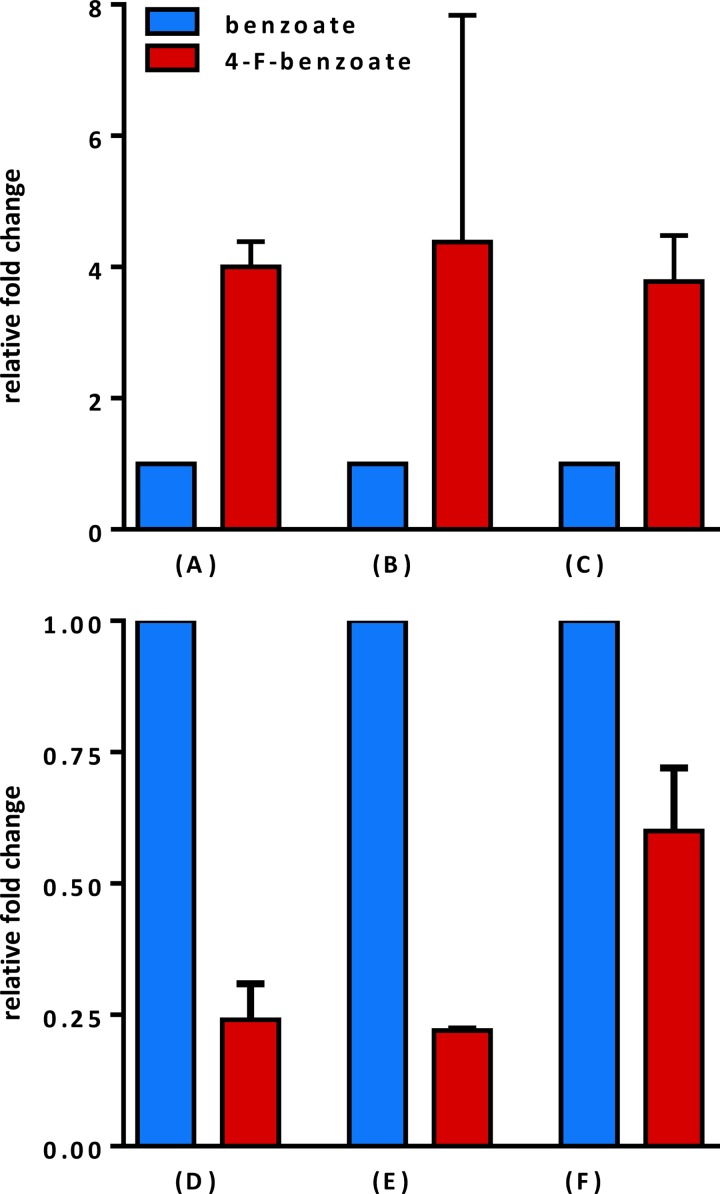
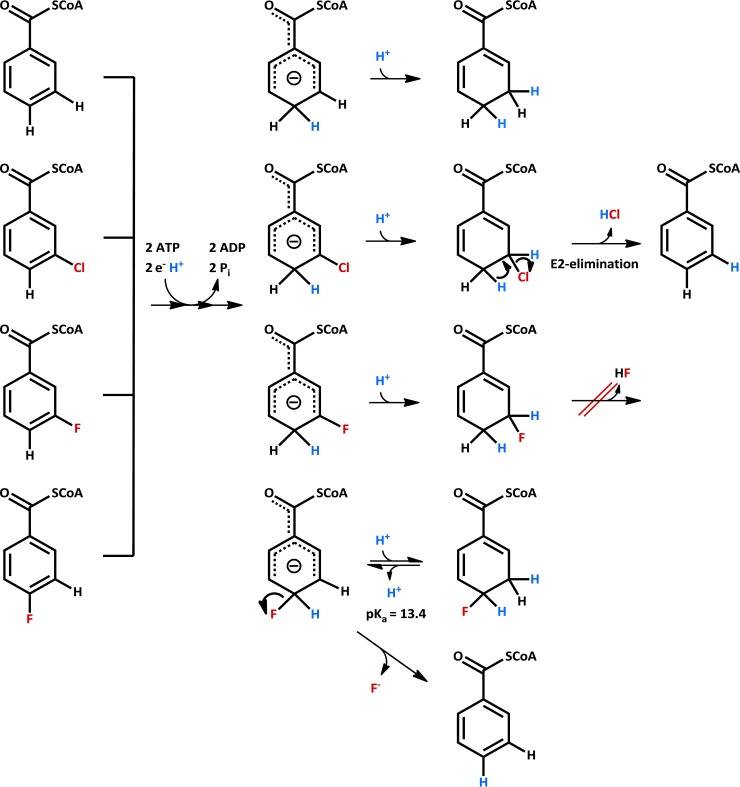
Verification
Claims the paper makes
The claims and statistics of this paper haven’t been checked yet.
Run the check — free, no account needed. It reads the open-access text and checks the sources it cites.
Claims other papers make about this one
Each is checked against this paper’s own text: does it say what the citing paper says it does?
The cited source doesn’t support the claim as written.
In the citing paper
“Biodegradation of fluorinated compounds, as observed to date, occurs on scales of weeks and months, the range of chemicals degraded is limited, and there are few enzymes yet identified that represent the different chemical mechanisms of defluorination (Bondar et al., 1998; Hasan et al., 2011; Tiedt et al., 2016; Huang and Jaffé, 2019; Yu et al., 2020).”
From Nothing lasts forever: understanding microbial biodegradation of polyfluorinated compounds and perfluorinated alkyl substances (2022) · cites this paper as Tiedt et al., 2016
Checked by a reasoning model — may be wrong.
Experimental — accuracy not yet measuredThe source backs part of the claim, not all of it — or backs it for a different population, condition or comparison.
In the citing paper
“Biodegradation of fluorinated compounds, as observed to date, occurs on scales of weeks and months, the range of chemicals degraded is limited, and there are few enzymes yet identified that represent the different chemical mechanisms of defluorination (Bondar et al., 1998; Hasan et al., 2011; Tiedt et al., 2016; Huang and Jaffé, 2019; Yu et al., 2020).”
From Nothing lasts forever: understanding microbial biodegradation of polyfluorinated compounds and perfluorinated alkyl substances (2022) · cites this paper as Tiedt et al., 2016
Experimental — accuracy not yet measuredIn the citing paper
“Biodegradation of fluorinated compounds, as observed to date, occurs on scales of weeks and months, the range of chemicals degraded is limited, and there are few enzymes yet identified that represent the different chemical mechanisms of defluorination (Bondar et al., 1998; Hasan et al., 2011; Tiedt et al., 2016; Huang and Jaffé, 2019; Yu et al., 2020).”
From Nothing lasts forever: understanding microbial biodegradation of polyfluorinated compounds and perfluorinated alkyl substances (2022) · cites this paper as Tiedt et al., 2016
In the citing paper
“Thauera aromatica has been shown to catalyze an ATP‐dependent reaction in which 4‐fluorobenzoyl‐CoA is overall reductively defluorinated to benzoyl‐CoA and HF.”
From Nothing lasts forever: understanding microbial biodegradation of polyfluorinated compounds and perfluorinated alkyl substances (2022) · cites this paper as Tiedt et al., 2016
In the citing paper
“Indeed, there is precedence for ATP‐dependent reductive defluorination”
From Nothing lasts forever: understanding microbial biodegradation of polyfluorinated compounds and perfluorinated alkyl substances (2022) · cites this paper as Tiedt et al., 2016
In the citing paper
“suggests that C–F bond reduction will require ATP, in contrast to C–Cl bond reduction that can generate ATP”
From Nothing lasts forever: understanding microbial biodegradation of polyfluorinated compounds and perfluorinated alkyl substances (2022) · cites this paper as Tiedt et al., 2016
In the citing paper
“The reaction is catalyzed by an enzyme homologous to known benzoyl‐CoA reductases”
From Nothing lasts forever: understanding microbial biodegradation of polyfluorinated compounds and perfluorinated alkyl substances (2022) · cites this paper as Tiedt et al., 2016
Self-check
Percentages, sums and reported differences re-computed from the paper’s own numbers.
The self-check needs the paper’s full text.
Citations
Cites
No references could be resolved yet.
Research works printed but not linked: 43
- 10.1016/B978-0-12-394291-3.00003-4 · DOI · Paper page
- 10.1016/S0045-6535(03)00207-8 · DOI
- 10.3762/bjoc.6.38 · DOI
- 10.1007/s00253-009-2127-0 · DOI
- Weinstein LH, Davison AW. 2004. The history of fluorine and sources of fluorides in the environment, p 1–20. In Fluorides in the environment: effects on plants and animals. CABI Publishing, Cambridge, MA. · DOI
- 10.1039/b610213c · DOI
- 10.1021/ar020230d · DOI
- 10.1007/s00253-015-6817-5 · DOI · Paper page
- 10.1111/j.1574-6976.1998.tb00377.x · DOI · Paper page
- 10.1098/rstb.2012.0322 · DOI · Paper page
- 10.3389/fmicb.2016.00249 · DOI
- 10.1021/acs.est.5b00303 · DOI
- 10.1111/j.1574-6968.1994.tb06703.x · DOI
- 10.1099/00207713-45-2-327 · DOI
- 10.1128/jb.161.1.321-325.1985 · DOI
- 10.1128/AEM.66.8.3446-3453.2000 · DOI
- 10.1099/00207713-51-2-589 · DOI
- 10.1007/BF00411295 · DOI
- 10.1007/s002530050032 · DOI
- 10.1128/jb.173.17.5494-5501.1991 · DOI
- 10.1128/JB.186.7.2156-2163.2004 · DOI
- 10.1111/j.1365-2958.2005.04909.x · DOI · Paper page
- 10.1111/j.1432-1033.1995.921_a.x · DOI
- 10.1021/bi0113770 · DOI
- 10.1128/AEM.67.3.1396-1399.2001 · DOI
- 10.1111/j.1365-2958.2011.07856.x · DOI
- 10.1111/1462-2920.12328 · DOI
- 10.1002/cbic.201402270 · DOI
- 10.1038/nrmicro2652 · DOI
- 10.1074/jbc.M001833200 · DOI
- 10.1111/1462-2920.13133 · DOI
- 10.1021/ja805091w · DOI
- 10.1039/c1cp20505f · DOI
- 10.1128/JB.181.7.2102-2109.1999 · DOI
- 10.1074/jbc.M412259200 · DOI
- 10.1016/S0021-9258(19)52362-6 · DOI
- 10.1074/jbc.M802841200 · DOI
- 10.1016/S0003-2697(02)00506-7 · DOI
- 10.1128/JB.185.16.4920-4929.2003 · DOI
- 10.1093/bioinformatics/btm091 · DOI
- 10.1186/gb-2002-3-7-research0034 · DOI · Paper page
- 10.1093/nar/29.9.e45 · DOI · Paper page
- 10.1038/nprot.2006.468 · DOI
Cited by
Sorted by citations
Wackett, L. P. (2022) · Microbial Biotechnology · doi:10.1111/1751-7915.13928 · Cited by 165
Stockbridge, R. B., & Wackett, L. P. (2024) · Nature Communications · doi:10.1038/s41467-024-49018-1 · Cited by 80
Yu, Y., Xu, F., Zhao, W., Thoma, C., Che, S., Richman, J. E., Jin, B., Zhu, Y., Xing, Y., Wackett, L., et al. (2024) · Science Advances · doi:10.1126/sciadv.ado2957 · Cited by 63
Metadata
- Authors
- Tiedt, O., Mergelsberg, M., Boll, K., Müller, M., Adrian, L., Jehmlich, N., von Bergen, M., & Boll, M.
- Affiliations
- Faculty of Biology, Microbiology, Albert-Ludwigs-Universität Freiburg, Freiburg, Germany
- Institute of Pharmaceutical Sciences, Albert-Ludwigs-Universität Freiburg, Freiburg, Germany
- Department of Isotope Biogeochemistry Proteomics, Helmholtz Centre for Environmental Research, UFZ, Leipzig, Germany
- Department of Molecular Systems Biology, Helmholtz Centre for Environmental Research, UFZ, Leipzig, Germany
- Venue
- mBio
- Publisher
- American Society for Microbiology
- Published
- 2016-09-07
- Volume
- 7
- Issue
- 4
- ISSN
- 2161-2129
- 2150-7511
- PMC
- PMC4992971
- Cited by
- 50
- References
- 0
- Language
- en
- Funders
- German Research Foundation (BO1565/11-2)
About these checks
Registry, retraction, Cites and statistics results are computed, not judged, with one exception: a printed reference that no index lists is read once by a model before it counts as a citation error. Claims are extracted by a model and kept only when their quote appears verbatim in the text; each cited source is then checked, with a model’s help, for whether it says what the claim relies on. Those verdicts can be wrong — read the claim’s quote and the cited source before relying on one.
Statistics and arithmetic are recomputed, not judged.
Confidence bands are shown only for fields calibrated on our annotated test set. None is calibrated yet, so no band is shown.
What counts as a claim ›How we measure confidence ›How we check this ›
Are you an author, or do you see a problem with this page? Request a review
