

The DOI matches its Crossref record; 47 of the 47 references it cites were found in a registry or an index.
Tongue microbiota and oral health status in community-dwelling elderly adults.
Open accessAbstract
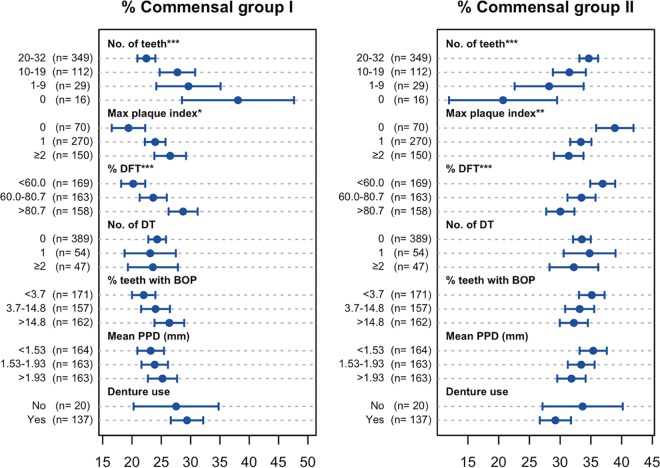
Aspiration of oral contents can lead to pneumonia, which is a major cause of death among elderly adults susceptible to swallowing impairments. Tongue microbiota are a dominant source of oral microbial populations that are ingested with saliva. This large-scale population-based study revealed variations in the tongue microbiota among community-dwelling elderly adults. The total bacterial density was independent of the conditions of teeth surrounding the tongue, whereas the microbiota composition, especially the relative abundances of predominant commensals, showed an association with tooth conditions. Our results demonstrate that the elderly with fewer teeth, poorer dental hygiene, and more dental caries experience constantly ingest more dysbiotic microbiota, which could be harmful for their respiratory health.
Overview
The claims and statistics of this paper haven’t been checked yet.
Run the check — free, no account needed. It reads the open-access text and checks the sources it cites.
Integrity signals
Registry
Cites
Statistics
Figures
Verification
Claims the paper makes
The claims and statistics of this paper haven’t been checked yet.
Run the check — free, no account needed. It reads the open-access text and checks the sources it cites.
Claims other papers make about this one
Each is checked against this paper’s own text: does it say what the citing paper says it does?
In the citing paper
“The tongue dorsum is one habitat niche of oral microbes, there the dominant microflora are Prevotella and Veillonella, which are associated with an increased risk of death due to pneumonia in older, frail patients (Asakawa et al., 2018; Kageyama et al., 2018).”
From Oral Microbiome and SARS-CoV-2: Beware of Lung Co-infection (2020) · cites this paper as Asakawa et al., 2018
Self-check
Percentages, sums and reported differences re-computed from the paper’s own numbers.
The self-check needs the paper’s full text.
Citations
Cites
UPARSE: highly accurate OTU sequences from microbial amplicon reads
Edgar, R. C. (2013) · Nature Methods · doi:10.1038/nmeth.2604 · Cited by 16,770
Gardes, M., & Bruns, T. (1993) · Molecular Ecology · doi:10.1111/j.1365-294x.1993.tb00005.x · Cited by 10,249
UniFrac: a New Phylogenetic Method for Comparing Microbial Communities
Lozupone, C., & Knight, R. (2005) · Applied and Environmental Microbiology · doi:10.1128/aem.71.12.8228-8235.2005 · Cited by 8,227
Vilgalys, R. J., & Hester, M. (1990) · Journal of Bacteriology · doi:10.1128/jb.172.8.4238-4246.1990 · Cited by 6,125
Inferring Correlation Networks from Genomic Survey Data
Friedman, J., & Alm, E. J. (2012) · PLoS Computational Biology · doi:10.1371/journal.pcbi.1002687 · Cited by 2,765
Chen, T., Yu, W.-H., Izard, J., Baranova, O. V., Lakshmanan, A., & Dewhirst, F. E. (2010) · Database · doi:10.1093/database/baq013 · Cited by 1,162
ITS as an environmental DNA barcode for fungi: an in silico approach reveals potential PCR biases
Bellemain, E., Carlsen, T., Brochmann, C., Coissac, É., Taberlet, P., & Kauserud, H. (2010) · BMC Microbiology · doi:10.1186/1471-2180-10-189 · Cited by 1,154
Segata, N., Haake, S. K., Mannon, P., Lemon, K. P., Waldron, L., Gevers, D., Huttenhower, C., & Izard, J. (2012) · Genome Biology · doi:10.1186/gb-2012-13-6-r42 · Cited by 1,076
Aspiration Pneumonia and Dysphagia in the Elderly
Marik, P. E., & Kaplan, D. (2003) · CHEST Journal · doi:10.1378/chest.124.1.328 · Cited by 910
BACTERIAL ADHERENCE IN ORAL MICROBIAL ECOLOGY
Gibbons, R. J., & van Houte, J. (1975) · Annual Review of Microbiology · doi:10.1146/annurev.mi.29.100175.000315 · Cited by 864
Research works printed but not linked: 1
- Yanou Y. 2011. Components of oral malodor caused by aging and its origin. Shikoku Dent Res 24. (In Japanese.)
Cited by
Sorted by citations
The Human Oral Microbiome in Health and Disease: From Sequences to Ecosystems
Willis, J. R., & Gabaldón, T. (2020) · Microorganisms · doi:10.3390/microorganisms8020308 · Cited by 495
Oral Microbiome and SARS-CoV-2: Beware of Lung Co-infection
Bao, L., Zhang, C., Dong, J., Zhao, L., Li, Y., & Sun, J. (2020) · Frontiers in Microbiology · doi:10.3389/fmicb.2020.01840 · Cited by 207
Progress in Oral Microbiome Related to Oral and Systemic Diseases: An Update
Lee, Y., Chung, S. W., Chung, S. W., Hong, S.-J., Hong, S., Jung, J., Lee, G., Park, H. J., Shin, S., & Hong, J. (2021) · Diagnostics · doi:10.3390/diagnostics11071283 · Cited by 173
Könönen, E., Fteita, D., Gürsoy, U. K., & Gürsoy, M. (2022) · Journal of Oral Microbiology · doi:10.1080/20002297.2022.2079814 · Cited by 177
Haran, J. P., Bradley, E. S., Zeamer, A. L., Cincotta, L., Salive, M.-C., Dutta, P., Mutaawe, S., Anya, O., Meza-Segura, M., Moormann, A. M., et al. (2021) · JCI Insight · doi:10.1172/jci.insight.152346 · Cited by 159
Metadata
- Authors
- Asakawa, M., Takeshita, T., Furuta, M., Kageyama, S., Takeuchi, K., Hata, J., Ninomiya, T., & Yamashita, Y.
- Affiliations
- Kyushu University (JP)
- Corresponding author
- Yamashita, Yoshihisa
- ORCID
- Venue
- mSphere
- Publisher
- American Society for Microbiology
- Published
- 2018-08-29
- Volume
- 3
- Issue
- 4
- ISSN
- 2379-5042 (ISSN-L)
- PMC
- PMC6094060
- OpenAlex
- W2885874599
- Cited by
- 113
- References
- 47
- Citations by year
- 2026: 8 · 2025: 12 · 2024: 14 · 2023: 8 · 2022: 13 · 2021: 22 · 2020: 24 · 2019: 12
- FWCI
- 16.63
- Type
- journal article
- Language
- en
- Open access
- gold
- doi.org
- Licence
- Locations
- mSphere (publishedVersion, cc-by)
- Europe PMC (PubMed Central) (publishedVersion, cc-by)
- PubMed Central (publishedVersion, cc-by)
- PubMed (publishedVersion)
- Kyushu University Institutional Repository (QIR) (Kyushu University) (submittedVersion, cc-by)
- DOAJ (DOAJ: Directory of Open Access Journals) (submittedVersion)
- DOAJ (DOAJ: Directory of Open Access Journals) (submittedVersion, cc-by-sa)
- Funders
- MEXT | Japan Society for the Promotion of Science (16H05557, 16K15856, 16H02692, 16H05850)
- Topics
- Health Sciences › Dentistry › Periodontics › Oral microbiology and periodontitis research
- Health Sciences › Dentistry › General Dentistry › Dental Health and Care Utilization
- Life Sciences › Biochemistry, Genetics and Molecular Biology › Molecular Biology › Gut microbiota and health
- Keywords
- tongue microbiota, oral microbiota, community-dwelling older adults, oral health, aspiration, pneumonia, dysbiosis, tooth loss, dental caries, dental hygiene, commensal bacteria, respiratory health, swallowing impairment
- MeSH terms
- Aged, Bacteria, DNA, Bacterial, DNA, Ribosomal, Fungi, Humans, Japan, Oral Health, RNA, Ribosomal, 16S, Tongue, Cluster Analysis, Sequence Analysis, DNA, Independent Living, High-Throughput Nucleotide Sequencing, Real-Time Polymerase Chain Reaction, Microbiota
About these checks
Registry, retraction, Cites and statistics results are computed, not judged, with one exception: a printed reference that no index lists is read once by a model before it counts as a citation error. Claims are extracted by a model and kept only when their quote appears verbatim in the text; each cited source is then checked, with a model’s help, for whether it says what the claim relies on. Those verdicts can be wrong — read the claim’s quote and the cited source before relying on one.
Statistics and arithmetic are recomputed, not judged.
Confidence bands are shown only for fields calibrated on our annotated test set. None is calibrated yet, so no band is shown.
What counts as a claim ›How we measure confidence ›How we check this ›
Are you an author, or do you see a problem with this page? Request a review
