

The DOI matches its Crossref record; 94 of the 94 references it cites were found in a registry or an index.
Molecular and evolutionary basis of O-antigenic polysaccharide-driven phage sensitivity in environmental pseudomonads
Open accessPublished version of a preprint
Abstract
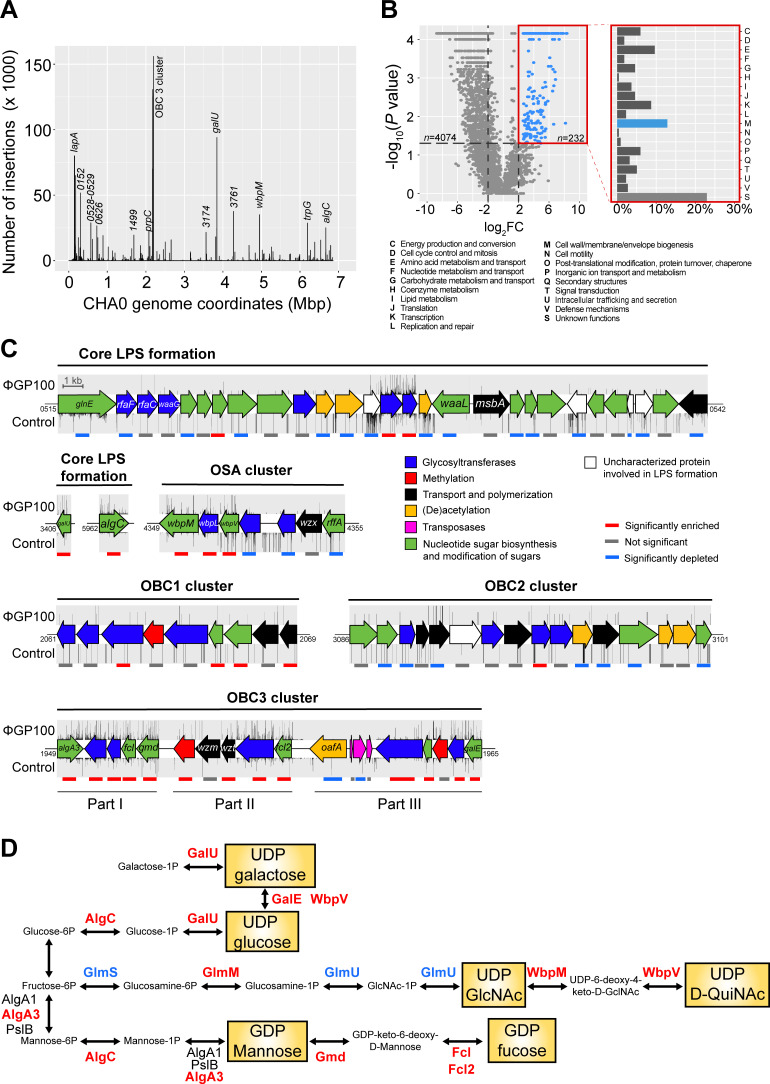
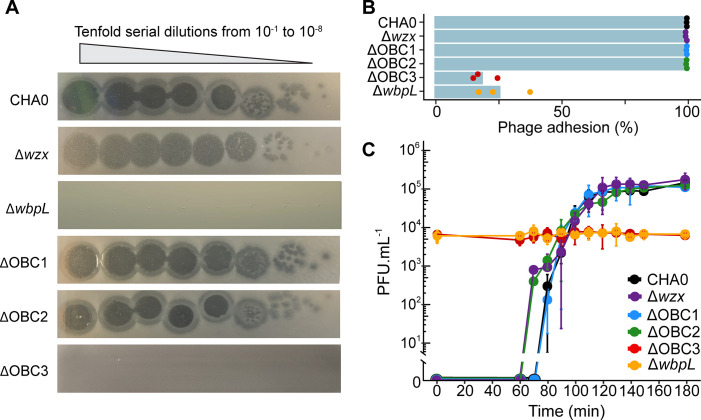
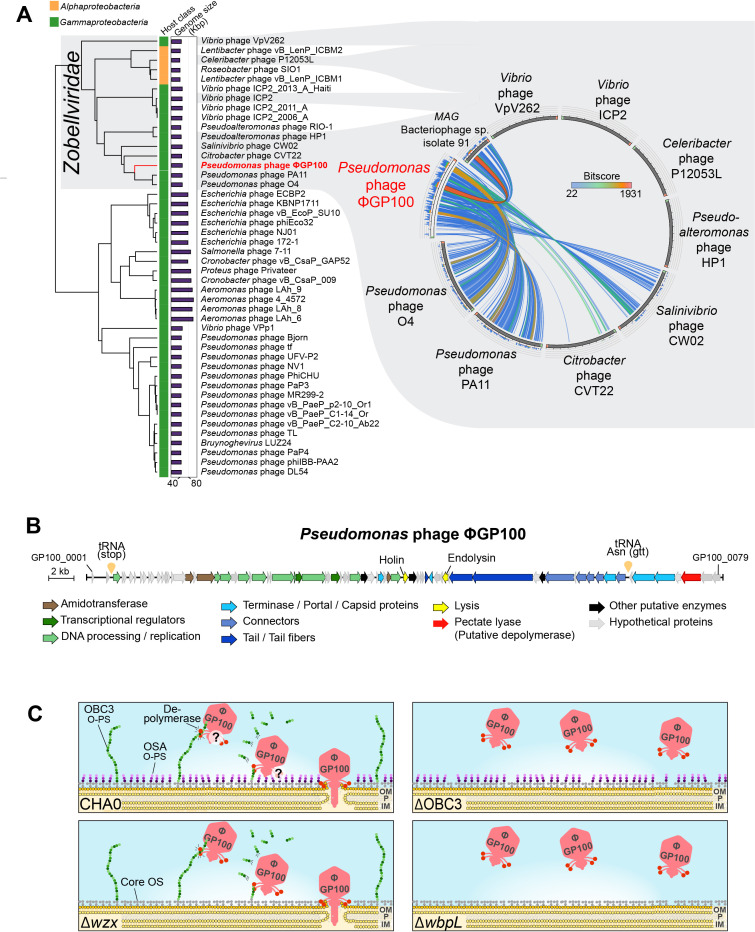
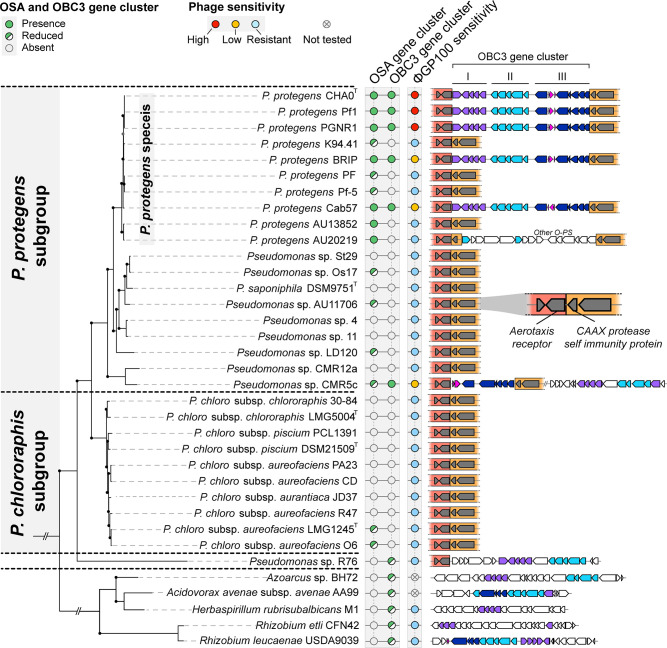
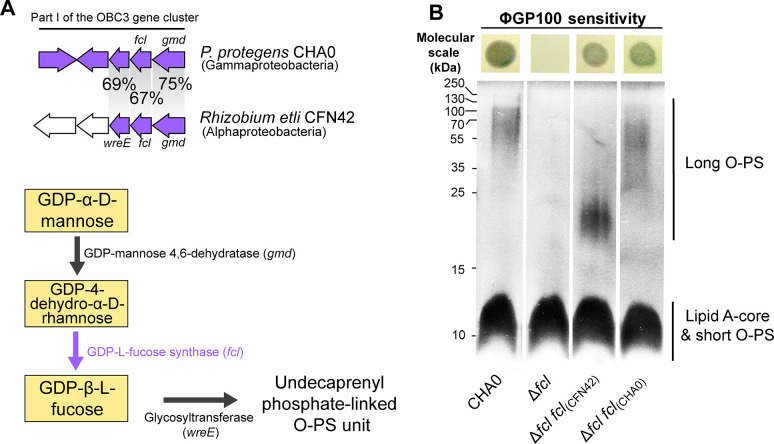
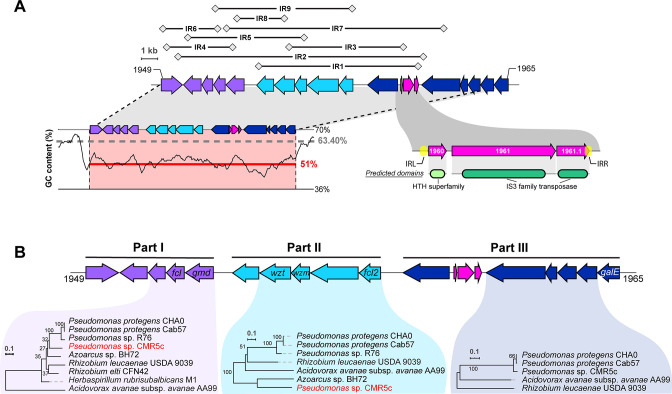
Pseudomonas protegens CHA0, a bacterial strain able to suppress plant pathogens as well as efficiently kill lepidopteran pest insects, has been studied as a biocontrol agent to prevent ensuing agricultural damage. However, the success of this method is dependent on efficient plant colonization by the bacterial inoculant, while it faces competition from the resident microbiota as well as predators such as bacteriophages. One of these naturally occurring phages, ΦGP100, was found to drastically reduce the abundance of CHA0 once inoculated into plant microcosms, resulting in the loss of plant protection effect against a phytopathogen. Here, we investigated the molecular determinants implicated in the interaction between CHA0 and the phage ΦGP100 using a high-density transposon-sequencing approach. We show that lipopolysaccharide cell surface decorations, specifically the longer OBC3-type O-antigenic polysaccharide (O-PS, O-antigen) of the two dominant O-PS of CHA0, are essential for the attachment and infection of ΦGP100. Moreover, when exploring the distribution of the OBC3 cluster in bacterial genomes, we identified several parts of this gene cluster that are conserved in phylogenetically distant bacteria. Through heterologous complementation, we integrated an OBC3-type gene copy from a phylogenetically distant bacterium and were able to restore the phage sensitivity of a CHA0 mutant which lacked the ability to form long O-PS. Finally, we evidence that the OBC3 gene cluster of CHA0 displays a high genomic plasticity and likely underwent several horizontal acquisitions and genomic rearrangements. Collectively, this study underlines the complexity of phage-bacteria interactions and the multifunctional aspect of bacterial cell surface decorations. IMPORTANCE: The application of plant-beneficial microorganisms to protect crop plants is a promising alternative to the usage of chemicals. However, biocontrol research often faces difficulties in implementing this approach due to the inconsistency of the bacterial inoculant to establish itself within the root microbiome. Beneficial bacterial inoculants can be decimated by the presence of their natural predators, notably bacteriophages (also called phages). Thus, it is important to gain knowledge regarding the mechanisms behind phage-bacteria interactions to overcome this challenge. Here, we evidence that the major long O-antigenic polysaccharide (O-PS, O-antigen) of the widely used model plant-beneficial bacterium Pseudomonas protegens CHA0 is the receptor of its natural predator, the phage ΦGP100. We examined the distribution of the gene cluster directing the synthesis of this O-PS and identified signatures of horizontal gene acquisitions. Altogether, our study highlights the importance of bacterial cell surface structure variation in the complex interplay between phages and their Pseudomonas hosts.
Overview
The claims and statistics of this paper haven’t been checked yet.
Run the check — free, no account needed. It reads the open-access text and checks the sources it cites.
Integrity signals
Registry
Cites
Statistics
Figures
Verification
Claims the paper makes
The claims and statistics of this paper haven’t been checked yet.
Run the check — free, no account needed. It reads the open-access text and checks the sources it cites.
Self-check
Percentages, sums and reported differences re-computed from the paper’s own numbers.
The self-check needs the paper’s full text.
Citations
Cites
Fast and accurate short read alignment with Burrows-Wheeler transform
Li, H., & Durbin, R. (2009) · Bioinformatics · doi:10.1093/bioinformatics/btp324 · Cited by 58,607
Highly accurate protein structure prediction with AlphaFold
Jumper, J., Evans, R., Pritzel, A., Green, T., Figurnov, M., Ronneberger, O., Tunyasuvunakool, K., Bates, R., Žídek, A., Potapenko, A., et al. (2021) · Nature · doi:10.1038/s41586-021-03819-2 · Cited by 43,764
Cutadapt removes adapter sequences from high-throughput sequencing reads
Martin, M. (2011) · EMBnet.journal · doi:10.14806/ej.17.1.200 · Cited by 33,889
Prokka: rapid prokaryotic genome annotation
Seemann, T. (2014) · Bioinformatics · doi:10.1093/bioinformatics/btu153 · Cited by 18,818
Fast and sensitive protein alignment using DIAMOND
Buchfink, B., Xie, C., & Huson, D. H. (2015) · Nature Methods · doi:10.1038/nmeth.3176 · Cited by 14,201
Selection of Conserved Blocks from Multiple Alignments for Their Use in Phylogenetic Analysis
Castresana, J. (2000) · Molecular Biology and Evolution · doi:10.1093/oxfordjournals.molbev.a026334 · Cited by 10,508
OrthoFinder: phylogenetic orthology inference for comparative genomics
Emms, D. M., & Kelly, S. (2019) · Genome Biology · doi:10.1186/s13059-019-1832-y · Cited by 7,676
A Rapid Bootstrap Algorithm for the RAxML Web Servers
Stamatakis, A., Hoover, P., & Rougemont, J. (2008) · Systematic Biology · doi:10.1080/10635150802429642 · Cited by 7,028
Huerta-Cepas, J., Szklarczyk, D., Heller, D., Hernández-Plaza, A., Forslund, S. K., Cook, H., Mende, D. R., Letunic, I., Rattei, T., Jensen, L. J., et al. (2019) · Nucleic Acids Research · doi:10.1093/nar/gky1085 · Cited by 4,902
RAxML-NG: a fast, scalable and user-friendly tool for maximum likelihood phylogenetic inference
Kozlov, A. M., Darriba, D., Flouri, T., Morel, B., & Stamatakis, A. (2019) · Bioinformatics · doi:10.1093/bioinformatics/btz305 · Cited by 4,454
Research works printed but not linked: 2
- 10.1111/j.1574-6968.2002.tb11193.x · DOI
- Reeves PP , Wang L . 2002. Genomic organization of LPS-specific loci. Curr Top Microbiol Immunol 264:109–135.
Metadata
- Authors
- Vacheron, J., Heiman, C. M., Garneau, J. R., Kupferschmied, P., de Jonge, R., Garrido-Sanz, D., & Keel, C.
- Affiliations
- University of Lausanne (CH)
- Utrecht University (NL)
- Department of Fundamental Microbiology, University of Lausanne , Lausanne, Switzerland
- Corresponding author
- Vacheron, Jordan
- Keel, Christoph
- ORCID
- Venue
- Microbiology Spectrum
- Publisher
- American Society for Microbiology
- Published
- 2023-12-12
- Volume
- 11
- Issue
- 6
- Pages
- e0204923-e0204923
- ISSN
- 2165-0497 (ISSN-L)
- PMC
- PMC10715155
- OpenAlex
- W4387392058
- Cited by
- 4
- References
- 94
- Citations by year
- 2026: 2 · 2024: 2
- FWCI
- 0.65
- Type
- journal article
- Language
- en
- Open access
- gold
- doi.org
- Licence
- cc-by
- creativecommons.org/licenses/by/4.0/ (vor)
- journals.asm.org/non-commercial-tdm-license (tdm)
- Locations
- Microbiology Spectrum (publishedVersion, cc-by)
- bioRxiv (Cold Spring Harbor Laboratory) (acceptedVersion, cc-by-nc-nd)
- PubMed Central (publishedVersion, cc-by)
- PubMed (publishedVersion)
- SERVAL (Université de Lausanne) (submittedVersion, cc-by)
- DOAJ (DOAJ: Directory of Open Access Journals) (submittedVersion, cc-by-sa)
- Utrecht University Repository (Utrecht University) (submittedVersion, other-oa)
- IRIS (submittedVersion, cc-by)
- Funders
- National Centre of Competence in Research Microbiomes (51NF40_180575)
- Swiss National Science Foundation (310030_184666)
- Topics
- Life Sciences › Immunology and Microbiology › Virology › Bacteriophages and microbial interactions
- Life Sciences › Biochemistry, Genetics and Molecular Biology › Genetics › Bacterial Genetics and Biotechnology
- Life Sciences › Agricultural and Biological Sciences › Plant Science › Plant-Microbe Interactions and Immunity
- Keywords
- phage sensitivity, phage-bacteria interactions, biological control agents, plant colonization, genome plasticity, horizontal gene transfer, genome rearrangement, transposon sequencing
- MeSH terms
- Bacteria, Bacteriophages, Biological Evolution, O Antigens
About these checks
Registry, retraction, Cites and statistics results are computed, not judged, with one exception: a printed reference that no index lists is read once by a model before it counts as a citation error. Claims are extracted by a model and kept only when their quote appears verbatim in the text; each cited source is then checked, with a model’s help, for whether it says what the claim relies on. Those verdicts can be wrong — read the claim’s quote and the cited source before relying on one.
Statistics and arithmetic are recomputed, not judged.
Confidence bands are shown only for fields calibrated on our annotated test set. None is calibrated yet, so no band is shown.
What counts as a claim ›How we measure confidence ›How we check this ›
Are you an author, or do you see a problem with this page? Request a review
How to cite
Cite CoChat for the checks on this page, and the paper for its own findings.
- This page
- CoChat. (2026). Citation check: Molecular and evolutionary basis of O-antigenic polysaccharide-driven phage sensitivity in environmental pseudomonads. https://app.cochat.ai/papers/10.1128/spectrum.02049-23
- The paper
- Vacheron, J., Heiman, C. M., Garneau, J. R., Kupferschmied, P., de Jonge, R., Garrido-Sanz, D., & Keel, C. (2023). Molecular and evolutionary basis of O-antigenic polysaccharide-driven phage sensitivity in environmental pseudomonads. Microbiology Spectrum. https://doi.org/10.1128/spectrum.02049-23
Data sources
Bibliographic data: Semantic Scholar, OpenAlex, Crossref.
Contains information from the Semantic Scholar Academic Graph Datasets, made available under the ODC Attribution License (ODC-BY 1.0).
Semantic Scholar’s data is described in: Kinney, R., et al. (2023). The Semantic Scholar Open Data Platform. arXiv:2301.10140.
