

Neonatal thyroid-stimulating hormone concentration and psychomotor development at preschool age
Open accessThe DOI matches its Crossref record; 32 of the 32 references it cites were found in a registry or an index.
Abstract
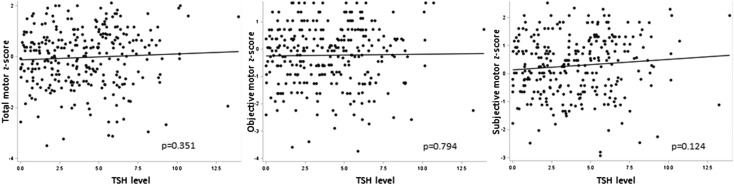
Objective: Thyroid hormones are essential for normal brain development. The aim of this study is to assess if high concentration of thyroid stimulating hormone (TSH) that is below the clinical threshold (5–15 mIU/L) at neonatal screening is linked to psychomotor development impairments in the offspring at preschool age. Design: A total of 284 Belgian preschool children 4–6 years old and their mothers were included in the study. The children were randomly selected from the total list of neonates screened in 2008, 2009 and 2010 by the Brussels newborn screening centre. The sampling was stratified by gender and TSH range (0.45–15 mIU/L). Infants with congenital hypothyroidism (>15 mIU/L), low birth weight and/or prematurity were excluded. Psychomotor development was assessed using the Charlop-Atwell scale of motor coordination. The iodine status of children was determined using median urinary iodine concentration. Socioeconomic, parental and child potential confounding factors were measured through a self-administered questionnaire. Results: TSH level was not significantly associated with total motor score (average change in z-score per unit increase in TSH is 0.02 (−0.03, 0.07), p=0.351), objective motor score (p=0.794) and subjective motor score (p=0.124). No significant associations were found using multivariate regression model to control confounding factors. Conclusions: Mild thyroid dysfunction in the newborn—reflected by an elevation of TSH that is below the clinical threshold (5–15 mIU/L)—was not associated with impaired psychomotor development at preschool age.
Overview
The claims and statistics of this paper haven’t been checked yet.
Free: it reads the open-access text and checks the first 5 claims that cite a source we can check. Create a free account to check every claim.
Integrity signals
Registry
Cites
Statistics
Figures
Verification
Claims the paper makes
The claims and statistics of this paper haven’t been checked yet.
Free: it reads the open-access text and checks the first 5 claims that cite a source we can check. Create a free account to check every claim.
Claims other papers make about this one
Each is checked against this paper’s own text: does it say what the citing paper says it does?
The source backs part of the claim, not all of it — or backs it for a different population, condition or comparison.
In the citing paper
“In contrast, in a Belgian cohort of children, there was no relationship between mild neonatal TSH elevation and neurodevelopment at the preschool age (52–54).”
From Congenital Hypothyroidism: A 2020–2021 Consensus Guidelines Update—An ENDO-European Reference Network Initiative Endorsed by the European Society for Pediatric Endocrinology and the European Society for Endocrinology (2021) · cites this paper as [53]
Experimental — accuracy not yet measured
Self-check
Percentages, sums and reported differences re-computed from the paper’s own numbers.
The self-check needs the paper’s full text.
Citations
Cites
Pop, V. J., Kuijpens, J. L., van Baar, A. L., Verkerk, G., van Son, M. M., de Vijlder, J. J., Vulsma, T., Wiersinga, W. M., Drexhage, H. A., & Vader, H. L. (1999) · Clinical Endocrinology · doi:10.1046/j.1365-2265.1999.00639.x · Cited by 1,009
Pop, V. J., Brouwers, E. P., Vader, H. L., Vulsma, T., Van Baar, A. L., & De Vijlder, J. J. (2003) · Clinical Endocrinology · doi:10.1046/j.1365-2265.2003.01822.x · Cited by 735
Thyroid hormone receptors in brain development and function
Bernal, J. (2007) · Nature Clinical Practice Endocrinology & Metabolism · doi:10.1038/ncpendmet0424 · Cited by 706
The Disorders Induced by Iodine Deficiency
DELANGE, F. (1994) · Thyroid · doi:10.1089/thy.1994.4.107 · Cited by 638
Iodine Deficiency in 2007: Global Progress since 2003
de Benoist, B., McLean, E., Andersson, M., & Rogers, L. (2008) · Food and Nutrition Bulletin · doi:10.1177/156482650802900305 · Cited by 425
Time-resolved fluorometer for lanthanide chelates--a new generation of nonisotopic immunoassays.
Soini, E., & Kojola, H. (1983) · Clinical Chemistry · doi:10.1093/clinchem/29.1.65 · Cited by 386
Zimmermann, M. B. (2009) · The American Journal of Clinical Nutrition · doi:10.3945/ajcn.2008.26811c · Cited by 357
Ammonium persulfate: a safe alternative oxidizing reagent for measuring urinary iodine
Pino, S., Fang, S. L., & Braverman, L. E. (1996) · Clinical Chemistry · doi:10.1093/clinchem/42.2.239 · Cited by 348
Iodine deficiency in Europe: a continuing public health problem
Anderson, M., de Benoist, B., Darnton‐Hill, I., & Delange, F. (2007) · eCite Digital Repository (University of Tasmania) · Cited by 260
Neonatal Screening for Congenital Hypothyroidism Results and Perspectives
Delange, F. (1997) · Hormone Research · doi:10.1159/000185485 · Cited by 221
Research works printed but not linked: 1
- WHO, UNICEF, ICCIDD. Indicators for assessing iodine deficiency disorders and their control through salt iodisation. WHO/NUT/94.6. Geneva: WHO, 1994.
Cited by
van Trotsenburg, P., Stoupa, A., Léger, J., Rohrer, T., Peters, C., Fugazzola, L., Cassio, A., Heinrichs, C., Beauloye, V., Pohlenz, J., et al. (2021) · Thyroid® · doi:10.1089/thy.2020.0333 · Cited by 469
Wassner, A. J. (2018) · Clinics in Perinatology · doi:10.1016/j.clp.2017.10.004 · Cited by 165
The Role of Iodine for Thyroid Function in Lactating Women and Infants
Andersson, M., & Braegger, C. (2021) · Endocrine Reviews · doi:10.1210/endrev/bnab029 · Cited by 135
“The consequences of mild or subclinical hypothyroidism on development in early infancy or childhood remain unclear (68, 87-89), but neurocognitive deficits in neonates are possible (89).”
BackgroundCongenital Hypothyroidism: Screening and Management
Rose, S. R., Wassner, A. J., Wintergerst, K. A., Jones, N. Y., Hopkin, R. J., Chuang, J., Smith, J. R., Abell, K. B., LAFRANCHI, S. H., Wintergerst, K. A., et al. (2022) · PEDIATRICS · doi:10.1542/peds.2022-060420 · Cited by 129
Congenital hypothyroidism: insights into pathogenesis and treatment
Cherella, C. E., & Wassner, A. J. (2017) · International Journal of Pediatric Endocrinology · doi:10.1186/s13633-017-0051-0 · Cited by 106
Are lower TSH cutoffs in neonatal screening for congenital hypothyroidism warranted?
Lain, S., Trumpff, C., Grosse, S. D., Olivieri, A., & Van Vliet, G. (2017) · European Journal of Endocrinology · doi:10.1530/eje-17-0107 · Cited by 96
“As described in the previous section, recent publications have reported contradictory results on the relationship between TSH concentrations at NBS that are considered normal by most programs and cognitive, psychomotor, behavioral or educational outcomes (27, 29).”
InfluentialSelf-citationPediatric Hypothyroidism: Diagnosis and Treatment
Wassner, A. J. (2017) · Pediatric Drugs · doi:10.1007/s40272-017-0238-0 · Cited by 116
“One study of 284 Belgian children found no association between mild TSH elevation on newborn screening and psychomotor development at preschool age [64].”
BackgroundNewborn Screening in the US May Miss Mild Persistent Hypothyroidism
Kilberg, M. J., Rasooly, I. R., LaFranchi, S. H., Bauer, A. J., & Hawkes, C. P. (2018) · The Journal of Pediatrics · doi:10.1016/j.jpeds.2017.09.003 · Cited by 70
“At the lower end of this spectrum, infants with whole blood TSH concentrations of up to 15 mU/L do not have detectable reductions in intelligence quotient(10) or psychomotor development.(11) In studies showing neurocognitive effects of mild hyperthyrotropinemia, confounding effects of maternal iodine deficiency on fet…”
Thyroid hormone therapy in congenital hypothyroidism and pediatric hypothyroidism
Bauer, A. J., & Wassner, A. J. (2019) · Endocrine · doi:10.1007/s12020-019-02024-6 · Cited by 69
Moncayo, R., & Moncayo, H. (2017) · BBA Clinical · doi:10.1016/j.bbacli.2017.03.003 · Cited by 54
“[25] demonstrated that thyroid dysfunction of mild degree in the newborn (n = 284), i.”
BackgroundNeonatal thyroid‐stimulating hormone and association with attention‐deficit/hyperactivity disorder
Villanger, G. D., Ystrøm, E., Engel, S. M., Longnecker, M. P., Pettersen, R. D., Rowe, A. D., Reichborn‐Kjennerud, T., & Aase, H. (2020) · Paediatric and Perinatal Epidemiology · doi:10.1111/ppe.12643 · Cited by 40
Aakre, I., Strand, T. A., Moubarek, K., Barikmo, I., & Henjum, S. (2017) · PLoS ONE · doi:10.1371/journal.pone.0187241 · Cited by 38
West, R., Hong, J., Derraik, J. G. B., Webster, D., Heather, N. L., & Hofman, P. L. (2020) · The Journal of Clinical Endocrinology & Metabolism · doi:10.1210/clinem/dgaa415 · Cited by 20
Wassie, M. M., Smithers, L. G., & Zhou, S. J. (2021) · Biological Trace Element Research · doi:10.1007/s12011-021-02665-7 · Cited by 19
“= 0.53 - Verbal IQ: 94 ± 19.8 vs. 100.8 ± 14.2 vs. 86.7 ± 22.8; P = 0.006 Trumpff, 2016 [34], Belgiumd Retrospective Cohort N = 310 Healthy infants from the PsychoTSH study Exclusion criteria: TSH > 15 mIU/L, low birthweight, prematurity 3–5 days (DELFIAc) G1 (n = 113): ≥ 5 mIU/L G2 (n = 197): < 5…”
InfluentialCord Blood Thyroid Hormones and Neurodevelopment in 2-Year-Old Boys and Girls
Fan, P., Chen, Y., Luo, Z., Shen, L., Wang, W., Liu, Z., Zhang, J., & Ouyang, F. (2021) · Frontiers in Nutrition · doi:10.3389/fnut.2021.773965 · Cited by 21
Trumpff, C., Schepper, J. D., Vanderfaeillie, J., Vercruysse, N., Tafforeau, J., Oyen, H. J. V., & Vandevijvere, S. (2016) · Frontiers in Endocrinology · doi:10.3389/fendo.2016.00161 · Cited by 13
“We previously reported no association between elevated TSH measured at birth and cognitive and psychomotor development of preschool children when confounding factors were taken into account (22, 23).”
BackgroundSelf-citationLain, S. J., Wiley, V. C., Jack, M., Martin, A. J., Wilcken, B. M., & Nassar, N. (2020) · European Journal of Pediatrics · doi:10.1007/s00431-020-03828-9 · Cited by 13
Butler, A. M., Charoensiriwatana, W., Krasao, P., Pankanjanato, R., Thong-Ngao, P., Polson, R. C., Snow, G. L., & Ehrenkranz, J. R. L. (2017) · Thyroid · doi:10.1089/thy.2016.0452 · Cited by 14
Thyroid Hormone Function in Small for Gestational Age Term Newborns
Kaluarachchi, D. C., Nicksic, V. B., Allen, D. B., Eickhoff, J. C., Baker, M. W., & Kling, P. J. (2021) · The Journal of Pediatrics · doi:10.1016/j.jpeds.2021.06.067 · Cited by 11
Braga, N. T. P., Antunes, J. M. V., Colosimo, E. A., Dias, V. M. A., Januário, J. N., & Silva, I. N. (2024) · International Journal of Neonatal Screening · doi:10.3390/ijns10030052 · Cited by 10
Wassie, M. M., Smithers, L. G., Yelland, L. N., Makrides, M., & Zhou, S. J. (2021) · British Journal Of Nutrition · doi:10.1017/s0007114521000325 · Cited by 10
“Our finding of a null association between newborn TSH and Bayley-III scores in PINK study is consistent with the PsychoTSH study (n = 315) (24; 25; 26) in an iodine sufficient population in Belgium, which is a prospective cohort study designed to assess the association”
BackgroundResultvan Trotsenburg, A. S. P., Stoupa, A., Léger, J., Rohrer, T. R., Peters, C. J., Fugazzola, L., Cassio, A., Heinrichs, C., Beauloye, V., Pohlenz, J., et al. (2021) · Yearbook of pediatric endocrinology · doi:10.1530/ey.18.3.8 · Cited by 9
Zhang, S., Cheng, F., Wang, H., Wen, J., Zeng, J., Zhang, C., Liu, W., Wang, N., Jia, T., Wang, M., et al. (2021) · PLoS ONE · doi:10.1371/journal.pone.0253324 · Cited by 9
Kopčíková, M., Rašková, B., Belica, I., Bakoš, J., Celušáková, H., Chladná, Z., Zibolenová, J., & Ostatníková, D. (2024) · Endocrine Regulations · doi:10.2478/enr-2024-0031 · Cited by 6
Nicksic, V. B., Allen, D. B., Stanley, M. A., Baker, M. W., Eickhoff, J. C., & Kaluarachchi, D. C. (2022) · Journal of Neonatal-Perinatal Medicine · doi:10.3233/npm-210910 · Cited by 6
Jin, M., Zhou, Z., Zhang, L., Chen, Y., Liu, L., & Shen, H. (2022) · Biological Trace Element Research · doi:10.1007/s12011-022-03187-6 · Cited by 6
Razavi, Z., Dalili, S., Sabzehei, M. K., Yousefi, A., Nouri, S., Abedi, M., & Bazmamoun, H. (2019) · Iranian journal of child neurology. · doi:10.22037/ijcn.v13i2.18475 · Cited by 8
“On the other hand, no association was found between mild congenital hypothyroidism (TSH levels less than 15 mIU/L) and psychomotor development of preschool children in Belgium (27).”
BackgroundYan, X., Jiang, G., Yang, C., Chen, Y., Zeng, J., Huang, L., Chen, X., & Liao, J. (2023) · Endokrynologia Polska · doi:10.5603/ep.a2023.0024 · Cited by 5
Graham, J. W., Paul, S. P., Mulholland, S., Tran, S. C., Butler, C. L., Mankiewitz, R., & Beech, G. (2019) · Indian Journal of Clinical Biochemistry · doi:10.1007/s12291-019-00865-6 · Cited by 3
Giannakopoulos, A., Efthymiadou, A., Kritikou, D., & Chrysis, D. (2025) · Frontiers in Endocrinology · doi:10.3389/fendo.2025.1365354 · Cited by 2
Shreder, E. V., Shiryaeva, T., Nagaeva, E. V., & Bezlepkina, O. B. (2021) · Clinical and experimental thyroidology · doi:10.14341/ket12703 · Cited by 3
Amirikandbon, Z., Moienafshar, A., Shariatpanahi, G., Mojtahedi, S. Y., & Tavakolizadeh, R. (2024) · Journal of Comprehensive Pediatrics · doi:10.5812/jcp-147428 · Cited by 1
dos Santos, N. R., Bah, H. A. F., Júnior, E. A. G., Costa, D. O., Martinez, V. O., Pires, E. M., Souza, M. I. S. S., de Carvalho, C. F., Andrade, N. C., & Menezes‐Filho, J. A. (2025) · Early Human Development · doi:10.1016/j.earlhumdev.2025.106320 · Cited by 1
Florczyk, W., Weber‐Nowakowska, K., & Gębska, M. (2020) · Journal of Education Health and Sport · doi:10.12775/jehs.2020.10.04.012 · Cited by 1
Almatani, R. S., Alsahaf, A. S., Alluhaybi, M., Refaai, R. A., Alharbi, W. I., & Alhindi, Y. Z. (2022) · International Journal of Life Science and Pharma Research · doi:10.22376/ijlpr.2023.13.1.p129-135 · Cited by 1
Kara, C., & Korkmaz, H. A. (2024) · Journal of Clinical Research in Pediatric Endocrinology · doi:10.4274/jcrpe.galenos.2024.2024-4-15 · Cited by 1
Akhrif, M. (2021) · European journal of applied sciences · doi:10.14738/aivp.93.10322
Disfunção tireoidiana e doença autoimune da tireoide em pacientes com Síndrome de Down
Rossi, I. C. B. (2021) · doi:10.14393/ufu.di.2021.5543 · Cited by 4
West, R., Hong, J. S. S., Derraik, J. G. B., WEBSTER, D. R., Heather, N. L., & Hofman, P. L. (2021) · Yearbook of pediatric endocrinology · doi:10.1530/ey.18.3.9
Tonelli, F., Cotti, S., Leoni, L., Besio, R., Gioia, R., Marchese, L., Giorgetti, S., Villani, S., Gistelinck, C., Wagener, R., et al. (2021) · Yearbook of pediatric endocrinology · doi:10.1530/ey.18.5.11
Bauer, A. J. (2024) · Elsevier eBooks · doi:10.1016/b978-0-323-69415-5.00026-6
Étude PRETHY : prééclampsie et hypothyroïdie néonatale
Magistris, D. (2026) · Archive ouverte UNIGE (University of Geneva) · doi:10.13097/archive-ouverte/unige:196671
Metadata
- Authors
- Trumpff, C., De Schepper, J., Vanderfaeillie, J., Vercruysse, N., Van Oyen, H., Moreno-Reyes, R., Tafforeau, J., & Vandevijvere, S.
- Affiliations
- Institut Scientifique de Santé Publique (BE)
- Vrije Universiteit Brussel (BE)
- Université Libre de Bruxelles (BE)
- Corresponding author
- Trumpff, Caroline
- Venue
- Archives of Disease in Childhood
- Publisher
- BMJ
- Published
- 2016-07-08
- Volume
- 101
- Issue
- 12
- Pages
- 1100-1106
- ISSN
- 0003-9888 (ISSN-L)
- 1468-2044
- PMC
- PMC5256416
- OpenAlex
- W2469846032
- Cited by
- 42
- References
- 32
- Citations by year
- 2025: 2 · 2024: 4 · 2023: 3 · 2022: 4 · 2021: 12 · 2020: 5 · 2019: 3 · 2018: 1 · 2017: 7 · 2016: 1
- FWCI
- 4.02
- Type
- journal article
- Language
- en
- Open access
- hybrid
- doi.org
- Licence
- cc-by
- Locations
- Archives of Disease in Childhood (publishedVersion, cc-by)
- PubMed Central (publishedVersion, cc-by)
- PubMed (publishedVersion)
- Dépôt institutionnel de l'Université libre de Bruxelles (Université Libre de Bruxelles) (submittedVersion, other-oa)
- HighWire Press Open Archive (submittedVersion)
- VUBIR (Vrije Universiteit Brussel) (submittedVersion)
- Funders
- Belgian Federal Science Policy Office
- Topics
- Health Sciences › Medicine › Endocrinology, Diabetes and Metabolism › Thyroid Disorders and Treatments
- Life Sciences › Biochemistry, Genetics and Molecular Biology › Clinical Biochemistry › Metabolism and Genetic Disorders
- Health Sciences › Medicine › Pediatrics, Perinatology and Child Health › Prenatal Substance Exposure Effects
- Keywords
- neonatal thyroid-stimulating hormone, subclinical thyroid dysfunction, psychomotor development, motor coordination, preschool children, newborn screening, urinary iodine, iodine status, brain development
- MeSH terms
- Belgium, Child, Developmental Disabilities, Child, Preschool, Congenital Hypothyroidism, Female, Humans, Infant, Infant, Newborn, Male, Neuropsychological Tests, Prospective Studies, Psychomotor Disorders, Thyrotropin
About these checks
Registry, retraction, Cites and statistics results are computed, not judged, with one exception: a printed reference that no index lists is read once by a model before it counts as a citation error. Claims are extracted by a model and kept only when their quote appears verbatim in the text; each cited source is then checked, with a model’s help, for whether it says what the claim relies on. Those verdicts can be wrong — read the claim’s quote and the cited source before relying on one.
Statistics and arithmetic are recomputed, not judged.
Confidence bands are shown only for fields calibrated on our annotated test set. None is calibrated yet, so no band is shown.
What counts as a claim ›How we measure confidence ›How we check this ›
Are you an author, or do you see a problem with this page? Request a review
Data sources
Bibliographic data: Semantic Scholar, OpenAlex, Crossref.
Contains information from the Semantic Scholar Academic Graph Datasets, made available under the ODC Attribution License (ODC-BY 1.0).
Semantic Scholar’s data is described in: Kinney, R., et al. (2023). The Semantic Scholar Open Data Platform. arXiv:2301.10140.
