

The DOI matches its Crossref record; 53 of the 54 references it cites were found in a registry or an index.
Cognitive functional therapy compared with a group-based exercise and education intervention for chronic low back pain: a multicentre randomised controlled trial (RCT)
Open accessAbstract
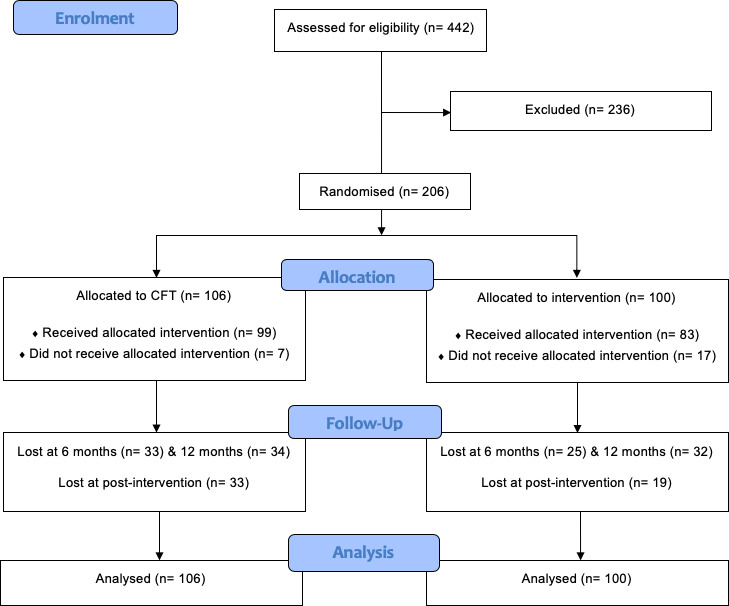
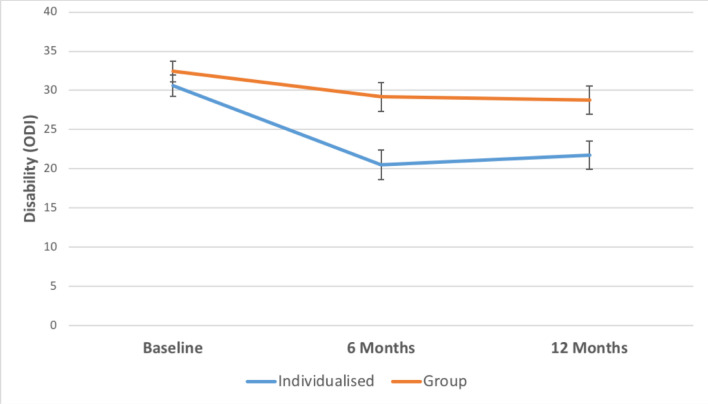
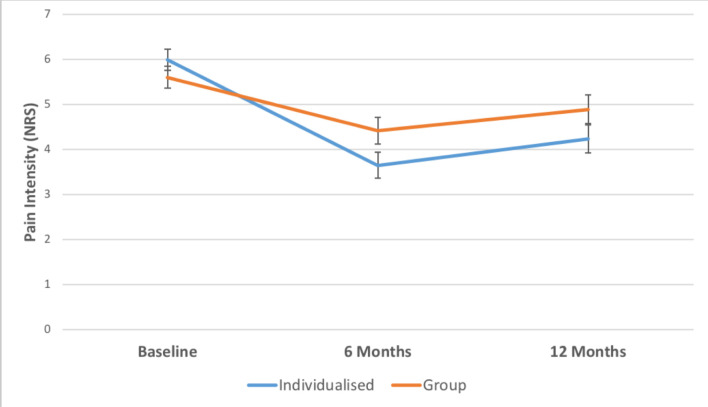
Background: One-size-fits-all interventions reduce chronic low back pain (CLBP) a small amount. An individualised intervention called cognitive functional therapy (CFT) was superior for CLBP compared with manual therapy and exercise in one randomised controlled trial (RCT). However, systematic reviews show group interventions are as effective as one-to-one interventions for musculoskeletal pain. This RCT investigated whether a physiotherapist-delivered individualised intervention (CFT) was more effective than physiotherapist-delivered group-based exercise and education for individuals with CLBP. Methods: 206 adults with CLBP were randomised to either CFT (n=106) or group-based exercise and education (n=100). The length of the CFT intervention varied according to the clinical progression of participants (mean=5 treatments). The group intervention consisted of up to 6 classes (mean=4 classes) over 6–8 weeks. Primary outcomes were disability and pain intensity in the past week at 6 months and 12months postrandomisation. Analysis was by intention-to-treat using linear mixed models. Results: CFT reduced disability more than the group intervention at 6 months (mean difference, 8.65; 95% CI 3.66 to 13.64; p=0.001), and at 12 months (mean difference, 7.02; 95% CI 2.24 to 11.80; p=0.004). There were no between-group differences observed in pain intensity at 6 months (mean difference, 0.76; 95% CI -0.02 to 1.54; p=0.056) or 12 months (mean difference, 0.65; 95% CI -0.20 to 1.50; p=0.134). Conclusion: CFT reduced disability, but not pain, at 6 and 12 months compared with the group-based exercise and education intervention. Future research should examine whether the greater reduction in disability achieved by CFT renders worthwhile differences for health systems and patients. Trial registration number: ClinicalTrials.gov registry (NCT02145728 ).
Overview
The claims and statistics of this paper haven’t been checked yet.
Run the check — free, no account needed. It reads the open-access text and checks the sources it cites.
Integrity signals
Registry
Cites
Statistics
Figures
Verification
Claims the paper makes
The claims and statistics of this paper haven’t been checked yet.
Run the check — free, no account needed. It reads the open-access text and checks the sources it cites.
Claims other papers make about this one
Each is checked against this paper’s own text: does it say what the citing paper says it does?
The cited source says what the claim attributes to it.
In the citing paper
“In addition to the core muscles, low back pain may be related to psychological factors, such as perceptions of back pain, depression, fear of activity, and pain self-efficacy [13].”
Self-check
Percentages, sums and reported differences re-computed from the paper’s own numbers.
The self-check needs the paper’s full text.
Citations
Cites
R: A Language and Environment for Statistical Computing
R Core Team (2000) · doi:10.32614/r.manuals · Cited by 355,893
Statistical Analysis With Missing Data
Lahiff, M., Little, R. J. A., & Rubin, D. B. (1989) · Journal of the American Statistical Association · doi:10.2307/2289883 · Cited by 17,385
Fairbank, J. C. T., & Pynsent, P. B. (2000) · Spine · doi:10.1097/00007632-200011150-00017 · Cited by 5,851
Marginal Structural Models and Causal Inference in Epidemiology
Robins, J. M., Hernán, M. Á., & Brumback, B. (2000) · Epidemiology · doi:10.1097/00001648-200009000-00011 · Cited by 5,581
What low back pain is and why we need to pay attention
Hartvigsen, J., Hancock, M. J., Kongsted, A., Louw, Q., Ferreira, M. L., Genevay, S., Hoy, D., Karppinen, J., Pransky, G., Sieper, J., et al. (2018) · The Lancet · doi:10.1016/s0140-6736(18)30480-x · Cited by 4,652 · cited 7×
“This is an important finding as treating people together in a group may be an effective use of limited resources for treating LBP. 30 A physiotherapy-led individualised intervention called cognitive functional therapy (CFT), that targets physical, lifestyle and psychological barriers to recovery, was developed to help…”
InfluentialQaseem, A., Wilt, T. J., McLean, R. M., Forciea, M. A., & for the Clinical Guidelines Committee of the American College of Physicians* (2017) · Annals of Internal Medicine · doi:10.7326/m16-2367 · Cited by 3,234
Waddell, G., Newton, M., Henderson, I., Somerville, D., & Main, C. J. (1993) · Pain · doi:10.1016/0304-3959(93)90127-b · Cited by 3,167
Maher, C., Underwood, M., & Buchbinder, R. (2017) · The Lancet · doi:10.1016/s0140-6736(16)30970-9 · Cited by 2,535
Prevention and treatment of low back pain: evidence, challenges, and promising directions
Foster, N. E., Anema, J. R., Cherkin, D., Chou, R., Cohen, S. P., Gross, D. P., Ferreira, P. H., Fritz, J. M., Koes, B. W., Peul, W., et al. (2018) · The Lancet · doi:10.1016/s0140-6736(18)30489-6 · Cited by 2,398
Hill, J. C., Whitehurst, D. G., Lewis, M., Bryan, S., Dunn, K. M., Foster, N. E., Konstantinou, K., Main, C. J., Mason, E., Somerville, S., et al. (2011) · The Lancet · doi:10.1016/s0140-6736(11)60937-9 · Cited by 1,306
Research works printed but not linked: 1
- Cohen J . Pp. 79–81 in statistical power analysis for the behavioral sciences. Hillsdale, NJ Lawrence Erlbaum Associates; 1988.
Cited by
Sorted by citations
Exercise therapy for chronic low back pain
Hayden, J. A., Ellis, J., Ogilvie, R., Malmivaara, A., & van Tulder, M. W. (2021) · Cochrane Database of Systematic Reviews · doi:10.1002/14651858.cd009790.pub2 · Cited by 589
Beliefs about the body and pain: the critical role in musculoskeletal pain management
Cañeiro, J. P., Bunzli, S., & O’Sullivan, P. (2020) · Brazilian Journal of Physical Therapy · doi:10.1016/j.bjpt.2020.06.003 · Cited by 292
Self-citationHo, E. K.-Y., Chen, L., Simic, M., Ashton-James, C. E., Comachio, J., Wang, D. X. M., Hayden, J. A., Ferreira, M. L., & Ferreira, P. H. (2022) · BMJ · doi:10.1136/bmj-2021-067718 · Cited by 220
Kent, P. M., Haines, T. P., O’Sullivan, P., Smith, A. J., Campbell, A., Schütze, R., Attwell, S., Cañeiro, J. P., Laird, R. A., O’Sullivan, K., et al. (2023) · The Lancet · doi:10.1016/s0140-6736(23)00441-5 · Cited by 236
Self-citationHolopainen, R., Simpson, P., Piirainen, A., Karppinen, J., Schütze, R., Smith, A., O'Sullivan, P., & Kent, P. (2020) · Pain · doi:10.1097/j.pain.0000000000001809 · Cited by 180
Self-citation
Metadata
- Authors
- O'Keeffe, M., O'Sullivan, P., Purtill, H., Bargary, N., & O'Sullivan, K.
- Affiliations
- Institute for Musculoskeletal Health, Sydney School of Public Health, Faculty of Medicine and Health, University of Sydney, Sydney, New South Wales, Australia
- School of Physiotherapy and Exercise Science, Curtin University, Shenton Park, Perth, Western Australia, Australia
- University of Limerick (IE)
- Health Research Institute, University of Limerick, Limerick, Ireland
- Venue
- British Journal of Sports Medicine
- Publisher
- BMJ
- Published
- 2019-10-19
- Volume
- 54
- Issue
- 13
- Pages
- 782-789
- ISSN
- 0306-3674 (ISSN-L)
- 1473-0480
- PMC
- PMC7361017
- OpenAlex
- W2981005913
- Cited by
- 217
- References
- 54
- Citations by year
- 2026: 21 · 2025: 27 · 2024: 55 · 2023: 45 · 2022: 27 · 2021: 27 · 2020: 14 · 2019: 1
- FWCI
- 10.69
- Type
- journal article
- Language
- en
- Open access
- hybrid
- doi.org
- Licence
- Locations
- British Journal of Sports Medicine (publishedVersion, cc-by-nc)
- PubMed Central (publishedVersion, cc-by-nc)
- PubMed (publishedVersion)
- Cork Open Research Archive (University College Cork, Ireland) (publishedVersion, other-oa)
- University of Limerick Institutional Repository (University of Limerick) (acceptedVersion, cc-by-nc-sa)
- University of Limerick Institutional Repository (University of Limerick) (acceptedVersion, other-oa)
- Zenodo (CERN European Organization for Nuclear Research) (submittedVersion, cc-by)
- Arrow@dit (Dublin Institute of Technology) (submittedVersion, cc-by-nc-sa)
- Arrow@dit (Dublin Institute of Technology) (submittedVersion, cc-by-nc)
- Figshare (submittedVersion, cc-by-nc-sa)
- HighWire Press Open Archive (submittedVersion)
- Lenus, The Irish Health Repository (Dr Steevens Hospital Library) (submittedVersion, cc-by-nc)
- University of Limerick Institutional Repository (University of Limerick)
- Funders
- University of Limerick
- Irish Research Council
- Topics
- Health Sciences › Health Professions › Physical Therapy, Sports Therapy and Rehabilitation › Musculoskeletal pain and rehabilitation
- Health Sciences › Medicine › Anesthesiology and Pain Medicine › Pain Management and Treatment
- Health Sciences › Medicine › Obstetrics and Gynecology › Pregnancy-related medical research
- Keywords
- cognitive functional therapy, chronic low back pain, disability, pain intensity, musculoskeletal pain
- MeSH terms
- Adult, Aged, Combined Modality Therapy, Exercise Therapy, Female, Humans, Male, Middle Aged, Patient Education as Topic, Cognitive Behavioral Therapy, Low Back Pain, Intention to Treat Analysis, Chronic Pain
About these checks
Registry, retraction, Cites and statistics results are computed, not judged, with one exception: a printed reference that no index lists is read once by a model before it counts as a citation error. Claims are extracted by a model and kept only when their quote appears verbatim in the text; each cited source is then checked, with a model’s help, for whether it says what the claim relies on. Those verdicts can be wrong — read the claim’s quote and the cited source before relying on one.
Statistics and arithmetic are recomputed, not judged.
Confidence bands are shown only for fields calibrated on our annotated test set. None is calibrated yet, so no band is shown.
What counts as a claim ›How we measure confidence ›How we check this ›
Are you an author, or do you see a problem with this page? Request a review
