

The DOI matches its Crossref record; 49 of the 49 references it cites were found in a registry or an index; 21 of the 36 sources its claims cite were checked for support.
Effectiveness of exercise for improving cognition, memory and executive function: a systematic umbrella review and meta-meta-analysis
Open accessAbstract
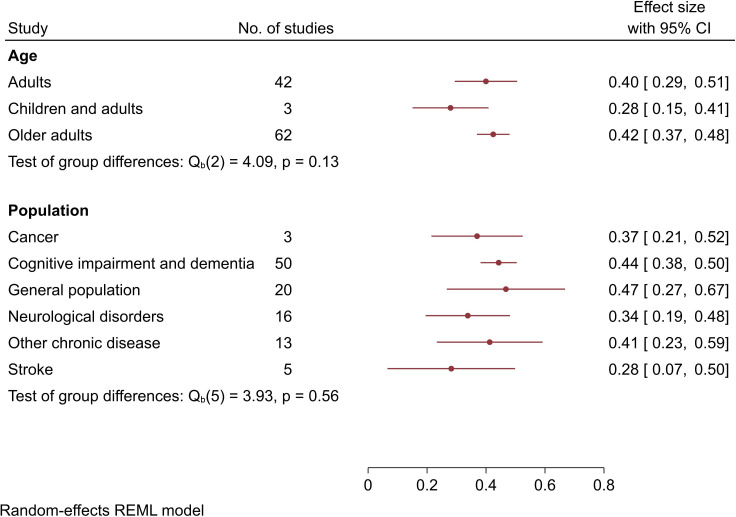
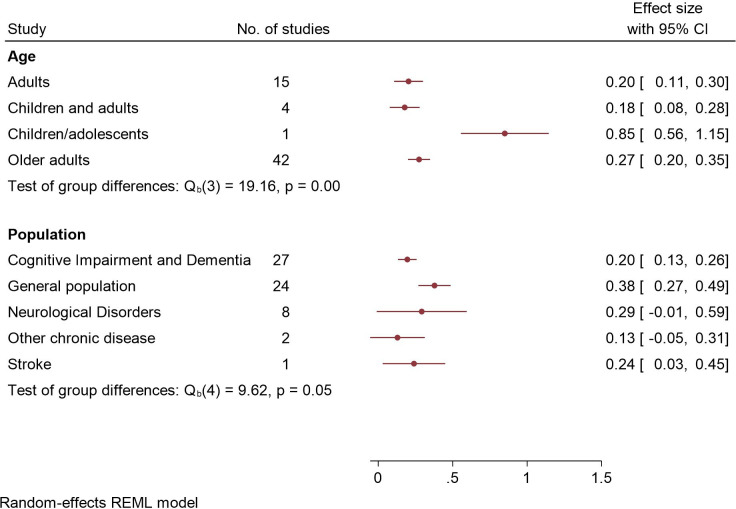
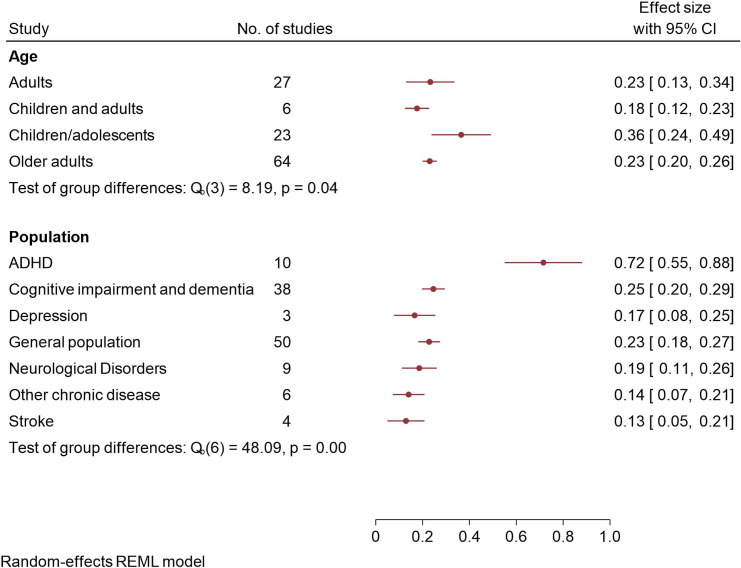
OBJECTIVE: To evaluate systematic reviews of randomised controlled trials (RCTs) on the effects of exercise on general cognition, memory and executive function across all populations and ages. METHODS: Systematic reviews and meta-analyses of RCTs evaluating the effects of exercise on general cognition, memory and executive function were eligible. Data extraction and risk of bias scoring were conducted in duplicate. The A MeaSurement Tool to Assess systematic Reviews (AMSTAR-2) was used to assess the risk of bias. Effect sizes were pooled using random effects models and reported as standardised mean differences (SMD). Subgroup analyses were conducted for participant and intervention characteristics.General cognition, memory and executive function. DATA SOURCES: CINAHL, The Cochrane Library, Embase, MEDLINE via OVID, Emcare, ProQuest Central, ProQuest Nursing and Allied Health Source, PsycINFO, Scopus, Sport Discus and Web of Science. RESULTS: 133 systematic reviews (2,724 RCTs and 258 279 participants) were included. Exercise significantly improved general cognition (SMD=0.42), memory (SMD=0.26) and executive function (SMD=0.24). Memory and executive function improvements from exercise were greater for children and adolescents than for adults and older adults. Those with attention-deficit/hyperactivity disorder exhibited greater improvement in executive function than other populations. Effects were generally larger for low- and moderate-intensity interventions. Shorter interventions (1-3 months) and exergames (video games that require physical movement) had the largest effects on general cognition and memory. Findings remained statistically significant after excluding reviews rated as low and critically low quality. CONCLUSIONS: These findings provide strong evidence that exercise, even light intensity, benefits general cognition, memory and executive function across all populations, reinforcing exercise as an essential, inclusive recommendation for optimising cognitive health. TRIAL REGISTRATION NUMBER: PROSPERO ID: CRD42023468991.
Overview
CoChat Summary
TL;DR
This umbrella review and meta-meta-analysis of 133 systematic reviews (2,724 RCTs; 258,279 participants) found that exercise significantly improved general cognition, memory and executive function across all populations and ages. Benefits were small-to-moderate overall, with larger memory and executive function gains in children/adolescents and larger executive function gains in people with ADHD.
Key findings
- Exercise significantly improved general cognition (SMD=0.42, 95% CI 0.37 to 0.47), memory (SMD=0.26, 95% CI 0.20 to 0.32) and executive function (SMD=0.24, 95% CI 0.21 to 0.27); all p<0.01.
- Memory improvements were larger in children/adolescents (SMD=0.85) than in adults and older populations (SMD range=0.18–0.27), and executive function improvements were largest in ADHD (SMD=0.72) compared with other populations (SMD range=0.13–0.25).
- Exergames had the largest effects on general cognition (SMD=0.61) and memory (SMD=0.58); 1–3 month interventions had the greatest effect on general cognition (SMD=0.39) compared with 4–6 month and >6 month interventions (SMD range=0.20–0.30).
- Findings remained statistically significant after excluding low- and critically low-quality reviews; when restricted to high-confidence studies, effect sizes were 0.23 for general cognition, 0.22 for memory and 0.16 for executive function.
Methods
- Umbrella review of systematic reviews and meta-analyses of RCTs evaluating exercise versus no intervention, waitlist, usual care, sham, equal-attention non-exercise or lower/lesser exercise; outcomes were general cognition, memory and executive function. Searches covered 11 databases from inception to 1 November 2023.
- Data extraction and AMSTAR-2 risk-of-bias scoring were done in duplicate; effect sizes were pooled using random-effects models and reported as SMDs, with mean differences where sufficient data existed. Subgroup analyses examined age, population, exercise mode, intensity, intervention length, session frequency, session duration, weekly duration and risk of bias.
- The review included 133 systematic reviews comprising 2,724 unique RCTs and 258,279 participants; Corrected Covered Area was 0.78%, indicating slight overlap. PROSPERO registration: CRD42023468991.
Limitations
- Stated by the paper: cognitive assessment tools varied substantially across and within studies; many tests were designed to detect impairment rather than differentiate healthy adults, risking ceiling effects; some meta-analyses combined different cognitive tests/domains; most included reviews had poor methodological quality (94/133 critically low AMSTAR-2; 71% in discussion); there was a lack of studies in healthy middle-aged adults; shorter-term studies may have higher risk of bias and learning effects; and low-intensity interventions often included cognitive engagement, making it unclear whether physical intensity or cognitive engagement drove benefits.
- Stated by the paper: the AMSTAR-2 scores apply to the included systematic reviews, not necessarily to the RCTs within them, and sensitivity analyses excluding lower-quality studies did not significantly alter direction or significance of pooled effects.
- Evident from the text: heterogeneity was considerable (I²=82.73% for general cognition, 78.16% for memory, 70.34% for executive function), and funnel plots showed asymmetry suggesting possible publication bias; trim-and-fill estimated true effects of d=0.31, d=0.24 and d=0.20 for general cognition, memory and executive function, respectively.
Model-written summary. Check it against the paper before relying on it.
Integrity signals
Registry
Cites
Statistics
Figures

Verification
Claims the paper makes
17 Valid · 3 Not valid · 10 Not checked · 118 Own results and interpretations
The cited sources support only part of this claim — read each source’s verdict below.
In the paper
“they are often limited to specific populations (ie, older adults or children),10 11 particular conditions (ie, Alzheimer’s disease12 or attention deficit disorder13 and specific forms of exercise (ie, resistance exercise14 or yoga).15”
§ Effectiveness of exercise for improving cognition, memory and executive function: a systematic umbrella review and meta-meta-analysis > Introduction
What the sources say
- Not matchedcites 10 11
Couldn’t be matched to a paper in Crossref, so it can’t be checked.
- Supportedcites [12] Liu, 2022, Effect of Physical Exercise on Cognitive Function of Alzheimer’s Disease Patients: A Systematic Review and Meta-Analysis of Randomized Controlled Trial, Front Psychiatry source
Citation 12 is attached to the Alzheimer’s disease example, not the other populations, conditions, or exercise forms in the sentence. The Methods (Study Selection) restrict the review to older adults diagnosed with Alzheimer’s disease, and the Results (Study Characteristics) report 22 included trials involving participants with Alzheimer’s disease. (LLM, conf=0.94)
- Supportedcites [13] Song, 2023, Meta-analysis of the effects of physical activity on executive function in children and adolescents with attention deficit hyperactivity disorder, PLoS ONE source
Citation 13 is attached to the example of reviews focused on attention deficit disorder, not to the examples of particular exercise forms. The Methods (Inclusion and exclusion criteria) restrict this meta-analysis to physical activity and executive function in children and adolescents with ADHD, so the source is an example of a review limited to a specific condition and population. (LLM, conf=0.93)
plain- Asserted: passes — The authors put it forward as true.
- Checkable: passes — It can be checked against evidence.
- Load-bearing: passes — The paper’s conclusions depend on it.
- Based: passes — The paper gives a reason why it holds.
- Not matched
Every source the paper cites for this claim was checked and supports it.
In the paper
“Their findings, while valuable, remain limited in scope, as the review exclusively focused on healthy populations and excluded individuals who might derive the greatest benefit from exercise interventions, such as those with cognitive impairment or chronic diseases.”
§ Effectiveness of exercise for improving cognition, memory and executive function: a systematic umbrella review and meta-meta-analysis > Introduction
What the sources say
- Supportedcites [16] source
The Inclusion and exclusion criteria section limits participants to healthy people and explicitly excludes meta-analyses of clinical populations, including those with obesity or mild cognitive impairment. The Discussion likewise says the review focuses on healthy populations and leaves open possible benefits for people with certain diseases. The suggestion about who might benefit most is the citing authors’ framing, not a finding attributed to this review. (LLM, conf=0.94)
plain- Asserted: passes — The authors put it forward as true.
- Checkable: passes — It can be checked against evidence.
- Load-bearing: passes — The paper’s conclusions depend on it.
- Based: passes — The paper gives a reason why it holds.
- Supported
The cited sources support only part of this claim — read each source’s verdict below.
In the paper
“only one systematic review of systematic reviews (ie, an umbrella review) has examined the effect of exercise on cognition.16”
§ Effectiveness of exercise for improving cognition, memory and executive function: a systematic umbrella review and meta-meta-analysis > Introduction
What the sources say
- Partly supportedcites [16] sourceExperimental — accuracy not yet measured
The Introduction identifies this paper as an umbrella review examining meta-analytic reviews of exercise and cognition, and the Results say it selected 24 meta-analyses. Those passages support citing it as an example of such a review, but they do not establish that it was the only one. (LLM, conf=0.83)
plain- Asserted: passes — The authors put it forward as true.
- Checkable: passes — It can be checked against evidence.
- Load-bearing: passes — The paper’s conclusions depend on it.
- Based: passes — The paper gives a reason why it holds.
- Partly supported
The sources with a verdict support this claim; the rest weren’t checked yet, have no full text we could read, or their verdicts aren’t rated yet.
In the paper
“Physiologically, exercise may bolster cognition through mechanisms such as the augmented release of neurotrophic factors,8 increased vascularisation of the brain,31 greater dendritic spine density,32 enhanced synaptic plasticity33 and reduced systemic inflammation.34”
§ Effectiveness of exercise for improving cognition, memory and executive function: a systematic umbrella review and meta-meta-analysis > Discussion
What the sources say
- Supportedcites [8] source
Citation 8 is attached to the augmented release of neurotrophic factors, not to the subsequent mechanisms, which have separate citations. The paper’s “Human studies” section states that physical exercise facilitates the release of neurotrophic factors such as peripheral BDNF; Table 2 also lists increased neurotrophic-factor levels. Page numbers were not provided. (LLM, conf=0.93)
- Not checked — no full text of the sourcecites [31] source
- Not checked — no full text of the sourcecites [32] source
hedgedstates a possible cause- Asserted: passes — The authors put it forward as true.
- Checkable: passes — It can be checked against evidence.
- Load-bearing: unclear — It is unclear whether the paper’s conclusions depend on it.
- Based: passes — The paper gives a reason why it holds.
- Supported
The cited sources support only part of this claim — read each source’s verdict below.
In the paper
“Our findings highlight the cognitive potency of exergaming, which likely merges physical exertion with cognitively stimulating tasks, enhancing general cognition through the dual demands of physically and mentally demanding tasks that require participants to recall movements, recognise visual and verbal cues and memorise sequences and steps.36”
§ Effectiveness of exercise for improving cognition, memory and executive function: a systematic umbrella review and meta-meta-analysis > Discussion
What the sources say
- Partly supportedcites [36] sourceExperimental — accuracy not yet measured
The Abstract’s Conclusions describe exergames as combining physical movement with cognitive tasks and say that combining exercise with cognitive stimulation may improve cognitive skills in older adults. The Results discuss sound, light and screen interactions and improvements in working memory, but do not specify recalling movements, recognising visual and verbal cues, or memorising sequences and steps as the demands responsible for improved general cognition. (LLM, conf=0.83)
hedgedstates a possible cause- Asserted: passes — The authors put it forward as true.
- Checkable: passes — It can be checked against evidence.
- Load-bearing: passes — The paper’s conclusions depend on it.
- Based: passes — The paper gives a reason why it holds.
- Partly supported
69 more claims · 3 with their cited sources checked
Create a free account to see all 148 claims and to verify the 1 reference still open.
- Probably not a substantial claim. 36
- It may state two separate claims as one. 47
- Borderline: one of the tests for a substantial claim is unclear. 1
Statistics that don’t add up
Each reported p-value recomputed from its test statistic and degrees of freedom.
Rated minor: it would not touch a result — a value no result rests on, a p-value that stays on the same side of the significance level, or a conflict that is clerical, resolved elsewhere in the paper, or outside its own findings.
In the paper
“Qb(2)=1.91, p=0.75”
§ Effectiveness of exercise for improving cognition, memory and executive function: a systematic umbrella review and meta-meta-analysis > Results > Session duration
Reported p = .75 · recomputed p = .385
Statistics recomputed
Every reported test result, recomputed from its test statistic and degrees of freedom. A result shows as not adding up only once an independent check has confirmed it.
- Doesn’t add upQ(2) = 1.91reported p = .75 · recomputed p = .385
“Qb(2)=1.91, p = .75”
- ConsistentQ(2) = 47.1reported p < .01 · recomputed p < .001
“Qb(2)=47.10, p < .01”
- ConsistentQ(4) = 28.46reported p < .01 · recomputed p < .001
“Qb(4)=28.46, p < .01”
- ConsistentQ(1) = 2.92reported p = .09 · recomputed p = .087
“Qb(1)=2.92, p = .09”
- ConsistentQ(2) = 4.09reported p = .13 · recomputed p = .129
“Qb(2)=4.09, p = .13”
24 more recomputed tests
Create a free account to see every test the Stats check recomputed.
Self-check
Percentages, sums and reported differences re-computed from the paper’s own numbers.
Each contradiction between two passages listed here was confirmed by an independent check.
Rated minor: it would not touch a result — a value no result rests on, a p-value that stays on the same side of the significance level, or a conflict that is clerical, resolved elsewhere in the paper, or outside its own findings.
In the paper
§ Effectiveness of exercise for improving cognition, memory and executive function: a systematic umbrella review and meta-meta-analysis > Results > Exercise mode
“Exercise mode also had significant effects on memory, with large effects observed for exergames (SMD=0.58) and small-to-medium effects observed for aerobic, dance, mind-body, mixed mode and resistance exercise (SMD range=0.13–0.51; test of subgroup differences: Qb(5)=28.02, p<0.05, online supplemental table 7).”
§ Effectiveness of exercise for improving cognition, memory and executive function: a systematic umbrella review and meta-meta-analysis > Discussion
“All exercise modalities were effective, with exergames benefiting cognition most and mind-body exercises benefiting memory most.”
Rated minor: it would not touch a result — a value no result rests on, a p-value that stays on the same side of the significance level, or a conflict that is clerical, resolved elsewhere in the paper, or outside its own findings.
In the paper
§ Effectiveness of exercise for improving cognition, memory and executive function: a systematic umbrella review and meta-meta-analysis > Results > Intervention length
“The beneficial effect of exercise on memory and executive function was consistent across different intervention durations, with no significant differences observed for memory (Qb(2)=2.12, p=0.35, online supplemental table 7)”
§ Effectiveness of exercise for improving cognition, memory and executive function: a systematic umbrella review and meta-meta-analysis > Discussion
“Interestingly, our analysis indicates that interventions of shorter duration (≤3 months) were more efficacious than those extending beyond 6 months for general cognition and memory.”
Citations
Cites
The PRISMA 2020 statement: An updated guideline for reporting systematic reviews
Page, M. J., McKenzie, J. E., Bossuyt, P. M., Boutron, I., Hoffmann, T. C., Mulrow, C. D., Shamseer, L., Tetzlaff, J. M., Akl, E. A., Brennan, S. E., et al. (2021) · BMJ · doi:10.1136/bmj.n71 · Cited by 108,283
Bias in meta-analysis detected by a simple, graphical test
Egger, M., Smith, G. D., Schneider, M., & Minder, C. (1997) · BMJ · doi:10.1136/bmj.315.7109.629 · Cited by 56,722
Shea, B. J., Reeves, B. C., Wells, G., Thuku, M., Hamel, C., Moran, J., Moher, D., Tugwell, P., Welch, V., Kristjansson, E., et al. (2017) · BMJ · doi:10.1136/bmj.j4008 · Cited by 10,636
Lakens, D. (2013) · Frontiers in Psychology · doi:10.3389/fpsyg.2013.00863 · Cited by 10,303
(1985) · Europe PMC (PubMed Central) · Cited by 9,143
The PRISMA 2020 statement: an updated guideline for reporting systematic reviews
Page, M. J., McKenzie, J., Bossuyt, P., Boutron, I., Hoffmann, T., mulrow, C., Shamseer, L., Tetzlaff, J., Akl, E., Brennan, S. E., et al. (2020) · doi:10.31222/osf.io/v7gm2 · Cited by 5,177
Analysing data and undertaking meta‐analyses
Deeks, J. J., Higgins, J. P., Altman, D. G., & on behalf of the Cochrane Statistical Methods Group (2019) · Cochrane Handbook for Systematic Reviews of Interventions · doi:10.1002/9781119536604.ch10 · Cited by 2,672 · cited 1×
“24 The following values were used: 0%–29%: no heterogeneity; 30%–49%: moderate heterogeneity; 50%–74%: substantial heterogeneity and 75%–100%: considerable heterogeneity.”
The Impact of Age on Cognition
Murman, D. (2015) · Seminars in Hearing · doi:10.1055/s-0035-1555115 · Cited by 1,619
Perceptual-Cognitive Expertise in Sport: A Meta-Analysis
Mann, D. T. Y., Williams, A. M., Ward, P., & Janelle, C. M. (2007) · Journal of Sport and Exercise Psychology · doi:10.1123/jsep.29.4.457 · Cited by 1,425
Systematic review finds overlapping reviews were not mentioned in every other overview
Pieper, D., Antoine, S.-L., Mathes, T., Neugebauer, E. A. M., & Eikermann, M. (2014) · Journal of Clinical Epidemiology · doi:10.1016/j.jclinepi.2013.11.007 · Cited by 1,318
Research works printed but not linked: 3
- 10.2307/20056429 · doi:10.2307/20056429
- ACSM’s guidelines for exercise testing and prescription. United Kingdom, Wolters Kluwer Health, 2014.
- University of Oxford . Oxford centre for evidence-based medicine. levels of evidence. 2009.
Cited by
Beyond “just” fun: The role of exergames in advancing health promotion and disease prevention
Manser, P., de Bruin, E. D., Temprado, J.-J., Bherer, L., & Herold, F. (2025) · Neuroscience & Biobehavioral Reviews · doi:10.1016/j.neubiorev.2025.106260 · Cited by 41
Gkintoni, E., Vassilopoulos, S. P., & Νικολάου, Γ. (2025) · Biomimetics · doi:10.3390/biomimetics10060397 · Cited by 65
Zhang, Z., Yu, Q., Chen, Y., Zou, L., Ludyga, S., Mavilidi, M. F., Lubans, D. R., Li, J., Hillman, C. H., Wang, J., et al. (2025) · Educational Psychology Review · doi:10.1007/s10648-025-10049-9 · Cited by 32
Guzmán-Muñoz, E., Concha‐Cisternas, Y., Jofré‐Saldía, E., Castillo-Paredes, A., Molina-Márquez, I., & Sepulveda, R. A. Y. (2025) · Brain Sciences · doi:10.3390/brainsci15111238 · Cited by 46
Li, G., Teng, G., Zhang, W., Song, T., Li, Y., Wang, Z., & Chen, A. (2025) · Clinical Psychology Review · doi:10.1016/j.cpr.2025.102604 · Cited by 21
Metadata
- Authors
- Singh, B., Bennett, H., Miatke, A., Dumuid, D., Curtis, R., Ferguson, T., Brinsley, J., Szeto, K., Petersen, J. M., Gough, C., Eglitis, E., Simpson, C. E., Ekegren, C. L., Smith, A. E., Erickson, K. I., & Maher, C.
- Affiliations
- University of South Australia (AU)
- Flinders University (AU)
- Monash University (AU)
- University of Pittsburgh (US)
- Corresponding author
- Singh, Ben
- ORCID
- Venue
- British Journal of Sports Medicine
- Publisher
- BMJ
- Published
- 2025-03-06
- Volume
- 59
- Issue
- 12
- Pages
- 866-876
- ISSN
- 0306-3674 (ISSN-L)
- 1473-0480
- PMC
- PMC12229068
- OpenAlex
- W4408230620
- Cited by
- 157
- References
- 48
- Citations by year
- 2026: 118 · 2025: 39
- FWCI
- 100.06
- Type
- journal article
- Language
- en
- Open access
- hybrid
- doi.org
- Licence
- Locations
- British Journal of Sports Medicine (publishedVersion, cc-by-nc)
- Europe PMC (PubMed Central) (publishedVersion, cc-by-nc)
- PubMed Central (publishedVersion, cc-by-nc)
- PubMed (publishedVersion)
- Adelaide Research & Scholarship (AR&S) (University of Adelaide) (submittedVersion, cc-by-nc)
- Funders
- Henry Brodaty Dementia Australia Research Foundation mid-career fellowship
- Centre of Research Excellence in Driving Global Investment in Adolescent Health (APP1171981)
- Medical Research Future Fund Emerging Leader Grant (GNT1193862)
- Australian Research Council Discovery Early Career Award (DE230101174)
- Topics
- Health Sciences › Medicine › Public Health, Environmental and Occupational Health › Physical Activity and Health
- Health Sciences › Medicine › Psychiatry and Mental health › Dementia and Cognitive Impairment Research
- Social Sciences › Psychology › Experimental and Cognitive Psychology › Cognitive Functions and Memory
- Keywords
- physical activity, global cognition, memory, executive function, cognitive health, children and adolescents, older adults, attention deficit hyperactivity disorder, exergames, exercise intensity, intervention duration, umbrella review
- MeSH terms
- Systematic Reviews as Topic, Attention Deficit Disorder with Hyperactivity, Cognition, Exercise Therapy, Humans, Memory, Meta-Analysis as Topic, Exercise, Randomized Controlled Trials as Topic, Executive Function
About these checks
Registry, retraction, Cites and statistics results are computed, not judged, with one exception: a printed reference that no index lists is read once by a model before it counts as a citation error. Claims are extracted by a model and kept only when their quote appears verbatim in the text; each cited source is then checked, with a model’s help, for whether it says what the claim relies on. Those verdicts can be wrong — read the claim’s quote and the cited source before relying on one.
The claim verdicts this report counts are experimental: their accuracy is not yet measured.
A language model drew the claims from the paper on 2026-10-10, under version 3 of the claim definition (model deepseek-v4.1-flash, prompt extract-v3).
A second model labelled each claim on 2026-10-10 (model jev-1.13-20260917, definition revision gold-guideline-v0.2).
Cited sources are checked with a language model’s help (gpt-6-sol).
Statistics and arithmetic are recomputed, not judged.
Confidence bands are shown only for fields calibrated on our annotated test set. None is calibrated yet, so no band is shown.
What counts as a claim ›How we measure confidence ›How we check this ›
Are you an author, or do you see a problem with this page? Request a review
How to cite
Cite CoChat for the checks on this page, and the paper for its own findings.
- This page
- CoChat. (2026). Citation check: Effectiveness of exercise for improving cognition, memory and executive function: a systematic umbrella review and meta-meta-analysis. https://app.cochat.ai/papers/10.1136/bjsports-2024-108589
- The paper
- Singh, B., Bennett, H., Miatke, A., Dumuid, D., Curtis, R., Ferguson, T., Brinsley, J., Szeto, K., Petersen, J. M., Gough, C., Eglitis, E., Simpson, C. E., Ekegren, C. L., Smith, A. E., Erickson, K. I., & Maher, C. (2025). Effectiveness of exercise for improving cognition, memory and executive function: a systematic umbrella review and meta-meta-analysis. British Journal of Sports Medicine. https://doi.org/10.1136/bjsports-2024-108589
Data sources
Bibliographic data: Semantic Scholar, OpenAlex, Crossref.
Contains information from the Semantic Scholar Academic Graph Datasets, made available under the ODC Attribution License (ODC-BY 1.0).
Semantic Scholar’s data is described in: Kinney, R., et al. (2023). The Semantic Scholar Open Data Platform. arXiv:2301.10140.
