

The DOI matches its Crossref record; 47 of the 47 references it cites were found in a registry or an index.
Multicomponent intervention to prevent mobility disability in frail older adults: randomised controlled trial (SPRINTT project)
Open accessAbstract
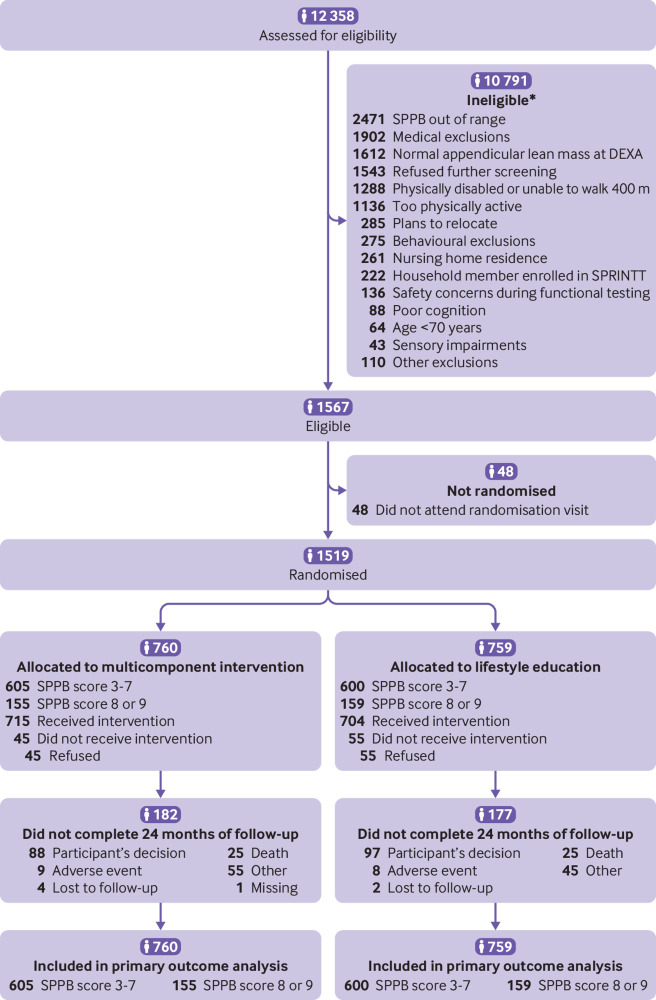
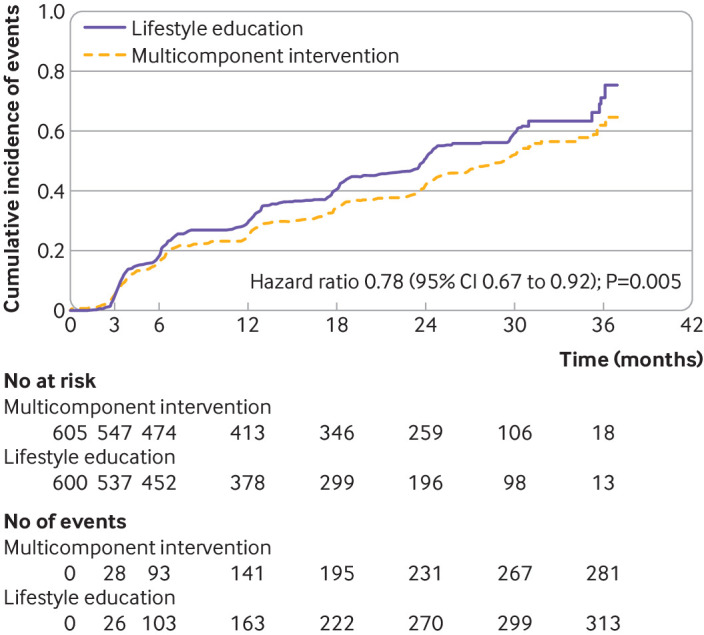
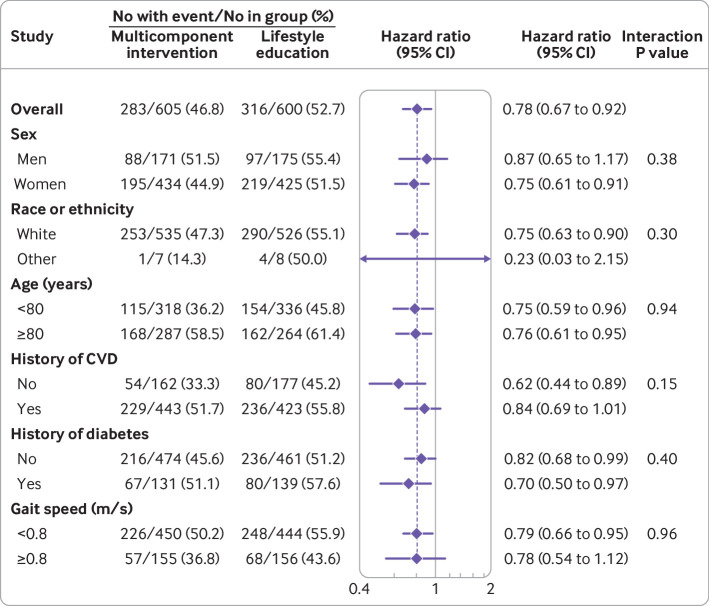
Objective: To determine whether a multicomponent intervention based on physical activity with technological support and nutritional counselling prevents mobility disability in older adults with physical frailty and sarcopenia. Design: Evaluator blinded, randomised controlled trial. Setting: 16 clinical sites across 11 European countries, January 2016 to 31 October 2019. Participants: 1519 community dwelling men and women aged 70 years or older with physical frailty and sarcopenia, operationalised as the co-occurrence of low functional status, defined as a short physical performance battery (SPPB) score of 3 to 9, low appendicular lean mass, and ability to independently walk 400 m. 760 participants were randomised to a multicomponent intervention and 759 received education on healthy ageing (controls). Interventions: The multicomponent intervention comprised moderate intensity physical activity twice weekly at a centre and up to four times weekly at home. Actimetry data were used to tailor the intervention. Participants also received personalised nutritional counselling. Control participants received education on healthy ageing once a month. Interventions and follow-up lasted for up to 36 months. Main outcome measures: The primary outcome was mobility disability (inability to independently walk 400 m in <15 minutes). Persistent mobility disability (inability to walk 400 m on two consecutive occasions) and changes from baseline to 24 and 36 months in physical performance, muscle strength, and appendicular lean mass were analysed as pre-planned secondary outcomes. Primary comparisons were conducted in participants with baseline SPPB scores of 3-7 (n=1205). Those with SPPB scores of 8 or 9 (n=314) were analysed separately for exploratory purposes. Results: Mean age of the 1519 participants (1088 women) was 78.9 (standard deviation 5.8) years. The average follow-up was 26.4 (SD 9.5) months. Among participants with SPPB scores of 3-7, mobility disability occurred in 283/605 (46.8%) assigned to the multicomponent intervention and 316/600 (52.7%) controls (hazard ratio 0.78, 95% confidence interval 0.67 to 0.92; P=0.005). Persistent mobility disability occurred in 127/605 (21.0%) participants assigned to the multicomponent intervention and 150/600 (25.0%) controls (0.79, 0.62 to 1.01; P=0.06). The between group difference in SPPB score was 0.8 points (95% confidence interval 0.5 to 1.1 points; P<0.001) and 1.0 point (95% confidence interval 0.5 to 1.6 points; P<0.001) in favour of the multicomponent intervention at 24 and 36 months, respectively. The decline in handgrip strength at 24 months was smaller in women assigned to the multicomponent intervention than to control (0.9 kg, 95% confidence interval 0.1 to 1.6 kg; P=0.028). Women in the multicomponent intervention arm lost 0.24 kg and 0.49 kg less appendicular lean mass than controls at 24 months (95% confidence interval 0.10 to 0.39 kg; P<0.001) and 36 months (0.26 to 0.73 kg; P<0.001), respectively. Serious adverse events occurred in 237/605 (39.2%) participants assigned to the multicomponent intervention and 216/600 (36.0%) controls (risk ratio 1.09, 95% confidence interval 0.94 to 1.26). In participants with SPPB scores of 8 or 9, mobility disability occurred in 46/155 (29.7%) in the multicomponent intervention and 38/159 (23.9%) controls (hazard ratio 1.25, 95% confidence interval 0.79 to 1.95; P=0.34). Conclusions: A multicomponent intervention was associated with a reduction in the incidence of mobility disability in older adults with physical frailty and sarcopenia and SPPB scores of 3-7. Physical frailty and sarcopenia may be targeted to preserve mobility in vulnerable older people. Trial registration: ClinicalTrials.gov NCT02582138 .
Overview
The claims and statistics of this paper haven’t been checked yet.
Run the check — free, no account needed. It reads the open-access text and checks the sources it cites.
Integrity signals
Registry
Cites
Statistics
Figures
Verification
Claims the paper makes
The claims and statistics of this paper haven’t been checked yet.
Run the check — free, no account needed. It reads the open-access text and checks the sources it cites.
Claims other papers make about this one
Each is checked against this paper’s own text: does it say what the citing paper says it does?
In the citing paper
“A study published in the BMJ 26 in 2022 reported that 337 of the 605 (55.7%) participants in the intervention group and 297 of the 600 (49.5%) participants in the lifestyle education group experienced at least one adverse event (including any adverse event defined by the trial) during the trial (RR: 1.13, 95% CI: 1.01 to 1.25).”
From Exercise for sarcopenia in older people: A systematic review and network meta‐analysis (2023) · cites this paper as [26]
In the citing paper
“There is one large randomized controlled trial (RCT) 26 including 1519 older adults with sarcopenia available but was not included in the two NMAs.”
From Exercise for sarcopenia in older people: A systematic review and network meta‐analysis (2023) · cites this paper as [26]
In the citing paper
“Falls were recorded in 80 of the 605 (13.2%) participants in the multicomponent intervention group and 49 of the 600 (8.2%) participants in the lifestyle education group (RR: 1.62, 95% CI: 1.16 to 2.27). 26”
From Exercise for sarcopenia in older people: A systematic review and network meta‐analysis (2023) · cites this paper as [26]
In the citing paper
“One study 26 published in the BMJ in 2022 reported that death occurred in 31 of the 605 (5.1%) participants in intervention group (moderate‐intensity exercise including aerobic, resistance and balance exercise plus nutrition) and 25 of the 600 (4.2%) participants in the lifestyle education control group (risk ratio [RR]: 1.23, 95% CI: 0.74 to 2.06).”
From Exercise for sarcopenia in older people: A systematic review and network meta‐analysis (2023) · cites this paper as [26]
In the citing paper
“Participants in the multicomponent intervention arm also experienced handgrip strength or muscle mass reductions over 36 months of follow‐up.”
From Exercise for sarcopenia in older people: A systematic review and network meta‐analysis (2023) · cites this paper as [26]
In the citing paper
“A large, randomized trial 26 demonstrated that a multicomponent intervention (exercise and nutritional counselling) could reduce the incidence of mobility disability for people aged 70 years or older with frailty and sarcopenia.”
From Exercise for sarcopenia in older people: A systematic review and network meta‐analysis (2023) · cites this paper as [26]
Self-check
Percentages, sums and reported differences re-computed from the paper’s own numbers.
The self-check needs the paper’s full text.
Citations
Cites
Folstein, M. F., Folstein, S. E., & McHugh, P. R. (1975) · Journal of Psychiatric Research · doi:10.1016/0022-3956(75)90026-6 · Cited by 88,282
Hirono, N., Mori, E., Ikejiri, Y., Imamura, T., Shimomura, T., Hashimoto, M., Yamashita, H., & Ikeda, M. (1997) · PubMed · Cited by 21,012
Kok, J. S., Berg, I. J., & Scherder, E. J. A. (2013) · Dementia and Geriatric Cognitive Disorders Extra · doi:10.1159/000353441 · Cited by 20,589
Older Adults' Reasons for Using Technology while Aging in Place
Peek, S. T. M., Luijkx, K. G., Rijnaard, M. D., Nieboer, M. E., van der Voort, C. S., Aarts, S., van Hoof, J., Vrijhoef, H. J., & Wouters, E. (2015) · Gerontology · doi:10.1159/000430949 · Cited by 19,852
Sensitivity and False Alarm Rate of a Fall Sensor in Long-Term Fall Detection in the Elderly
Kangas, M., Korpelainen, R., Vikman, I., Nyberg, L., & Jämsä, T. J. (2014) · Gerontology · doi:10.1159/000362720 · Cited by 19,007
Guralnik, J. M., Simonsick, E. M., Ferrucci, L., Glynn, R. J., Berkman, L. F., Blazer, D. G., Scherr, P. A., & Wallace, R. B. (1994) · Journal of Gerontology · doi:10.1093/geronj/49.2.m85 · Cited by 9,792
Perceived exertion as an indicator of somatic stress
Borg, G. (1970) · Journal of Rehabilitation Medicine · doi:10.2340/1650197719702239298 · Cited by 4,723
Gait speed and survival in older adults.
Studenski, S. (2011) · JAMA · doi:10.1001/jama.2010.1923 · Cited by 4,558
Ngandu, T., Lehtisalo, J., Solomon, A., Levälahti, E., Ahtiluoto, S., Antikainen, R., Bäckman, L., Hänninen, T., Jula, A., Laatikainen, T., et al. (2015) · The Lancet · doi:10.1016/s0140-6736(15)60461-5 · Cited by 3,689
Self-citationMeaningful change and responsiveness in common physical performance measures in older adults.
Perera, S., Mody, S. H., Woodman, R. C., & Studenski, S. A. (2006) · Journal of the American Geriatrics Society · doi:10.1111/j.1532-5415.2006.00701.x · Cited by 2,513
Cited by
Sorted by citations
Kirk, B., Cawthon, P. M., Arai, H., Ávila‐Funes, J. A., Barazzoni, R., Bhasin, S., Binder, E. F., Bruyère, O., Cederholm, T., Chen, L., et al. (2024) · Age and Ageing · doi:10.1093/ageing/afae052 · Cited by 631
Self-citationSarcopenia definition, diagnosis and treatment: consensus is growing
Sayer, A. A., & Cruz-Jentoft, A. J. (2022) · Age and Ageing · doi:10.1093/ageing/afac220 · Cited by 616
“A recent multicentre randomised controlled trial has shown that a multicomponent intervention comprised of moderate intensity exercise and personalised nutritional counselling can significantly reduce by 22% the incidence of mobility disability (defined as the inability to independently walk 400 m in <15 minutes) in p…”
Self-citationExercise for sarcopenia in older people: A systematic review and network meta‐analysis
Shen, Y., Shi, Q., Nong, K., Li, S., Yue, J., Huang, J., Dong, B., Beauchamp, M., & Hao, Q. (2023) · Journal of Cachexia, Sarcopenia and Muscle · doi:10.1002/jcsm.13225 · Cited by 464
Sayer, A. A., Cooper, R., Arai, H., Cawthon, P. M., Essomba, M.-J. N., Fielding, R. A., Grounds, M. D., Witham, M. D., & Cruz-Jentoft, A. J. (2024) · Nature Reviews Disease Primers · doi:10.1038/s41572-024-00550-w · Cited by 441
“For example, large trials such as the SPRINTT project, involving individuals with physical frailty and sarcopenia, have demonstrated that such interventions can reduce the incidence of mobility disability 100 .”
Self-citationEl Assar, M., Álvarez-Bustos, A., Sosa, P., Angulo, J., & Rodríguez-Mañas, L. (2022) · International Journal of Molecular Sciences · doi:10.3390/ijms23158713 · Cited by 371
“Additionally, the loss of grip strength and muscle mass was lower in women in the intervention group [30], demonstrating that exercise can relieve the decline in functional performance, strength and muscle mass associated with aging.”
Self-citation
Metadata
- Authors
- Bernabei, R., Landi, F., Calvani, R., Cesari, M., Del Signore, S., Anker, S. D., Bejuit, R., Bordes, P., Cherubini, A., Cruz-Jentoft, A. J., Di Bari, M., Friede, T., Gorostiaga Ayestarán, C., Goyeau, H., Jónsson, P. V., Kashiwa, M., Lattanzio, F., Maggio, M., Mariotti, L., Miller, R. R., Rodriguez-Mañas, L., Roller-Wirnsberger, R., Rýznarová, I., Scholpp, J., Schols, A. M. W. J., Sieber, C. C., Sinclair, A. J., Skalska, A., Strandberg, T., Tchalla, A., Topinková, E., Tosato, M., Vellas, B., von Haehling, S., Pahor, M., Roubenoff, R., & Marzetti, E.
- Affiliations
- Università Cattolica del Sacro Cuore (IT)
- Agostino Gemelli University Polyclinic (IT)
- University of Milan (IT)
- Bluecompanion, London, UK
- German Centre for Cardiovascular Research (DE)
- Sanofi-Aventis R&D, Chilly-Mazarin, France
- Sanofi (France) (FR)
- Istituto Nazionale di Riposo e Cura per Anziani (IT)
- Instituto Ramón y Cajal de Investigación Sanitaria (ES)
- Geriatric Intensive Care Medicine, Università degli Studi di Firenze and Azienda Ospedaliero-Universitaria Careggi, Florence, Italy
- Universitätsmedizin Göttingen (DE)
- International Clinical Trial Research Department, Servier, Madrid, Spain
- University of Iceland (IS)
- Astellas Pharma (Japan) (JP)
- University of Parma (IT)
- Translational Medicine, Novartis Institutes for Biomedical Research, Cambridge, MA, USA
- Servicio de Geriatría, Hospital Universitario de Getafe, Getafe, Spain
- Department of Internal Medicine, Medizinische Universität Graz, Graz, Austria
- Silesian Hospital in Opava, Opava, Czech Republic
- Boehringer Ingelheim (Germany) (DE)
- Maastricht University (NL)
- Friedrich-Alexander-Universität Erlangen-Nürnberg (DE)
- Diabetes Frail, Droitwich Spa, UK
- Jagiellonian University (PL)
- University of Helsinki (FI)
- Centre Hospitalier Universitaire de Limoges (FR)
- Charles University (CZ)
- Centre Hospitalier Universitaire de Toulouse (FR)
- German Centre for Cardiovascular Research (DZHK) partner site Göttingen, Goettingen, Germany
- University of Florida (US)
- Novartis (Switzerland) (CH)
- Corresponding author
- Marzetti, Emanuele
- ORCID
- Bernabei, Roberto
- Landi, Francesco
- Calvani, Riccardo
- Cesari, Matteo
- Anker, Stefan D
- Cherubini, Antonio
- Cruz-Jentoft, Alfonso J
- Friede, Tim
- Jónsson, Pálmi V
- Lattanzio, Fabrizia
- Maggio, Marcello
- Miller, Ram R
- Rýznarová, Ingrid
- Schols, Annemie M W J
- Sieber, Cornel C
- Sinclair, Alan J
- Skalska, Anna
- Strandberg, Timo
- Tchalla, Achille
- Topinková, Eva
- Tosato, Matteo
- Vellas, Bruno
- Roubenoff, Ronenn
- Marzetti, Emanuele
- Venue
- BMJ
- Publisher
- BMJ
- Published
- 2022-05-11
- Volume
- 377
- Pages
- e068788
- ISSN
- 1756-1833 (ISSN-L)
- PMC
- PMC9092831
- OpenAlex
- W4280521333
- Cited by
- 318
- References
- 47
- Citations by year
- 2026: 55 · 2025: 82 · 2024: 78 · 2023: 78 · 2022: 25
- FWCI
- 37.56
- Type
- journal article
- Language
- en
- Open access
- hybrid
- doi.org
- Licence
- Locations
- BMJ (publishedVersion, cc-by-nc)
- PubMed Central (publishedVersion, cc-by-nc)
- PubMed (publishedVersion)
- Research Publications (Maastricht University) (publishedVersion, cc-by-nc)
- HAL (submittedVersion, cc-by-nc)
- Opin vísindi (Opin vísindi) (submittedVersion, cc-by-nc-sa)
- PubliCatt (Università Cattolica del Sacro Cuore) (submittedVersion, cc-by-nc)
- Homo Politicus (Academy of Humanities and Economics in Lodz) (submittedVersion, cc-by-nc-nd)
- Florence Research (University of Florence) (submittedVersion, cc-by-nc)
- Työväentutkimus Vuosikirja (submittedVersion)
- Università Politecnica delle Marche (Università Politecnica delle Marche) (submittedVersion, cc-by-nc)
- Opin vísindi (Opin vísindi) (submittedVersion, cc-by-nc)
- Research Publications (Maastricht University) (submittedVersion, other-oa)
- Funders
- Innovative Medicines Initiative
- Topics
- Health Sciences › Medicine › Geriatrics and Gerontology › Frailty in Older Adults
- Health Sciences › Medicine › Physiology (medical) › Nutrition and Health in Aging
- Health Sciences › Health Professions › Physical Therapy, Sports Therapy and Rehabilitation › Balance, Gait, and Falls Prevention
- Keywords
- mobility impairment, frailty, sarcopenia, older adults, multicomponent intervention, physical activity, nutrition counseling, actigraphy, home-based exercise, physical performance, muscle strength, appendicular lean mass, community-dwelling older adults, walking ability
- MeSH terms
- Frailty, Aged, Child, Preschool, Female, Humans, Male, Frail Elderly, Hand Strength, Sarcopenia, Independent Living
About these checks
Registry, retraction, Cites and statistics results are computed, not judged, with one exception: a printed reference that no index lists is read once by a model before it counts as a citation error. Claims are extracted by a model and kept only when their quote appears verbatim in the text; each cited source is then checked, with a model’s help, for whether it says what the claim relies on. Those verdicts can be wrong — read the claim’s quote and the cited source before relying on one.
Statistics and arithmetic are recomputed, not judged.
Confidence bands are shown only for fields calibrated on our annotated test set. None is calibrated yet, so no band is shown.
What counts as a claim ›How we measure confidence ›How we check this ›
Are you an author, or do you see a problem with this page? Request a review
