

The DOI matches its Crossref record; 48 of the 48 references it cites were found in a registry or an index.
Muscular strength in male adolescents and premature death: cohort study of one million participants
Open accessAbstract
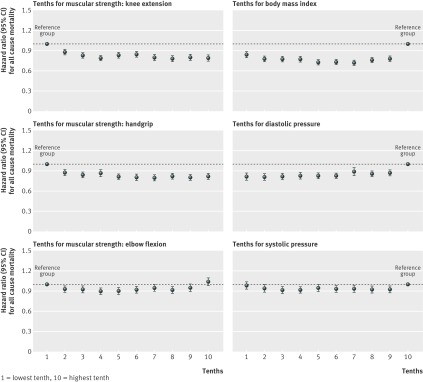
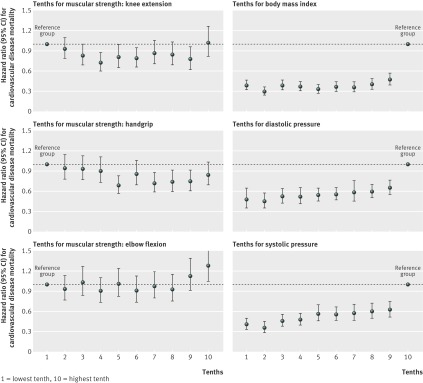
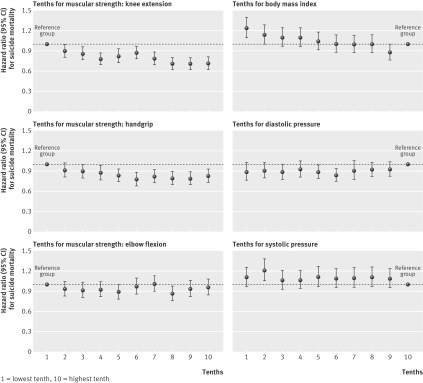
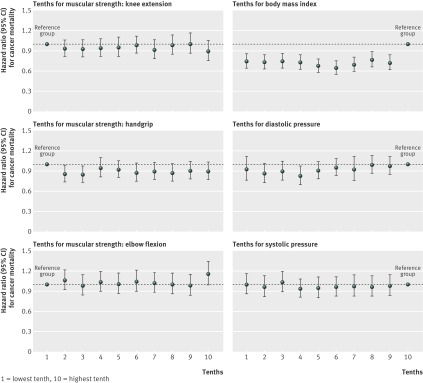
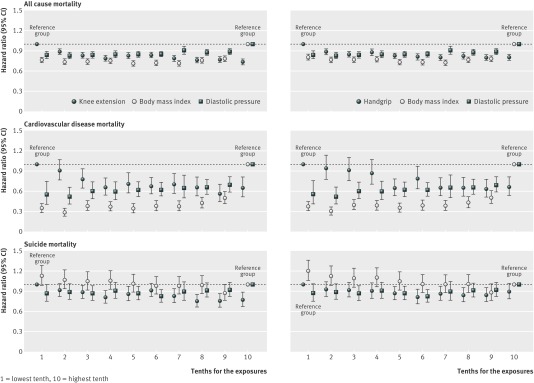
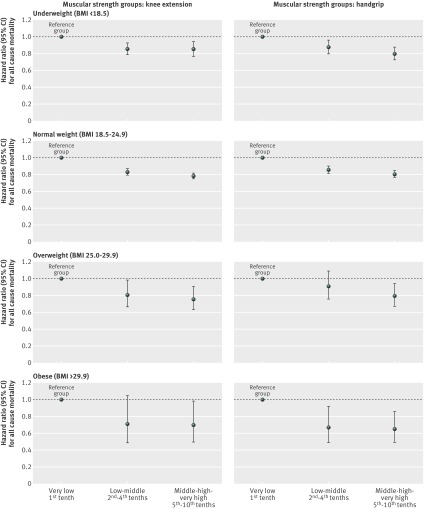
OBJECTIVES: To explore the extent to which muscular strength in adolescence is associated with all cause and cause specific premature mortality (<55 years). DESIGN: Prospective cohort study. SETTING: Sweden. PARTICIPANTS: 1,142,599 Swedish male adolescents aged 16-19 years were followed over a period of 24 years. MAIN OUTCOME MEASURES: Baseline examinations included knee extension, handgrip, and elbow flexion strength tests, as well as measures of diastolic and systolic blood pressure and body mass index. Cox regression was used to estimate hazard ratios for mortality according to muscular strength categories (tenths). RESULTS: During a median follow-up period of 24 years, 26,145 participants died. Suicide was a more frequent cause of death in young adulthood (22.3%) than was cardiovascular diseases (7.8%) or cancer (14.9%). High muscular strength in adolescence, as assessed by knee extension and handgrip tests, was associated with a 20-35% lower risk of premature mortality due to any cause or cardiovascular disease, independently of body mass index or blood pressure; no association was observed with mortality due to cancer. Stronger adolescents had a 20-30% lower risk of death from suicide and were 15-65% less likely to have any psychiatric diagnosis (such as schizophrenia and mood disorders). Adolescents in the lowest tenth of muscular strength showed by far the highest risk of mortality for different causes. All cause mortality rates (per 100,000 person years) ranged between 122.3 and 86.9 for the weakest and strongest adolescents; corresponding figures were 9.5 and 5.6 for mortality due to cardiovascular diseases and 24.6 and 16.9 for mortality due to suicide. CONCLUSIONS: Low muscular strength in adolescents is an emerging risk factor for major causes of death in young adulthood, such as suicide and cardiovascular diseases. The effect size observed for all cause mortality was equivalent to that for well established risk factors such as elevated body mass index or blood pressure.
Overview
The claims and statistics of this paper haven’t been checked yet.
Run the check — free, no account needed. It reads the open-access text and checks the sources it cites.
Integrity signals
Registry
Cites
Statistics
Figures
Verification
Claims the paper makes
The claims and statistics of this paper haven’t been checked yet.
Run the check — free, no account needed. It reads the open-access text and checks the sources it cites.
Claims other papers make about this one
Each is checked against this paper’s own text: does it say what the citing paper says it does?
The source backs part of the claim, not all of it — or backs it for a different population, condition or comparison.
In the citing paper
“it should also be noted that there is now some evidence that muscular strength and resistance training also are protective against mental illness, even independently of general physical activity 88-90 .”
From A meta-review of "lifestyle psychiatry": the role of exercise, smoking, diet and sleep in the prevention and treatment of mental disorders (2020) · cites this paper as [88]
Experimental — accuracy not yet measured
Self-check
Percentages, sums and reported differences re-computed from the paper’s own numbers.
The self-check needs the paper’s full text.
Citations
Cites
Exercise capacity and mortality among men referred for exercise testing
Myers, J., Prakash, M., Froelicher, V., Do, D., Partington, S., & Atwood, J. E. (2002) · New England Journal of Medicine · doi:10.1056/nejmoa011858 · Cited by 4,114
Kodama, S. (2009) · JAMA · doi:10.1001/jama.2009.681 · Cited by 3,035
Childhood Obesity, Other Cardiovascular Risk Factors, and Premature Death
Franks, P. W., Hanson, R. L., Knowler, W. C., Sievers, M. L., Bennett, P. H., & Looker, H. C. (2010) · New England Journal of Medicine · doi:10.1056/nejmoa0904130 · Cited by 1,382
Skeletal Muscle Strength as a Predictor of All-Cause Mortality in Healthy Men
Metter, E. J., Talbot, L. A., Schrager, M., & CONWIT, R. A. (2002) · The Journals of Gerontology Series A · doi:10.1093/gerona/57.10.b359 · Cited by 854
Association between muscular strength and mortality in men: prospective cohort study
Ruiz, J. R., Sui, X., Lobelo, F., Morrow, J. R., Jackson, A. W., Sjostrom, M., & Blair, S. N. (2008) · BMJ · doi:10.1136/bmj.a439 · Cited by 815
Ruiz, J. R., Castro‐Piñero, J., España‐Romero, V., Artero, E. G., Ortega, F. B., Cuenca, M. M., Jiménez‐Pavón, D., Chillón, P., Girela‐Rejón, M. J., Mora, J., et al. (2010) · British Journal of Sports Medicine · doi:10.1136/bjsm.2010.075341 · Cited by 771
Self-citationGrip strength, body composition, and mortality
Galé, C. R., Martyn, C., Cooper, C. C., & Sayer, A. A. (2006) · International Journal of Epidemiology · doi:10.1093/ije/dyl224 · Cited by 740
Muscle strength and body mass index as long-term predictors of mortality in initially healthy men
Rantanen, T., Harris, T., Leveille, S. G., Visser, M., Foley, D., Masaki, K., & Guralnik, J. M. (2000) · The Journals of Gerontology Series A: Biological Sciences and Medical Sciences · doi:10.1093/gerona/55.3.m168 · Cited by 647
Physical fitness levels among European adolescents: the HELENA study
Ortega, F. B., Artero, E. G., Ruiz, J. R., España‐Romero, V., Jiménez‐Pavón, D., Vicente‐Rodríguez, G., Moreno, L. A., Μanios, Y., Béghin, L., Ottevaere, C., et al. (2009) · British Journal of Sports Medicine · doi:10.1136/bjsm.2009.062679 · Cited by 521
Self-citationGrip Strength Predicts Cause-Specific Mortality in Middle-Aged and Elderly Persons
Sasaki, H., Kasagi, F., Yamada, M., & Fujita, S. (2007) · The American Journal of Medicine · doi:10.1016/j.amjmed.2006.04.018 · Cited by 500
Cited by
Sorted by citations
2021 ESC Guidelines on cardiovascular disease prevention in clinical practice
Visseren, F. L. J., Mach, F., Smulders, Y. M., Carballo, D., Koskinas, K. C., Bäck, M., Benetos, A., Biffi, A., Boavida, J.-M., Capodanno, D., et al. (2021) · European Heart Journal · doi:10.1093/eurheartj/ehab484 · Cited by 6,485
Leong, D. P., Teo, K. K., Rangarajan, S., Lopez-Jaramillo, P., Avezum, A., Orlandini, A., Seron, P., Ahmed, S. H., Rosengren, A., Kelishadi, R., et al. (2015) · The Lancet · doi:10.1016/s0140-6736(14)62000-6 · Cited by 1,876
Firth, J., Solmi, M., Wootton, R. E., Vancampfort, D., Schuch, F. B., Hoare, E., Gilbody, S., Torous, J., Teasdale, S. B., Jackson, S. E., et al. (2020) · World Psychiatry · doi:10.1002/wps.20773 · Cited by 1,242
Celis-Morales, C. A., Welsh, P., Lyall, D. M., Steell, L., Petermann, F., Anderson, J., Iliodromiti, S., Sillars, A., Graham, N., Mackay, D. F., et al. (2018) · BMJ · doi:10.1136/bmj.k1651 · Cited by 772
Role of Inactivity in Chronic Diseases: Evolutionary Insight and Pathophysiological Mechanisms
Booth, F. W., Roberts, C. K., Thyfault, J. P., Ruegsegger, G. N., & Toedebusch, R. G. (2017) · Physiological Reviews · doi:10.1152/physrev.00019.2016 · Cited by 696
Metadata
- Authors
- Ortega, F. B., Silventoinen, K., Tynelius, P., & Rasmussen, F.
- Affiliations
- Universidad de Granada (ES)
- University of Helsinki (FI)
- Karolinska Institutet (SE)
- Corresponding author
- Rasmussen, F.
- Venue
- BMJ
- Publisher
- BMJ
- Published
- 2012-11-20
- Volume
- 345
- Issue
- nov20 3
- Pages
- e7279-e7279
- ISSN
- 1756-1833 (ISSN-L)
- PMC
- PMC3502746
- OpenAlex
- W2109995138
- Cited by
- 555
- References
- 48
- Citations by year
- 2026: 24 · 2025: 31 · 2024: 42 · 2023: 52 · 2022: 65 · 2021: 48 · 2020: 45 · 2019: 50 · 2018: 50 · 2017: 46 · 2016: 37 · 2015: 25 · 2014: 21 · 2013: 15 · 2012: 4
- FWCI
- 13.94
- Type
- journal article
- Language
- en
- Open access
- hybrid
- doi.org
- Licence
- cc-by-nc
- Locations
- BMJ (publishedVersion, cc-by-nc)
- PubMed Central (publishedVersion, cc-by-nc)
- PubMed (publishedVersion)
- Institutional Repository of the University of Granada (University of Granada) (submittedVersion, cc-by-nc)
- LA Referencia (Red Federada de Repositorios Institucionales de Publicaciones Científicas) (submittedVersion, cc-by-nc)
- Työväentutkimus Vuosikirja (submittedVersion, cc-by-nc)
- Funders
- Vetenskapsrådet
- Ministerio de Ciencia e Innovación (RYC‐2011‐09011)
- Topics
- Health Sciences › Medicine › Public Health, Environmental and Occupational Health › Physical Activity and Health
- Social Sciences › Health › Health disparities and outcomes
- Health Sciences › Medicine › Physiology (medical) › Cardiovascular and exercise physiology
- Keywords
- muscle strength, adolescent physical fitness, premature mortality, suicide, cardiovascular mortality, cancer mortality, grip strength, quadriceps strength, elbow flexion strength, young adult mortality, body mass index, blood pressure, mental illness, schizophrenia, mood disorders
- MeSH terms
- Adolescent, Cause of Death, Humans, Male, Prospective Studies, Cohort Studies, Muscle Strength, Mortality, Premature
About these checks
Registry, retraction, Cites and statistics results are computed, not judged, with one exception: a printed reference that no index lists is read once by a model before it counts as a citation error. Claims are extracted by a model and kept only when their quote appears verbatim in the text; each cited source is then checked, with a model’s help, for whether it says what the claim relies on. Those verdicts can be wrong — read the claim’s quote and the cited source before relying on one.
Statistics and arithmetic are recomputed, not judged.
Confidence bands are shown only for fields calibrated on our annotated test set. None is calibrated yet, so no band is shown.
What counts as a claim ›How we measure confidence ›How we check this ›
Are you an author, or do you see a problem with this page? Request a review
