

The DOI matches its Crossref record; 57 of the 57 references it cites were found in a registry or an index.
Evaluating the risk of ovarian cancer before surgery using the ADNEX model to differentiate between benign, borderline, early and advanced stage invasive, and secondary metastatic tumours: prospective multicentre diagnostic study
Open accessAbstract
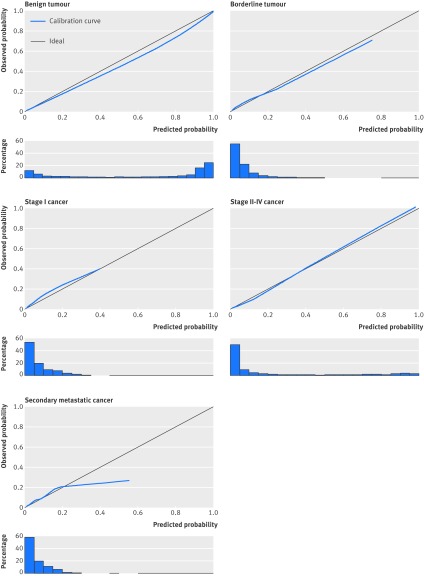
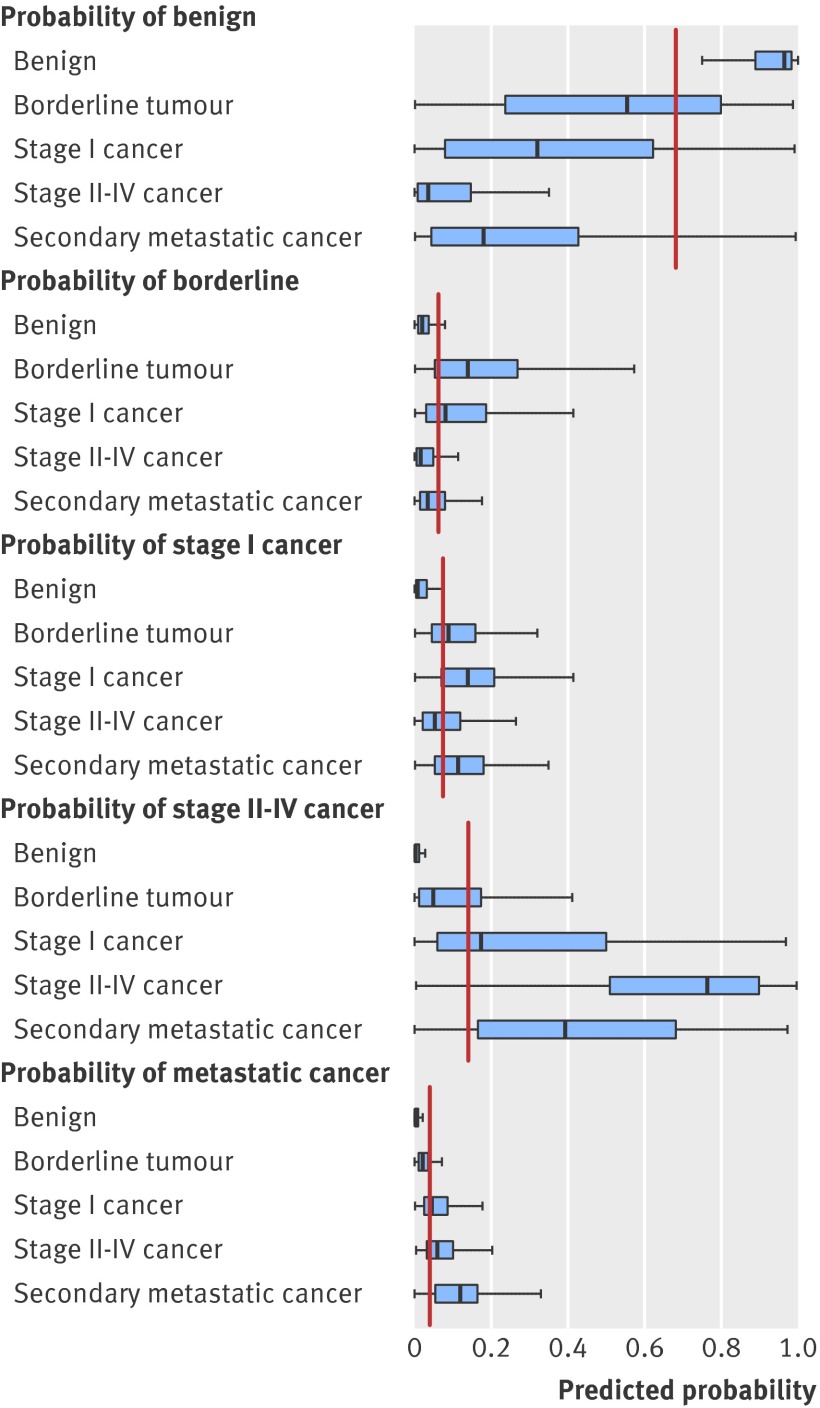
OBJECTIVES: To develop a risk prediction model to preoperatively discriminate between benign, borderline, stage I invasive, stage II-IV invasive, and secondary metastatic ovarian tumours. DESIGN: Observational diagnostic study using prospectively collected clinical and ultrasound data. SETTING: 24 ultrasound centres in 10 countries. PARTICIPANTS: Women with an ovarian (including para-ovarian and tubal) mass and who underwent a standardised ultrasound examination before surgery. The model was developed on 3506 patients recruited between 1999 and 2007, temporally validated on 2403 patients recruited between 2009 and 2012, and then updated on all 5909 patients. MAIN OUTCOME MEASURES: Histological classification and surgical staging of the mass. RESULTS: The Assessment of Different NEoplasias in the adneXa (ADNEX) model contains three clinical and six ultrasound predictors: age, serum CA-125 level, type of centre (oncology centres v other hospitals), maximum diameter of lesion, proportion of solid tissue, more than 10 cyst locules, number of papillary projections, acoustic shadows, and ascites. The area under the receiver operating characteristic curve (AUC) for the classic discrimination between benign and malignant tumours was 0.94 (0.93 to 0.95) on temporal validation. The AUC was 0.85 for benign versus borderline, 0.92 for benign versus stage I cancer, 0.99 for benign versus stage II-IV cancer, and 0.95 for benign versus secondary metastatic. AUCs between malignant subtypes varied between 0.71 and 0.95, with an AUC of 0.75 for borderline versus stage I cancer and 0.82 for stage II-IV versus secondary metastatic. Calibration curves showed that the estimated risks were accurate. CONCLUSIONS: The ADNEX model discriminates well between benign and malignant tumours and offers fair to excellent discrimination between four types of ovarian malignancy. The use of ADNEX has the potential to improve triage and management decisions and so reduce morbidity and mortality associated with adnexal pathology.
Overview
The claims and statistics of this paper haven’t been checked yet.
Run the check — free, no account needed. It reads the open-access text and checks the sources it cites.
Integrity signals
Registry
Cites
Statistics
Figures
Verification
Claims the paper makes
The claims and statistics of this paper haven’t been checked yet.
Run the check — free, no account needed. It reads the open-access text and checks the sources it cites.
Claims other papers make about this one
Each is checked against this paper’s own text: does it say what the citing paper says it does?
In the citing paper
“The ADNEX model, developed by the International Ovarian Tumor Analysis (IOTA) consortium (authors BVC and DT are part of this consortium), preoperatively estimates the probability of malignancy in women with an ovarian tumour who are scheduled for surgery. 31”
From Evaluation of performance measures in predictive artificial intelligence models to support medical decisions: overview and guidance (2025) · cites this paper as [31]
In the citing paper
“ADNEX was developed on the data from 5909 individuals recruited between 1999 and 2012 in 24 secondary and tertiary care centres from 10 countries (Italy, Belgium, Sweden, Czech Republic, Poland, France, United Kingdom, China, Spain, and Canada).”
From Evaluation of performance measures in predictive artificial intelligence models to support medical decisions: overview and guidance (2025) · cites this paper as [31]
Self-check
Percentages, sums and reported differences re-computed from the paper’s own numbers.
The self-check needs the paper’s full text.
Citations
Cites
(1990) · Choice Reviews Online · doi:10.5860/choice.27-3338 · Cited by 35,305
Hosmer, D. W., & Lemeshow, S. (2000) · doi:10.1002/0471722146 · Cited by 20,302
Siegel, R., Ma, J., Zou, Z., & Jemal, A. (2014) · CA: A Cancer Journal for Clinicians · doi:10.3322/caac.21208 · Cited by 11,499
SEER Cancer Statistics Review, 1975-2003
Ries, L. A. G., Harkins, D., Krapcho, M. F., Mariotto, A. B., Miller, B., Feuer, E. J., Clegg, L. X., Eisner, M. P., Horner, M., Howlader, N., et al. (2006) · Digital Archive @ GSU · Cited by 11,404
Regression Modeling Strategies
Harrell, F. E. (2001) · Springer series in statistics · doi:10.1007/978-1-4757-3462-1 · Cited by 9,270
Sterne, J. A. C., White, I. R., Carlin, J. B., Spratt, M., Royston, P., Kenward, M. G., Wood, A. M., & Carpenter, J. R. (2009) · BMJ · doi:10.1136/bmj.b2393 · Cited by 7,299
Signet-Ring Cell Carcinoma of the Colon: A Case Report and Review of the Literature
Park, P. Y., Goldin, T. A., Chang, J. C. S., Markman, M. M., & Kundranda, M. N. (2015) · Case Reports in Oncology · doi:10.1159/000441772 · Cited by 5,273
Clinical Prediction Models: A Practical Approach to Development, Validation, and Updating
Steyerberg, E. W. (2019) · Statistics for Biology and Health · doi:10.1007/978-3-030-16399-0 · Cited by 3,281
Rubin, M., & Stephen, C. D. (1993) · Cited by 3,149
Rao, S. J. (2003) · Journal of the American Statistical Association · doi:10.1198/jasa.2003.s263 · Cited by 1,967
Cited by
Sorted by citations
Andreotti, R. F., Timmerman, D., Strachowski, L. M., Froyman, W., Benacerraf, B. R., Bennett, G. L., Bourne, T., Brown, D. L., Coleman, B. G., Frates, M. C., et al. (2019) · Radiology · doi:10.1148/radiol.2019191150 · Cited by 530
van den Goorbergh, R., van Smeden, M., Timmerman, D., & CALSTER, B. V. (2022) · Journal of the American Medical Informatics Association · doi:10.1093/jamia/ocac093 · Cited by 427
Timmerman, D., CALSTER, B. V., Testa, A. C., Savelli, L., Fischerová, D., Froyman, W., Wynants, L., Holsbeke, C. V., Epstein, E., Franchi, D., et al. (2016) · American Journal of Obstetrics and Gynecology · doi:10.1016/j.ajog.2016.01.007 · Cited by 337
Meys, E. M. J., Kaijser, J., Kruitwagen, R. F. P. M., Slangen, B. F. M., CALSTER, B. V., Aertgeerts, B., Verbakel, J. Y. J., Timmerman, D., & Gorp, T. V. (2016) · European Journal of Cancer · doi:10.1016/j.ejca.2016.01.007 · Cited by 281
“Someof thesehavenotbeenvalidatedextensivelybut seem promising, such as the ADNEX-model [83].”
BackgroundClinical Use of Cancer Biomarkers in Epithelial Ovarian Cancer
Sölétormos, G., Duffy, M. J., Hassan, S. O. A., Verheijen, R. H. M., Tholander, B., Bast, R. C., Gaarenstroom, K. N., Sturgeon, C. M., Bonfrèr, J. M. G., Petersen, P. H., et al. (2015) · International Journal of Gynecological Cancer · doi:10.1097/igc.0000000000000586 · Cited by 255
“Assessment of Different NEoplasias in the adneXa.(33) The National Institute for Health and Care Excellence has introduced guidelines for early detection of ovarian cancer in symptomatic women for use by general practitioners.”
Metadata
- Authors
- Van Calster, B., Van Hoorde, K., Valentin, L., Testa, A. C., Fischerova, D., Van Holsbeke, C., Savelli, L., Franchi, D., Epstein, E., Kaijser, J., Van Belle, V., Czekierdowski, A., Guerriero, S., Fruscio, R., Lanzani, C., Scala, F., Bourne, T., Timmerman, D., & International Ovarian Tumour Analysis (IOTA) group
- Affiliations
- Lund University (SE)
- Università Cattolica del Sacro Cuore (IT)
- IRCCS Azienda Ospedliero-Universitaria di Bologna Policlinico di Sant'Orsola (IT)
- European Institute of Oncology (IT)
- Karolinska University Hospital (SE)
- Universitair Ziekenhuis Leuven (BE)
- Medical University of Lublin (PL)
- Azienda Ospedaliero-Universitaria Cagliari (IT)
- University of Milan (IT)
- Istituto Nazionale Tumori IRCCS "Fondazione G. Pascale" (IT)
- ORCID
- Venue
- BMJ
- Publisher
- BMJ
- Published
- 2014-10-15
- Volume
- 349
- Issue
- oct07 3
- Pages
- g5920-g5920
- ISSN
- 1756-1833 (ISSN-L)
- PMC
- PMC4198550
- OpenAlex
- W2099878111
- Cited by
- 510
- References
- 57
- Citations by year
- 2026: 52 · 2025: 60 · 2024: 70 · 2023: 54 · 2022: 55 · 2021: 59 · 2020: 36 · 2019: 24 · 2018: 30 · 2017: 19 · 2016: 27 · 2015: 19 · 2014: 4
- FWCI
- 27.87
- Type
- journal article
- Language
- en
- Open access
- hybrid
- doi.org
- Licence
- cc-by-nc
- Locations
- BMJ (publishedVersion, cc-by-nc)
- PubMed Central (publishedVersion, cc-by-nc)
- PubMed (publishedVersion)
- BOA (University of Milano-Bicocca) (submittedVersion, cc-by-nc)
- Lirias (KU Leuven) (submittedVersion, cc-by-nc)
- UNICA IRIS Institutional Research Information System (University of Cagliari) (submittedVersion, other-oa)
- Lund University Publications (Lund University) (submittedVersion, other-oa)
- HighWire Press Open Archive (submittedVersion)
- PubliCatt (Università Cattolica del Sacro Cuore) (submittedVersion, cc-by-nc)
- Spiral (Imperial College London) (submittedVersion, other-oa)
- Funders
- National Institute for Health and Care Research
- Imperial College London
- Imperial College Healthcare NHS Trust
- Fonds Wetenschappelijk Onderzoek (G049312N)
- iMinds
- Malmö Högskola
- Skånes universitetssjukhus
- Vlaamse regering (G049312N)
- Medical Research Council
- Topics
- Health Sciences › Medicine › Oncology › Ovarian cancer diagnosis and treatment
- Life Sciences › Biochemistry, Genetics and Molecular Biology › Genetics › BRCA gene mutations in cancer
- Health Sciences › Medicine › Pathology and Forensic Medicine › Breast Lesions and Carcinomas
- Keywords
- ovarian cancer, ADNEX model, preoperative risk prediction, ovarian ultrasonography, borderline ovarian tumors, CA125, surgical staging, adnexal mass, triage
- MeSH terms
- Adnexal Diseases, Adult, Female, Humans, Neoplasm Staging, Ovarian Neoplasms, Predictive Value of Tests, Prospective Studies, Ultrasonography, Models, Statistical, Risk Assessment
About these checks
Registry, retraction, Cites and statistics results are computed, not judged, with one exception: a printed reference that no index lists is read once by a model before it counts as a citation error. Claims are extracted by a model and kept only when their quote appears verbatim in the text; each cited source is then checked, with a model’s help, for whether it says what the claim relies on. Those verdicts can be wrong — read the claim’s quote and the cited source before relying on one.
Statistics and arithmetic are recomputed, not judged.
Confidence bands are shown only for fields calibrated on our annotated test set. None is calibrated yet, so no band is shown.
What counts as a claim ›How we measure confidence ›How we check this ›
Are you an author, or do you see a problem with this page? Request a review
