

The DOI matches its Crossref record; 39 of the 40 references it cites were found in a registry or an index.
Uptake, outcomes, and costs of implementing non-invasive prenatal testing for Down's syndrome into NHS maternity care: prospective cohort study in eight diverse maternity units
Open accessAbstract
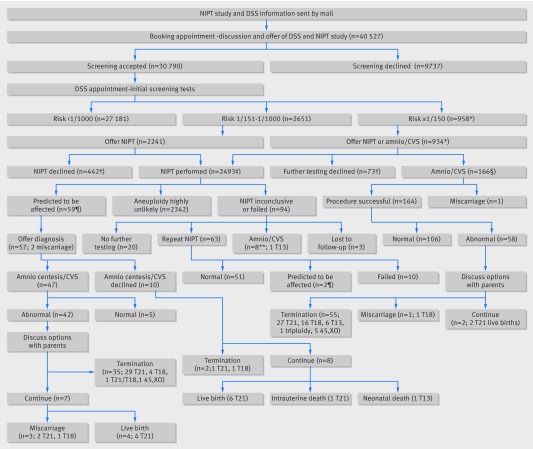
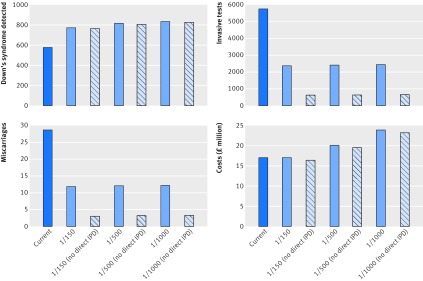
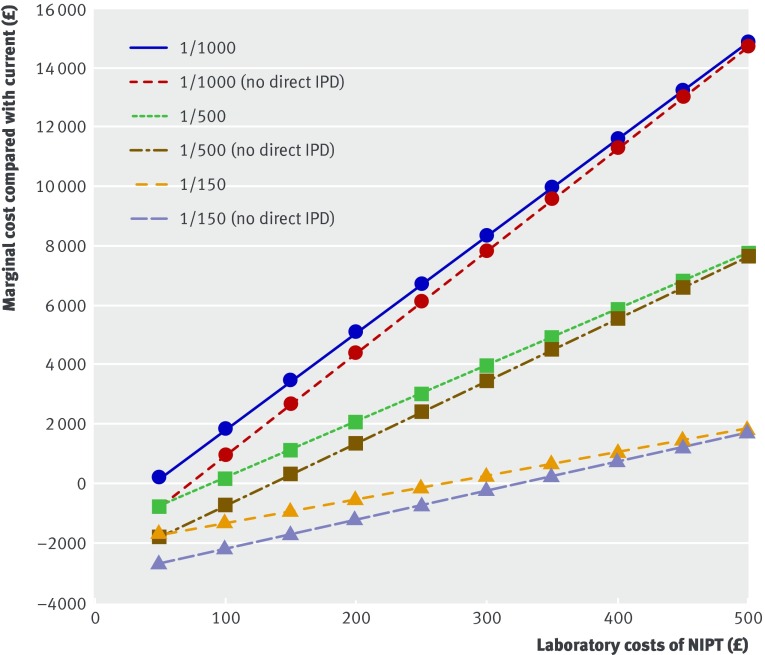
OBJECTIVE: To investigate the benefits and costs of implementing non-invasive prenatal testing (NIPT) for Down's syndrome into the NHS maternity care pathway. DESIGN: Prospective cohort study. SETTING: Eight maternity units across the United Kingdom between 1 November 2013 and 28 February 2015. PARTICIPANTS: All pregnant women with a current Down's syndrome risk on screening of at least 1/1000. MAIN OUTCOME MEASURES: Outcomes were uptake of NIPT, number of cases of Down's syndrome detected, invasive tests performed, and miscarriages avoided. Pregnancy outcomes and costs associated with implementation of NIPT, compared with current screening, were determined using study data on NIPT uptake and invasive testing in combination with national datasets. RESULTS: NIPT was prospectively offered to 3175 pregnant women. In 934 women with a Down's syndrome risk greater than 1/150, 695 (74.4%) chose NIPT, 166 (17.8%) chose invasive testing, and 73 (7.8%) declined further testing. Of 2241 women with risks between 1/151 and 1/1000, 1799 (80.3%) chose NIPT. Of 71 pregnancies with a confirmed diagnosis of Down's syndrome, 13/42 (31%) with the diagnosis after NIPT and 2/29 (7%) after direct invasive testing continued, resulting in 12 live births. In an annual screening population of 698 500, offering NIPT as a contingent test to women with a Down's syndrome screening risk of at least 1/150 would increase detection by 195 (95% uncertainty interval -34 to 480) cases with 3368 (2279 to 4027) fewer invasive tests and 17 (7 to 30) fewer procedure related miscarriages, for a non-significant difference in total costs (£-46 000, £-1 802 000 to £2 661 000). The marginal cost of NIPT testing strategies versus current screening is very sensitive to NIPT costs; at a screening threshold of 1/150, NIPT would be cheaper than current screening if it cost less than £256. Lowering the risk threshold increases the number of Down's syndrome cases detected and overall costs, while maintaining the reduction in invasive tests and procedure related miscarriages. CONCLUSIONS: Implementation of NIPT as a contingent test within a public sector Down's syndrome screening programme can improve quality of care, choices for women, and overall performance within the current budget. As some women use NIPT for information only, the Down's syndrome live birth rate may not change significantly. Future research should consider NIPT uptake and informed decision making outside of a research setting.
Overview
The claims and statistics of this paper haven’t been checked yet.
Run the check — free, no account needed. It reads the open-access text and checks the sources it cites.
Integrity signals
Registry
Cites
Statistics
Figures
Verification
Claims the paper makes
The claims and statistics of this paper haven’t been checked yet.
Run the check — free, no account needed. It reads the open-access text and checks the sources it cites.
Claims other papers make about this one
Each is checked against this paper’s own text: does it say what the citing paper says it does?
In the citing paper
“The usefulness of this marker is limited by the uptake of trisomy screening, which is around 66% in the UK [12].”
From Volume and vascularity: Using ultrasound to unlock the secrets of the first trimester placenta (2019) · cites this paper as [12]
Self-check
Percentages, sums and reported differences re-computed from the paper’s own numbers.
The self-check needs the paper’s full text.
Citations
Cites
Yaşlı Kadınlarda Üreme Sağlığı
Kokanalı, D., & Engin Üstün, Y. (n.d.) · DergiPark (Istanbul University) · Cited by 170,090
Two new Later Stone Age sites from the Final Pleistocene in the Falémé Valley, eastern Senegal
Ndiaye, M., Lespez, L., Tribolo, C., Rassé, M., Hadjas, I., Davidoux, S., Huysecom, É., & Douze, K. (2024) · Monash University Research Portal (Monash University) · doi:10.3929/ethz-b-000667478 · Cited by 24,214
Palomaki, G. E., Kloza, E. M., Lambert-Messerlian, G. M., Haddow, J. E., Neveux, L. M., Ehrich, M., van den Boom, D., Bombard, A. T., Deciu, C., Grody, W. W., et al. (2011) · Genetics in Medicine · doi:10.1097/gim.0b013e3182368a0e · Cited by 937
Gil, M. M., Quezada, M. S., Revello, R., Akolekar, R., & Nicolaides, K. H. (2015) · Ultrasound in Obstetrics and Gynecology · doi:10.1002/uog.14791 · Cited by 822
Cell-free DNA Analysis for Noninvasive Examination of Trisomy
Norton, M. E., Jacobsson, B., Swamy, G. K., Laurent, L. C., Ranzini, A. C., Brar, H., Tomlinson, M. W., Pereira, L., Spitz, J. L., Hollemon, D., et al. (2015) · New England Journal of Medicine · doi:10.1056/nejmoa1407349 · Cited by 817
Update on Procedure-Related Risks for Prenatal Diagnosis Techniques
Tabor, A., & Alfirević, Ž. (2009) · Fetal Diagnosis and Therapy · doi:10.1159/000271995 · Cited by 398
Zhang, H., Gao, Y. M., Jiang, F., Fu, M., Yuan, Y., Guo, Y., Zhu, Z., Lin, M.-W., Liu, Q., Tian, Z., et al. (2015) · Ultrasound in Obstetrics and Gynecology · doi:10.1002/uog.14792 · Cited by 394
(2015) · Obstetrics and Gynecology · doi:10.1097/aog.0000000000001051 · Cited by 350
BENN, P. A., BORRELL, A., Chiu, R. W. K., Cuckle, H., Dugoff, L., Faas, B. H. W., Gross, S. J., Huang, T., Johnson, J.-A. M., Maymon, R., et al. (2015) · Prenatal Diagnosis · doi:10.1002/pd.4608 · Cited by 299
Self-citationACMG statement on noninvasive prenatal screening for fetal aneuploidy
Gregg, A. R., Gross, S. J., Best, R. G., Monaghan, K. G., Bajaj, K., Skotko, B. G., Thompson, B. H., & Watson, M. (2013) · Genetics in Medicine · doi:10.1038/gim.2013.29 · Cited by 272
Research works printed but not linked: 3
- [13]Cuckle H, Benn P, Pergament E. Maternal cfDNA screening for Down syndrome--a cost sensitivity analysis. Prenat Diagn 2013; 33: 636- 42. 10.1002/pd.4157 pmid:23674341. 23674341 · DOI
- [14]Garfield SS, Armstrong SO. Clinical and cost consequences of incorporating a novel non-invasive prenatal test into the diagnostic pathway for fetal trisomies. J Managed Care Med 2012; 15: 34- 41.
- [35]National Institute for Health and Care Excellence. Developing NICE guidelines: the manual. NICE, 2014 (available from https://www.nice.org.uk/article/pmg20/chapter/glossary#costconsequences-analysis). 26677490
Cited by
Sorted by citations
Gil, M. M., Quezada, M. S., Revello, R., Akolekar, R., & Nicolaides, K. H. (2015) · Ultrasound in Obstetrics and Gynecology · doi:10.1002/uog.14791 · Cited by 822
Analysis of cell-free DNA in maternal blood in screening for aneuploidies: Updated meta-analysis
Gil, M. M., Accurti, V., Santacruz, B., Plana, M. N., & Nicolaides, K. H. (2017) · Ultrasound in Obstetrics & Gynecology · doi:10.1002/uog.17484 · Cited by 683
Sequencing of Circulating Cell-free DNA during Pregnancy
Bianchi, D. W., & Chiu, R. W. K. (2018) · New England Journal of Medicine · doi:10.1056/nejmra1705345 · Cited by 315
The Emergence and Global Spread of Noninvasive Prenatal Testing
Ravitsky, V., Roy, M., Haidar, H., Henneman, L., Marshall, J., Newson, A. J., Ngan, O. M. Y., & Nov‐Klaiman, T. (2021) · Annual Review of Genomics and Human Genetics · doi:10.1146/annurev-genom-083118-015053 · Cited by 150
Hui, L., Ellis, K., Mayen, D., Pertile, M. D., Reimers, R., Sun, L., Vermeesch, J., Vora, N. L., & Chitty, L. S. (2023) · Prenatal Diagnosis · doi:10.1002/pd.6357 · Cited by 109
Self-citation
Metadata
- Authors
- Chitty, L. S., Wright, D., Hill, M., Verhoef, T. I., Daley, R., Lewis, C., Mason, S., McKay, F., Jenkins, L., Howarth, A., Cameron, L., McEwan, A., Fisher, J., Kroese, M., & Morris, S.
- Affiliations
- Great Ormond Street Hospital (GB)
- University of Plymouth (GB)
- University College London (GB)
- Great Ormond Street Hospital for Children NHS Foundation Trust (GB)
- PHG Foundation (GB)
- Nottingham University Hospitals NHS Trust (GB)
- Corresponding author
- Chitty, Lyn S
- ORCID
- Venue
- BMJ
- Publisher
- BMJ
- Published
- 2016-07-04
- Volume
- 354
- Pages
- i3426
- ISSN
- 1756-1833 (ISSN-L)
- PMC
- PMC4933930
- OpenAlex
- W2462899390
- Cited by
- 149
- References
- 40
- Citations by year
- 2026: 4 · 2025: 5 · 2024: 5 · 2023: 11 · 2022: 11 · 2021: 14 · 2020: 16 · 2019: 26 · 2018: 20 · 2017: 30 · 2016: 6
- FWCI
- 31.81
- Type
- journal article
- Language
- en
- Open access
- hybrid
- doi.org
- Locations
- BMJ (publishedVersion, cc-by)
- PubMed Central (publishedVersion, cc-by)
- PubMed (publishedVersion)
- UCL Discovery (University College London) (submittedVersion)
- Figshare (submittedVersion, cc-by)
- HighWire Press Open Archive (submittedVersion)
- Funders
- National Institute for Health and Care Research (NF-SI-0513-10141, RP-PG-0707-10107)
- Great Ormond Street Hospital Charity
- Programme Grants for Applied Research (RP-PG-0707-10107)
- Topics
- Health Sciences › Medicine › Pediatrics, Perinatology and Child Health › Prenatal Screening and Diagnostics
- Health Sciences › Medicine › Public Health, Environmental and Occupational Health › Down syndrome and intellectual disability research
- Health Sciences › Medicine › Obstetrics and Gynecology › Maternal and Perinatal Health Interventions
- Keywords
- non-invasive prenatal testing, Down syndrome, prenatal screening, implementation costs, invasive prenatal diagnosis, miscarriage prevention, screening thresholds, diagnostic accuracy, pregnancy outcomes, cost-effectiveness, NHS Health Scotland
- MeSH terms
- Cost-Benefit Analysis, Down Syndrome, Female, Genetic Testing, United Kingdom, Humans, Maternal Age, Patient Acceptance of Health Care, Pregnancy, Pregnancy Outcome, Pregnancy Trimester, Second, Prenatal Diagnosis, Prospective Studies
About these checks
Registry, retraction, Cites and statistics results are computed, not judged, with one exception: a printed reference that no index lists is read once by a model before it counts as a citation error. Claims are extracted by a model and kept only when their quote appears verbatim in the text; each cited source is then checked, with a model’s help, for whether it says what the claim relies on. Those verdicts can be wrong — read the claim’s quote and the cited source before relying on one.
Statistics and arithmetic are recomputed, not judged.
Confidence bands are shown only for fields calibrated on our annotated test set. None is calibrated yet, so no band is shown.
What counts as a claim ›How we measure confidence ›How we check this ›
Are you an author, or do you see a problem with this page? Request a review
