

ROBINS-I: a tool for assessing risk of bias in non-randomised studies of interventions
Open accessThe DOI matches its Crossref record; 27 of the 27 references it cites were found in a registry or an index; none of the 8 sources its claims cite is checked for support yet.
Abstract
Non-randomised studies of the effects of interventions are critical to many areas of healthcare evaluation, but their results may be biased. It is therefore important to understand and appraise their strengths and weaknesses. We developed ROBINS-I (“Risk Of Bias In Non-randomised Studies - of Interventions”), a new tool for evaluating risk of bias in estimates of the comparative effectiveness (harm or benefit) of interventions from studies that did not use randomisation to allocate units (individuals or clusters of individuals) to comparison groups. The tool will be particularly useful to those undertaking systematic reviews that include non-randomised studies.
Overview
CoChat Summary
TL;DR
The authors developed ROBINS-I, a consensus-based tool for assessing risk of bias in non-randomised studies of interventions by comparing each study with a hypothetical pragmatic randomised “target” trial. It assesses seven bias domains using signalling questions and produces domain-level and overall risk-of-bias judgements.
Key findings
- ROBINS-I was developed over three years by expert consensus, with piloting and user feedback, and covers seven distinct bias domains: confounding, selection of participants, classification of interventions, deviations from intended interventions, missing data, measurement of outcomes, and selection of the reported result.
- The tool uses signalling questions with response options “Yes,” “Probably yes,” “Probably no,” “No,” and “No information” to inform domain-level judgements.
- Risk-of-bias judgements are categorised as “Low risk,” “Moderate risk,” “Serious risk,” and “Critical risk”; “Low risk” corresponds to the risk of bias in a high quality randomised trial.
- The authors recommend against including studies assessed as at “Critical risk” of bias in any meta-analysis and advocate caution for studies assessed as at “Serious risk” of bias.
Methods
- Development was largely by expert consensus, following seven principles previously described for assessing risk of bias in clinical trials; a core group coordinated recruitment, documents, and administrative support.
- Development activities included an initial scoping meeting in October 2011, a survey of Cochrane Review Groups in March 2012, a meeting in April 2012 to identify bias domains and working groups, a two-day face-to-face meeting in March 2013, piloting within working groups between September 2013 and March 2014, substantial revisions in June 2014, posting of version 1.0.0 in September 2014, and a three-day workshop in December 2014 where the tool was applied to six papers reporting NRSI.
- The paper describes the tool and its conceptual basis rather than reporting a quantitative validation study; no statistical analysis of reliability or validity is presented.
Limitations
- The paper states that the technical difficulty in making risk of bias judgements is expected to limit reliability, despite explicit links between signalling questions and judgements.
- The paper states that ROBINS-I focuses specifically on bias and does not address problems related to imprecision of results, such as when statistical analyses fail to account for clustering or matching of participants.
- The paper states that use of ROBINS-I requires review groups to include members with substantial methodological expertise and familiarity with modern epidemiological thinking; it also notes planned future consideration of specific NRSI types such as self-controlled designs, controlled before-and-after studies, interrupted time series, regression discontinuity, and instrumental variable analyses.
Model-written summary. Check it against the paper before relying on it.
Integrity signals
Registry
Cites
Statistics
Figures
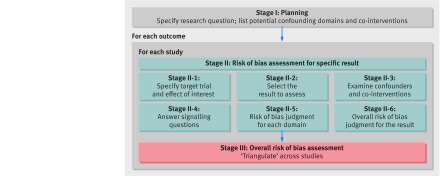
Verification
Claims the paper makes
0 Valid · 0 Not valid · 8 Not checked · 21 Own results and interpretations
What the paper did — it cites no source for this, so there is none to check. The quote shows it is in the paper.
In the paper
“The tool views each study as an attempt to emulate (mimic) a hypothetical pragmatic randomised trial, and covers seven distinct domains through which bias might be introduced”
- Also stated in: § Domains of bias · plain
“We achieved consensus on seven domains through which bias might be introduced into a NRSI (see table 1 and appendix in supplementary data).”
§ ROBINS-I: a tool for assessing risk of bias in non-randomised studies of interventions > Summary points
plain- Asserted: passes — The authors put it forward as true.
- Checkable: passes — It can be checked against evidence.
- Load-bearing: passes — The paper’s conclusions depend on it.
- Based: passes — The paper gives a reason why it holds.
- Also stated in: § Domains of bias · plain
A conclusion the paper draws from its own results — it cites no other source for it, so there is none to check. The quote shows it is in the paper.
In the paper
“Therefore, there is substantial overlap for the last four domains between bias assessments in NRSI and randomised trials.”
§ ROBINS-I: a tool for assessing risk of bias in non-randomised studies of interventions > Methodological issues in assessing risk of bias in non-randomised studies > Domains of bias
plainstates an association- Asserted: passes — The authors put it forward as true.
- Checkable: passes — It can be checked against evidence.
- Load-bearing: unclear — It is unclear whether the paper’s conclusions depend on it.
- Based: passes — The paper gives a reason why it holds.
- Rests on 2 assumptions not shown here.
In the paper
“The tool views each study as an attempt to emulate (mimic) a hypothetical pragmatic randomised trial, and covers seven distinct domains through which bias might be introduced”
- Also stated in: § The target trial · plain
“Evaluations of risk of bias in the results of NRSI are facilitated by considering each NRSI as an attempt to emulate (mimic) a “target” trial.”
§ ROBINS-I: a tool for assessing risk of bias in non-randomised studies of interventions > Summary points
What the sources say
- Not matchedcites 11 12
This doesn’t read as a citation we can look up.
plain- Asserted: passes — The authors put it forward as true.
- Checkable: passes — It can be checked against evidence.
- Load-bearing: passes — The paper’s conclusions depend on it.
- Based: passes — The paper gives a reason why it holds.
- Also stated in: § The target trial · plain
In the paper
“We developed a tool for assessing risk of bias in the results of non-randomised studies of interventions that addresses weaknesses in previously available approaches.4”
§ ROBINS-I: a tool for assessing risk of bias in non-randomised studies of interventions > Discussion
What the sources say
- Not matchedcites [4] Sanderson S, Tatt ID, Higgins JPT. Tools for assessing quality and susceptibility to bias in observational studies in epidemiology: a systematic review and annotated bibliography. Int J Epidemiol 2007; 36: 666- 76. 10.1093/ije/dym018 pmid:17470488. 17470488
We don’t have this paper’s reference list.
plainstates a cause- Asserted: passes — The authors put it forward as true.
- Checkable: passes — It can be checked against evidence.
- Load-bearing: passes — The paper’s conclusions depend on it.
- Based: passes — The paper gives a reason why it holds.
- Not matched
A statement the paper makes itself — it cites no source for it, so there is none to check. The quote shows it is in the paper.
In the paper
“By contrast, unbiased estimation of the effect of starting and adhering to intervention requires consideration of both adherence and differences in additional interventions (“co-interventions”) between intervention groups.”
§ ROBINS-I: a tool for assessing risk of bias in non-randomised studies of interventions > Methodological issues in assessing risk of bias in non-randomised studies > The effect of interest
plain- Asserted: passes — The authors put it forward as true.
- Checkable: passes — It can be checked against evidence.
- Load-bearing: passes — The paper’s conclusions depend on it.
- Based: passes — The paper gives a reason why it holds.
9 more claims
Create a free account to see all 29 claims and every source verdict.
- Probably not a substantial claim. 14
- It may state two separate claims as one. 4
Claims other papers make about this one
Each is checked against this paper’s own text: does it say what the citing paper says it does?
The cited source doesn’t support the claim as written.
In the citing paper
“Quality assessment of RCTs was performed using the Cochrane Collaboration’s tool for assessing risk of bias in randomized trials (RoB-2) by two independent authors (M.A.C.C.A. and M.S.) [14].”
From Efficacy and safety of obicetrapib in patients with dyslipidemia: An updated meta-analysis of randomized controlled trials (2025) · cites this paper as [14]
Checked by a reasoning model — may be wrong.
Experimental — accuracy not yet measuredThe source backs part of the claim, not all of it — or backs it for a different population, condition or comparison.
In the citing paper
“we excluded studies rated to be at critical risk of bias (n = 19) from all of our analyses and figures, except for Fig. 2a”
From A systematic review and meta-analysis of the evidence on learning during the COVID-19 pandemic (2023) · cites this paper as [9]
Experimental — accuracy not yet measuredThe source backs part of the claim, not all of it — or backs it for a different population, condition or comparison.
In the citing paper
“When assessing the risk of bias, seven general principles are relevant, based on theoretical considerations, empirical work, and the experience with assessing risk of bias in RCTs and other studies [55–57].”
From COSMOS-E: Guidance on conducting systematic reviews and meta-analyses of observational studies of etiology (2019) · cites this paper as [56]
Experimental — accuracy not yet measuredThe source backs part of the claim, not all of it — or backs it for a different population, condition or comparison.
In the citing paper
“Relevant domains of risk of bias that should be considered include (i) bias due to (time-dependent) confounding, (ii) bias in selection of participants into the study (selection bias), (iii) bias in measurement of exposures or outcomes (information bias), (iv) bias due to missing data (selection bias), and (v) bias in selection of studies or reported outcomes (selection bias) [56].”
From COSMOS-E: Guidance on conducting systematic reviews and meta-analyses of observational studies of etiology (2019) · cites this paper as [56]
Experimental — accuracy not yet measuredThe source backs part of the claim, not all of it — or backs it for a different population, condition or comparison.
In the citing paper
“A modified Cochrane Collaboration's Risk of Bias in Non-Randomized Studies of Interventions was used to evaluate the risk of bias in selected studies as low, moderate, serious, and critical based on 6 domains (Table 3) (29,30).”
From Alterations in Heart Rate Variability Associated With Irritable Bowel Syndrome or Inflammatory Bowel Disease: A Systematic Review and Meta-Analysis (2021) · cites this paper as [29]
Experimental — accuracy not yet measured
64 more claims about this paper
Create a free account to see every claim other papers make about this one.
Citations
Cites
Yaşlı Kadınlarda Üreme Sağlığı
Kokanalı, D., & Engin Üstün, Y. (n.d.) · DergiPark (Istanbul University) · Cited by 170,090
The Cochrane Collaboration's tool for assessing risk of bias in randomised trials
Higgins, J. P. T., Altman, D. G., Gotzsche, P. C., Juni, P., Moher, D., Oxman, A. D., Savovic, J., Schulz, K. F., Weeks, L., Sterne, J. A. C., et al. (2011) · BMJ · doi:10.1136/bmj.d5928 · Cited by 33,817
Self-citationDermyshi, E., Wang, Y., Yan, C., Hong, W., Qiu, G., Gong, X., & Zhang, T. (2017) · Neonatology · doi:10.1159/000454668 · Cited by 24,451
Two new Later Stone Age sites from the Final Pleistocene in the Falémé Valley, eastern Senegal
Ndiaye, M., Lespez, L., Tribolo, C., Rassé, M., Hadjas, I., Davidoux, S., Huysecom, É., & Douze, K. (2024) · Monash University Research Portal (Monash University) · doi:10.3929/ethz-b-000667478 · Cited by 23,868
(2014) · Medical Entomology and Zoology · Cited by 17,633
Self-citationQUADAS-2: a revised tool for the quality assessment of diagnostic accuracy studies
Whiting, P. F., Rutjes, A. W. S., Westwood, M. E., Mallett, S., Deeks, J. J., Reitsma, J. B., Leeflang, M. M. G., Sterne, J. A. C., Bossuyt, P. M. M., & the QUADAS-2 Group* (2011) · Annals of Internal Medicine · doi:10.7326/0003-4819-155-8-201110180-00009 · Cited by 14,199
Self-citationDowns, S. H., & Black, N. (1998) · Journal of Epidemiology and Community Health · doi:10.1136/jech.52.6.377 · Cited by 8,252
Using Big Data to Emulate a Target Trial When a Randomized Trial Is Not Available: Table 1.
Hernán, M. A., & Robins, J. M. (2016) · American Journal of Epidemiology · doi:10.1093/aje/kwv254 · Cited by 3,115 · cited 1×
“11 12 Such a “target” trial need not be feasible or ethical: for example, it could compare individuals who were and were not assigned to start smoking.”
BackgroundSelf-citationGRADE guidelines: a new series of articles in the Journal of Clinical Epidemiology
Guyatt, G. H., Oxman, A. D., Schünemann, H. J., Tugwell, P., & Knottnerus, A. (2011) · Journal of Clinical Epidemiology · doi:10.1016/j.jclinepi.2010.09.011 · Cited by 3,094
Self-citationEvaluating non-randomised intervention studies
Deeks, J., Dinnes, J., D'Amico, R., Sowden, A., Sakarovitch, C., Song, F., Petticrew, M., & Altman, D. (2003) · Health Technology Assessment · doi:10.3310/hta7270 · Cited by 2,907
Self-citation
Cited by
Items 15,301–15,400 of 19,837
Letter to the editor: methodological rigor when using big data analytic platforms
Schulte, P. J., & Warner, N. S. (2025) · Regional Anesthesia & Pain Medicine · doi:10.1136/rapm-2025-107049 · Cited by 1
Gut Dysbiosis Pattern in Diffuse Large B-Cell Lymphoma: A Systematic Review and Meta-analysisPreprint
Elkourashy, S. A., Abu-El-Ruz, R., Askar, M. Z., et al. (2025) · Research Square · doi:10.21203/rs.3.rs-7320885/v1 · Cited by 1
Effectiveness of neurofeedback interventions in cerebral palsy: A systematic reviewPreprint
Abay, S. N., Alaerts, K., Dan, B., Monbaliu, E., & Bekteshi, S. (2025) · medRxiv · doi:10.1101/2025.08.14.25333687 · Cited by 1
Madoshi, P. B., Tibenderana, J. R., Katusi, G. C., Karuhanga, T. A., & Machang’u, R. S. (2025) · medRxiv · doi:10.1101/2025.08.19.25333802 · Cited by 1
Corrotea-Maltez, C. C., Fernández-Flores, C. V., Gutierrez-Neira, C. L., Nirrian-Pérez, A. J., Mansilla-Muñoz, J., & Bustos-González, L. (2025) · medRxiv · doi:10.1101/2025.08.19.25334031 · Cited by 1
Juneja, M. M., Patel, D. M., Garde, M., Kandula, A., John, M. E., Patel, P. N., Reddy, G. S., Shekar, V. C., Khan, R., Ramteke, H. D., et al. (2025) · medRxiv · doi:10.1101/2025.09.21.25336272 · Cited by 1
Artificial Intelligence in Reminiscence Therapy for Older Adults: A Systematic Review ProtocolPreprint
Shankar, R., Ali, J., & Xu, Q. (2025) · medRxiv · doi:10.1101/2025.09.21.25336299 · Cited by 1
Plastic and Reconstructive Surgery Best Paper Awards 2025
Chung, K. C., Weinstein, A. G., Disa, J. J., et al. (2025) · Plastic & Reconstructive Surgery · doi:10.1097/prs.0000000000012340 · Cited by 1
Shankar, R., Devi, F., & Qian, X. (2025) · medRxiv · doi:10.1101/2025.10.01.25337131 · Cited by 2
Torreno, F., & Torreno, M. L. F. (2025) · Research Square · doi:10.21203/rs.3.rs-7769361/v1 · Cited by 2
Youth co-creation in health interventions: a systematic review and meta-analysisPreprint
Tao, Y., Adedeji, O. J., Sakuma, Y., Conklin, J., Magista, M., Aung, M. T., Septiawa, K. G. A. P., Ortiz‐Prado, E., Siddique, M. K. B., Azugo, N. O., et al. (2025) · medRxiv · doi:10.1101/2025.10.20.25338251 · Cited by 4
Durán, E., Vázquez-Frutos, M., Alcocer, E., & Ocaña, F. M. (2025) · Research Square · doi:10.21203/rs.3.rs-7931877/v1 · Cited by 1
Alnahdi, A. H., Salmon, C., Svensson, M., et al. (2026) · medRxiv · doi:10.64898/2026.01.26.26344897 · Cited by 1
Mahfouz, M., & Alzaben, E. (2026) · medRxiv · doi:10.64898/2026.02.21.26346646 · Cited by 1
Singh, A. K. (2026) · Research Square · doi:10.21203/rs.3.rs-9302415/v1 · Cited by 1
Victoria-Montesinos, D., García-Muñoz, A. M., Mercader-Ros, M. T., Jaraba-Salinero, Y., & Figueroa-Morales, F. (2026) · Frontiers in Nutrition · doi:10.3389/fnut.2026.1939289 · Cited by 1
“Non-randomized controlled studies, quasi-experimental studies, and before-after studies were assessed using ROBINS-I or an adapted ROBINS-I framework according to design (27).”
Qi, K., Wang, Q., Xu, D., Kawczyński, A., & Chen, A. (2026) · Frontiers in Nutrition · doi:10.3389/fnut.2026.1883923 · Cited by 1
The effectiveness of implementation intentions in children: A systematic review and meta‐analysis
Breitwieser, J., & Reinelt, T. (2026) · British Journal of Psychology · doi:10.1111/bjop.70065 · Cited by 1
“The authors independently assessed the risk of bias in the included studies using the Cochrane Risk of Bias Tools, which were suitable for each study (RoB 2.0, RoB 2 crossover, ROBINS-I; Eldridge et al., 2016; Sterne et al., 2016, 2019).”
InfluentialGutiérrez-Tamayo, A. M., Mirama-Calderón, L. V., Vallejo- Ortega, M. T., & Gaitán-Duarte, H. G. (2025) · Revista Colombiana de Obstetricia y Ginecología · doi:10.18597/rcog.4268 · Cited by 1
Prince, N., Lochnan, H., Shorr, R., Garon-Mailer, A., & Sun, C. J. (2026) · BMC Endocrine Disorders · doi:10.1186/s12902-025-02144-3
“Compared to another commonly-used tool for risk-of-bias assessment (“Risk Of Bias In Non-randomised Studies - of Interventions” [24]), the Newcastle-Ottawa scale includes less detailed criteria for the evaluation of confounders, and protocol deviations.”
Potential harms of interventions for spinal metastatic disease
Carrwik, C., Murakami, H., Willander, J., & Robinson, Y. (2017) · Cochrane Database of Systematic Reviews · doi:10.1002/14651858.cd012724
PhD, U., PhD, N., PhD, R., et al. (2017) · International Journal of Advanced Research · doi:10.21474/ijar01/4694
Wilkinson, J., Vail, A., & Roberts, S. A. (2017) · bioRxiv (Cold Spring Harbor Laboratory) · doi:10.1101/173534
Kwong, J. S., Li, S., Gu, W., Chen, H., Zhang, C., Zeng, X., & Yu, C. (2017) · BMJ Open · doi:10.1136/bmjopen-2017-017868
Zhang, C., Ning, F., & Dai, D. (2018) · International Journal of Surgery · doi:10.1016/j.ijsu.2018.01.030
Verbiest, A., Meerleer, G. D., Albersen, M., & Beuselinck, B. (2018) · Kidney Cancer · doi:10.3233/kca-170023 · Cited by 1
Statistics in Endocrinology: Meta-Analysis Advantages and Pitfalls
Dekkers, O. M. (2018) · Elsevier eBooks · doi:10.1016/b978-0-12-801238-3.65799-9
Henry, D. A., Stehlik, P., & Rosella, L. C. (2018) · International Journal of Epidemiology · doi:10.1093/ije/dyy051
Self-citationClear reporting of study design in a trial on patient education in psoriasis
Dressler, C., Nast, A., & Galdas, P. (2018) · DOAJ (DOAJ: Directory of Open Access Journals)
Dahm, P., Sultan, S., & Jung, J. H. (2018) · doi:10.1002/9781119129875.ch3
In Dogs Does Feeding Raw Dietary Treats Reduce or Prevent Periodontal Disease?
van Veggel, N., & Oxley, J. A. (2018) · Veterinary Evidence · doi:10.18849/ve.v3i3.153
Pasquali, S., Sommariva, A., Mahteme, H., et al. (2018) · Cochrane Database of Systematic Reviews · doi:10.1002/14651858.cd005659.pub3
Wee, I. J. Y., Syn, N. L. X., & Choong, A. M. T. L. (2018) · Annals of Vascular Surgery · doi:10.1016/j.avsg.2018.10.009
Interventions for treating or managing faecal incontinence in older people living in care homes
Musa, M. K., Vinsnes, A. G., Blekken, L. E., et al. (2018) · Cochrane Database of Systematic Reviews · doi:10.1002/14651858.cd013200
Dimitropoulos, K., & Gravas, S. (2019) · World Journal of Urology · doi:10.1007/s00345-018-02625-2
Nóbrega, B. N. (2019) · Digital Library of Theses and Dissertations (Universidade de São Paulo) · doi:10.11606/d.17.2019.tde-15012019-102453
Strijbos (2019) · Research Publications (Maastricht University) · doi:10.26481/dis.20190405ds
Does Room Air Reduce Mortality Among Term Neonates Requiring Respiratory Support at Birth?
Long, B., & April, M. D. (2019) · Annals of Emergency Medicine · doi:10.1016/j.annemergmed.2019.03.017
Schandelmaier, S. (2019) · MacSphere (McMaster University) · doi:10.71548/14968 · Cited by 1
Comprehensive evidence and clinical judgment
Knottnerus, J. A., & Tugwell, P. (2019) · Journal of Clinical Epidemiology · doi:10.1016/j.jclinepi.2019.07.004
Self-citationChew, B., Lim, P. Y., Lee, S. W. H., Devaraj, N. K., Ismail, A. H., Shamsuddin, N. H., Kassim, P. S. J., Rashid, A. A., Fernandez, A., Zakuan, N. M., et al. (2019) · medRxiv · doi:10.1101/19004010
Neighborhood Built Environment Characteristics and Cognition in Non-demented Older Adults
Besser, L. M. (2017) · Carolina Digital Repository (University of North Carolina at Chapel Hill) · doi:10.17615/d0he-3z94 · Cited by 3
Gonçalves, C. A. (2019) · Digital Library of Theses and Dissertations (Universidade de São Paulo) · doi:10.11606/t.22.2019.tde-23102019-143239 · Cited by 2
Evaluating the impact of Inpatient Pain Management Interactive Systems
Aldekhyyel, R. N. (2019) · University of Minnesota Digital Conservancy (University of Minnesota)
Let op: observationeel onderzoek!
van der Wouden, H. (2019) · Huisarts en Wetenschap · doi:10.1007/s12445-019-0408-0
Alblowi, J. A., & Gamal‐AbdelNaser, A. (2019) · The Open Dentistry Journal · doi:10.2174/1874210601913010557
Systematic Review and Meta-Analysis: A Clinical Exercise
Merchant, N. N., & Maggard-Gibbons, M. A. (2020) · Success in academic surgery · doi:10.1007/978-3-030-28357-5_17
Estrella-Porter, P., Freire, L. E. G., Molina, J. P. A., Raza, M. V. B., Celi, H. A. C., Borja, I. M. E., Paez, A. F., Vega, A. S. G., Jaramillo-Cartwright, M. J., Vargas, S. X. O., et al. (2020) · F1000Research · doi:10.12688/f1000research.21525.1 · Cited by 1
Gutiérrez, J. M. M., Dueño, A. L., Sonido, A. E., Abriam, J. A., Paragas, E. D., & Generale, A. J. A. (2020) · Journal of Medicine University of Santo Tomas · doi:10.35460/2546-1621.2018-0017
Internalizing Symptoms in Pediatric Migraine: A Systematic Review Protocol
Falla, K., Ronksley, P. E., Noel, M. E., & Orr, S. L. (2020) · Headache The Journal of Head and Face Pain · doi:10.1111/head.13778
Veazie, S., Gilbert, J., Winchell, K. A., Paynter, R. A., & Guise, J. (2019)
Xu, H., Águila, N. M., Yu, H., Linares-Pérez, N., & Romaní, C. M. E. T. (2020) · F1000Research · doi:10.12688/f1000research.22660.1
A Systematic Review of the Safety and Efficacy of Ayurveda Interventions for Hepatitis
Dedge, A. P., Mandal, T. K., Gundeti, M., et al. (2019) · Journal of Research in Ayurvedic Sciences · doi:10.5005/jras-10064-0073
Zeng, J. J. (2018) · Carolina Digital Repository (University of North Carolina at Chapel Hill) · doi:10.17615/060z-k807
Information Sources for Pharmacy Practice Researchers
Tonin, F. S., Borba, H. H. L., Mendes, A. M., Wiens, A., Pontarolo, R., & Fernández-Llimós, F. (2020) · Springer eBooks · doi:10.1007/978-981-15-2993-1_11
Rayner, T. A., Harrison, S., Savović, J., & Vohra, H. A. (2020) · European Journal of Cardio-Thoracic Surgery · doi:10.1093/ejcts/ezaa135
Self-citationChachaima-Mar, J. E., Sánchez-Velazco, D. F., & Ugarte‐Gil, C. (2020) · medRxiv · doi:10.1101/2020.05.19.20107177
Removal of intrauterine device as part of the treatment for women with pelvic inflammatory disease
Viveros-Carreño, D. A., Grillo‐Ardila, C. F., & Amaya-Guío, J. (2020) · Cochrane Database of Systematic Reviews · doi:10.1002/14651858.cd013618 · Cited by 1
Adverse paediatric outcomes of macrolide antibiotics treatment in pregnancy
Fan, H. (2020) · UCL Discovery (University College London)
Mahzari, M., & Mamun, A. A. (2020) · International Journal of Medicine and Pharmacy · doi:10.15640/ijmp.v8n1a1 · Cited by 2
Carrapita, J., Abrantes, A. M., Sousa‐Pinto, B., Santos, J. N., Botelho, M. F., Tralhão, J. G., & Barbosa, J. M. (2020) · Surgery Gastroenterology and Oncology · doi:10.21614/sgo-25-3-113 · Cited by 1
Protocol for Systematic Review of Efficacy and Safety of Ayurveda Interventions in Bronchial Asthma
Ranade, A. V., Kolhe, R., & Prasad, G. P. (2019) · Journal of Research in Ayurvedic Sciences · doi:10.5005/jras-10064-0093
Dave, P., Ahmad, A., & Gundeti, M. (2019) · Journal of Research in Ayurvedic Sciences · doi:10.5005/jras-10064-0089
Luo, Y., Funada, S., Yoshioka, T., et al. (2020) · Arthritis & Rheumatology · doi:10.1002/art.41442
In Reply to Managing Bias in Research
Best, A. M. (2020) · Wilderness and Environmental Medicine · doi:10.1016/j.wem.2020.04.010
Prophylactic cranial irradiation for patients with limited-stage small cell lung cancer
Jaoude, J. A., Adib, E., Kayali, M., Khabsa, J., Akl, E. A., & Zeidan, Y. H. (2020) · Cochrane Database of Systematic Reviews · doi:10.1002/14651858.cd013701
Value of saccadic latency as a diagnostic tool for multiple sclerosis
Hamdy, H. S., Sherif, H. E., & Ibrahim, I. (2020) · Hearing Balance and Communication · doi:10.1080/21695717.2020.1807276
Kaczor, M. P., Staśkiewicz, W., Homa, M., Górecka, M., Wójcik, R., & Potemski, P. (2021) · Oncology in Clinical Practice · doi:10.5603/ocp.2020.0011
Peuchot, V. A., Boietti, B. R., Franco, J. V. A., Liquitay, C. M. E., Thomas, D. S., Gómez, F. T., Peroni, L., Báez, G., Pisula, P., & Pollán, J. A. (2020) · Evidencia actualizacion en la práctica ambulatoria · doi:10.51987/evidencia.v23i2.4289
O’Brien, K. S. (2020) · eScholarship (California Digital Library)
Steen, J., Morzywołek, P., Biesen, W. V., Decruyenaere, J. M. A., & Vansteelandt, S. (2020) · arXiv (Cornell University) · doi:10.48550/arxiv.2011.04833
Ng, J. J., Liang, Z. C., & Choong, A. M. T. L. (2020) · Research Square · doi:10.21203/rs.3.rs-74260/v1
Shamliyan, T., Avanesova, A. A., & Aronow, W. S. (2020) · Vessel Plus · doi:10.20517/2574-1209.2020.34 · Cited by 2
Prosthetic Valve in Chronic Dialysis: a Systematic Review and Meta-AnalysisPreprint
Belley‐Côté, E. P., Gupta, S. K., Pandey, A. K., et al. (2020) · doi:10.22541/au.160855011.14022169/v1
Cloroquina e hidroxicloroquina en el manejo del COVID-19: una revisión
Zapata, J. M., Villalva, A. A., Guamanarca, R. I. S., Lincango-Naranjo, E. P., Sánchez, K. L. N., Vaca, Á. L., & Olalla, J. A. N. (2022) · Investigación y Desarrollo · doi:10.31243/id.v12.2020.980
Sadana, D., Kaur, S., Sankaramangalam, K. P., Banerjee, K., Siuba, M., Amaral, V., Gadre, S. K., Torbic, H., Krishnan, S., & Duggal, A. (2020) · doi:10.21203/rs.3.rs-99742/v1
Nguyen, A. T. H., BMed, S., Hamdan, T. A., et al. (2020) · Basrah Journal of Surgery · doi:10.33762/bsurg.2020.165459
de Berker, H. T., Čebron, U., Bradley, D., et al. (2021) · Research Square · doi:10.21203/rs.3.rs-144661/v1
Brown, K. K., Smith, J. G., Jeffers, R., & Pierre, C. J. (2020) · doi:10.21203/rs.2.23905/v1
Развитие бизнеса в сети интернет: налоговый аспект
Огородникова, И. И. (2010) · Вестник Тюменского государственного университета. Социально-экономические и правовые исследования
Chen, S., Yu, J., Yuen, S., Lam, J. C.-S., Suen, L. K. P., & Yeung, W. (2020) · Research Square · doi:10.21203/rs.3.rs-59513/v1
Maraghi, E., Safarpour, A. R., Hajmohammadi, M., et al. (2021) · Research Square · doi:10.21203/rs.3.rs-271086/v1
Prophetis, D., & Stephen, E. M. (2019) · TSpace (University of Toronto)
Persistence of immunoglobulin G after natural infection with SARS-CoV-2
Kreuzberger, N., Hirsch, C., Vanshylla, K., Cristanziano, V. D., Dorando, E., Khosravi, Z., Neidhardt, M., Salomon, S., Monsef, I., Lange, B., et al. (2021) · Cochrane Database of Systematic Reviews · doi:10.1002/14651858.cd014946 · Cited by 1
Gill, E. M., Jung, K., Qvist, N., et al. (2021) · Research Square · doi:10.21203/rs.3.rs-384464/v1
Learning styles and the myths surrounding it: a systematic scoping review of the literature.Preprint
de Mendonça, L., Vieira, R. R., & Duailibi, M. S. (2021) · Research Square · doi:10.21203/rs.3.rs-396082/v1
A pan-European perspective on food allergy: prevalence, predictors and patient profiles
Lyons, S. (2021) · Utrecht University Repository (Utrecht University) · doi:10.33540/545 · Cited by 2
Dinas, P. C., Domanović, D., Koutedakis, Y., Hadjichristodoulou, C. S., Stefanidis, I., Papadopoulou, K. Κ., DIMAS, K. S., Perivoliotis, K., Tepetes, K., & Flouris, A. D. (2021) · JMIR Research Protocols · doi:10.2196/25674
Metadata
- Authors
- Sterne, J. A., Hernán, M. A., Reeves, B. C., Savović, J., Berkman, N. D., Viswanathan, M., Henry, D., Altman, D. G., Ansari, M. T., Boutron, I., Carpenter, J. R., Chan, A.-W., Churchill, R., Deeks, J. J., Hróbjartsson, A., Kirkham, J., Jüni, P., Loke, Y. K., Pigott, T. D., Ramsay, C. R., Regidor, D., Rothstein, H. R., Sandhu, L., Santaguida, P. L., Schünemann, H. J., Shea, B., Shrier, I., Tugwell, P., Turner, L., Valentine, J. C., Waddington, H., Waters, E., Wells, G. A., Whiting, P. F., & Higgins, J. P.
- Affiliations
- University of Bristol (GB)
- University Hospitals Bristol NHS Foundation Trust (GB)
- RTI International (US)
- University of Toronto (CA)
- University of Oxford (GB)
- University of Ottawa (CA)
- Inserm (FR)
- London School of Hygiene & Tropical Medicine (GB)
- University of York (GB)
- University of Birmingham (GB)
- University of Southern Denmark (DK)
- University of Liverpool (GB)
- St. Michael's Hospital (CA)
- University of East Anglia (GB)
- Loyola University Chicago (US)
- University of Aberdeen (GB)
- Kaiser Permanente (US)
- Baruch College (US)
- McMaster University (CA)
- Cochrane Canada (CA)
- Jewish General Hospital (CA)
- Ottawa Hospital Research Institute (CA)
- University of Louisville (US)
- London International Development Centre (GB)
- The University of Melbourne (AU)
- Ottawa Heart Institute (CA)
- Corresponding author
- Sterne, Jonathan AC
- ORCID
- Sterne, Jonathan AC
- Reeves, Barnaby C
- Savović, Jelena
- Berkman, Nancy D
- Viswanathan, Meera
- Henry, David
- Altman, Douglas G
- Boutron, Isabelle
- Carpenter, James R
- Chan, An-Wen
- Churchill, Rachel
- Deeks, Jonathan J
- Hróbjartsson, Asbjørn
- Kirkham, Jamie
- Jüni, Peter
- Loke, Yoon K
- Ramsay, Craig R
- Rothstein, Hannah R
- Santaguida, Pasqualina L
- Schünemann, Holger J
- Shrier, Ian
- Tugwell, Peter
- Valentine, Jeffrey C
- Waddington, Hugh
- Wells, George A
- Whiting, Penny F
- Higgins, Julian PT
- Venue
- BMJ
- Publisher
- BMJ
- Published
- 2016-10-12
- Volume
- 355
- Pages
- i4919
- ISSN
- 1756-1833 (ISSN-L)
- PMC
- PMC5062054
- OpenAlex
- W2531269403
- Cited by
- 20,329
- References
- 26
- Citations by year
- 2026: 3595 · 2025: 3693 · 2024: 3237 · 2023: 2484 · 2022: 2425 · 2021: 2040 · 2020: 1386 · 2019: 771 · 2018: 459 · 2017: 197 · 2016: 15
- FWCI
- 446.93
- Type
- journal article
- Language
- en
- Open access
- hybrid
- doi.org
- Licence
- cc-by-nc
- www.bmj.org/licenses/tdm/1.0/terms-and-conditions.html (tdm)
- Locations
- BMJ (publishedVersion, cc-by-nc)
- Europe PMC (PubMed Central) (publishedVersion, cc-by-nc)
- PubMed Central (publishedVersion, cc-by-nc)
- PubMed (publishedVersion)
- Bristol Research (University of Bristol) (publishedVersion, cc-by-nc)
- University of Southern Denmark Research Portal (University of Southern Denmark) (publishedVersion, cc-by-nc)
- White Rose Research Online (University of Leeds, The University of Sheffield, University of York) (acceptedVersion)
- UEA Digital Repository (University of East Anglia) (acceptedVersion, other-oa)
- LSHTM Research Online (London School of Hygiene and Tropical Medicine) (acceptedVersion)
- Aberdeen University Research Archive (Aberdeen University) (submittedVersion, other-oa)
- CUNY Academic Works (City University of New York) (submittedVersion, cc-by-nc)
- DSpace@MIT (Massachusetts Institute of Technology) (submittedVersion, cc-by-nc)
- eScholarship@McGill (McGill) (submittedVersion, cc-by)
- eScholarship (California Digital Library) (submittedVersion, cc-by)
- HighWire Press Open Archive (submittedVersion)
- Research Explorer (The University of Manchester) (submittedVersion, other-oa)
- Funders
- Cancer Research UK (16895)
- National Institute for Health and Care Research (NF-SI-0611-10168)
- University of Bristol
- National Institutes of Health (CA134294)
- Medical Research Council (MR/M025209/1, MC_UU_12023/21, MR/J004855/1, MC_UU_12023/24)
- National Cancer Institute (P01CA134294, R35CA197449)
- Topics
- Social Sciences › Decision Sciences › Statistics, Probability and Uncertainty › Meta-analysis and systematic reviews
- Physical Sciences › Mathematics › Statistics and Probability › Advanced Causal Inference Techniques
- Physical Sciences › Mathematics › Statistics and Probability › Statistical Methods in Epidemiology
- Keywords
- ROBINS-I, risk of bias assessment, non-randomized studies, observational studies, comparative effectiveness, systematic reviews, allocation bias, confounding, attrition bias, reporting bias, selection bias
- MeSH terms
- Clinical Trials as Topic, Humans, Pilot Projects, Risk, Statistics as Topic, Bias, Confounding Factors, Epidemiologic, Observational Studies as Topic
About these checks
Registry, retraction, Cites and statistics results are computed, not judged, with one exception: a printed reference that no index lists is read once by a model before it counts as a citation error. Claims are extracted by a model and kept only when their quote appears verbatim in the text; each cited source is then checked, with a model’s help, for whether it says what the claim relies on. Those verdicts can be wrong — read the claim’s quote and the cited source before relying on one.
A language model drew the claims from the paper on 2026-09-29, under version 3 of the claim definition (model deepseek-v4.1-flash, prompt extract-v3).
A second model labelled each claim on 2026-09-29 (model jev-1.13-20260917, definition revision gold-guideline-v0.2).
Statistics and arithmetic are recomputed, not judged.
Confidence bands are shown only for fields calibrated on our annotated test set. None is calibrated yet, so no band is shown.
What counts as a claim ›How we measure confidence ›How we check this ›
Are you an author, or do you see a problem with this page? Request a review
Data sources
Bibliographic data: Semantic Scholar, OpenAlex, Crossref.
Contains information from the Semantic Scholar Academic Graph Datasets, made available under the ODC Attribution License (ODC-BY 1.0).
Semantic Scholar’s data is described in: Kinney, R., et al. (2023). The Semantic Scholar Open Data Platform. arXiv:2301.10140.
