

ROBINS-I: a tool for assessing risk of bias in non-randomised studies of interventions
Open accessThe DOI matches its Crossref record; 27 of the 27 references it cites were found in a registry or an index; none of the 8 sources its claims cite is checked for support yet.
Abstract
Non-randomised studies of the effects of interventions are critical to many areas of healthcare evaluation, but their results may be biased. It is therefore important to understand and appraise their strengths and weaknesses. We developed ROBINS-I (“Risk Of Bias In Non-randomised Studies - of Interventions”), a new tool for evaluating risk of bias in estimates of the comparative effectiveness (harm or benefit) of interventions from studies that did not use randomisation to allocate units (individuals or clusters of individuals) to comparison groups. The tool will be particularly useful to those undertaking systematic reviews that include non-randomised studies.
Overview
CoChat Summary
TL;DR
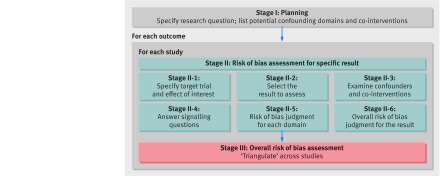
The authors developed ROBINS-I, a consensus-based tool for assessing risk of bias in non-randomised studies of interventions by comparing each study with a hypothetical pragmatic randomised “target” trial. It assesses seven bias domains using signalling questions and produces domain-level and overall risk-of-bias judgements.
Key findings
- ROBINS-I was developed over three years by expert consensus, with piloting and user feedback, and covers seven distinct bias domains: confounding, selection of participants, classification of interventions, deviations from intended interventions, missing data, measurement of outcomes, and selection of the reported result.
- The tool uses signalling questions with response options “Yes,” “Probably yes,” “Probably no,” “No,” and “No information” to inform domain-level judgements.
- Risk-of-bias judgements are categorised as “Low risk,” “Moderate risk,” “Serious risk,” and “Critical risk”; “Low risk” corresponds to the risk of bias in a high quality randomised trial.
- The authors recommend against including studies assessed as at “Critical risk” of bias in any meta-analysis and advocate caution for studies assessed as at “Serious risk” of bias.
Methods
- Development was largely by expert consensus, following seven principles previously described for assessing risk of bias in clinical trials; a core group coordinated recruitment, documents, and administrative support.
- Development activities included an initial scoping meeting in October 2011, a survey of Cochrane Review Groups in March 2012, a meeting in April 2012 to identify bias domains and working groups, a two-day face-to-face meeting in March 2013, piloting within working groups between September 2013 and March 2014, substantial revisions in June 2014, posting of version 1.0.0 in September 2014, and a three-day workshop in December 2014 where the tool was applied to six papers reporting NRSI.
- The paper describes the tool and its conceptual basis rather than reporting a quantitative validation study; no statistical analysis of reliability or validity is presented.
Limitations
- The paper states that the technical difficulty in making risk of bias judgements is expected to limit reliability, despite explicit links between signalling questions and judgements.
- The paper states that ROBINS-I focuses specifically on bias and does not address problems related to imprecision of results, such as when statistical analyses fail to account for clustering or matching of participants.
- The paper states that use of ROBINS-I requires review groups to include members with substantial methodological expertise and familiarity with modern epidemiological thinking; it also notes planned future consideration of specific NRSI types such as self-controlled designs, controlled before-and-after studies, interrupted time series, regression discontinuity, and instrumental variable analyses.
Model-written summary. Check it against the paper before relying on it.
Integrity signals
Registry
Cites
Statistics
Figures
Verification
Claims the paper makes
0 Valid · 0 Not valid · 8 Not checked · 21 Own results and interpretations
What the paper did — it cites no source for this, so there is none to check. The quote shows it is in the paper.
In the paper
“The tool views each study as an attempt to emulate (mimic) a hypothetical pragmatic randomised trial, and covers seven distinct domains through which bias might be introduced”
- Also stated in: § Domains of bias · plain
“We achieved consensus on seven domains through which bias might be introduced into a NRSI (see table 1 and appendix in supplementary data).”
§ ROBINS-I: a tool for assessing risk of bias in non-randomised studies of interventions > Summary points
plain- Asserted: passes — The authors put it forward as true.
- Checkable: passes — It can be checked against evidence.
- Load-bearing: passes — The paper’s conclusions depend on it.
- Based: passes — The paper gives a reason why it holds.
- Also stated in: § Domains of bias · plain
A conclusion the paper draws from its own results — it cites no other source for it, so there is none to check. The quote shows it is in the paper.
In the paper
“Therefore, there is substantial overlap for the last four domains between bias assessments in NRSI and randomised trials.”
§ ROBINS-I: a tool for assessing risk of bias in non-randomised studies of interventions > Methodological issues in assessing risk of bias in non-randomised studies > Domains of bias
plainstates an association- Asserted: passes — The authors put it forward as true.
- Checkable: passes — It can be checked against evidence.
- Load-bearing: unclear — It is unclear whether the paper’s conclusions depend on it.
- Based: passes — The paper gives a reason why it holds.
- Rests on 2 assumptions not shown here.
In the paper
“The tool views each study as an attempt to emulate (mimic) a hypothetical pragmatic randomised trial, and covers seven distinct domains through which bias might be introduced”
- Also stated in: § The target trial · plain
“Evaluations of risk of bias in the results of NRSI are facilitated by considering each NRSI as an attempt to emulate (mimic) a “target” trial.”
§ ROBINS-I: a tool for assessing risk of bias in non-randomised studies of interventions > Summary points
What the sources say
- Not matchedcites 11 12
This doesn’t read as a citation we can look up.
plain- Asserted: passes — The authors put it forward as true.
- Checkable: passes — It can be checked against evidence.
- Load-bearing: passes — The paper’s conclusions depend on it.
- Based: passes — The paper gives a reason why it holds.
- Also stated in: § The target trial · plain
In the paper
“We developed a tool for assessing risk of bias in the results of non-randomised studies of interventions that addresses weaknesses in previously available approaches.4”
§ ROBINS-I: a tool for assessing risk of bias in non-randomised studies of interventions > Discussion
What the sources say
- Not matchedcites [4] Sanderson S, Tatt ID, Higgins JPT. Tools for assessing quality and susceptibility to bias in observational studies in epidemiology: a systematic review and annotated bibliography. Int J Epidemiol 2007; 36: 666- 76. 10.1093/ije/dym018 pmid:17470488. 17470488
We don’t have this paper’s reference list.
plainstates a cause- Asserted: passes — The authors put it forward as true.
- Checkable: passes — It can be checked against evidence.
- Load-bearing: passes — The paper’s conclusions depend on it.
- Based: passes — The paper gives a reason why it holds.
- Not matched
A statement the paper makes itself — it cites no source for it, so there is none to check. The quote shows it is in the paper.
In the paper
“By contrast, unbiased estimation of the effect of starting and adhering to intervention requires consideration of both adherence and differences in additional interventions (“co-interventions”) between intervention groups.”
§ ROBINS-I: a tool for assessing risk of bias in non-randomised studies of interventions > Methodological issues in assessing risk of bias in non-randomised studies > The effect of interest
plain- Asserted: passes — The authors put it forward as true.
- Checkable: passes — It can be checked against evidence.
- Load-bearing: passes — The paper’s conclusions depend on it.
- Based: passes — The paper gives a reason why it holds.
9 more claims
Create a free account to see all 29 claims and every source verdict.
- Probably not a substantial claim. 14
- It may state two separate claims as one. 4
Claims other papers make about this one
Each is checked against this paper’s own text: does it say what the citing paper says it does?
The cited source doesn’t support the claim as written.
In the citing paper
“Quality assessment of RCTs was performed using the Cochrane Collaboration’s tool for assessing risk of bias in randomized trials (RoB-2) by two independent authors (M.A.C.C.A. and M.S.) [14].”
From Efficacy and safety of obicetrapib in patients with dyslipidemia: An updated meta-analysis of randomized controlled trials (2025) · cites this paper as [14]
Checked by a reasoning model — may be wrong.
Experimental — accuracy not yet measuredThe source backs part of the claim, not all of it — or backs it for a different population, condition or comparison.
In the citing paper
“we excluded studies rated to be at critical risk of bias (n = 19) from all of our analyses and figures, except for Fig. 2a”
From A systematic review and meta-analysis of the evidence on learning during the COVID-19 pandemic (2023) · cites this paper as [9]
Experimental — accuracy not yet measuredThe source backs part of the claim, not all of it — or backs it for a different population, condition or comparison.
In the citing paper
“When assessing the risk of bias, seven general principles are relevant, based on theoretical considerations, empirical work, and the experience with assessing risk of bias in RCTs and other studies [55–57].”
From COSMOS-E: Guidance on conducting systematic reviews and meta-analyses of observational studies of etiology (2019) · cites this paper as [56]
Experimental — accuracy not yet measuredThe source backs part of the claim, not all of it — or backs it for a different population, condition or comparison.
In the citing paper
“Relevant domains of risk of bias that should be considered include (i) bias due to (time-dependent) confounding, (ii) bias in selection of participants into the study (selection bias), (iii) bias in measurement of exposures or outcomes (information bias), (iv) bias due to missing data (selection bias), and (v) bias in selection of studies or reported outcomes (selection bias) [56].”
From COSMOS-E: Guidance on conducting systematic reviews and meta-analyses of observational studies of etiology (2019) · cites this paper as [56]
Experimental — accuracy not yet measuredThe source backs part of the claim, not all of it — or backs it for a different population, condition or comparison.
In the citing paper
“A modified Cochrane Collaboration's Risk of Bias in Non-Randomized Studies of Interventions was used to evaluate the risk of bias in selected studies as low, moderate, serious, and critical based on 6 domains (Table 3) (29,30).”
From Alterations in Heart Rate Variability Associated With Irritable Bowel Syndrome or Inflammatory Bowel Disease: A Systematic Review and Meta-Analysis (2021) · cites this paper as [29]
Experimental — accuracy not yet measured
64 more claims about this paper
Create a free account to see every claim other papers make about this one.
Citations
Cites
Yaşlı Kadınlarda Üreme Sağlığı
Kokanalı, D., & Engin Üstün, Y. (n.d.) · DergiPark (Istanbul University) · Cited by 170,090
The Cochrane Collaboration's tool for assessing risk of bias in randomised trials
Higgins, J. P. T., Altman, D. G., Gotzsche, P. C., Juni, P., Moher, D., Oxman, A. D., Savovic, J., Schulz, K. F., Weeks, L., Sterne, J. A. C., et al. (2011) · BMJ · doi:10.1136/bmj.d5928 · Cited by 33,817
Self-citationDermyshi, E., Wang, Y., Yan, C., Hong, W., Qiu, G., Gong, X., & Zhang, T. (2017) · Neonatology · doi:10.1159/000454668 · Cited by 24,451
Two new Later Stone Age sites from the Final Pleistocene in the Falémé Valley, eastern Senegal
Ndiaye, M., Lespez, L., Tribolo, C., Rassé, M., Hadjas, I., Davidoux, S., Huysecom, É., & Douze, K. (2024) · Monash University Research Portal (Monash University) · doi:10.3929/ethz-b-000667478 · Cited by 23,868
(2014) · Medical Entomology and Zoology · Cited by 17,633
Self-citationQUADAS-2: a revised tool for the quality assessment of diagnostic accuracy studies
Whiting, P. F., Rutjes, A. W. S., Westwood, M. E., Mallett, S., Deeks, J. J., Reitsma, J. B., Leeflang, M. M. G., Sterne, J. A. C., Bossuyt, P. M. M., & the QUADAS-2 Group* (2011) · Annals of Internal Medicine · doi:10.7326/0003-4819-155-8-201110180-00009 · Cited by 14,199
Self-citationDowns, S. H., & Black, N. (1998) · Journal of Epidemiology and Community Health · doi:10.1136/jech.52.6.377 · Cited by 8,252
Using Big Data to Emulate a Target Trial When a Randomized Trial Is Not Available: Table 1.
Hernán, M. A., & Robins, J. M. (2016) · American Journal of Epidemiology · doi:10.1093/aje/kwv254 · Cited by 3,115 · cited 1×
“11 12 Such a “target” trial need not be feasible or ethical: for example, it could compare individuals who were and were not assigned to start smoking.”
BackgroundSelf-citationGRADE guidelines: a new series of articles in the Journal of Clinical Epidemiology
Guyatt, G. H., Oxman, A. D., Schünemann, H. J., Tugwell, P., & Knottnerus, A. (2011) · Journal of Clinical Epidemiology · doi:10.1016/j.jclinepi.2010.09.011 · Cited by 3,094
Self-citationEvaluating non-randomised intervention studies
Deeks, J., Dinnes, J., D'Amico, R., Sowden, A., Sakarovitch, C., Song, F., Petticrew, M., & Altman, D. (2003) · Health Technology Assessment · doi:10.3310/hta7270 · Cited by 2,907
Self-citation
Cited by
Items 16,901–17,000 of 19,837
Cai, X., Zhu, J., Yang, J., Tang, C., Cong, Z., & Ma, C. (2022) · Figshare · doi:10.6084/m9.figshare.19556368
Wang, Y., Xie, H., Wang, L., et al. (2024) · Figshare · doi:10.6084/m9.figshare.25282780
Qian, J., Sun, S., Liu, L., & Yu, X. (2021) · Figshare · doi:10.6084/m9.figshare.16620858
Srivastav, P., Vaishali, K., Rajwar, E., Broadbent, S., & Bhat, H. V. (2023) · Figshare · doi:10.6084/m9.figshare.22715209
Jenner, E. A., Chauhan, G. S., Burahee, A., et al. (2024) · Figshare · doi:10.6084/m9.figshare.25282763
Zhang, Y., Karahalios, A., Aung, Y. K., Win, A. K., Boussioutas, A., & Jenkins, M. A. (2024) · Figshare · doi:10.6084/m9.figshare.24709107
Mirzohreh, S. T., Panahi, P., & Heidari, F. (2024) · Figshare · doi:10.6084/m9.figshare.26368554
Mino, E., Pfeifer, K., Hanson, C. L., Schuler, M., Brandmeier, A., Klamroth, S., Naber, I., Weißenfels, A., McHale, S., Abu-Omar, K., et al. (2024) · Figshare · doi:10.6084/m9.figshare.26757016
Tildy, B. E., McNeill, A. D., Perman‐Howe, P. R., & Brose, L. S. (2024) · Figshare · doi:10.6084/m9.figshare.26564025
Totoki, T., Makino, Y., Yamakawa, K., et al. (2024) · Figshare · doi:10.6084/m9.figshare.25001611
Koroki, T., Kotani, Y., Yaguchi, T., Shibata, T., Fujii, M., Fresilli, S., Tonai, M., Karumai, T., Lee, T. C., Landoni, G., et al. (2024) · Figshare · doi:10.6084/m9.figshare.25239402
Chiocchia, V., Nikolakopoulou, A., Higgins, J. P. T., Page, M. J., Papakonstantinou, T., Cipriani, A., Furukawa, T. A., Siontis, G. C. M., Egger, M., & Salanti, G. (2021) · Figshare · doi:10.6084/m9.figshare.17066019
Self-citationLuo, X., Wu, Y., Xu, Y., et al. (2024) · Figshare · doi:10.6084/m9.figshare.26747270
Edwards, L., Jamieson, S. K., Bowman, J., Chang, S., Newton, J., & Sullivan, E. A. (2022) · Figshare · doi:10.6084/m9.figshare.17798559
Paul, B., Kirubakaran, R., Isaac, R., Dozier, M., Grant, L., & Weller, D. (2022) · Figshare · doi:10.6084/m9.figshare.20115575
Gatti, M., Cojutti, P. G., & Pea, F. (2024) · Figshare · doi:10.6084/m9.figshare.26707439
Oladimeji, O. I., Harding, J., Crowther, C. A., & Lin, L. (2024) · Figshare · doi:10.6084/m9.figshare.26623969
Piggott, T., Raja, M., Michels, C. T. J., Herrmann, A., Scahill, K., Darzi, A. J., Jewell, L. M., Saif-Ur-Rahman, K., Napierala, H., Heuer, R., et al. (2024) · Figshare · doi:10.6084/m9.figshare.26738004
Self-citationKaiser, L., Conrad, S., Neugebauer, E. A. M., Pietsch, B., & Pieper, D. (2022) · Figshare · doi:10.6084/m9.figshare.20485833
Gatti, M., Cojutti, P. G., & Pea, F. (2024) · Figshare · doi:10.6084/m9.figshare.25622023
Uimonen, M., Kuitunen, I., Ponkilainen, V., Mennander, A., & Mattila, M. S. (2024) · Figshare · doi:10.6084/m9.figshare.26112984
Mino, E., Pfeifer, K., Hanson, C. L., Schüler, M., Brandmeier, A., Klamroth, S., Naber, I., Weißenfels, A., McHale, S., Abu-Omar, K., et al. (2024) · Figshare · doi:10.6084/m9.figshare.26757022
Jones, K., Backhouse, M. R., & Bruce, J. (2023) · Figshare · doi:10.6084/m9.figshare.22622177
Munn, Z., Stone, J., Barker, T. H., Price, C., Pollock, D., Kabaghe, A. N., Gimnig, J. E., & Stevenson, J. C. (2024) · Figshare · doi:10.6084/m9.figshare.26593262
Nakano, Y., Mitsuboshi, S., Tada, K., et al. (2024) · Figshare · doi:10.6084/m9.figshare.25998628
Pho, J. N. Q., Tan, A. C., Chaudhary, K., Hines, S., Ellison, C., Isaac, V., & Lim, D. (2021) · Figshare · doi:10.6084/m9.figshare.13626856
Moffat, K. R., Shi, W., Cannon, P., & Sullivan, F. (2023) · Figshare · doi:10.6084/m9.figshare.22616201
Mino, E., Pfeifer, K., Hanson, C. L., Schuler, M., Brandmeier, A., Klamroth, S., Naber, I., Weißenfels, A., McHale, S., Abu-Omar, K., et al. (2024) · Figshare · doi:10.6084/m9.figshare.26757031
Lambert, J.-F., Stete, K., Balmford, J., et al. (2021) · Figshare · doi:10.6084/m9.figshare.16456341
Roohani, S., Ehret, F., Kobus, M., Flörcken, A., Märdian, S., Striefler, J. K., Rau, D., Öllinger, R., Jarosch, A., Budach, V., et al. (2022) · Figshare · doi:10.6084/m9.figshare.21117560
Sáenz‐Ravello, G., Ossandón-Zúñiga, B., Muñoz-Meza, V., Mora-Ferraro, D., Baeza, M., Fan, S., Sagheb, K., Schiegnitz, E., & Díaz, L. (2024) · Figshare · doi:10.6084/m9.figshare.26599846
Moors, J. J. E., Xu, Z., Xie, K., Rashad, A., Egger, J., Röhrig, R., Hölzle, F., & Puladi, B. (2024) · Figshare · doi:10.6084/m9.figshare.26685411
Mirzohreh, S. T., Panahi, P., & Heidari, F. (2024) · Figshare · doi:10.6084/m9.figshare.26753428
Ricci‐Cabello, I., Carvallo‐Castañeda, D., Vásquez-Mejía, A., Alonso‐Coello, P., Saz‐Parkinson, Z., Parmelli, E., Morgano, G. P., Rigau, D., Solà, I., Neamţiu, L., et al. (2023) · Figshare · doi:10.6084/m9.figshare.23083960
Tildy, B. E., McNeill, A. D., Perman‐Howe, P. R., & Brose, L. S. (2024) · Figshare · doi:10.6084/m9.figshare.26564007
Tsou, C., Robinson, S., Boyd, J., Jamieson, A., Blakeman, R., Bosich, K., Yeung, J., Waters, S., & Hendrie, D. V. (2020) · Figshare · doi:10.6084/m9.figshare.12151023
Koroki, T., Kotani, Y., Yaguchi, T., Shibata, T., Fujii, M., Fresilli, S., Tonai, M., Karumai, T., Lee, T. C., Landoni, G., et al. (2024) · Figshare · doi:10.6084/m9.figshare.26682259
Qi, Y., Wang, J., Yuan, D., Duan, P., Hou, L., & Wang, T. (2024) · Figshare · doi:10.6084/m9.figshare.25708963
Alsanie, S., Lim, S. E. R., & Wootton, S. A. (2024) · Figshare · doi:10.6084/m9.figshare.26553317
Hamza, T., Schwarzer, G., & Salanti, G. (2024) · Figshare · doi:10.6084/m9.figshare.26757622
Salajegheh, Z., Nasiri, M., Imanipour, M., et al. (2024) · Figshare · doi:10.6084/m9.figshare.26658070
Lovén, M., Pitkänen, L. J., Paananen, M., & Torkki, P. (2024) · Figshare · doi:10.6084/m9.figshare.26659477
Gao, J., Peng, X., & Wang, L. (2024) · Figshare · doi:10.6084/m9.figshare.26643832
Areia, C., Biggs, C. A., Santos, M., Thurley, N., Gerry, S., Tarassenko, L., Watkinson, P., & Vollam, S. (2021) · Figshare · doi:10.6084/m9.figshare.16696591
Poon, E. T.-C., Wongpipit, W., Sun, F., Tse, A. C. Y., & Sit, C. H.-P. (2023) · Figshare · doi:10.6084/m9.figshare.22603693
Hussain, U., Campobasso, A., Noman, M., Alam, S., Mujeeb, R., Shehzad, S., & Papageorgiou, S. N. (2024) · Figshare · doi:10.6084/m9.figshare.26047006
Khaliq, N., McMunn, A., Machuca-Vargas, C., & Heilmann, A. (2022) · Figshare · doi:10.6084/m9.figshare.19766618
Koroki, T., Kotani, Y., Yaguchi, T., Shibata, T., Fujii, M., Fresilli, S., Tonai, M., Karumai, T., Lee, T. C., Landoni, G., et al. (2024) · Figshare · doi:10.6084/m9.figshare.26682286
Hernandez, J., Demiranda, L., Perisetla, P., Andrews, L., Zhang, K., Henderson, R. R., Mittal, A., Norton, H., & Hagen, M. G. (2024) · Figshare · doi:10.6084/m9.figshare.26739678
Evans, C. N. B., Badenhorst, A., & van Wijk, F. J. (2024) · Figshare · doi:10.6084/m9.figshare.25844510
Dubbeldam, R., Lee, Y. Y., Pennone, J., Mochizuki, L., & Mouel, C. L. (2024) · Figshare · doi:10.6084/m9.figshare.26567890
Piggott, T., Raja, M., Michels, C. T. J., Herrmann, A., Scahill, K., Darzi, A. J., Jewell, L. M., Saif-Ur-Rahman, K., Napierala, H., Heuer, R., et al. (2024) · Figshare · doi:10.6084/m9.figshare.26738007
Self-citationNg, J. J., Liang, Z. C., & Choong, A. M. T. L. (2021) · Figshare · doi:10.6084/m9.figshare.14091100
Wade, S. W. T., Velan, G. M., Tedla, N. T., Briggs, N., & Moscova, M. (2024) · Figshare · doi:10.6084/m9.figshare.26666266
Kyo, M., Shimatani, T., Hosokawa, K., Taito, S., Kataoka, Y., Ohshimo, S., & Shime, N. (2021) · Figshare · doi:10.6084/m9.figshare.15179392
Navas-León, S., Tajadura‐Jiménez, A., Motrico, E., Morales, L., Mas, M. D. L. M. B., Almeda, N., & Sánchez-Martín, M. (2024) · Figshare · doi:10.6084/m9.figshare.26680487
Hamza, T., Schwarzer, G., & Salanti, G. (2024) · Figshare · doi:10.6084/m9.figshare.26757637
Gatti, M., Cojutti, P. G., & Pea, F. (2024) · Figshare · doi:10.6084/m9.figshare.26707445
Laskosky, N. A., Huston, P., Lam, W. C., Anderson, C., & Zhong, L. L. D. (2024) · Figshare · doi:10.6084/m9.figshare.25157398
Moffat, K. R., Shi, W., Cannon, P., & Sullivan, F. (2023) · Figshare · doi:10.6084/m9.figshare.22616207
Gatti, M., Cojutti, P. G., & Pea, F. (2024) · Figshare · doi:10.6084/m9.figshare.26707442
Pang, H.-Y., Chen, X.-F., Chen, L.-H., et al. (2024) · Figshare · doi:10.6084/m9.figshare.26602186
Lin, C.-M., Chang, L.-C., Shau, W.-Y., Chen, C.-L., Yao, C.-Y., & Tien, F.-M. (2023) · Figshare · doi:10.6084/m9.figshare.22877604
Murali, N., Turmezei, T., Bhatti, S., et al. (2021) · Figshare · doi:10.6084/m9.figshare.16944521
Liang, F., Zhou, Y., Zhang, Z., et al. (2023) · Figshare · doi:10.6084/m9.figshare.23512676
Nweke, M., Ejiroghene, E., Fawole, H. O., & Mshunqane, N. (2024) · Figshare · doi:10.6084/m9.figshare.26659030
Wu, Q., Ma, W., Wang, Q., et al. (2024) · Figshare · doi:10.6084/m9.figshare.26640919
Czwikla, G., Boen, F., Cook, D. G., de Jong, J., Harris, T., Hilz, L. K., Iliffe, S., Lechner, L., Morris, R. W., Muellmann, S., et al. (2021) · Figshare · doi:10.6084/m9.figshare.14608384
Piggott, T., Raja, M., Michels, C. T. J., Herrmann, A., Scahill, K., Darzi, A. J., Jewell, L. M., Saif-Ur-Rahman, K., Napierala, H., Heuer, R., et al. (2024) · Figshare · doi:10.6084/m9.figshare.26738010
Self-citationRombey, T., Eckhardt, H., Kiselev, J., Silzle, J., Mathes, T., & Quentin, W. (2023) · Figshare · doi:10.6084/m9.figshare.23714209
Tildy, B. E., McNeill, A. D., Perman‐Howe, P. R., & Brose, L. S. (2024) · Figshare · doi:10.6084/m9.figshare.26564013
Lovén, M., Pitkänen, L. J., Paananen, M., & Torkki, P. (2024) · Figshare · doi:10.6084/m9.figshare.26659465
Tildy, B. E., McNeill, A. D., Perman‐Howe, P. R., & Brose, L. S. (2024) · Figshare · doi:10.6084/m9.figshare.26564028
Gharib, E., Rejali, L., Piroozkhah, M., Zonoobi, E., Nasrabadi, P. N., Arabsorkhi, Z., Baghdar, K., Shams, E., Sadeghi, A., Kuppen, P. J. K., et al. (2024) · Figshare · doi:10.6084/m9.figshare.25779515
Zhang, Y., Karahalios, A., Aung, Y. K., Win, A. K., Boussioutas, A., & Jenkins, M. A. (2023) · Figshare · doi:10.6084/m9.figshare.24708928
Gulea, C., Zakeri, R., Alderman, V., Morgan, A., Ross, J., & Quint, J. K. (2021) · Figshare · doi:10.6084/m9.figshare.14100592
Page, M. J., McKenzie, J. E., Bossuyt, P. M., Boutron, I., Hoffmann, T., Mulrow, C. D., Shamseer, L., Tetzlaff, J., Akl, E. A., Brennan, S. E., et al. (2021) · Figshare · doi:10.6084/m9.figshare.14431751
Self-citationBröckelmann, N., Stadelmaier, J., Harms, L., Kubiak, C., Beyerbach, J., Wolkewitz, M., Meerpohl, J. J., & Schwingshackl, L. (2022) · Figshare · doi:10.6084/m9.figshare.21385915
Tsou, C., Robinson, S., Boyd, J., Jamieson, A., Blakeman, R., Bosich, K., Yeung, J., Waters, S., & Hendrie, D. V. (2020) · Figshare · doi:10.6084/m9.figshare.12151035
Edwards, L., Jamieson, S. K., Bowman, J., Chang, S., Newton, J., & Sullivan, E. A. (2022) · Figshare · doi:10.6084/m9.figshare.17798553
Areia, C., Biggs, C. A., Santos, M., Thurley, N., Gerry, S., Tarassenko, L., Watkinson, P., & Vollam, S. (2021) · Figshare · doi:10.6084/m9.figshare.16696609
Cai, X., Zhu, J., Yang, J., Tang, C., Cong, Z., & Ma, C. (2022) · Figshare · doi:10.6084/m9.figshare.19556380
Kyo, M., Shimatani, T., Hosokawa, K., Taito, S., Kataoka, Y., Ohshimo, S., & Shime, N. (2021) · Figshare · doi:10.6084/m9.figshare.15179389
Evans, C. N. B., Badenhorst, A., & van Wijk, F. J. (2024) · Figshare · doi:10.6084/m9.figshare.25844456
Kiely, A. L., Nolan, G. S., & Cooper, L. R. L. (2020) · Figshare · doi:10.6084/m9.figshare.12552872
Abamecha, A., Yilma, D., Adissu, W., Yewhalaw, D., & Abdissa, A. (2021) · Figshare · doi:10.6084/m9.figshare.14551677
Gundtoft, P. H., Jørstad, M., Erichsen, J. L., et al. (2021) · Figshare · doi:10.6084/m9.figshare.15253489
MacKinnon, M. C., Sargeant, J. M., Pearl, D. L., Reid‐Smith, R. J., Carson, C. A., Parmley, E. J., & McEwen, S. A. (2020) · Figshare · doi:10.6084/m9.figshare.13364148
Seo, C., Corrado, M., Fournier, K., Bailey, T., & Haykal, K.-A. (2021) · Figshare · doi:10.6084/m9.figshare.13685005
de León, B. G., del Pino‐Sedeño, T., Serrano-Pérez, P., Rodríguez Álvarez, C., Bejarano-Quisoboni, D., & Trujillo-Martín, M. M. (2022) · Figshare · doi:10.6084/m9.figshare.20347597
Rathnayake, D., & Clarke, M. J. (2021) · Figshare · doi:10.6084/m9.figshare.14053224
Cai, X., Zhu, J., Yang, J., Tang, C., Cong, Z., & Ma, C. (2022) · Figshare · doi:10.6084/m9.figshare.19556371
Laohajaroensombat, S., Prusmetikul, S., Rattanasiri, S., Thakkinstian, A., & Woratanarat, P. (2023) · Figshare · doi:10.6084/m9.figshare.22978112
Gatti, M., Cojutti, P. G., & Pea, F. (2024) · Figshare · doi:10.6084/m9.figshare.25622052
Yu, H., Southerst, D., Wong, J. J., Verville, L., Connell, G. P., Ead, L., Mior, S. A., Hestbaek, L., Swain, M. S., Brunton, G., et al. (2024) · Figshare · doi:10.6084/m9.figshare.25779520
Martins, R. S., Fatimi, A. S., Ansari, A. I., et al. (2024) · Figshare · doi:10.6084/m9.figshare.26680610
Metadata
- Authors
- Sterne, J. A., Hernán, M. A., Reeves, B. C., Savović, J., Berkman, N. D., Viswanathan, M., Henry, D., Altman, D. G., Ansari, M. T., Boutron, I., Carpenter, J. R., Chan, A.-W., Churchill, R., Deeks, J. J., Hróbjartsson, A., Kirkham, J., Jüni, P., Loke, Y. K., Pigott, T. D., Ramsay, C. R., Regidor, D., Rothstein, H. R., Sandhu, L., Santaguida, P. L., Schünemann, H. J., Shea, B., Shrier, I., Tugwell, P., Turner, L., Valentine, J. C., Waddington, H., Waters, E., Wells, G. A., Whiting, P. F., & Higgins, J. P.
- Affiliations
- University of Bristol (GB)
- University Hospitals Bristol NHS Foundation Trust (GB)
- RTI International (US)
- University of Toronto (CA)
- University of Oxford (GB)
- University of Ottawa (CA)
- Inserm (FR)
- London School of Hygiene & Tropical Medicine (GB)
- University of York (GB)
- University of Birmingham (GB)
- University of Southern Denmark (DK)
- University of Liverpool (GB)
- St. Michael's Hospital (CA)
- University of East Anglia (GB)
- Loyola University Chicago (US)
- University of Aberdeen (GB)
- Kaiser Permanente (US)
- Baruch College (US)
- McMaster University (CA)
- Cochrane Canada (CA)
- Jewish General Hospital (CA)
- Ottawa Hospital Research Institute (CA)
- University of Louisville (US)
- London International Development Centre (GB)
- The University of Melbourne (AU)
- Ottawa Heart Institute (CA)
- Corresponding author
- Sterne, Jonathan AC
- ORCID
- Sterne, Jonathan AC
- Reeves, Barnaby C
- Savović, Jelena
- Berkman, Nancy D
- Viswanathan, Meera
- Henry, David
- Altman, Douglas G
- Boutron, Isabelle
- Carpenter, James R
- Chan, An-Wen
- Churchill, Rachel
- Deeks, Jonathan J
- Hróbjartsson, Asbjørn
- Kirkham, Jamie
- Jüni, Peter
- Loke, Yoon K
- Ramsay, Craig R
- Rothstein, Hannah R
- Santaguida, Pasqualina L
- Schünemann, Holger J
- Shrier, Ian
- Tugwell, Peter
- Valentine, Jeffrey C
- Waddington, Hugh
- Wells, George A
- Whiting, Penny F
- Higgins, Julian PT
- Venue
- BMJ
- Publisher
- BMJ
- Published
- 2016-10-12
- Volume
- 355
- Pages
- i4919
- ISSN
- 1756-1833 (ISSN-L)
- PMC
- PMC5062054
- OpenAlex
- W2531269403
- Cited by
- 20,329
- References
- 26
- Citations by year
- 2026: 3595 · 2025: 3693 · 2024: 3237 · 2023: 2484 · 2022: 2425 · 2021: 2040 · 2020: 1386 · 2019: 771 · 2018: 459 · 2017: 197 · 2016: 15
- FWCI
- 446.93
- Type
- journal article
- Language
- en
- Open access
- hybrid
- doi.org
- Licence
- cc-by-nc
- www.bmj.org/licenses/tdm/1.0/terms-and-conditions.html (tdm)
- Locations
- BMJ (publishedVersion, cc-by-nc)
- Europe PMC (PubMed Central) (publishedVersion, cc-by-nc)
- PubMed Central (publishedVersion, cc-by-nc)
- PubMed (publishedVersion)
- Bristol Research (University of Bristol) (publishedVersion, cc-by-nc)
- University of Southern Denmark Research Portal (University of Southern Denmark) (publishedVersion, cc-by-nc)
- White Rose Research Online (University of Leeds, The University of Sheffield, University of York) (acceptedVersion)
- UEA Digital Repository (University of East Anglia) (acceptedVersion, other-oa)
- LSHTM Research Online (London School of Hygiene and Tropical Medicine) (acceptedVersion)
- Aberdeen University Research Archive (Aberdeen University) (submittedVersion, other-oa)
- CUNY Academic Works (City University of New York) (submittedVersion, cc-by-nc)
- DSpace@MIT (Massachusetts Institute of Technology) (submittedVersion, cc-by-nc)
- eScholarship@McGill (McGill) (submittedVersion, cc-by)
- eScholarship (California Digital Library) (submittedVersion, cc-by)
- HighWire Press Open Archive (submittedVersion)
- Research Explorer (The University of Manchester) (submittedVersion, other-oa)
- Funders
- Cancer Research UK (16895)
- National Institute for Health and Care Research (NF-SI-0611-10168)
- University of Bristol
- National Institutes of Health (CA134294)
- Medical Research Council (MR/M025209/1, MC_UU_12023/21, MR/J004855/1, MC_UU_12023/24)
- National Cancer Institute (P01CA134294, R35CA197449)
- Topics
- Social Sciences › Decision Sciences › Statistics, Probability and Uncertainty › Meta-analysis and systematic reviews
- Physical Sciences › Mathematics › Statistics and Probability › Advanced Causal Inference Techniques
- Physical Sciences › Mathematics › Statistics and Probability › Statistical Methods in Epidemiology
- Keywords
- ROBINS-I, risk of bias assessment, non-randomized studies, observational studies, comparative effectiveness, systematic reviews, allocation bias, confounding, attrition bias, reporting bias, selection bias
- MeSH terms
- Clinical Trials as Topic, Humans, Pilot Projects, Risk, Statistics as Topic, Bias, Confounding Factors, Epidemiologic, Observational Studies as Topic
About these checks
Registry, retraction, Cites and statistics results are computed, not judged, with one exception: a printed reference that no index lists is read once by a model before it counts as a citation error. Claims are extracted by a model and kept only when their quote appears verbatim in the text; each cited source is then checked, with a model’s help, for whether it says what the claim relies on. Those verdicts can be wrong — read the claim’s quote and the cited source before relying on one.
A language model drew the claims from the paper on 2026-09-29, under version 3 of the claim definition (model deepseek-v4.1-flash, prompt extract-v3).
A second model labelled each claim on 2026-09-29 (model jev-1.13-20260917, definition revision gold-guideline-v0.2).
Statistics and arithmetic are recomputed, not judged.
Confidence bands are shown only for fields calibrated on our annotated test set. None is calibrated yet, so no band is shown.
What counts as a claim ›How we measure confidence ›How we check this ›
Are you an author, or do you see a problem with this page? Request a review
Data sources
Bibliographic data: Semantic Scholar, OpenAlex, Crossref.
Contains information from the Semantic Scholar Academic Graph Datasets, made available under the ODC Attribution License (ODC-BY 1.0).
Semantic Scholar’s data is described in: Kinney, R., et al. (2023). The Semantic Scholar Open Data Platform. arXiv:2301.10140.
