

Effect of regular exercise training on changes in HbA1c, BMI and VO 2 max among patients with type 2 diabetes mellitus: an 8-year trial
Open accessThe DOI matches its Crossref record; 37 of the 41 references it cites were found in a registry or an index.
Abstract
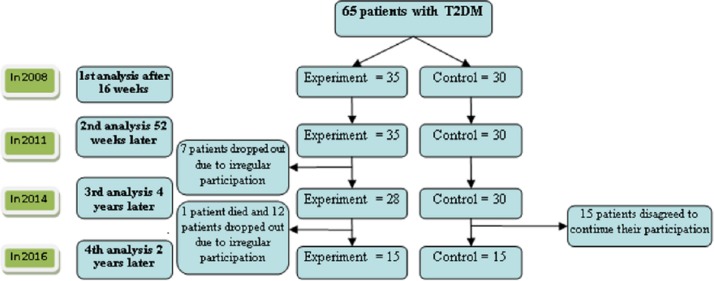
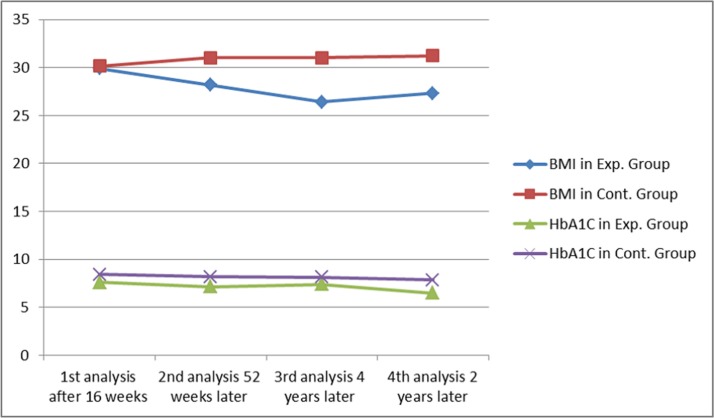
Objective: The effects of regular exercise on the health promotion of patients with type 2 diabetes mellitus (T2DM) have been well documented. The present study investigated the long-term effects of regular exercise training on biological indicators among these patients. Methods: In this quasi-experimental trial with pretest-post-test design, 65 patients with T2DM aged 33–69 years (experiment (35), control (30)) participated. After 8 years of conducting the program, the data on 30 patients (experiment (15), control (15)) were entered into analysis. The training program included aerobic exercise three sessions per week, 90 min, 50%–80% VO 2 max. Before and after the intervention, the biological indicators (hemoglobin A1c (HbA1c), body mass index (BMI) and VO 2 max) were measured. Data were analyzed using multivariate analysis of covariance. Results: Our long-term exercise training program had a significant effect on HbA1C, BMI and Vo 2 max (P<0.05). Compared with patients in the control group, HbA1c was significantly reduced and BMI and VO 2 max were significantly improved among the experiment group. Conclusions: Long-term regular physical activity training was found to be helpful in improving glycemic control, body composition and cardiovascular fitness among patients with T2DM. Long-term continuous physical activity offsets the deteriorations of biological indicators found in the control group. Further research, with a particular focus on practical and real-world programming, is needed to determine the responsive health outcomes of such long-term programs on the patients.
Overview
The claims and statistics of this paper haven’t been checked yet.
Free: it reads the open-access text and checks the first 5 claims that cite a source we can check. Create a free account to check every claim.
Integrity signals
Registry
Cites
Statistics
Figures
Verification
Claims the paper makes
The claims and statistics of this paper haven’t been checked yet.
Free: it reads the open-access text and checks the first 5 claims that cite a source we can check. Create a free account to check every claim.
Claims other papers make about this one
Each is checked against this paper’s own text: does it say what the citing paper says it does?
The source backs part of the claim, not all of it — or backs it for a different population, condition or comparison.
In the citing paper
“and induces clinically signi fi cant bene fi ts in cardiorespiratory fi tness (101,110,119).”
From Management of Hyperglycemia in Type 2 Diabetes, 2022. A Consensus Report by the American Diabetes Association (ADA) and the European Association for the Study of Diabetes (EASD) (2022) · cites this paper as [119]
Experimental — accuracy not yet measuredIn the citing paper
“One study had 30 T2DM patients perform 90-minutes of regular exercise 3 times a week for 8 years, with this group having an A1c 1.06% lower than the non-exercise group.”
From The Impact of Physical Activity in Patients With Type 2 Diabetes (2025) · cites this paper as [40]
Self-check
Percentages, sums and reported differences re-computed from the paper’s own numbers.
The self-check needs the paper’s full text.
Citations
Cites
Health benefits of physical activity: the evidence
Warburton, D. E. R. (2006) · Canadian Medical Association Journal · doi:10.1503/cmaj.051351 · Cited by 8,007
Janssen, I., & LeBlanc, A. G. (2010) · International Journal of Behavioral Nutrition and Physical Activity · doi:10.1186/1479-5868-7-40 · Cited by 4,829
Health benefits of physical activity: a systematic review of current systematic reviews
Warburton, D. E. R., & Bredin, S. S. D. (2017) · Current Opinion in Cardiology · doi:10.1097/hco.0000000000000437 · Cited by 2,410
Boulé, N. G., Haddad, E., Kenny, G. P., Wells, G. A., & Sigal, R. J. (2001) · JAMA · doi:10.1001/jama.286.10.1218 · Cited by 1,889
Effects of the amount and intensity of exercise on plasma lipoproteins
Kraus, W. E., Houmard, J. A., Duscha, B. D., Knetzger, K. J., Wharton, M. B., McCartney, J. S., Bales, C. W., Henes, S., Samsa, G. P., Otvos, J. D., et al. (2002) · New England Journal of Medicine · doi:10.1056/nejmoa020194 · Cited by 1,554
Guidelines for Exercise Testing and Prescription
Sharp, N. C. C. (1993) · British Journal of Sports Medicine · doi:10.1136/bjsm.27.2.138-a · Cited by 1,183
Church, T. S., Blair, S. N., Cocreham, S., Johannsen, N., Johnson, W., Kramer, K., Mikus, C. R., Myers, V., Nauta, M., Rodarte, R. Q., et al. (2010) · JAMA · doi:10.1001/jama.2010.1710 · Cited by 944
Guidelines for Exercise Testing and Prescription
Scavarda, A. (1986) · Military Medicine · doi:10.1093/milmed/151.9.465a · Cited by 842
Update on the effects of physical activity on insulin sensitivity in humans
Bird, S. R., & Hawley, J. A. (2017) · BMJ Open Sport & Exercise Medicine · doi:10.1136/bmjsem-2016-000143 · Cited by 646 · cited 1×
“A reduction in daily physical activity may result in obesity and insulin resistance, which are important components of metabolic syndrome.(4) This syndrome predicts an increased risk of developing type 2 diabetes mellitus (T2DM) and cardiovascular diseases,(5) as well.”
Background(2000) · Medicine & Science in Sports & Exercise · doi:10.1097/00005768-200007000-00024 · Cited by 604
Research works printed but not linked: 1
- Shenoy S, Arova E, Jaspal S Effects of progressive resistance training and aerobic exercise onT2DM in Indian population. Int. J. Diabetes Metab 2009; 17: 27– 30.
Cited by
Items 101–126 of 126
Brîndușe, L. A., Vicol, C., Cucu, M. A., & Bratu, E. C. (2026) · Diabetology · doi:10.3390/diabetology7070138
Liu, Y., Zhao, M., & Qian, B. (2026) · Frontiers in Endocrinology · doi:10.3389/fendo.2026.1835096
Park, S., Heo, C. M., Park, B. S., & Ko, J. H. (2026) · Research Square · doi:10.21203/rs.3.rs-9673396/v1
Qadir, R., Sculthorpe, N. F., Todd, T., & Brown, E. C. (2021) · Figshare · doi:10.6084/m9.figshare.14702623
Qadir, R., Sculthorpe, N. F., Todd, T., & Brown, E. C. (2021) · Figshare · doi:10.6084/m9.figshare.14702617
Qadir, R., Sculthorpe, N. F., Todd, T., & Brown, E. C. (2021) · Figshare · doi:10.6084/m9.figshare.14702620
Haris, F., Silvia, F., Irawati, K., Budi, A. W. S., Rahman, F. F., Wahab, P. A., & Lung, C.-W. (2026) · Malaysian Journal of Medicine and Health Sciences · doi:10.47836/mjmhs.22.s9.44
Lejk, A., Myśliwiec, K., Chrzanowski, J., Burzyński, J., Michalak, A., Musiał-Paździor, M., Bandura, M., Rutkowska-Kośmińska, J., Drzewińska, K., Grabowska, A., et al. (2025) · Nutrients · doi:10.3390/nu17203304
Khuntia, M., Mahapatra, H., Jena, D., Jena, S. K., Behera, M. R., & Mishra, P. R. (2026) · National Journal of Community Medicine · doi:10.55489/njcm.170720266562
(2026) · Károli könyvek. Tanulmánykötet · doi:10.56037/978-963-646-461-5
Elema, K. A., Kebede, W. S., & Tefera, K. (2024) · Ethiopian Journal of Medical and Health Sciences · doi:10.82127/geptwr75
Characteristic Lifestyle for a Person with Type 2 Diabetes Mellitus
Elawad, D. (2025) · Lithuanian University of Health Sciences
Chlup, R. (2026) · Directory of Open access Books (OAPEN Foundation)
Barbosa, A. R. R. (2024) · Portuguese National Funding Agency for Science, Research and Technology (RCAAP Project by FCT) · doi:10.34626/f8x2-te09
Moderate Vigorous Physical Activity for Mental Health in Sedentary Middle- Aged Adults
Moxley, E., Henert, S. E., Habtezgi, D., Bode, B. P., Kowal, R. A., Budhwani, S., & Varothai, K. (2026) · International journal of exercise science · doi:10.70252/ijes2026504
Vidor, R. B. (2025) · DSpace (Federal University of Santa Catarina)
Impact of Endurance Exercise on Glycated Hemoglobin (HbA1c) Among Diabetic Patients
Ahmed, M. (2025) · Journal of Biological and Allied Health Sciences · doi:10.56536/jbahs.v6i1.91
Döhla, A. (2024) · Online Publication Service of Würzburg University (Würzburg University) · doi:10.25972/opus-37449
Szabadidő-eltöltési irányzatok és színterek
Fritz, P., Ilics, K. B., & Magyar, M. (2026) · Károli könyvek. Tanulmánykötet · doi:10.56037/978-963-646-461-5-10
Subramanian, T., & Kour, L. (2024) · Medical Hypotheses · doi:10.1016/j.mehy.2024.111560
Abdulsalam, A., Mohammed, Y. M., Haruna, A., Imam, L. N. G., Hadiza, S., Umar, M., & Shoyemi, O. S. (2024) · NIU journal of social sciences. · doi:10.58709/niujss.v10i4.2040
Luka, S., Michael, L., Christian, I. O., Ishaku, A. A., Longwap, A. S., & Warshu, S. (2025) · World Journal of Public Health · doi:10.11648/j.wjph.20251003.15
Pereira Rodríguez, J. E., Lara-Vargas, J. A., Flórez, D. G. P., Pereira Rodríguez, P., Meza, I. A., & Ceballos Portilla, L. F. (2022) · Revista Cubana de Cardiología y Cirugía Cardiovascular
Moktan, S., Wongsiri, S., Chanchao, C., Suwannapong, G., & Thapa, R. (2026) · Apis · doi:10.62949/03917046.0871114
Nigella Sativa a Promising Drug in Treatment of Diabetes and Prevention of Its Complication
Ahmed, M. A.-F., Mohammed, H. S., Elamin, N. M. H., & Musa, O. A. A. (2019) · International Journal of Biomedical and Advance Research · doi:10.7439/ijbar.v10i12.5292
Metadata
- Authors
- Najafipour, F., Mobasseri, M., Yavari, A., Nadrian, H., Aliasgarzadeh, A., Mashinchi Abbasi, N., Niafar, M., Houshyar Gharamaleki, J., & Sadra, V.
- Affiliations
- Tabriz University of Medical Sciences (IR)
- Department of Psychology, Tabriz University, Tabriz, Iran
- Endocrine Research Center, Tabriz University of Medical Sciences, Tabriz, Iran
- Corresponding author
- Yavari, Abbas
- Venue
- BMJ Open Diabetes Research & Care
- Publisher
- BMJ
- Published
- 2017-11
- Volume
- 5
- Issue
- 1
- Pages
- e000414
- ISSN
- 2052-4897 (ISSN-L)
- PMC
- PMC5687538
- OpenAlex
- W2767631144
- Cited by
- 93
- References
- 41
- Citations by year
- 2026: 8 · 2025: 8 · 2024: 9 · 2023: 13 · 2022: 14 · 2021: 18 · 2020: 12 · 2019: 5 · 2018: 6
- FWCI
- 4.66
- Type
- journal article
- Language
- en
- Open access
- gold
- doi.org
- Licence
- cc-by-nc
- Locations
- BMJ Open Diabetes Research & Care (publishedVersion, cc-by-nc)
- Europe PMC (PubMed Central) (publishedVersion, cc-by-nc)
- PubMed Central (publishedVersion, cc-by-nc)
- PubMed (publishedVersion)
- Funders
- Tabriz University of Medical Sciences
- Topics
- Health Sciences › Medicine › Public Health, Environmental and Occupational Health › Physical Activity and Health
- Health Sciences › Medicine › Physiology (medical) › Cardiovascular and exercise physiology
- Health Sciences › Medicine › Endocrinology, Diabetes and Metabolism › Diabetes, Cardiovascular Risks, and Lipoproteins
- Keywords
- type 2 diabetes, aerobic exercise training, long-term exercise intervention, glycemic control, HbA1c, body mass index, body composition, VO2max, cardiorespiratory fitness, physical activity
About these checks
Registry, retraction, Cites and statistics results are computed, not judged, with one exception: a printed reference that no index lists is read once by a model before it counts as a citation error. Claims are extracted by a model and kept only when their quote appears verbatim in the text; each cited source is then checked, with a model’s help, for whether it says what the claim relies on. Those verdicts can be wrong — read the claim’s quote and the cited source before relying on one.
Statistics and arithmetic are recomputed, not judged.
Confidence bands are shown only for fields calibrated on our annotated test set. None is calibrated yet, so no band is shown.
What counts as a claim ›How we measure confidence ›How we check this ›
Are you an author, or do you see a problem with this page? Request a review
Data sources
Bibliographic data: Semantic Scholar, OpenAlex, Crossref.
Contains information from the Semantic Scholar Academic Graph Datasets, made available under the ODC Attribution License (ODC-BY 1.0).
Semantic Scholar’s data is described in: Kinney, R., et al. (2023). The Semantic Scholar Open Data Platform. arXiv:2301.10140.
