

Effect of regular exercise training on changes in HbA1c, BMI and VO 2 max among patients with type 2 diabetes mellitus: an 8-year trial
Open accessThe DOI matches its Crossref record; 37 of the 41 references it cites were found in a registry or an index.
Abstract
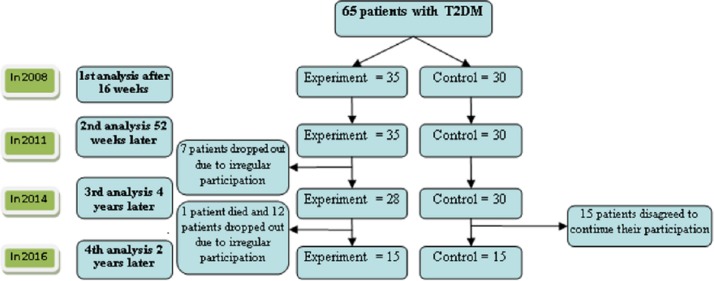
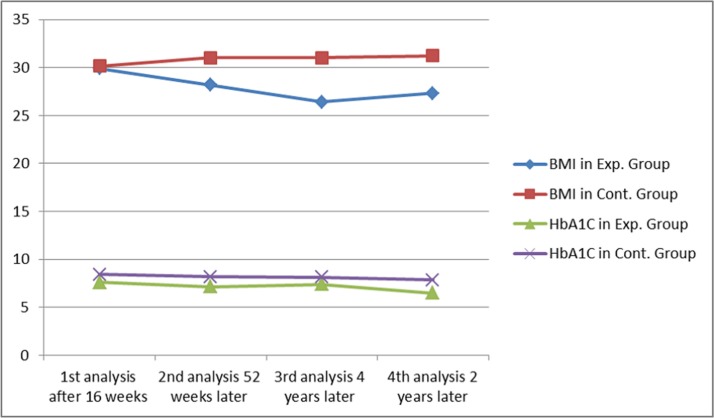
Objective: The effects of regular exercise on the health promotion of patients with type 2 diabetes mellitus (T2DM) have been well documented. The present study investigated the long-term effects of regular exercise training on biological indicators among these patients. Methods: In this quasi-experimental trial with pretest-post-test design, 65 patients with T2DM aged 33–69 years (experiment (35), control (30)) participated. After 8 years of conducting the program, the data on 30 patients (experiment (15), control (15)) were entered into analysis. The training program included aerobic exercise three sessions per week, 90 min, 50%–80% VO 2 max. Before and after the intervention, the biological indicators (hemoglobin A1c (HbA1c), body mass index (BMI) and VO 2 max) were measured. Data were analyzed using multivariate analysis of covariance. Results: Our long-term exercise training program had a significant effect on HbA1C, BMI and Vo 2 max (P<0.05). Compared with patients in the control group, HbA1c was significantly reduced and BMI and VO 2 max were significantly improved among the experiment group. Conclusions: Long-term regular physical activity training was found to be helpful in improving glycemic control, body composition and cardiovascular fitness among patients with T2DM. Long-term continuous physical activity offsets the deteriorations of biological indicators found in the control group. Further research, with a particular focus on practical and real-world programming, is needed to determine the responsive health outcomes of such long-term programs on the patients.
Overview
The claims and statistics of this paper haven’t been checked yet.
Free: it reads the open-access text and checks the first 5 claims that cite a source we can check. Create a free account to check every claim.
Integrity signals
Registry
Cites
Statistics
Figures
Verification
Claims the paper makes
The claims and statistics of this paper haven’t been checked yet.
Free: it reads the open-access text and checks the first 5 claims that cite a source we can check. Create a free account to check every claim.
Claims other papers make about this one
Each is checked against this paper’s own text: does it say what the citing paper says it does?
The source backs part of the claim, not all of it — or backs it for a different population, condition or comparison.
In the citing paper
“and induces clinically signi fi cant bene fi ts in cardiorespiratory fi tness (101,110,119).”
From Management of Hyperglycemia in Type 2 Diabetes, 2022. A Consensus Report by the American Diabetes Association (ADA) and the European Association for the Study of Diabetes (EASD) (2022) · cites this paper as [119]
Experimental — accuracy not yet measuredIn the citing paper
“One study had 30 T2DM patients perform 90-minutes of regular exercise 3 times a week for 8 years, with this group having an A1c 1.06% lower than the non-exercise group.”
From The Impact of Physical Activity in Patients With Type 2 Diabetes (2025) · cites this paper as [40]
Self-check
Percentages, sums and reported differences re-computed from the paper’s own numbers.
The self-check needs the paper’s full text.
Citations
Cites
Health benefits of physical activity: the evidence
Warburton, D. E. R. (2006) · Canadian Medical Association Journal · doi:10.1503/cmaj.051351 · Cited by 8,007
Janssen, I., & LeBlanc, A. G. (2010) · International Journal of Behavioral Nutrition and Physical Activity · doi:10.1186/1479-5868-7-40 · Cited by 4,829
Health benefits of physical activity: a systematic review of current systematic reviews
Warburton, D. E. R., & Bredin, S. S. D. (2017) · Current Opinion in Cardiology · doi:10.1097/hco.0000000000000437 · Cited by 2,410
Boulé, N. G., Haddad, E., Kenny, G. P., Wells, G. A., & Sigal, R. J. (2001) · JAMA · doi:10.1001/jama.286.10.1218 · Cited by 1,889
Effects of the amount and intensity of exercise on plasma lipoproteins
Kraus, W. E., Houmard, J. A., Duscha, B. D., Knetzger, K. J., Wharton, M. B., McCartney, J. S., Bales, C. W., Henes, S., Samsa, G. P., Otvos, J. D., et al. (2002) · New England Journal of Medicine · doi:10.1056/nejmoa020194 · Cited by 1,554
Guidelines for Exercise Testing and Prescription
Sharp, N. C. C. (1993) · British Journal of Sports Medicine · doi:10.1136/bjsm.27.2.138-a · Cited by 1,183
Church, T. S., Blair, S. N., Cocreham, S., Johannsen, N., Johnson, W., Kramer, K., Mikus, C. R., Myers, V., Nauta, M., Rodarte, R. Q., et al. (2010) · JAMA · doi:10.1001/jama.2010.1710 · Cited by 944
Guidelines for Exercise Testing and Prescription
Scavarda, A. (1986) · Military Medicine · doi:10.1093/milmed/151.9.465a · Cited by 842
Update on the effects of physical activity on insulin sensitivity in humans
Bird, S. R., & Hawley, J. A. (2017) · BMJ Open Sport & Exercise Medicine · doi:10.1136/bmjsem-2016-000143 · Cited by 646 · cited 1×
“A reduction in daily physical activity may result in obesity and insulin resistance, which are important components of metabolic syndrome.(4) This syndrome predicts an increased risk of developing type 2 diabetes mellitus (T2DM) and cardiovascular diseases,(5) as well.”
Background(2000) · Medicine & Science in Sports & Exercise · doi:10.1097/00005768-200007000-00024 · Cited by 604
Effective exercise modality to reduce insulin resistance in women with type 2 diabetes
Cuff, D. J., Meneilly, G. S., Martin, A., Ignaszewski, A., Tildesley, H. D., & Frohlich, J. J. (2003) · Diabetes Care · doi:10.2337/diacare.26.11.2977 · Cited by 545 · cited 1×
“25 In the study conducted by Gold-haber-Fiebert et al , 26 significant weight loss was observed in the experimental group.”
MethodEstimation of &OV0312;O2max from a one-mile track walk, gender, age, and body weight
KLINE, G. M., PORCARI, J. P., HINTERMEISTER, R., FREEDSON, P. S., WARD, A., MCCARRON, R. F., ROSS, J., & RIPPE, J. M. (1987) · Medicine & Science in Sports & Exercise · doi:10.1249/00005768-198706000-00012 · Cited by 520
Prevention of Overweight and Obesity: How Effective is the Current Public Health Approach
Chan, R. S. M., & Woo, J. (2010) · International Journal of Environmental Research and Public Health · doi:10.3390/ijerph7030765 · Cited by 457
The prevention and control the type-2 diabetes by changing lifestyle and dietary pattern
Asif, M. (2014) · Journal of Education and Health Promotion · doi:10.4103/2277-9531.127541 · Cited by 441 · cited 1×
“In particular, it diminishes the blood glucose levels, and plays an important role in the treatment of patients with diabetes.(11) It has also been found that beside diet control and medical treatment, regular exercise may improve glycemic control, reduce cardiovascular risk factors, play a role in weight loss and, co…”
BackgroundCauza, E., Hanusch-Enserer, U., Strasser, B., Ludvik, B., Metz-Schimmerl, S., Pacini, G., Wagner, O., Georg, P., Prager, R., Kostner, K., et al. (2005) · Archives of Physical Medicine and Rehabilitation · doi:10.1016/j.apmr.2005.01.007 · Cited by 392
Kelley, G. A., & Kelley, K. S. (2007) · Public Health · doi:10.1016/j.puhe.2007.02.014 · Cited by 184
Tokmakidis, S. P., Zois, C., Volaklis, K. A., Kotsa, K., & Touvra, A.-M. (2004) · European Journal of Applied Physiology · doi:10.1007/s00421-004-1174-6 · Cited by 184
Goldhaber-Fiebert, J. D., Goldhaber-Fiebert, S. N., Tristán, M. L., & Nathan, D. M. (2003) · Diabetes Care · doi:10.2337/diacare.26.1.24 · Cited by 163
Optimizing the therapeutic benefits of exercise in Type 2 diabetes
Praet, S. F. E., & van Loon, L. J. C. (2007) · Journal of Applied Physiology · doi:10.1152/japplphysiol.00566.2007 · Cited by 134
Balducci, S., Leonetti, F., Di Mario, U., & Fallucca, F. (2004) · Diabetes Care · doi:10.2337/diacare.27.3.841 · Cited by 131 · cited 1×
“These findings are consistent with those reported by Balucci et al 24 and Cuff et al .”
ResultEffects of resistance versus endurance training on serum adiponectin and insulin resistance index.
Ahmadizad, S., Haghighi, A. H., & Hamedinia, M. R. (2007) · European Journal of Endocrinology · doi:10.1530/eje-07-0223 · Cited by 115
Yavari, A., Najafipoor, F., Aliasgharzadeh, A., Niafar, M., & Mobasseri, M. (2012) · Biology of Sport · doi:10.5604/20831862.990466 · Cited by 112
Self-citationThe effects of physical training of functional capacity in adults. Ages 46 to 90: a meta-analysis.
LeMura, L. M., von DUVILLARD, S. P., & Mookerjee, S. (2000) · PubMed · Cited by 110
Alam, S., Stolinski, M., Pentecost, C., Boroujerdi, M. A., Jones, R. H., Sonksen, P. H., & Umpleby, A. M. (2004) · The Journal of Clinical Endocrinology & Metabolism · doi:10.1210/jc.2003-031036 · Cited by 97
Health promoting lifestyle and its determinants among University students in Sabzevar, Iran
Solhi, M., Mehri, A., Garmaroudi, G., Nadrian, H., & Sighaldeh, S. (2016) · International Journal of Preventive Medicine · doi:10.4103/2008-7802.180411 · Cited by 94
Self-citationRÖNNEMAA, T., MATTILA, K., LEHTONEN, A., & KALLIO, V. (1986) · Acta Medica Scandinavica · doi:10.1111/j.0954-6820.1986.tb02754.x · Cited by 91
Does home-based exercise improve body mass index in patients with type 2 diabetes?
Krousel-Wood, M. A., Berger, L., Jiang, X., Blonde, L., Myers, L., & Webber, L. (2008) · Diabetes Research and Clinical Practice · doi:10.1016/j.diabres.2007.08.028 · Cited by 62
Byrkjeland, R., Njerve, I. U., Anderssen, S., Arnesen, H., Seljeflot, I., & Solheim, S. (2015) · Diabetes and Vascular Disease Research · doi:10.1177/1479164115590552 · Cited by 52
Sigal, R. J., Kenny, G. P., Boulé, N. G., Wells, G. A., Prud'homme, D., Fortier, M., Reid, R. D., Tulloch, H., Coyle, D., Phillips, P., et al. (2007) · Annals of Internal Medicine · doi:10.7326/0003-4819-147-6-200709180-00005 · Cited by 48
Effect of Aerobic Training on Glucose Control and Blood Pressure in T2DDM East African Males
Yan, H., Prista, A., Ranadive, S. M., Damasceno, A., Caupers, P., Kanaley, J. A., & Fernhall, B. (2014) · ISRN Endocrinology · doi:10.1155/2014/864897 · Cited by 43
Exercise training: can it improve cardiovascular health in patients with type 2 diabetes?
Stewart, K. J. (2004) · British Journal of Sports Medicine · doi:10.1136/bjsm.2004.012187 · Cited by 42
Nayak, B. S., Ramsingh, D., Gooding, S., Legall, G., Bissram, S., Mohammed, A., Raychaudhuri, A., Sahadeo, B., Pandohie, V., & Figaro, K. (2010) · Primary care diabetes · doi:10.1016/j.pcd.2010.05.006 · Cited by 40
Associations of Aging and Birth Cohort with Body Mass Index in a Biethnic Cohort
Juhaeri, J., Stevens, J., Jones, D. W., & Arnett, D. K. (2003) · Obesity Research · doi:10.1038/oby.2003.58 · Cited by 36
The effect of aerobic exercise on glycosylated hemoglobin values in type 2 diabetes patients.
Yavari, A., Hajiyev, A. M., & Naghizadeh, F. (2010) · PubMed · Cited by 36
Self-citationMobasseri, M., Yavari, A., Najafipoor, F., Aliasgarzadeh, A., & Niafar, M. (2015) · PubMed · Cited by 21
Self-citationDiabetes and the public's health
Tuchman, A. M. (2009) · The Lancet · doi:10.1016/s0140-6736(09)61730-x · Cited by 16
Glycosylated Hemoglobin: The Importance in Management of Type 2 Diabetes
Yavari, A. (2011) · Journal of stress physiology & biochemistry · Cited by 11
Self-citation
Research works printed but not linked: 1
- Shenoy S, Arova E, Jaspal S Effects of progressive resistance training and aerobic exercise onT2DM in Indian population. Int. J. Diabetes Metab 2009; 17: 27– 30.
Cited by
Davies, M. J., Aroda, V. R., Collins, B. S., Gabbay, R. A., Green, J., Maruthur, N. M., Rosas, S. E., Del Prato, S., Mathieu, C., Mingrone, G., et al. (2022) · Diabetes Care · doi:10.2337/dci22-0034 · Cited by 2,104
Davies, M. J., Aroda, V. R., Collins, B. S., Gabbay, R. A., Green, J., Maruthur, N. M., Rosas, S. E., Del Prato, S., Mathieu, C., Mingrone, G., et al. (2022) · Diabetologia · doi:10.1007/s00125-022-05787-2 · Cited by 1,048
The importance of exercise for glycemic control in type 2 diabetes
Syeda, U. S. A., Battillo, D. J., Visaria, A., & Malin, S. K. (2023) · American Journal of Medicine Open · doi:10.1016/j.ajmo.2023.100031 · Cited by 234
Regulation of Skeletal Muscle Glucose Transport and Glucose Metabolism by Exercise Training
Evans, P. L., McMillin, S. L., Weyrauch, L. A., & Witczak, C. A. (2019) · Nutrients · doi:10.3390/nu11102432 · Cited by 190
Beneficial Effects of Physical Activity in Diabetic Patients
Cannata, F., Vadalà, G., Russo, F., Papalia, R., Napoli, N., & Pozzilli, P. (2020) · Journal of Functional Morphology and Kinesiology · doi:10.3390/jfmk5030070 · Cited by 135
Metadata
- Authors
- Najafipour, F., Mobasseri, M., Yavari, A., Nadrian, H., Aliasgarzadeh, A., Mashinchi Abbasi, N., Niafar, M., Houshyar Gharamaleki, J., & Sadra, V.
- Affiliations
- Tabriz University of Medical Sciences (IR)
- Department of Psychology, Tabriz University, Tabriz, Iran
- Endocrine Research Center, Tabriz University of Medical Sciences, Tabriz, Iran
- Corresponding author
- Yavari, Abbas
- Venue
- BMJ Open Diabetes Research & Care
- Publisher
- BMJ
- Published
- 2017-11
- Volume
- 5
- Issue
- 1
- Pages
- e000414
- ISSN
- 2052-4897 (ISSN-L)
- PMC
- PMC5687538
- OpenAlex
- W2767631144
- Cited by
- 93
- References
- 41
- Citations by year
- 2026: 8 · 2025: 8 · 2024: 9 · 2023: 13 · 2022: 14 · 2021: 18 · 2020: 12 · 2019: 5 · 2018: 6
- FWCI
- 4.66
- Type
- journal article
- Language
- en
- Open access
- gold
- doi.org
- Licence
- cc-by-nc
- Locations
- BMJ Open Diabetes Research & Care (publishedVersion, cc-by-nc)
- Europe PMC (PubMed Central) (publishedVersion, cc-by-nc)
- PubMed Central (publishedVersion, cc-by-nc)
- PubMed (publishedVersion)
- Funders
- Tabriz University of Medical Sciences
- Topics
- Health Sciences › Medicine › Public Health, Environmental and Occupational Health › Physical Activity and Health
- Health Sciences › Medicine › Physiology (medical) › Cardiovascular and exercise physiology
- Health Sciences › Medicine › Endocrinology, Diabetes and Metabolism › Diabetes, Cardiovascular Risks, and Lipoproteins
- Keywords
- type 2 diabetes, aerobic exercise training, long-term exercise intervention, glycemic control, HbA1c, body mass index, body composition, VO2max, cardiorespiratory fitness, physical activity
About these checks
Registry, retraction, Cites and statistics results are computed, not judged, with one exception: a printed reference that no index lists is read once by a model before it counts as a citation error. Claims are extracted by a model and kept only when their quote appears verbatim in the text; each cited source is then checked, with a model’s help, for whether it says what the claim relies on. Those verdicts can be wrong — read the claim’s quote and the cited source before relying on one.
Statistics and arithmetic are recomputed, not judged.
Confidence bands are shown only for fields calibrated on our annotated test set. None is calibrated yet, so no band is shown.
What counts as a claim ›How we measure confidence ›How we check this ›
Are you an author, or do you see a problem with this page? Request a review
Data sources
Bibliographic data: Semantic Scholar, OpenAlex, Crossref.
Contains information from the Semantic Scholar Academic Graph Datasets, made available under the ODC Attribution License (ODC-BY 1.0).
Semantic Scholar’s data is described in: Kinney, R., et al. (2023). The Semantic Scholar Open Data Platform. arXiv:2301.10140.
