

The DOI matches its Crossref record; 46 of the 47 references it cites were found in a registry or an index.
Engagement and outcomes in a digital Diabetes Prevention Program: 3-year update
Open accessAbstract
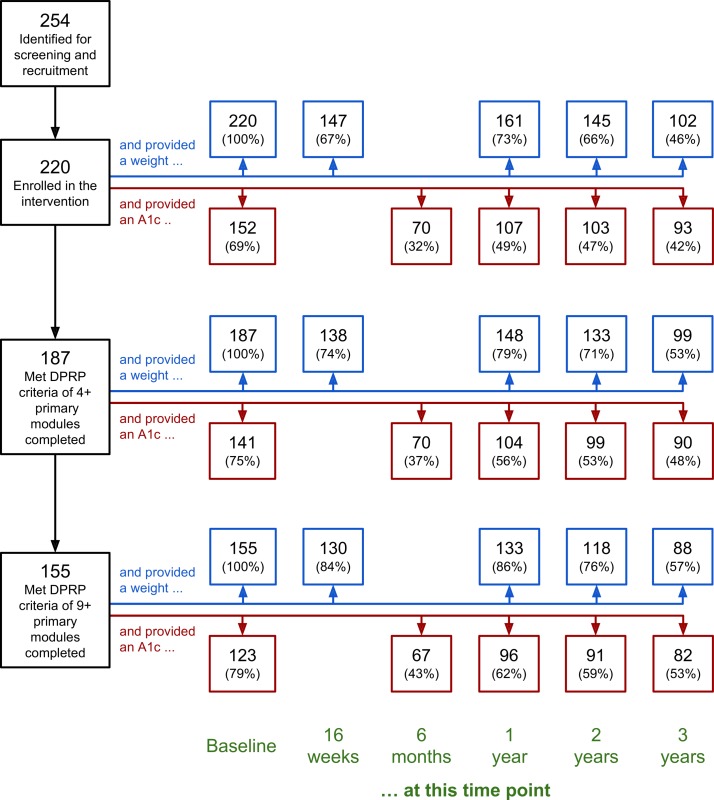
Objective: Translations of the Diabetes Prevention Program (DPP) have proliferated in recent years, with increasing expansion to digital formats. Although these DPP translations have consistently shown favorable clinical outcomes, long-term data for digital formats are limited. This study’s objective was to examine clinical outcomes up to 3 years post-baseline and the relationship between program engagement and clinical outcomes in a digital DPP. Research design and methods: In a single-arm, non-randomized trial, 220 patients previously diagnosed with prediabetes were enrolled in the Omada Health Program, a commercially available, 16-week DPP-based weight loss intervention followed by an ongoing weight maintenance intervention. Changes in body weight and A1c were assessed annually. Relationships between program engagement during the first year and clinical outcomes across 3 years were examined. Results: Participants were socioeconomically diverse (62% women, 50.2% non-Hispanic white, 51.7% college educated or higher). From baseline to 3 years, those participants who completed four or more lessons and nine or more lessons achieved significant sustained weight loss (–3.0% and –2.9%, respectively) and an absolute reduction in A1c (–0.31 and –0.33, respectively) with an average remission from the prediabetes range to the normal glycemic range. Factor analysis of engagement metrics during the first year revealed two underlying dimensions, one comprising lesson completion and health behavior tracking consistency, and the other comprising website logins and group participation. When these two factors were used to predict weight loss, only the logins and group participation factor was a significant predictor of weight loss at 16 weeks and 1 year. Conclusions: This study demonstrates significant long-term reductions in body weight and A1c in a digital DPP and identifies patterns of program engagement that predict weight loss.
Overview
The claims and statistics of this paper haven’t been checked yet.
Run the check — free, no account needed. It reads the open-access text and checks the sources it cites.
Integrity signals
Registry
Cites
Statistics
Figures
Verification
Claims the paper makes
The claims and statistics of this paper haven’t been checked yet.
Run the check — free, no account needed. It reads the open-access text and checks the sources it cites.
Claims other papers make about this one
Each is checked against this paper’s own text: does it say what the citing paper says it does?
The source backs part of the claim, not all of it — or backs it for a different population, condition or comparison.
In the citing paper
“Omada Health’s outcomes are more centered on diabetes prevention, focusing on weight reduction and lowering the risk of developing T2D (30).”
From Personalized nutrition in type 2 diabetes remission: application of digital twin technology for predictive glycemic control (2024) · cites this paper as [30]
Experimental — accuracy not yet measuredThe cited source says what the claim attributes to it.
In the citing paper
“The DT technology offers a unique and comprehensive approach to diabetes management, setting itself apart from other digital tools such as Livongo (29), Omada Health (30), One Drop (31), and mySugr (32).”
From Personalized nutrition in type 2 diabetes remission: application of digital twin technology for predictive glycemic control (2024) · cites this paper as [30]
Experimental — accuracy not yet measured
Self-check
Percentages, sums and reported differences re-computed from the paper’s own numbers.
The self-check needs the paper’s full text.
Citations
Cites
Reduction in the incidence of type 2 diabetes with lifestyle intervention or metformin
(2002) · New England Journal of Medicine · doi:10.1056/nejmoa012512 · Cited by 19,011 · cited 4×
“The program consisted of (1) one year of a behavior change curriculum(35) approved by the CDC DPRP; (2) technology-enabled tools to track nutritional intake, physical activity, and body weight; (3) personalized health coaching; and (4) small group support.”
InfluentialA First Course in Factor Analysis
Comrey, A. L., & Lee, H. B. (2013) · doi:10.4324/9781315827506 · Cited by 4,546
Diabetes Prevention Program Research Group (2009) · The Lancet · doi:10.1016/s0140-6736(09)61457-4 · Cited by 3,020
The Diabetes Prevention Program (DPP)
The Diabetes Prevention Program (DPP) Research Group (2002) · Diabetes Care · doi:10.2337/diacare.25.12.2165 · Cited by 1,938
Ramachandran, A., Snehalatha, C., Mary, S., Mukesh, B., Bhaskar, A. D., Vijay, V., & Indian Diabetes Prevention Programme (IDPP) (2006) · Diabetologia · doi:10.1007/s00125-005-0097-z · Cited by 1,881
The Finnish Diabetes Prevention Study (DPS)
Lindström, J., Louheranta, A., Mannelin, M., Rastas, M., Salminen, V., Eriksson, J., Uusitupa, M., Tuomilehto, J., & for the Finnish Diabetes Prevention Study Group (2003) · Diabetes Care · doi:10.2337/diacare.26.12.3230 · Cited by 1,848
(2015) · The Lancet Diabetes & Endocrinology · doi:10.1016/s2213-8587(15)00291-0 · Cited by 1,029
Tate, D. F., Jackvony, E. H., & Wing, R. R. (2003) · JAMA · doi:10.1001/jama.289.14.1833 · Cited by 666
Ali, M. K., Echouffo-Tcheugui, J. B., & Williamson, D. F. (2012) · Health Affairs · doi:10.1377/hlthaff.2011.1009 · Cited by 594
Gerstein, H. C., Santaguida, P., Raina, P., Morrison, K. M., Balion, C., Hunt, D., Yazdi, H., & Booker, L. (2007) · Diabetes Research and Clinical Practice · doi:10.1016/j.diabres.2007.05.004 · Cited by 575
Research works printed but not linked: 1
- Institute for Clinical and Economic Review. Diabetes prevention programs: effectiveness and value (final evidence report and meeting summary). 2016 https://icer-review.org/material/final-report-dpp/.
Cited by
Sorted by citations
Items 101–123 of 123
Interventional Analytics in Skilled Nursing Facilities Associated With Reduced Readmissions
Kaknes, D. (2024) · The American Journal of Managed Care · doi:10.37765/ajmc.2024.89557
Shared Decision-Making for Lung Cancer Screening: More Straw for the Camel’s Back
Green, J. (2024) · The American Journal of Managed Care · doi:10.37765/ajmc.2024.89548
Soltero, E. G., Partida, M., Mihail, S., Villanueva, L., Lopez, C., Musaad, S. M. A., Connor, T. O. A., REDONDO, M. J., Buman, M. P., & Debbe, T. (2025) · SSRN Electronic Journal · doi:10.2139/ssrn.5124511
AI to Bridge the Knowledge Gap Between Patients and Healthcare Professionals: A Narrative Study
Lamghafri, A. L., Alami, A. C., Bouchti, K. E., & Ziti, S. (2025) · Lecture notes in networks and systems · doi:10.1007/978-3-032-01970-7_24
Approaches for sustaining diabetes prevention program practices post-graduation: A scoping review
Dudzik, J. M., Johnston, E. A., Liu, Y., LaPolla, F. W. Z., & Beasley, J. M. (2025) · Preventive Medicine Reports · doi:10.1016/j.pmedr.2025.103329
Abusamaan, M. S., Ballreich, J. M., Dobs, A. S., Kane, B., Maruthur, N., McGready, J., Riekert, K. A., Wanigatunga, A. A., Alderfer, M. E., Alver, D., et al. (2024) · Figshare · doi:10.6084/m9.figshare.26721714
Golovaty, I., Wadhwa, S., Fisher, L., Lobach, I. V., Crowe, B., Levi, R., & Seligman, H. (2021) · Figshare · doi:10.6084/m9.figshare.14913305
Golovaty, I., Wadhwa, S., Fisher, L., Lobach, I. V., Crowe, B., Levi, R., & Seligman, H. (2021) · Figshare · doi:10.6084/m9.figshare.14913308
Golovaty, I., Wadhwa, S., Fisher, L., Lobach, I. V., Crowe, B., Levi, R., & Seligman, H. (2021) · Figshare · doi:10.6084/m9.figshare.14913299
Golovaty, I., Wadhwa, S., Fisher, L., Lobach, I. V., Crowe, B., Levi, R., & Seligman, H. (2021) · Figshare · doi:10.6084/m9.figshare.14913311
Abusamaan, M. S., Ballreich, J. M., Dobs, A. S., Kane, B., Maruthur, N., McGready, J., Riekert, K. A., Wanigatunga, A. A., Alderfer, M. E., Alver, D., et al. (2024) · Figshare · doi:10.6084/m9.figshare.26721711
Golovaty, I., Wadhwa, S., Fisher, L., Lobach, I. V., Crowe, B., Levi, R., & Seligman, H. (2021) · Figshare · doi:10.6084/m9.figshare.14913302
Abusamaan, M. S., Ballreich, J. M., Dobs, A. S., Kane, B., Maruthur, N., McGready, J., Riekert, K. A., Wanigatunga, A. A., Alderfer, M. E., Alver, D., et al. (2024) · Figshare · doi:10.6084/m9.figshare.26721708
Hansen, A. M., Raymond, K., Simon, A., Kim, S., Bayandorian, H., Marriott, D. J., & Saslow, L. R. (2026) · JMIR Research Protocols · doi:10.2196/81041
Sampford, J., Gibson, J., Jones, G., Myers-Ingram, R., Pena-Altamira, E., Duncan, A. E., & O'Keeffe, M. (2026) · Digital Health · doi:10.1177/20552076251411211
Soltero, E. G., Partida, M., Mihail, S., Villanueva, L., Lopez, C., Musaad, S. M. A., O’Connor, T. M., REDONDO, M. J., Buman, M. P., & Thompson, D. I. (2026) · JMIR Research Protocols · doi:10.2196/75331
Samajdar, S. S., Parikh, R. M., Husain, N., Bhaduri, G., Chawla, M. S., Mehta, R. J., Kalia, A., Mulwani, N., Rastogi, A., Tyagi, S., et al. (2026) · International Journal of Diabetes and Technology · doi:10.4103/ijdt.ijdt_14_26
Motivating Patients to Engage in Evidence-Based Strategies to Prevent Diabetes: An RCT
Kullgren, J. T., STOLL, S. C., Carter, E. W., Vadari, H. S., Resnicow, K., Herman, W. H., Kim, H. M., McEwen, L. N., Volpp, K. G. M., & Heisler, M. (2026) · American Journal of Preventive Medicine · doi:10.1016/j.amepre.2026.108407
Charan, I. A., Soomro, S., Mahmood, S. E., Shati, A. A., Alqahtani, Y. A., & Aftab, M. (2026) · Frontiers in Public Health · doi:10.3389/fpubh.2026.1595794
Lalani, B., SIEW, G. M., Valdez, Y., SHEHADEH, A., ZADE, D., Riekert, K. A., Mathioudakis, N. N., & AI-DPP Study Group (2026) · JMIR mhealth and uhealth · doi:10.2196/92981
Type 2 Diabetes Remission and Role of Technology
Joshi, S., & Shamanna, P. (2026) · Springer eBooks · doi:10.1007/978-3-032-24854-1_13
Ross, J., Ng, C. M., Lee, S. W. H., & Gupta, S. (2026) · Springer eBooks · doi:10.1007/978-3-032-24854-1_12
Metadata
- Authors
- Sepah, S. C., Jiang, L., Ellis, R. J., McDermott, K., & Peters, A. L.
- Affiliations
- University of California, San Francisco (US)
- University of California, Irvine (US)
- Medical Affairs, Omada Health, San Francisco, California, USA
- Dominican University of California (US)
- University of Southern California (US)
- Corresponding author
- Sepah, S Cameron
- Venue
- BMJ Open Diabetes Research & Care
- Publisher
- BMJ
- Published
- 2017-09
- Volume
- 5
- Issue
- 1
- Pages
- e000422
- ISSN
- 2052-4897 (ISSN-L)
- PMC
- PMC5595194
- OpenAlex
- W2752742138
- Cited by
- 122
- References
- 47
- Citations by year
- 2026: 9 · 2025: 9 · 2024: 23 · 2023: 14 · 2022: 17 · 2021: 22 · 2020: 10 · 2019: 12 · 2018: 6
- FWCI
- 12.41
- Type
- journal article
- Language
- en
- Open access
- gold
- doi.org
- Licence
- cc-by-nc
- Locations
- BMJ Open Diabetes Research & Care (publishedVersion, cc-by-nc)
- PubMed Central (publishedVersion, cc-by-nc)
- PubMed (publishedVersion)
- Dominican Scholar (Dominican University of California) (submittedVersion, cc-by-nc)
- eScholarship (California Digital Library) (submittedVersion, cc-by)
- Funders
- National Center for Complementary and Integrative Health (T32AT003997)
- Topics
- Health Sciences › Health Professions › General Health Professions › Mobile Health and mHealth Applications
- Health Sciences › Medicine › Endocrinology, Diabetes and Metabolism › Diabetes Management and Education
- Health Sciences › Medicine › Endocrinology, Diabetes and Metabolism › Diabetes, Cardiovascular Risks, and Lipoproteins
- Keywords
- Diabetes Prevention Program, digital health interventions, prediabetes, weight loss, weight maintenance, glycemic control, HbA1c, program engagement, long-term outcomes, group participation
About these checks
Registry, retraction, Cites and statistics results are computed, not judged, with one exception: a printed reference that no index lists is read once by a model before it counts as a citation error. Claims are extracted by a model and kept only when their quote appears verbatim in the text; each cited source is then checked, with a model’s help, for whether it says what the claim relies on. Those verdicts can be wrong — read the claim’s quote and the cited source before relying on one.
Statistics and arithmetic are recomputed, not judged.
Confidence bands are shown only for fields calibrated on our annotated test set. None is calibrated yet, so no band is shown.
What counts as a claim ›How we measure confidence ›How we check this ›
Are you an author, or do you see a problem with this page? Request a review
