

The DOI matches its Crossref record; 10 of the 10 references it cites were found in a registry or an index.
Over 1000 terms have been used to describe evidence synthesis: a scoping review
Abstract
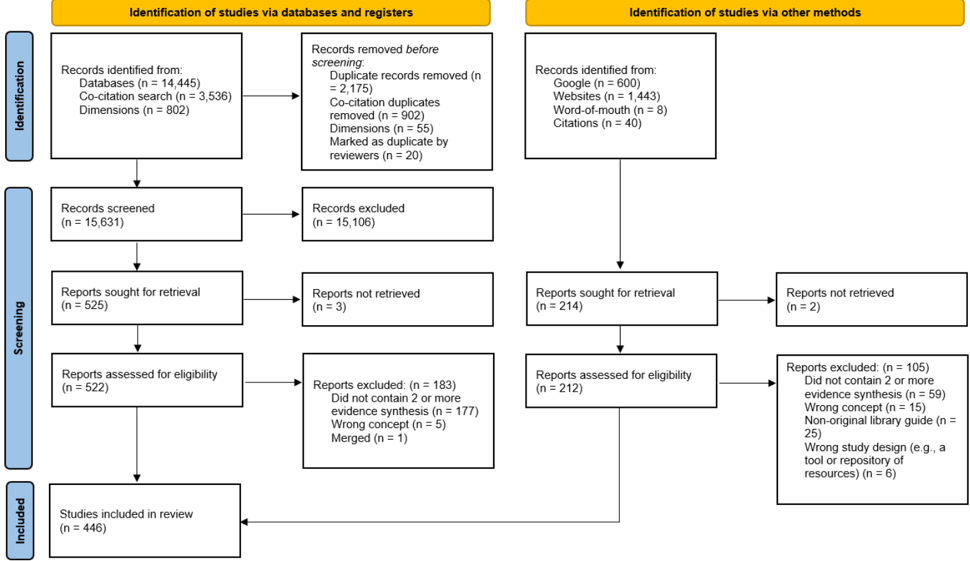
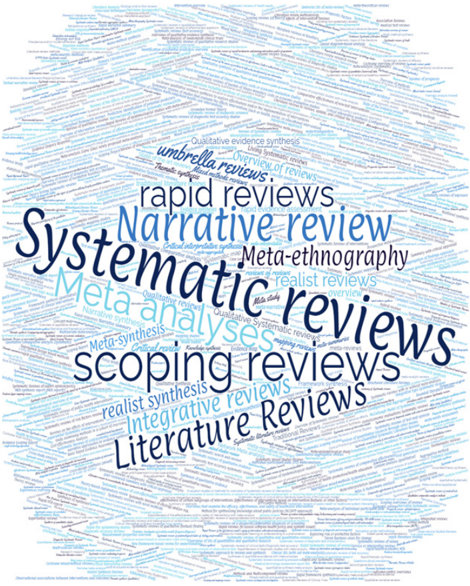
Objective: To inform the development of an evidence synthesis taxonomy, we aimed to identify and examine all classification systems, typologies or taxonomies that have been proposed for evidence synthesis methods. Design: Scoping review. Methods: This review followed JBI (previously Joanna Briggs Institute) scoping review methodology and was reported according to PRISMA-ScR (Preferred Reporting Items for Systematic Reviews and Meta-Analyses extension for Scoping Reviews). Resources that investigated typologies, taxonomies, classification systems and compendia for evidence synthesis within any field were eligible for inclusion. A comprehensive search across MEDLINE (Ovid), Embase (OVID), CINAHL with Full-Text (EBSCO), ERIC (EBSCO), Scopus, Compendex (Elsevier) and JSTOR was performed on 28 April 2022. This was supplemented by citation searching of key articles, contact with experts, targeted searching of organisational websites and additional grey literature searching. Documents were extracted by one reviewer and extractions verified by another reviewer. Data were analysed using frequency counts and a basic qualitative content analysis approach. Results are presented using bar charts, word clouds and narrative summary. Results: There were 15 634 titles and abstracts screened, and 703 full texts assessed for eligibility. Ultimately, 446 documents were included, and 49 formal classification systems identified, with the remaining documents presenting structured lists, simple listings or general discussions. Included documents were mostly not field-specific (n=242) or aligned to clinical sciences (n=83); however, public health, education, information technology, law and engineering were also represented. Documents (n=148) mostly included two to three evidence synthesis types, while 22 documents mentioned over 20 types of evidence synthesis. We identified 1010 unique terms to describe a type of evidence synthesis; of these, 742 terms were only mentioned once. Facets that could usefully distinguish (ie, similarities and differences or characteristics) between evidence synthesis approaches were categorised based on similarity into 15 overarching dimensions. These dimensions include review question and foci of interest, discipline/field, perspective, coverage, eligibility criteria, review purpose, methodological principles, theoretical underpinnings/philosophical perspective, resource considerations, compatibility with heterogeneity, sequence planning, analytical synthesis techniques, intended product/output, intended audience and intended impact or influence. Conclusion: This scoping review identified numerous unique terms to describe evidence synthesis approaches and many diverse ways to distinguish or categorise review types. These results suggest a need for the evidence synthesis community to organise, categorise and harmonise evidence synthesis approaches and terminolog
Overview
The claims and statistics of this paper haven’t been checked yet.
Run the check — free, no account needed. It reads the open-access text and checks the sources it cites.
Integrity signals
Registry
Cites
Statistics
Figures
Verification
Claims the paper makes
The claims and statistics of this paper haven’t been checked yet.
Run the check — free, no account needed. It reads the open-access text and checks the sources it cites.
Claims other papers make about this one
Each is checked against this paper’s own text: does it say what the citing paper says it does?
In the citing paper
“Other innovations include a methodological quality appraisal tool for ScRs that is currently under development [30] and the teasing out of different knowledge synthesis methods (eg, systematic reviews, qualitative evidence syntheses, mixed methods reviews) to inform an evidence synthesis taxonomy [31][32][33][34].”
From Updating the PRISMA reporting guideline for scoping reviews: a scoping review (2026) · cites this paper as [34]
In the citing paper
“Pollock et al [34] recently published a paper supporting the lack of consensus in evidence synthesis terminology.”
From Updating the PRISMA reporting guideline for scoping reviews: a scoping review (2026) · cites this paper as [34]
Self-check
Percentages, sums and reported differences re-computed from the paper’s own numbers.
The self-check needs the paper’s full text.
Citations
Cites
PRISMA Extension for Scoping Reviews (PRISMA-ScR): Checklist and Explanation
Tricco, A. C., Lillie, E., Zarin, W., O'Brien, K. K., Colquhoun, H., Levac, D., Moher, D., Peters, M. D. J., Horsley, T., Weeks, L., et al. (2018) · Annals of Internal Medicine · doi:10.7326/m18-0850 · Cited by 43,565 · cited 1×
“16 An a priori protocol of our methods has been published.”
Self-citationUpdated methodological guidance for the conduct of scoping reviews
Peters, M. D. J., Marnie, C., Tricco, A. C., Pollock, D., Munn, Z., Alexander, L., McInerney, P., Godfrey, C. M., & Khalil, H. (2020) · JBI Evidence Synthesis · doi:10.11124/jbies-20-00167 · Cited by 9,046
Self-citationPRESS Peer Review of Electronic Search Strategies: 2015 Guideline Statement
McGowan, J., Sampson, M., Salzwedel, D. M., Cogo, E., Foerster, V., & Lefebvre, C. (2016) · Journal of Clinical Epidemiology · doi:10.1016/j.jclinepi.2016.01.021 · Cited by 5,700 · cited 1×
“21 An initial exploratory search of MEDLINE (Ovid) was conducted to identify key articles on the topic.”
Synthesizing information systems knowledge: A typology of literature reviews
Paré, G., Trudel, M.-C., Jaana, M., & Kitsiou, S. (2015) · Information & Management · doi:10.1016/j.im.2014.08.008 · Cited by 1,987
Recommendations for the Extraction, Analysis, and Presentation of Results in Scoping Reviews
Pollock, D., Peters, M. D. J., Khalil, H., McInerney, P., Alexander, L., Tricco, A. C., Evans, C., de Moraes, É. B., Godfrey, C. M., Pieper, D., et al. (2023) · JBI Evidence Synthesis · doi:10.11124/jbies-22-00123 · Cited by 1,975
Self-citationMunn, Z., Stern, C., Aromataris, E., Lockwood, C., & Jordan, Z. (2018) · BMC Medical Research Methodology · doi:10.1186/s12874-017-0468-4 · Cited by 1,164
Self-citationClarifying differences between review designs and methods
Gough, D., Thomas, J., & Oliver, S. (2012) · Systematic Reviews · doi:10.1186/2046-4053-1-28 · Cited by 1,063
Meeting the review family: exploring review types and associated information retrieval requirements
Sutton, A., Clowes, M., Preston, L., & Booth, A. (2019) · Health Information & Libraries Journal · doi:10.1111/hir.12276 · Cited by 570
Self-citationBooth, A., Noyes, J., Flemming, K., Gerhardus, A., Wahlster, P., van der Wilt, G. J., Mozygemba, K., Refolo, P., Sacchini, D., Tummers, M., et al. (2018) · Journal of Clinical Epidemiology · doi:10.1016/j.jclinepi.2018.03.003 · Cited by 198
Self-citationClarifying differences between reviews within evidence ecosystems
Gough, D., Thomas, J., & Oliver, S. (2019) · Systematic Reviews · doi:10.1186/s13643-019-1089-2 · Cited by 115
Research works printed but not linked: 29
- Schünemann, 2022, The ecosystem of health decision making: from fragmentation to synergy, Lancet Public Health, 7, e378, 10.1016/S2468-2667(22)00057-3 · DOI
- 10.1136/bmjebm-2022-112065 · DOI · Paper page
- 10.1111/1468-0009.12210 · DOI · Paper page
- Campbell, 2017, Systematic Reviews in Burns Care: Poor Quality and Getting Worse, J Burn Care Res, 38, e552, 10.1097/BCR.0000000000000409 · DOI
- Munn, 2018, Evidence transfer: ensuring end users are aware of, have access to, and understand the evidence, Int J Evid Based Healthc, 16, 83, 10.1097/XEB.0000000000000134 · DOI
- 10.1016/j.psychres.2019.04.025 · DOI · Paper page
- 10.1016/j.jclinepi.2022.03.004 · DOI
- Clyne, 2024, An international modified Delphi process supported updating the web-based “right review” tool, J Clin Epidemiol, 170, 111333, 10.1016/j.jclinepi.2024.111333 · DOI
- Littell, 2018, Conceptual and practical classification of research reviews and other evidence synthesis products, Campbell Syst Rev, 14, 1
- 10.1016/j.jclinepi.2020.07.020 · DOI · Paper page
- Munn, 2023, Investigating different typologies for the synthesis of evidence: a scoping review protocol, JBI Evid Synth, 21, 592, 10.11124/JBIES-22-00122 · DOI · Paper page
- Higgins JPT , Thomas J , Chandler J , et al . Cochrane handbook for systematic reviews of interventions. 2nd edn. Newark: John Wiley & Sons, Incorporated, 2019. · DOI · Paper page
- 10.1111/j.1471-1842.2009.00848.x · DOI · Paper page
- 10.1016/j.jclinepi.2009.11.007 · DOI
- Veritas Health Innovation . Covidence systematic review software. Melbourne, Australia, 2023.
- Institute for Evidence-Based Healthcare . Systematic review accelerator: deduplicator. Queensland, Australia Bond University; 2023.
- Arevalo-Rodriguez, 2019, Rapid reviews of medical tests used many similar methods to systematic reviews but key items were rarely reported: a scoping review, J Clin Epidemiol, 116, 98, 10.1016/j.jclinepi.2019.09.004 · DOI
- 10.1007/BF03177550 · DOI · Paper page
- 10.1016/j.jclinepi.2015.05.036 · DOI
- Hartling L , Guise JM , Kato E . EPC methods: an exploration of methods and context for the production of rapid reviews. Rockville (MD): Agency for Healthcare Research and Quality (US); 2015. Available: https://www.ncbi.nlm.nih.gov/books/NBK274092/
- Hartling L , Guise JM , Hempel S . EPC Methods: AHRQ End-User Perspectives of Rapid Reviews. Rockville (MD): Agency for Healthcare Research and Quality (US); 2016. Available: https://www.ncbi.nlm.nih.gov/books/NBK362003/
- White, 2020, Guidance for producing a Campbell evidence and gap map, Campbell Syst Rev, 16
- Kastner, 2016, Conceptual recommendations for selecting the most appropriate knowledge synthesis method to answer research questions related to complex evidence, J Clin Epidemiol, 73, 43, 10.1016/j.jclinepi.2015.11.022 · DOI
- 10.1093/sf/48.1.1 · DOI
- Marradi, 1990, Classification, typology, taxonomy, Qual Quant, 24, 129, 10.1007/BF00209548 · DOI
- 10.1016/j.jclinepi.2013.06.014 · DOI · Paper page
- Barnett-Page, 2009, Methods for the synthesis of qualitative research: a critical review, BMC Med Res Methodol, 9, 10.1186/1471-2288-9-59 · DOI
- Chambergo-Michilot, 2021, Scoping reviews, umbrella reviews and focused mapping review synthesis: methodological aspects and applications, Rev Peru Med Exp Salud Publica, 38, 136, 10.17843/rpmesp.2021.381.6501 · DOI
- Gough D , Thomas J , Oliver S . An introduction to systematic reviews. 2017;1–352. · DOI
Cited by
Updating the PRISMA reporting guideline for scoping reviews: a scoping review
Tricco, A. C., Robinson, E., Straus, S. E., Colquhoun, H., Godfrey, C. M., Moher, D., Munn, Z., Pollock, D., Logan, S., Elsman, E. B. M., et al. (2026) · Journal of Clinical Epidemiology · doi:10.1016/j.jclinepi.2026.112314 · Cited by 9
Self-citation
Metadata
- Authors
- Pollock, D., Hasanoff, S., Barker, T. H., Clyne, B., Tricco, A. C., Booth, A., Godfrey, C., Khalil, H., Jia, R. M., Taneri, P.-E., Saif-Ur-Rahman, K., Conway, T., Konstantinidis, M., Stratton, C., Edwards, D., Alexander, L., Carrier, J., Habibi, N., Zaccagnini, M., Stern, C., Valenzuela, C., Price, C., Stone, J. C., Aromataris, E., Jordan, Z., Dias, M., McBride, G., Kanukula, R., Schuenemann, H. J., Mustafa, R. A., Pearson, A., Klugar, M., Ximena Rojas, M., Alonso-Coello, P., Whaley, P., Langendam, M., Merlin, T., Straus, S., Moola, S., Alper, B. S., & Munn, Z.
- Affiliations
- Health Evidence Synthesis, Recommendations and Impact (HESRI), School of Public Health, Faculty of Health and Medical Sciences, The University of Adelaide, Adelaide, South Australia, Australia
- Department of Public Health and Epidemiology, Royal College of Surgeons Ireland, Dublin, Ireland
- Queen’s Collaboration for Health Care Quality: A JBI Centre of Excellence, Queen’s University School of Nursing, Kingston, Ontario, Canada
- Sheffield Centre for Health and Related Research (SCHARR), University of Sheffield, Sheffield, South Yorkshire UK S1 4DA, Sheffield, South Yorkshire UK S1 4DA, UK
- School of Psychology and Public Health, Department of Public Health, La Trobe University, Melbourne, Victoria, Australia
- JBI, School of Public Health, Faculty of Health and Medical Sciences, The University of Adelaide, Adelaide, South Australia, Australia
- Evidence Synthesis Ireland and Cochrane Ireland, University of Galway, Galway, Ireland
- Knowledge Translation Program, Li Ka Shing Knowledge Institute, St. Michael’s Hospital, Unity Health Toronto, Toronto, Ontario, Canada
- Wales Centre For Evidence Based Care, School of Healthcare Sciences, Cardiff University, Cardiff, South Glamorgan, UK
- Scottish Centre for Evidence-based, Multi-professional Practice: a JBI Centre of Excellence; School of Health Sciences, Robert Gordon University, Aberdeen, Scotland, UK
- School of Agriculture, Food and Wine, Waite Research Institute, University of Adelaide, Adelaide, South Australia, Australia
- School of Physical and Occupational Therapy, McGill University, Montreal, Quebec, Canada
- Albert S. Cook Library, Towson University, Towson, Maryland, USA
- Clinical Epidemiology and Research Center (CERC), Humanitas University & Humanitas Research Hospital, Milan, Italy
- Department of Internal Medicine, Division of Nephrology and Hypertension, University of Kansas Medical Center, Kansas City, Kansas, USA
- Cochrane Czech Republic, Czech Republic: a JBI Centre of Excellence, Czech GRADE Network, Institute of Health Information and Statistics of the Czech Republic, Praha, Czech Republic
- Institut d’ Recerca, Hospital de la Santa Creu i Sant Pau, Barcelona, Spain
- Institut de Recerca Sant Pau, Barcelona, Catalunya, Spain
- Lancaster Environment Centre, Lancaster University, Lancaster, UK
- Department of Epidemiology and Data Science, Amsterdam UMC, Amsterdam, Netherlands
- Adelaide Health Technology Assessment (AHTA), School of Public Health, University of Adelaide, Adelaide, South Australia, Australia
- Department of Medicine, University of Toronto and Knowledge Translation Program, St. Michael’s Hospital, Unity Health Toronto, Toronto, Ontario, Canada
- Med Tech Reimbursement Consulting, Hyderabad, India
- Computable Publishing LLC, Scientific Knowledge Accelerator Foundation, Franklin, Tennessee, USA
- ORCID
- Venue
- BMJ Evidence-Based Medicine
- Publisher
- BMJ
- Published
- 2025-10-17
- Volume
- 31
- Issue
- 4
- Pages
- 221-231
- ISSN
- 2515-446X
- 2515-4478
- Cited by
- 5
- References
- 10
- Language
- en
- Funders
- National Health and Medical Research Council (1195676)
About these checks
Registry, retraction, Cites and statistics results are computed, not judged, with one exception: a printed reference that no index lists is read once by a model before it counts as a citation error. Claims are extracted by a model and kept only when their quote appears verbatim in the text; each cited source is then checked, with a model’s help, for whether it says what the claim relies on. Those verdicts can be wrong — read the claim’s quote and the cited source before relying on one.
Statistics and arithmetic are recomputed, not judged.
Confidence bands are shown only for fields calibrated on our annotated test set. None is calibrated yet, so no band is shown.
What counts as a claim ›How we measure confidence ›How we check this ›
Are you an author, or do you see a problem with this page? Request a review
How to cite
Cite CoChat for the checks on this page, and the paper for its own findings.
- This page
- CoChat. (2026). Citation check: Over 1000 terms have been used to describe evidence synthesis: a scoping review. https://app.cochat.ai/papers/10.1136/bmjebm-2024-113391
- The paper
- Pollock, D., Hasanoff, S., Barker, T. H., Clyne, B., Tricco, A. C., Booth, A., Godfrey, C., Khalil, H., Jia, R. M., Taneri, P.-E., Saif-Ur-Rahman, K., Conway, T., Konstantinidis, M., Stratton, C., Edwards, D., Alexander, L., Carrier, J., Habibi, N., Zaccagnini, M., . . . Munn, Z. (2026). Over 1000 terms have been used to describe evidence synthesis: a scoping review. BMJ Evidence-Based Medicine. https://doi.org/10.1136/bmjebm-2024-113391
Data sources
Bibliographic data: Semantic Scholar, OpenAlex, Crossref.
Contains information from the Semantic Scholar Academic Graph Datasets, made available under the ODC Attribution License (ODC-BY 1.0).
Semantic Scholar’s data is described in: Kinney, R., et al. (2023). The Semantic Scholar Open Data Platform. arXiv:2301.10140.
