

Alteration in the gastric microbiota and its restoration by probiotics in patients with functional dyspepsia
Open accessThe DOI matches its Crossref record; 24 of the 25 references it cites were found in a registry or an index.
Abstract
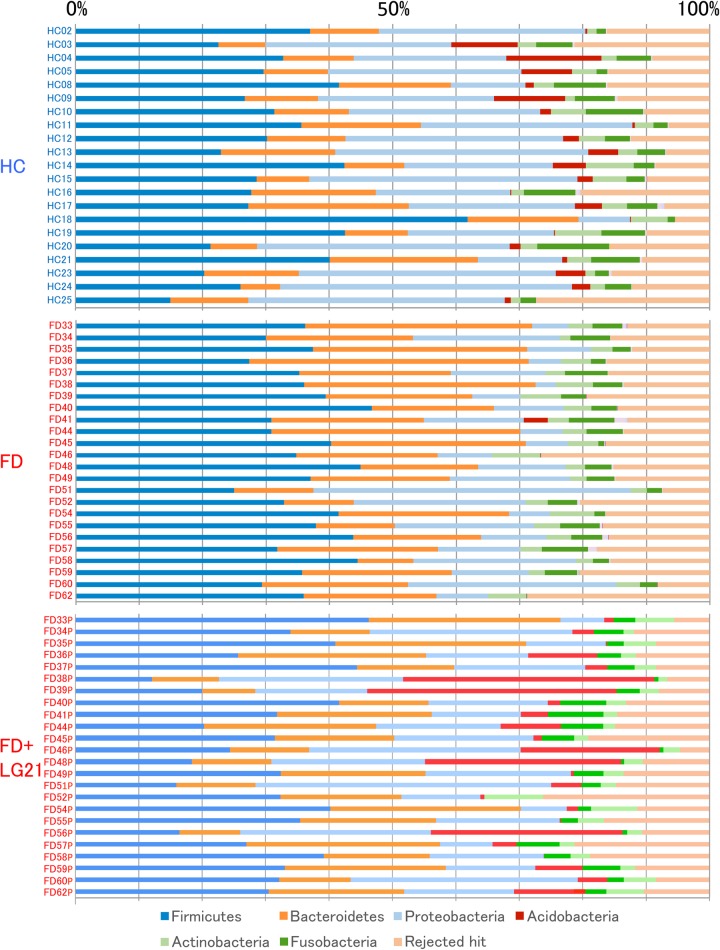
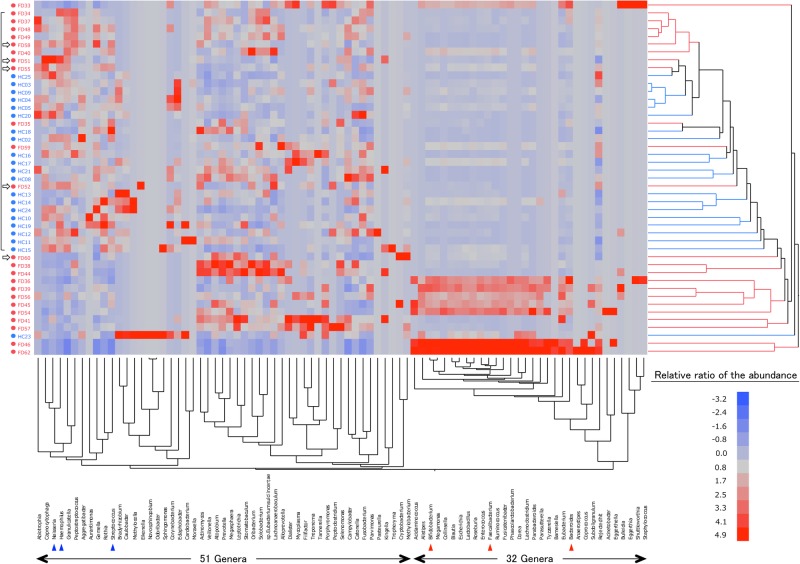
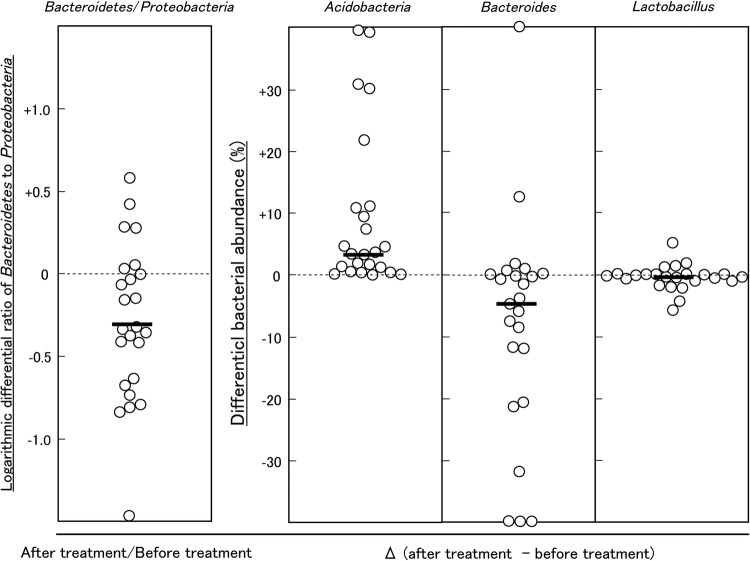
Objective: The objective of this study was to comparatively analyse the gastric fluid (GF) microbiota between patients with functional dyspepsia (FD) and healthy controls (HC), and to assess the effect of probiotics on the microbiota. Design: Twenty-four Japanese patients with FD who met the Rome III definition and 21 age-matched and gender-matched HC volunteers were enrolled. The patients with FD had been treated with LG21, a probiotic strain. The GF was sampled after an overnight fast using a nasogastric tube. The bile acids concentration was determined by ELISA. The V3-V4 region of 16S rRNA gene was amplified using bacterial DNA from the GF, and then about 30 000 high-quality amplicons per sample were grouped into operational taxonomic units for analyses. Results: The ratio of GF samples in which the bile acids were detectable was significantly greater in the FD than in the HC groups. In the bacterial composition analysis at the phylum level, the GF microbiota had a Bacteroidetes > Proteobacteria abundance and an absence of Acidobacteria in the FD group, in contrast, the GF microbiota had a Bacteroidetes < Proteobacteria abundance and the presence of Acidobacteria in the HC group. Probiotic therapy in patients with FD shifted the composition of the GF microbiota to that observed in the HC volunteers. Conclusions: Alteration in the GF microbiota was found in patients with FD compared with HC volunteers. Reflux of the small intestinal contents, including bile acid and intestinal bacteria, to the stomach was suggested to induce a bacterial composition change and be involved in the pathophysiology underlying FD. Probiotics appear effective in the treatment of FD through the normalisation of gastric microbiota. Trial registration number: UMINCTR 000022026; Results.
Overview
The claims and statistics of this paper haven’t been checked yet.
Free: it reads the open-access text and checks the first 5 claims that cite a source we can check. Create a free account to check every claim.
Integrity signals
Registry
Cites
Statistics
Figures
Verification
Claims the paper makes
The claims and statistics of this paper haven’t been checked yet.
Free: it reads the open-access text and checks the first 5 claims that cite a source we can check. Create a free account to check every claim.
Claims other papers make about this one
Each is checked against this paper’s own text: does it say what the citing paper says it does?
In the citing paper
“Igarashi et al145 found that gastric fluid samples from patients with FD were characterized by an increased Bacteroidetes to Proteobacteria ratio and absence of Acidobacteria. In contrast, healthy volunteers had a decreased Bacteroidetes to Proteobacteria ratio and presence of Acidobacteria.”
From The gut Microbiome in adult and pediatric functional gastrointestinal disorders (2019) · cites this paper as [145]
In the citing paper
“Non-blinded probiotic therapy with Lactobacillus gasseri OLL2716 was subsequently associated with shifts in gastric fluid microbial community composition similar to that found in healthy controls.”
From The gut Microbiome in adult and pediatric functional gastrointestinal disorders (2019) · cites this paper as [145]
Self-check
Percentages, sums and reported differences re-computed from the paper’s own numbers.
The self-check needs the paper’s full text.
Citations
Cites
QIIME allows analysis of high-throughput community sequencing data
Caporaso, J. G., Kuczynski, J., Stombaugh, J., Bittinger, K., Bushman, F. D., Costello, E. K., Fierer, N., Peña, A. G., Goodrich, J. K., Gordon, J. I., et al. (2010) · Nature Methods · doi:10.1038/nmeth.f.303 · Cited by 34,887
Search and clustering orders of magnitude faster than BLAST
Edgar, R. C. (2010) · Bioinformatics · doi:10.1093/bioinformatics/btq461 · Cited by 20,826
Muyzer, G., de Waal, E. C., & Uitterlinden, A. G. (1993) · Applied and Environmental Microbiology · doi:10.1128/aem.59.3.695-700.1993 · Cited by 11,429
Global patterns of 16S rRNA diversity at a depth of millions of sequences per sample
Caporaso, J. G., Lauber, C. L., Walters, W. A., Berg-Lyons, D., Lozupone, C. A., Turnbaugh, P. J., Fierer, N., & Knight, R. (2011) · Proceedings of the National Academy of Sciences · doi:10.1073/pnas.1000080107 · Cited by 9,711
Hill (2014) · doi:10.1038/nrgastro.2014.66 · Cited by 9,592
Functional Gastroduodenal Disorders
Tack, J., Talley, N. J., Camilleri, M., Holtmann, G., Hu, P., Malagelada, J.-R., & Stanghellini, V. (2006) · Gastroenterology · doi:10.1053/j.gastro.2005.11.059 · Cited by 2,418
Takahashi, S., Tomita, J., Nishioka, K., Hisada, T., & Nishijima, M. (2014) · PLoS ONE · doi:10.1371/journal.pone.0105592 · Cited by 1,506 · cited 1×
“PCR was performed in accordance with the method reported by Takahashi et al.(9) Sequencing was conducted using a paired-end and modified to 2×300 bp”
MethodSelf-citationComparison of Sequencing Utility Programs
Aronesty, E. (2013) · The Open Bioinformatics Journal · doi:10.2174/1875036201307010001 · Cited by 1,150
KUYKENDALL, L. D., ROY, M. A., O'NEILL, J. J., & DEVINE, T. E. (1988) · International Journal of Systematic Bacteriology · doi:10.1099/00207713-38-4-358 · Cited by 1,021
Small intestinal bacterial overgrowth syndrome
Bures, J. (2010) · World Journal of Gastroenterology · doi:10.3748/wjg.v16.i24.2978 · Cited by 620 · cited 1×
“Small intestinal bacterial overgrowth (SIBO) is broadly defined as an increase in the number of bacteria in the proximal small intestine.(18) More than 60% of Japanese patients with FD have been reported to have overlapping IBS, in which SIBO was considered a critical aetiological factor.”
Background
Cited by
Items 101–137 of 137
Syam Das, S., Veena, R. M., Aneesa, P. A., Parappilly, S. J., Mulakal, J. N., Baby Chakrapani, P. S., & Krishnakumar, I. M. (2025) · Medicine · doi:10.1097/md.0000000000044590 · Cited by 4
“[46] Similarly, the role of Bacteroides in producing short-chain fatty acids and facilitating dietary metabolism through the breakdown of polysaccharides and oligosaccharides, thereby providing essential nutrients and vitamins to the host and other intestinal microbes, is well documented.”
Comparative gastric microbiota profiles in non-ulcer dyspepsia and peptic ulcer patients
SARI, S. P., Soylu, A., Peker, K. D., Adaş, G., Akgül, Ö., Sapmaz, B., Öner, Y. A., Mayda, P. Y., & Çalışkan, R. (2025) · BMC Microbiology · doi:10.1186/s12866-025-04607-y · Cited by 3
“Additionally, Igarashi et al. observed a predominance of Bacteroidetes over Proteobacteria in NUD patients compared to healthy individuals, further supporting the hypothesis of microbiota alterations in dyspeptic conditions [28].”
Functional abdominal pain disorders and asthma: two disorders, but similar pathophysiology?
Kumari, M. V., Amarasiri, L., Rajindrajith, S., & Devanarayana, N. M. (2020) · Expert Review of Gastroenterology & Hepatology · doi:10.1080/17474124.2020.1821652 · Cited by 3
Doohan, D., Rezkitha, Y. A. A., Waskito, L. A., Vilaichone, R., Yamaoka, Y., & Miftahussurur, M. (2021) · Expert Reviews in Molecular Medicine · doi:10.1017/erm.2021.8 · Cited by 3
Duodenal Microbiome and Its Clinical Implications in Functional Dyspepsia
Kim, S. H. (2022) · Korean Journal of Gastroenterology · doi:10.4166/kjg.2022.027 · Cited by 3
Treatment with probiotics in functional dyspepsia
Blaga, T. S., Chira, A., & Dumitrascu, D. L. (2021) · NeuroGastroLATAM Reviews · doi:10.24875/ngl.20000010 · Cited by 3
Acid increases PGE2 in the duodenal mucosa in rats
Fujimura, T., Kondo, T., Kobayashi, K., Duan, S., Kanda, H., Kono, T., Fukushima, M., Tomita, T., Oshima, T., Fukui, H., et al. (2021) · Journal of Clinical Biochemistry and Nutrition · doi:10.3164/jcbn.21-59 · Cited by 2
Ombasa, L., Miller, J. C., Ware, L., Abbotts-Holmes, H., Tang, J. S., Gasser, O., Fraser, K., Bayer, S. B., Kemp, R. A., Costello, R., et al. (2025) · JMIR Research Protocols · doi:10.2196/66417 · Cited by 2
“…pathophysiologic mechanisms have been proposed to cause FD [1,4] which include altered gastric motility [5,6], visceral hypersensitivity [7,8], altered gut microbiota composition [9-11], and gastroduodenal inflammation characterized by lymphocyte infiltration and increased eosinophils [12-14].”
Modern aspects of the pathogenesis and treatment of dyspepsia
Tsukanov, V. V., Vasyutin, A. V., & Tonkikh, Y. L. (2020) · Meditsinskiy sovet = Medical Council · doi:10.21518/2079-701x-2020-15-40-46 · Cited by 2
Gastric Bacterial Flora in Patients with Helicobacter Pylori Infection with and without Dyspepsia
Kabil, S. M., ali, A. M., Ghazy, A. A., & Shewi, M. E. (2022) · Benha Medical Journal · doi:10.21608/bmfj.2022.119945.1540 · Cited by 2
Kucheryavy, Y. A., & Andreyev, D. N. (2020) · Effective Pharmacotherapy · doi:10.33978/2307-3586-2020-16-24-40-44 · Cited by 2
Biliary gastritis: modern methods of diagnosis and therapy
Livzan, M. A., Gaus, O. V., & Mozgovoi, S. I. (2022) · Russian Medical Inquiry · doi:10.32364/2587-6821-2022-6-5-244-251 · Cited by 2
The Role of Probiotics in Various Diseases
Rashid, S. A. (2021) · International Journal of Human and Health Sciences (IJHHS) · doi:10.31344/ijhhs.v5i3.292 · Cited by 1
Influence du microbiote sur la douleur
Gervason, S., Defaye, M., Ardid, D., Berthon, J., Altier, C., Filaire, E., & Carvalho, F. A. (2021) · Douleur et Analgésie · doi:10.3166/dea-2021-0144 · Cited by 1
Progress in understanding of relationship between gut microbiota and gastrointestinal motility
Wang, Y., Jia, Q., Li, L., Wang, X., & Ling, J. (2021) · World Chinese Journal of Digestology · doi:10.11569/wcjd.v29.i17.1020 · Cited by 2
Kim, N. (2024) · Springer eBooks · doi:10.1007/978-981-97-0130-8_5 · Cited by 1
Wu, X., Zhang, X., & Zhang, X. (2020) · World Chinese Journal of Digestology · doi:10.11569/wcjd.v28.i8.280 · Cited by 1
Progress in research of gastrointestinal motility regulation
Yu, H., Fu, M., Ji, X., & E-Ni, R.-G. (2020) · World Chinese Journal of Digestology · doi:10.11569/wcjd.v28.i23.1183
The Role of Gut Microbiota in Gastrointestinal Disease
Banerji, R. (2021) · Acta Scientific Gastrointestinal Disorders · doi:10.31080/asgis.2021.04.0249
Leites, M., Freire, T., & Olano, C. (2021) · NeuroGastroLATAM Reviews · doi:10.24875/ngl.21000001
Emerging Role of Gut Microbiota in Functional Gastrointestinal Disorders
Augustine, P., Ghoshal, U. C., Rizwan Ahamed, Z., & Philips, C. A. (2022) · Springer eBooks · doi:10.1007/978-981-16-7672-7_3
Wang, Z., & Yunsheng, Y. (2019) · Elsevier eBooks · doi:10.1016/b978-0-12-801238-3.62158-x
Research Progress on the Relationship between Intestinal Flora Disorders and Functional Dyspepsia
张, 硕. (2021) · Advances in Clinical Medicine · doi:10.12677/acm.2021.117468
Kim, N. (2022) · Springer eBooks · doi:10.1007/978-981-19-0120-1_7
Status of Drug Therapy for Functional Dyspepsia in Children
赵, 雪. (2023) · Advances in Clinical Medicine · doi:10.12677/acm.2023.133624
The food-gut-health axis of dairy lactic acid bacteria
Ağagündüz, D., & KARAKUŞ, G. (2024) · Elsevier eBooks · doi:10.1016/b978-0-443-18622-6.00012-8
Kang, Z., & Cui, D. (2025) · Journal of Acupuncture and Tuina Science · doi:10.1007/s11726-025-1487-z
“This inflammatory response may contribute to FD symptoms, including early satiation and abdominal distension [29-31] .”
Microbiota of the Stomach and Duodenum and Functional Dyspepsia: Is There Any Connection?
Sheptulin, A. A., Kardasheva, S. S., & Курбатова, А. А. (2025) · Russian Journal of Gastroenterology Hepatology Coloproctology · doi:10.22416/1382-4376-2025-35-4-98-103
Complimentary Treatments for Minor GI Disorders
Mohiuddin, A. (2019) · Zenodo (CERN European Organization for Nuclear Research) · doi:10.5281/zenodo.2597080
Zhang, Y., Zhang, R., Wang, G., & Liu, Y. (2026) · Biomedical Chromatography · doi:10.1002/bmc.70404
Dewi, S. R., Matsumoto, T., Sugihartono, T., Miftahussurur, M., & Yamaoka, Y. (2026) · Biomedicines · doi:10.3390/biomedicines14061221
“These microbial communities may affect upper gut physiology, including motility, gastric acid exposure, and symptom manifestation [29,30].”
Abdominal pain in functional dyspepsia
Waluga, M. (2026) · Elsevier eBooks · doi:10.1016/b978-0-443-41638-5.00007-7
Samuthpongtorn, C., Vimonsuntirungsri, T., Tangkijvanich, P., & Pittayanon, R. (2026) · Gut Pathogens · doi:10.1186/s13099-026-00863-z
Functional dyspepsia redefined: evidence supporting inflammatory dyspepsia - a systematic review.
Phang, L., Kim, A., Mu, C., & Rostami, K. (2026) · Gastroenterology and hepatology from bed to bench. · doi:10.22037/ghfbb.v19i01.3287
Abbood, H. M., Abbood, J. M., Yay, E., & Chapple, I. (2026) · Journal of Periodontology · doi:10.1002/jper.70177
Inflammatory storms of gastric cancer progression and anti-inflammatory intervention
Wang, L., Zheng, B., Jia, L., & Liang, A. (2026) · Chinese Herbal Medicines · doi:10.1016/j.chmed.2026.08.001
Lee, K. J., Lee, G. H., & Park, J. S. (2026) · Journal of Neurogastroenterology and Motility · doi:10.5056/jnm25252
Metadata
- Authors
- Igarashi, M., Nakae, H., Matsuoka, T., Takahashi, S., Hisada, T., Tomita, J., & Koga, Y.
- Affiliations
- Tokai University (JP)
- Technosuruga Laboratory Co., Ltd. (Japan) (JP)
- Corresponding author
- Koga, Yasuhiro
- Venue
- BMJ Open Gastroenterology
- Publisher
- BMJ
- Published
- 2017-05
- Volume
- 4
- Issue
- 1
- Pages
- e000144
- ISSN
- 2054-4774 (ISSN-L)
- PMC
- PMC5508964
- OpenAlex
- W2612600557
- Cited by
- 133
- References
- 25
- Citations by year
- 2026: 5 · 2025: 12 · 2024: 12 · 2023: 9 · 2022: 23 · 2021: 25 · 2020: 20 · 2019: 12 · 2018: 14 · 2017: 1
- FWCI
- 13.50
- Type
- journal article
- Language
- en
- Open access
- gold
- doi.org
- Licence
- cc-by-nc
- Locations
- BMJ Open Gastroenterology (publishedVersion, cc-by-nc)
- PubMed Central (publishedVersion, cc-by-nc)
- PubMed (publishedVersion)
- Topics
- Health Sciences › Medicine › Gastroenterology › Gastrointestinal motility and disorders
- Life Sciences › Biochemistry, Genetics and Molecular Biology › Molecular Biology › Gut microbiota and health
- Life Sciences › Agricultural and Biological Sciences › Food Science › Probiotics and Fermented Foods
- Keywords
- functional dyspepsia, gastric microbiota, probiotics, bile acids, bacterial community composition, Bacteroidetes, Proteobacteria, Acidobacteria, dysbiosis, 16S rRNA gene sequencing
About these checks
Registry, retraction, Cites and statistics results are computed, not judged, with one exception: a printed reference that no index lists is read once by a model before it counts as a citation error. Claims are extracted by a model and kept only when their quote appears verbatim in the text; each cited source is then checked, with a model’s help, for whether it says what the claim relies on. Those verdicts can be wrong — read the claim’s quote and the cited source before relying on one.
Statistics and arithmetic are recomputed, not judged.
Confidence bands are shown only for fields calibrated on our annotated test set. None is calibrated yet, so no band is shown.
What counts as a claim ›How we measure confidence ›How we check this ›
Are you an author, or do you see a problem with this page? Request a review
Data sources
Bibliographic data: Semantic Scholar, OpenAlex, Crossref.
Contains information from the Semantic Scholar Academic Graph Datasets, made available under the ODC Attribution License (ODC-BY 1.0).
Semantic Scholar’s data is described in: Kinney, R., et al. (2023). The Semantic Scholar Open Data Platform. arXiv:2301.10140.
