

‘Women and babies are dying but not of Ebola’: the effect of the Ebola virus epidemic on the availability, uptake and outcomes of maternal and newborn health services in Sierra Leone
Open accessThe DOI matches its Crossref record; 7 of the 7 references it cites were found in a registry or an index.
Abstract
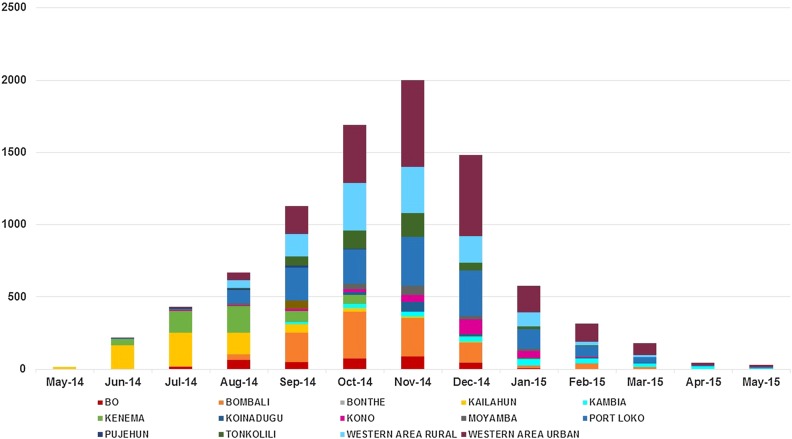
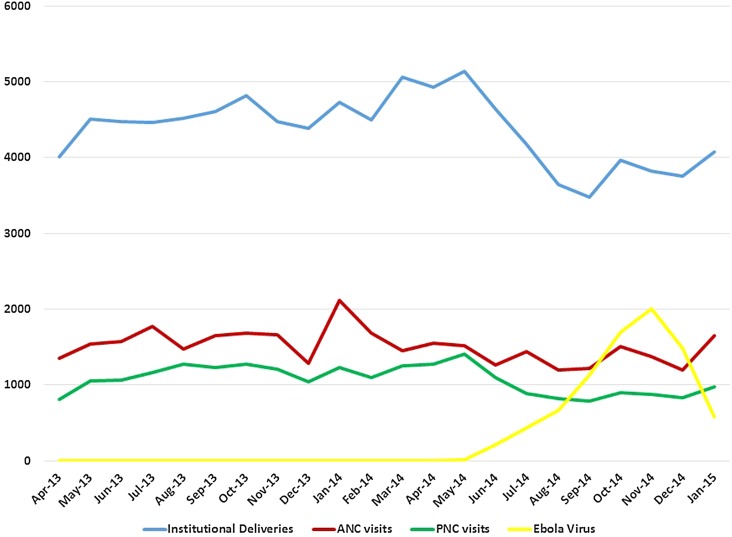
Background: We sought to determine the impact of the Ebola virus epidemic on the availability, uptake and outcome of routine maternity services in Sierra Leone. Methods: The number of antenatal and postnatal visits, institutional births, availability of emergency obstetric care (EmOC), maternal deaths and stillbirths were assessed by month, by districts and by level of healthcare for 10 months during, and 12 months prior to, the Ebola virus disease (EVD) epidemic. All healthcare facilities designated to provide comprehensive (n=13) or basic (n=67) EmOC across the 13 districts of Sierra Leone were included. Results: Preservice students were not deployed during the EVD epidemic. The number of healthcare providers in facilities remained constant (incidence rate ratio (IRR) 1.03, 95% CI 1.00 to 1.07). Availability of antibiotics, oxytocics, anticonvulsants, manual removal of placenta, removal of retained products of conception, blood transfusion and caesarean section were not affected by the EVD epidemic. Across Sierra Leone, following the onset of the EVD epidemic, there was a 18% decrease in the number of women attending for antenatal (IRR 0.82, 95% CI 0.79 to 0.84); 22% decrease in postnatal attendance (IRR 0.78, 95% CI 0.75 to 0.80) visits and 11% decrease in the number of women attending for birth at a healthcare facility (IRR 0.89, 95% CI 0.87 to 0.91). There was a corresponding 34% increase in the facility maternal mortality ratio (IRR 1.34, 95% CI 1.07 to 1.69) and 24% increase in the stillbirth rate (IRR 1.24, 95% CI 1.14 to 1.35). Conclusions: During the EVD epidemic, fewer pregnant women accessed healthcare. For those who did, an increase in maternal mortality and stillbirth was observed. In the post-Ebola phase, ‘readiness’ (or not) of the global partners for large-scale epidemics has been the focus of debate. The level of functioning of the health system with regard to ability to continue to provide high-quality effective routine care needs more attention.
Overview
The claims and statistics of this paper haven’t been checked yet.
Free: it reads the open-access text and checks the first 5 claims that cite a source we can check. Create a free account to check every claim.
Integrity signals
Registry
Cites
Statistics
Figures
Verification
Claims the paper makes
The claims and statistics of this paper haven’t been checked yet.
Free: it reads the open-access text and checks the first 5 claims that cite a source we can check. Create a free account to check every claim.
Claims other papers make about this one
Each is checked against this paper’s own text: does it say what the citing paper says it does?
The source backs part of the claim, not all of it — or backs it for a different population, condition or comparison.
In the citing paper
“These delays are worse during pandemics leading to low hospital visits for antenatal care, delivery, and postnatal care [6].”
From Community-based referral transportation system for accessing emergency obstetric services in the Rohingya refugee camp during the COVID-19 pandemic in Bangladesh: facilitators and barriers through beneficiaries’ and providers’ lens using a mixed-method design (2022) · cites this paper as [6]
Experimental — accuracy not yet measured
Self-check
Percentages, sums and reported differences re-computed from the paper’s own numbers.
The self-check needs the paper’s full text.
Citations
Cites
Monitoring emergency obstetric care : a handbook
Disability (2009) · Cited by 986
Moon, S., Sridhar, D., Pate, M. A., Jha, A. K., Clinton, C., Delaunay, S., Edwin, V., Fallah, M., Fidler, D. P., Garrett, L., et al. (2015) · The Lancet · doi:10.1016/s0140-6736(15)00946-0 · Cited by 629
Ameh, C., Msuya, S., Hofman, J., Raven, J., Mathai, M., & van den Broek, N. (2012) · PLoS ONE · doi:10.1371/journal.pone.0049938 · Cited by 139 · cited 1×
“Data were obtained on the availability of healthcare providers, availability and provision of EmOC signal functions, drugs, equipment, number of ANC and PNC visits, number of births at the facility, reported number of emergency complications, maternal deaths, and stillbirths.(11) Signal functions were classified as be…”
BackgroundSelf-citationBarden-O'Fallon, J., Barry, M. A., Brodish, P., & Hazerjian, J. (2015) · PLoS Currents · doi:10.1371/currents.outbreaks.0b0ba06009dd091bc39ddb3c6d7b0826 · Cited by 64
Dynes, M. M., Miller, L. J., Sam, T., Vandi, M. A., & Tomczyk, B. (2015) · PubMed · Cited by 58
Ebola viral disease and pregnancy
Black, B. O., Caluwaerts, S., & Achar, J. (2015) · Obstetric Medicine · doi:10.1177/1753495x15597354 · Cited by 55 · cited 1×
“However, such isolation may also prevent women from receiving timely obstetric care.(6) Obstetric care is considered one of the most high-risk areas for exposure to body fluids, through which EVD is spread, and as a consequence healthcare providers face increased risks of exposure to Ebola and so may be reluctant to a…”
BackgroundBlack, B. O. (2014) · BJOG An International Journal of Obstetrics & Gynaecology · doi:10.1111/1471-0528.13232 · Cited by 25 · cited 1×
“It can be difficult to differentiate between complications of pregnancy such as obstetric haemorrhage (the leading cause of maternal death in low resource settings) and the case definition of EVD, which could affect patient management.(5) Women suspected of having EVD would normally be isolated until their Ebola statu…”
Background
Cited by
(2020) · RePEc: Research Papers in Economics · Cited by 475
Semaan, A., Audet, C., Huysmans, E., Afolabi, B., Assarag, B., Banke-Thomas, A., Blencowe, H., Caluwaerts, S., Campbell, O. M. R., Cavallaro, F. L., et al. (2020) · BMJ Global Health · doi:10.1136/bmjgh-2020-002967 · Cited by 311
“58,66-68 These disruptions have previously led to an increase in maternal and neonatal mortality, 22, 69 and currently there are signs of similar trends reported from two maternity hospitals in Uganda.”
ResultChanges in Access to Health Services during the COVID-19 Pandemic: A Scoping Review
Pujolar, G., Oliver-Anglès, A., Vargas, I., & Vázquez, M.-L. (2022) · International Journal of Environmental Research and Public Health · doi:10.3390/ijerph19031749 · Cited by 284
“Likewise, one of the individual characteristics that has been most influential in terms of new barriers created by the pandemic is fear of contagion [83–86,88,89,94,95,97], an aspect that has been discussed in many publications, including opinion articles [113,137–142], and also played a highly significant role in pre…”
BackgroundShapira, G., Ahmed, T., Drouard, S. H. P., Amor Fernandez, P., Kandpal, E., Nzelu, C., Wesseh, C. S., Mohamud, N. A., Smart, F., Mwansambo, C., et al. (2021) · Health Policy and Planning · doi:10.1093/heapol/czab064 · Cited by 224
“Studies following the 2013–16 West African Ebola epidemic found disruptions measured from HMIS data were consistent estimates from facility registers, household surveys and key informant interviews (Iyengar et al., 2015; Lori et al., 2015; Jones et al., 2016; Wesseh et al., 2017; Wagenaar et al., 2018; Quaglio et al.,…”
MethodWilhelm, J. A., & Helleringer, S. (2019) · PubMed Central · doi:10.7189/jogh.09.010406 · Cited by 133
Metadata
- Authors
- Jones, S. A., Gopalakrishnan, S., Ameh, C. A., White, S., & van den Broek, N. R.
- Affiliations
- Liverpool School of Tropical Medicine (GB)
- Centre for Maternal and Newborn Health, Liverpool School of Tropical Medicine, Liverpool, UK
- Corresponding author
- Jones, Susan A
- Venue
- BMJ Global Health
- Publisher
- BMJ
- Published
- 2016-10
- Volume
- 1
- Issue
- 3
- Pages
- e000065
- ISSN
- 2059-7908 (ISSN-L)
- PMC
- PMC5321347
- OpenAlex
- W2527759547
- Cited by
- 114
- References
- 7
- Citations by year
- 2026: 4 · 2025: 6 · 2024: 14 · 2023: 9 · 2022: 30 · 2021: 18 · 2020: 16 · 2019: 11 · 2018: 2 · 2017: 3 · 2016: 1
- FWCI
- 6.59
- Type
- journal article
- Language
- en
- Open access
- gold
- doi.org
- Licence
- cc-by
- Locations
- BMJ Global Health (publishedVersion, cc-by)
- Europe PMC (PubMed Central) (publishedVersion, other-oa)
- PubMed Central (publishedVersion, cc-by)
- PubMed (publishedVersion)
- LSTM Online Archive (Liverpool School of Tropical Medicine) (acceptedVersion)
- Topics
- Health Sciences › Medicine › Pediatrics, Perinatology and Child Health › Global Maternal and Child Health
- Health Sciences › Medicine › Infectious Diseases › Viral Infections and Outbreaks Research
- Health Sciences › Health Professions › General Health Professions › Health and Conflict Studies
- Keywords
- obstetric care, emergency obstetric care, antenatal care uptake, postpartum care, facility-based childbirth, maternal mortality, stillbirth, health system resilience, Sierra Leone, health facility readiness, disaster preparedness, health system evaluation
About these checks
Registry, retraction, Cites and statistics results are computed, not judged, with one exception: a printed reference that no index lists is read once by a model before it counts as a citation error. Claims are extracted by a model and kept only when their quote appears verbatim in the text; each cited source is then checked, with a model’s help, for whether it says what the claim relies on. Those verdicts can be wrong — read the claim’s quote and the cited source before relying on one.
Statistics and arithmetic are recomputed, not judged.
Confidence bands are shown only for fields calibrated on our annotated test set. None is calibrated yet, so no band is shown.
What counts as a claim ›How we measure confidence ›How we check this ›
Are you an author, or do you see a problem with this page? Request a review
Data sources
Bibliographic data: Semantic Scholar, OpenAlex, Crossref.
Contains information from the Semantic Scholar Academic Graph Datasets, made available under the ODC Attribution License (ODC-BY 1.0).
Semantic Scholar’s data is described in: Kinney, R., et al. (2023). The Semantic Scholar Open Data Platform. arXiv:2301.10140.
